
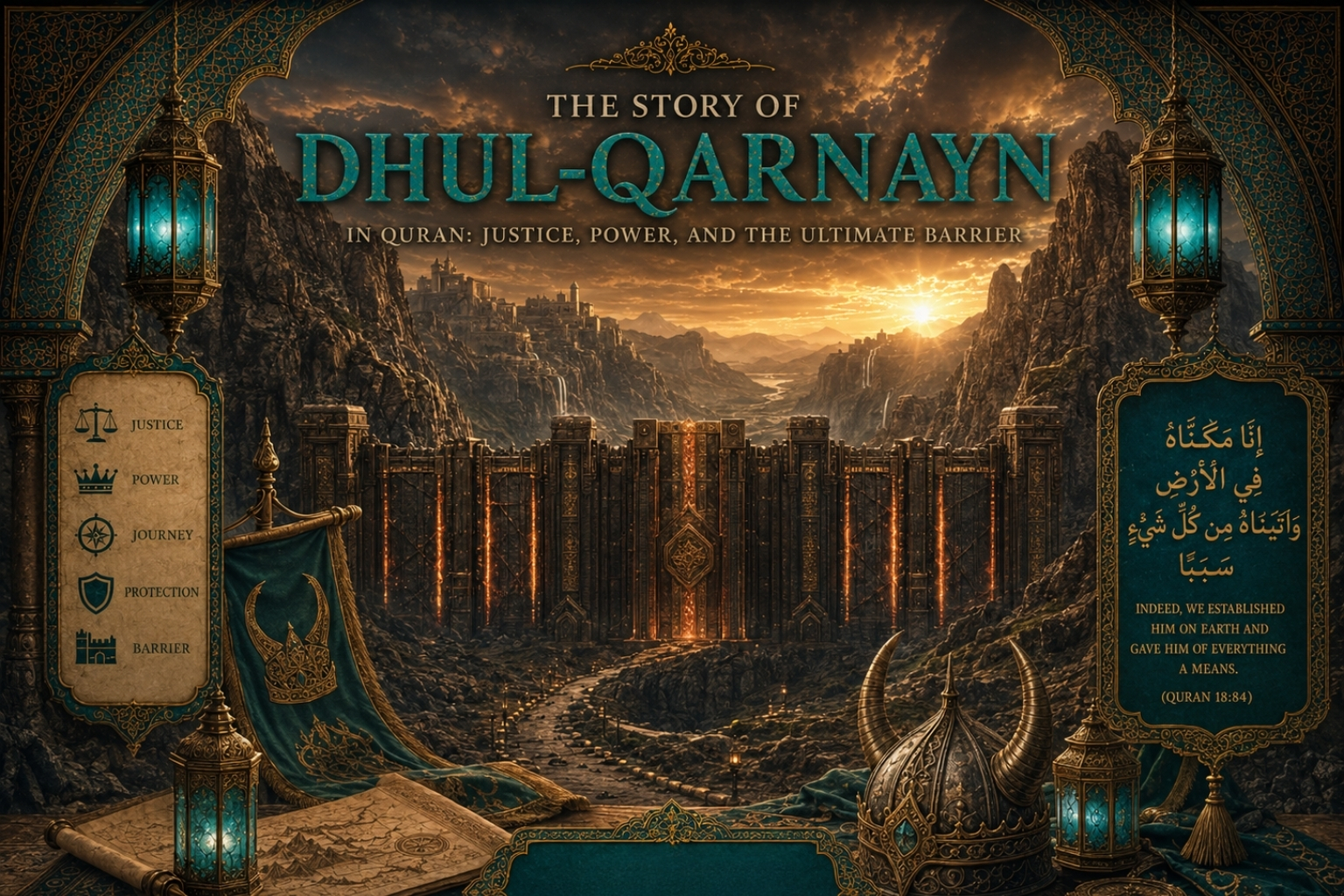

Among the most powerful narratives of leadership, justice, and divine empowerment in the Holy Quran is the history of Dhul-Qarnayn (The Two-Horned One). Detailed in the final section of Surah Al-Kahf, this narrative was revealed to the Prophet Muhammad as a response to the polytheists and people of the book who sought to test his prophethood.
Unlike worldly tyrants who use power for subjugation, Dhul-Qarnayn in Islam stands as the ultimate archetype of the righteous ruler. He recognized that his vast authority, technological advancement, and military might were absolute gifts from Allah, using them exclusively to establish justice, protect the oppressed, and spread monotheism across the earth.
The Divine Empowerment of a Righteous Ruler
Allah blessed Dhul-Qarnayn with an unprecedented dominion, granting him the material means, political stability, and knowledge necessary to achieve any objective he pursued.
“إِنَّا مَكَّنَّا لَهُ فِي الْأَرْضِ وَآتَيْنَاهُ مِن كُلِّ شَيْءٍ سَبَبًا فَأَتْبَعَ سَبَبًا”
“Indeed, We established him upon the earth, and We gave him from everything a way [into success]. So he followed a way.” — Surah Al-Kahf, 18:84-85
With this divine backing, he initiated three massive geopolitical expeditions across the known world to rectify corruption and establish peace.
The Three Great Journeys of Dhul-Qarnayn
1. The Journey to the West
Dhul-Qarnayn traveled westward until he reached the furthest inhabited land, described as the setting place of the sun in a dark, muddy spring. There, he encountered a nation and was given a divine choice: to punish them or treat them with kindness. His response defined his philosophy of governance—absolute justice without tyranny.
“قَالَ أَمَّا مَن ظَلَمَ فَسَوْفَ نُعَذِّبُهُ ثُمَّ يُرَدُّ إِلَىٰ رَبِّهِ فيُعَذِّبُهُ عَذَابًا نُّكْرًا وَأَمَّا مَنْ آمَنَ وَعَمِلَ صَالِحًا فَلَهُ جَزَاءً الْحُسْنَىٰ ۖ وَسَنَقُولُ لَهُ مِنْ أَمْرِنَا يُسْرًا”
“He said, ‘As for him who wrongs, we will punish him. Then he will be returned to his Lord, and He will punish him with a terrible punishment. But as for him who believes and does righteousness, he will have a reward of the best, and we will speak to him from our command with ease.'” — Surah Al-Kahf, 18:87-88
2. The Journey to the East
He then marched to the furthest eastern frontier of the civilized world. There, he found a nomadic tribe living in such a primitive state that they had no shelter or clothing to shield themselves from the harshness of the rising sun. He left them undisturbed, respecting their natural way of life while ensuring they were safe under his peaceful global umbrella.
3. The Journey to the Mountain Pass (The Barrier)
His final recorded journey took him between two massive mountain ranges. Here, he encountered a distinct nation that spoke a language so unique it was barely intelligible to outsiders. They were living in absolute terror of two savage, destructive tribes: Yajuj and Majuj (Gog and Magog).
The Construction of the Iron Barrier against Yajuj and Majuj
The desperate people recognized Dhul-Qarnayn’s immense power and offered to collect a tribute or tax to fund the construction of a protective wall between them and their brutal oppressors.
Demonstrating the integrity of an Islamic leader, Dhul-Qarnayn flatly rejected their money. He declared that the resources given to him by Allah were far superior to any wealth they could offer. Instead, he asked for their physical labor and engineering assistance to build a massive technological marvel.
“قَالَ مَا مَكَّنِّي فِيهِ رَبِّي خَيْرٌ فَأَعِينُونِي بِقُوَّةٍ أَجْعَلْ بَيْنَكُمْ وَبَيْنَهُمْ رَدْمًا”
“He said, ‘That in which my Lord has established me is better [than what you offer], so assist me with strength; I will make between you and them a dam.'” — Surah Al-Kahf, 18:95
The Engineering Miracle:
He instructed them to bring massive blocks of iron, stacking them until they completely filled the gap between the two mountains. He then ordered them to fan the flames of a massive fire until the iron was glowing red hot. Finally, he poured molten copper over the structure, creating an impenetrable, alloyed wall.
This metallic barrier was so smooth that Yajuj and Majuj could not scale it, and so dense that they could not pierce through it.
The Prophetic Warning and the End of Times
Despite achieving this magnificent architectural and military feat, Dhul-Qarnayn did not succumb to arrogance. He immediately attributed the success entirely to divine mercy, reminding the people that this barrier is temporary and will eventually fall in accordance with the divine decree.
“قَالَ هَٰذَا رَحْمَةٌ مِّن رَّبِّي ۖ فَإِذَا جَاءَ وَعْدُ رَبِّي جَعَلَهُ دَكَّاءَ ۖ وَكَانَ وَعْدُ رَبِّي حَقًّا”
“He said, ‘This is a mercy from my Lord; but when the promise of my Lord comes, He will make it level [with the ground], and the promise of my Lord is ever true.'” — Surah Al-Kahf, 18:98
The Prophet Muhammad confirmed that this barrier remains intact today, keeping Yajuj and Majuj trapped until the End of Times. He warned of the spiritual and physical disruption their eventual release would bring upon the earth before the Day of Resurrection.
“فَتَحَ اليَوْمَ مِنْ رَدْمِ يَأْجُوجَ وَمَأْجُوجَ مِثْلُ هَذِهِ وَعَقَدَ بَيْنَ أُصْبُعَيْهِ الإِبْهَامِ وَالَّتِي تَلِيهَا”
“Today a hole like this has been opened in the barrier of Yajuj and Majuj,” and he made a circle with his thumb and index finger. — Sahih al-Bukhari & Sahih Muslim
Core Spiritual Lessons from the Story of Dhul-Qarnayn
- Power is a Divine Trust (Amanah): True success is not in acquiring worldly power, but in how it is utilized. Dhul-Qarnayn possessed absolute authority but used it to serve Allah, defend the weak, and establish absolute equity.
- Rejecting Corruption and Bribery: A righteous leader does not exploit the vulnerability of oppressed people for material gain. He prioritized human development and collaborative labor over financial tribute.
- The Fusion of Faith and Science: The story demonstrates that Islam encourages advanced engineering, strategic planning, and utilizing worldly means (Asbab) alongside complete spiritual reliance on Allah.
- Humility in Success: Upon completing one of the greatest defensive engineering feats in human history, Dhul-Qarnayn did not build monuments to his own name. He humbled himself, declaring it a “mercy from my Lord.”
Conclusion
The profound chronicle of Dhul-Qarnayn provides an eternal blueprint for moral leadership, justice, and spiritual awareness. It reminds every believer that no matter how much wealth, knowledge, or influence they attain in this life, it must be anchored in the fear of Allah and directed toward the betterment of humanity. By internalizing these lessons from Surah Al-Kahf, we learn to seek true empowerment through humility, faith, and the tireless pursuit of justice.