

There are moments in the life of every person who carries truth when they look around and realize — with a clarity that is both liberating and terrifying — that they are alone.
Not alone in the sense of having no one nearby. Alone in the sense that no one nearby is standing where they are standing. No one nearby is saying what they are saying. No one nearby has chosen what they have chosen. The crowd has gone one way. And the truth has gone another. And the person carrying the truth must decide — every single day — whether they will follow the crowd or follow what Allah has placed in their heart.
Prophet Ilyas, peace be upon him, made that decision in one of the most idol-saturated, spiritually corrupt environments in the history of Bani Israel. He was sent to a people who had not drifted gradually from the worship of Allah — they had made a deliberate, organized, enthusiastic turn toward an idol called Ba’l, and they were worshipping it with the full support of their royal family and the majority of their society.
He stood against it. Alone. For years.
And Allah preserved his name in the Quran — honored, saluted, called among the righteous — as a permanent testament to what it means to carry truth in a place that does not want it.
Chapter One — The World Ilyas Was Sent Into: Ba’l and the Corruption of Bani Israel
Ilyas, peace be upon him, was a prophet from among the Children of Israel — sent to them in a period of deep spiritual collapse. The specific region he was sent to — believed by scholars to be the area of Baalbek in what is today Lebanon, or the northern regions of historical Canaan — had fallen into the worship of Ba’l, a Canaanite deity whose cult involved elaborate temples, organized priesthood, and royal patronage.
This was not a case of the people quietly holding to old folk traditions alongside their nominal faith. This was organized, official, celebrated idolatry — supported by the ruler, maintained by a professional class of priests, and embraced by the majority of the population.
Allah describes the situation directly through the words of Ilyas’s call:
Quran Verse:
وَإِنَّ إِلْيَاسَ لَمِنَ الْمُرْسَلِينَ ﴿١٢٣﴾ إِذْ قَالَ لِقَوْمِهِ أَلَا تَتَّقُونَ ﴿١٢٤﴾ أَتَدْعُونَ بَعْلًا وَتَذَرُونَ أَحْسَنَ الْخَالِقِينَ ﴿١٢٥﴾ اللَّهَ رَبَّكُمْ وَرَبَّ آبَائِكُمُ الْأَوَّلِينَ
“And indeed, Ilyas was among the messengers. When he said to his people: ‘Will you not fear Allah? Do you call upon Ba’l and leave the best of creators — Allah, your Lord and the Lord of your forefathers?'”
Surah As-Saffat (37:123–126)
The call of Ilyas is one of the most direct in the Quran. No extended preamble. No diplomatic softening. A question — will you not fear Allah? — followed immediately by the indictment: you are calling on Ba’l and leaving Allah, the best of creators, the Lord of your forefathers.
He reminded them of their history — “the Lord of your forefathers.” He was not asking them to embrace something foreign or new. He was asking them to return to what their own ancestors had known, what their own prophetic heritage had taught, what Allah had always been to the people He had chosen to carry His message.
They had left something real for something empty. And Ilyas named it without softening the indictment.
Chapter Two — The Response: Denial and the Loneliness of Truth
The Quran does not give us the detailed back-and-forth dialogue of Ilyas and his people the way it does for Musa or Ibrahim. What it gives us is the outcome of his call — and the outcome was rejection:
Quran Verse:
فَكَذَّبُوهُ فَإِنَّهُمْ لَمُحْضَرُونَ
“But they denied him, so indeed they will be brought to punishment.”
Surah As-Saffat (37:127)
They denied him. The brevity of this statement in the Quran should not be mistaken for simplicity. Behind those few words is the full weight of what denial means for a prophet: years of calling, of being dismissed, of watching people choose Ba’l over Allah day after day, of standing in a society where the official religion is the very thing you have been sent to oppose.
Ilyas knew what every prophet who has ever carried an unwelcome truth knows: rejection is not a sign that the truth has failed. It is a sign that the people carrying the truth are doing their job correctly — because truth is always unwelcome to those who have organized their lives around something else.
What sustained Ilyas through this rejection was not the support of numbers or the comfort of majority opinion. It was his certainty in Allah — the same certainty that had allowed him to stand up in the first place.
Chapter Three — The Servants of Allah Who Were Saved
In the darkness of a society consumed by Ba’l worship, there remained a remnant — a small group of sincere believers who had not abandoned Allah. And Ilyas was not abandoned by Allah even as his people rejected him:
Quran Verse:
إِلَّا عِبَادَ اللَّهِ الْمُخْلَصِينَ
“Except for the chosen servants of Allah.”
Surah As-Saffat (37:128)
This verse — a single phrase, an exception carved out of the statement of punishment — is one of the most quietly powerful verses in the entire account of Ilyas. In a nation that denied, there were those who were preserved. The mukhlaseen — the sincerely chosen servants of Allah — were not swept away with the rest.
This is a pattern Allah establishes consistently across the stories of the prophets: when a community is destroyed for its rejection of divine guidance, the sincere believers are always removed, always preserved, always carried through by the mercy of Allah. Not because their faith protected them from difficulty — but because Allah does not allow His sincere servants to be lost in the consequences of other people’s choices.
The lesson for every believer living in a spiritually corrupt environment is embedded in this single exception: your sincerity before Allah matters. Your individual choice to remain faithful in a faithless environment is seen, recorded, and honored — even when the society around you is moving in the opposite direction.
Chapter Four — The Eternal Salutation: How Allah Honored Ilyas
After the account of Ilyas’s call and the rejection of his people, Allah closes his story with one of the most beautiful honorifics in the entire Quran — the same salutation given to Nuh, to Ibrahim, to Musa:
Quran Verse:
وَتَرَكْنَا عَلَيْهِ فِي الْآخِرِينَ ﴿١٢٩﴾ سَلَامٌ عَلَىٰ إِلْ يَاسِينَ ﴿١٣٠﴾ إِنَّا كَذَٰلِكَ نَجْزِي الْمُحْسِنِينَ ﴿١٣١﴾ إِنَّهُ مِنْ عِبَادِنَا الْمُؤْمِنِينَ
“And We left for him favorable mention among later generations: ‘Peace be upon Ilyas.’ Indeed, We thus reward the doers of good. Indeed, he was of Our believing servants.”
Surah As-Saffat (37:129–132)
“Peace be upon Ilyas.” — Allah’s own salutation, preserved in His Book, recited by billions of people across fourteen centuries. The man who stood alone against a nation of Ba’l worshippers is greeted by Allah Himself with peace — and Allah promises that this greeting will remain, carried forward in the memory of every generation that reads His Book.
Four descriptions in three verses:
First — We left for him favorable mention among later generations. His story was not forgotten. His name was not erased by the majority who rejected him. Allah preserved his mention — and made it a favorable one.
Second — Peace be upon Ilyas. The salutation of Allah — the most honored greeting that any created being can receive.
Third — Indeed, We thus reward the doers of good. Allah generalizes from Ilyas’s story to a universal principle: this is how Allah rewards everyone who does good. The honor given to Ilyas is not unique to him — it is the pattern of Allah’s response to sincere goodness, regardless of whether the world acknowledges it.
Fourth — Indeed, he was of Our believing servants. Allah claimed Ilyas — “Our believing servants.” The possessive is deliberate. Ilyas belonged to Allah. And Allah does not abandon what belongs to Him.
Chapter Five — Ilyas in the Company of the Chosen
Allah also mentions Ilyas in another context — in the great list of prophets whom Allah guided and honored — placing him in the company of the most distinguished messengers:
Quran Verse:
وَزَكَرِيَّا وَيَحْيَىٰ وَعِيسَىٰ وَإِلْيَاسَ ۖ كُلٌّ مِّنَ الصَّالِحِينَ
“And Zakariyya and Yahya and Isa and Ilyas — all were of the righteous.”
Surah Al-An’am (6:85)
Zakariyya, Yahya, Isa — three of the most honored prophets in the Abrahamic tradition — and Ilyas among them, named as their equal in righteousness. The man who stood alone against Ba’l worship is placed by Allah in the same category as the prophets whose stories fill entire chapters and whose miracles are celebrated across generations.
This is Allah’s testimony about the equivalence of different forms of prophetic courage. Isa raised the dead. Zakariyya was given a son in old age. Ilyas — as far as the Quranic record shows us — simply stood and called. And Allah called him righteous with the same word He used for the others.
The quality that made them all righteous was not the miracle. It was the sincerity of their submission to Allah and the faithfulness of their mission — regardless of its visible results.
Chapter Six — The Connection to Elijah: A Bridge Across Traditions
Scholars of Islamic history and comparative religion have noted the connection between Ilyas and the figure of Elijah in the Hebrew Bible — a prophet who also confronted the worship of Ba’l in the northern kingdom of Israel, who also felt desperately alone in his mission, who also fled to the wilderness and asked Allah in exhaustion to take his soul.
The Hebrew account captures something that the Quran’s brevity leaves for us to understand through context: the profound personal cost of standing alone. The feeling of being the last faithful person remaining. The exhaustion that comes not from a single dramatic confrontation but from years of calling in a place that does not want to hear.
And Allah’s response in the Biblical account — which Islamic scholars read alongside the Quranic account as a remnant of original revelation — is profoundly instructive: when Elijah collapsed in the wilderness and asked to die, Allah sent an angel with food and water, let him sleep, sent the angel again, and said: “The journey is too great for you. Arise and eat.”
The mercy of Allah toward a prophet who has reached his limit is not a lecture about persistence. It is food. Rest. The simple, practical care of a Lord who knows that His servants are human — and that sometimes the most divine thing He can offer is not a new commission but a meal and the permission to sleep.
Hadith:
مَنْ رَأَى مِنْكُمْ مُنْكَرًا فَلْيُغَيِّرْهُ بِيَدِهِ، فَإِنْ لَمْ يَسْتَطِعْ فَبِلِسَانِهِ، فَإِنْ لَمْ يَسْتَطِعْ فَبِقَلْبِهِ، وَذَٰلِكَ أَضْعَفُ الْإِيمَانِ
“Whoever among you sees an evil, let him change it with his hand. If he is unable, then with his tongue. If he is unable, then with his heart — and that is the weakest of faith.”
Recorded in Sahih Muslim, Hadith No. 49
The Prophet Muhammad ﷺ established this principle — the obligation to oppose wrong in whatever capacity is available to a person. Ilyas lived this principle in one of its hardest forms: he could not change the idolatry of his people with his hand — they were the majority, supported by royal power. He changed it with his tongue — calling them directly, publicly, without softening. And when the tongue was rejected, his heart never wavered in its opposition to what Allah had forbidden.
He operated at every level available to him. And Allah called him among the righteous.
Chapter Seven — The Lesson of Baalbek: What Remains
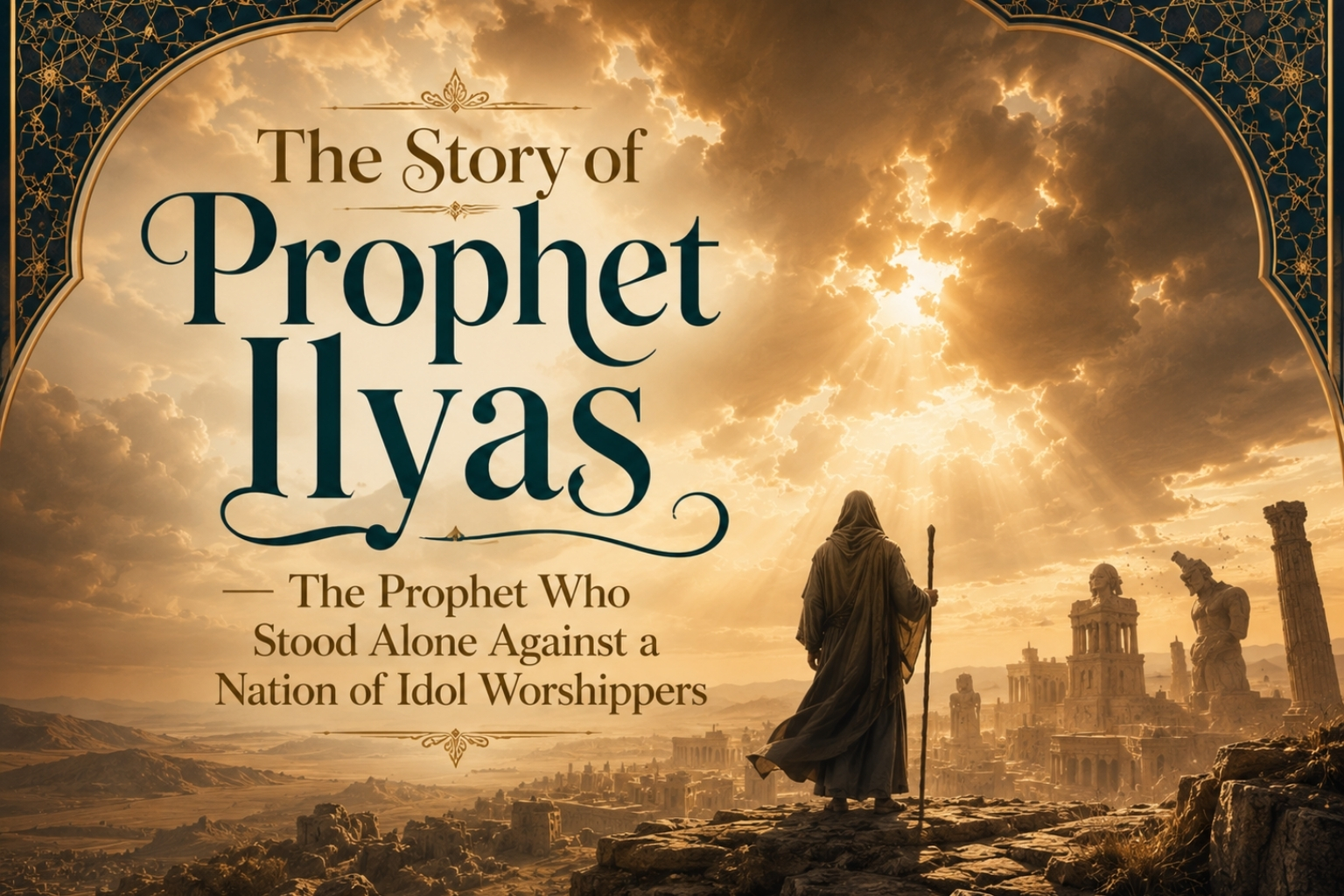
The city associated with the worship of Ba’l — Baalbek in modern Lebanon — stands today with its ancient ruins as one of the most visited archaeological sites in the world. The temples to Ba’l, built by later Roman hands on the same ground where the original idolatry flourished, are massive, impressive, and empty.
No one worships there. The priests are gone. The rituals are extinct. The entire civilization that organized its religious life around Ba’l has been absorbed into history.
And Ilyas — the man who stood against it, who was rejected by it, who called it to abandon its emptiness and return to Allah — is greeted by Allah Himself with peace, in a Book that has never been changed, recited by billions of Muslims every generation.
The idols are silent. The prophet is honored. This is always the ending when truth faces falsehood across sufficient time. The ending is not always visible within a single lifetime — and Ilyas may not have seen it in his. But Allah’s promise to preserve the honor of His sincere servants is not limited by the span of a human life.
Timeless Lessons from the Story of Ilyas
- Standing alone against the majority is sometimes the only faithful position Ilyas did not call a confused people — he called a deliberately, enthusiastically idolatrous one. He was not swimming against mild social pressure. He was standing against an organized, royal-sponsored, majority-embraced religious system. Sometimes faithfulness to Allah requires exactly this — standing where almost no one else is standing, saying what almost no one else is saying.
- The brevity of your story does not diminish your worth before Allah Ilyas has fewer verses than Musa or Ibrahim or Yusuf. His Quranic narrative is brief. And yet Allah saluted him with the same peace He gave the most famous prophets, called him righteous alongside Isa and Zakariyya, and promised that his mention would be preserved among later generations. Your worth before Allah is not measured by how much space your story takes up in the world’s memory.
- The sincerely faithful remnant is always preserved Among a nation of Ba’l worshippers, there were mukhlaseen — sincere, chosen servants of Allah — who were excepted from the punishment. Your individual faithfulness in a faithless environment is not invisible. It is precisely what Allah is looking for. And it is precisely what He preserves.
- Calling people back to their own heritage of faith is a powerful form of da’wah Ilyas did not call his people to something foreign. He called them back to *“Allah, your Lord and the Lord of your forefathers.” He appealed to their own history, their own prophetic heritage, their own roots. Sometimes the most effective call is not to something new but to something that was always theirs and that they have abandoned.
- Rejection does not mean failure — it means the message was delivered and Ilyas was rejected. His people denied him. And Allah honored him. The measure of a prophet’s — or any believer’s — faithfulness is not the response they receive but the sincerity and completeness with which they deliver what Allah has placed in their care. Deliver it. The response belongs to Allah.
- “Peace be upon him” from Allah is worth more than any worldly recognition. The people of Ilyas’s time had the royal court, the organized priesthood, the majority of the population — and they are forgotten. Ilyas had Allah’s salutation — and it is recited by billions until the end of time. When the world does not recognize you — when the powerful mock and the majority dismisses — remember that what Allah says about you is the only record that matters.
- Exhaustion in the service of truth is not weakness — it is the cost of faithfulness Prophets reached their limits. They were human. They felt alone, tired, defeated. Allah did not condemn them for this — He sent angels with food and rest. Your exhaustion in the service of Allah is not a sign of insufficient faith. It is the honest cost of doing something genuinely difficult. And Allah meets it with mercy, not lecture.
Closing Reflection
Ba’l is gone. The temples are ruins. The priests are dust. The royal family that patronized the cult has been absorbed into the anonymity of history.
And Ilyas — who stood alone in their midst and said: will you not fear Allah? Will you not leave this empty thing and return to the Lord who created you? — is greeted by Allah Himself with peace, in the most preserved Book in human history, in a salutation that will be read until the Day of Judgment.
He did not win the argument in his lifetime. He did not convert the majority. He did not dismantle the Ba’l cult from within. What he did was stand — faithfully, honestly, without compromise — and deliver what Allah had placed in his care.
And Allah took it from there.
Quran Verse:
سَلَامٌ عَلَىٰ إِلْ يَاسِينَ ﴿١٣٠﴾ إِنَّا كَذَٰلِكَ نَجْزِي الْمُحْسِنِينَ
“Peace be upon Ilyas. Indeed, We thus reward the doers of good.”
Surah As-Saffat (37:130–131)
Stand where the truth is standing, even if you are standing alone. Deliver what Allah has placed in your care, even if no one receives it. Stay faithful to the Lord of your forefathers — the Lord of all forefathers — even when the crowd has moved on.
Allah will take it from there.
And one day — in His Book, in His salutation, in His eternal record — He will say of you what He said of Ilyas:
Peace be upon you. You were of Our believing servants.