

We live in a culture that frequently rewards and commercializes outrage. From the algorithmic engines of social media that thrive on keeping us perpetually furious, to a modern self-help narrative that treats venting as the ultimate form of emotional honesty, we are told that anger is power. We are conditioned to believe that if someone crosses a boundary, offends our pride, or challenges our status, our most authentic response is an explosive, dominant display of force to reclaim control.
This constant indulgence in anger carries a devastating psychological and biological tax. When an individual allows anger to steer their mind, their nervous system enters a chronic, exhausting state of fight-or-flight. The long-term price is steep: sky-high cortisol levels, emotional burnout, fractured relationships, and a mind left wide open to severe overthinking in Islam. Anger acts like a flash flood; it storms through the intellect, sweeps away rational judgment, and leaves behind a landscape of deep regret and emotional instability.
However, when we engage in Tadabbur (deep Quranic reflection), we discover that Islam treats anger neither as a moral failing to be suppressed into toxic numbness, nor as a wild animal to be let loose. Instead, Islamic theology diagnoses anger as a volatile emotional fire that must be mastered, contained, and channeled. By mapping out the precise spiritual and physical anatomy of frustration, Islamic psychology provides an elite, actionable framework for extinguishing the flames of wrath, healing anxiety with the Quran, and guarding your internal peace of mind.
The Prophetic Definition: True Strength vs. Emotional Slavery
In everyday life, society often equates an explosive temper with strength, dominance, and a refusal to be broken. However, the Prophet Muhammad shattered this illusion with a groundbreaking psychological definition of power that cuts directly to the core of human emotional intelligence:
“The strong man is not the one who can wrestle, but the one who can control himself when he is angry.”
— Sahih al-Bukhari, 6114
According to this prophetic blueprint, losing your temper is not a sign of strength; it is an act of absolute submission. It is the moment your intellect abdicated its throne and handed the keys of your behavior over to your lowest impulses.
To help us master this, Islamic psychology breaks down the experience of anger into a highly scannable, three-tiered spectrum:
The Three Tiers of Anger | The Internal State | The Psychological & Spiritual Outcome |
1. Under-Reactivity (Inkhifāḍ) | A complete lack of healthy outrage, leading to apathy, cowardice, and an inability to defend oneself or others from injustice. | Blameworthy. Leaves the individual vulnerable to oppression and compromises moral dignity. |
2. Over-Reactivity (Ifrāṭ) | A wild, explosive temper where the individual completely loses rational control, using abusive language, physical violence, or vindictive behavior. | Destructive. The classic manifestation of Kibr (arrogance) and a primary weapon of Satan to destroy human souls. |
3. Perfect Balance (Iʿtidāl) | The ideal state where anger is fully governed by intellect and faith. It is triggered only by genuine injustice and expressed with measured, dignified restraint. | Praiseworthy. The hallmark of a noble Khalifah (steward) who uses emotional energy to correct wrongs without causing greater harm. |
This balanced middle ground is exactly why Allah describes the elite believers in the Quran not as people who never feel anger, but as masters of their emotional containment:
“وَالْكَاظِمِينَ الْغَيْظَ وَالْعَافِينَ عَنِ النَّاسِ ۗ وَاللَّهُ يُحِبُّ الْمُحْسِنِينَ”
“…and who restrain anger and who pardon the people – and Allah loves the doers of good.”
— Surah Ali ‘Imran, 3:134
The Spiritual Anatomy: The Elements of Fire and Water
To successfully manage an emotion, you must understand its origin. The Prophet provided an incredibly profound metaphysical and physical analogy for anger, mapping out its exact spiritual anatomy:
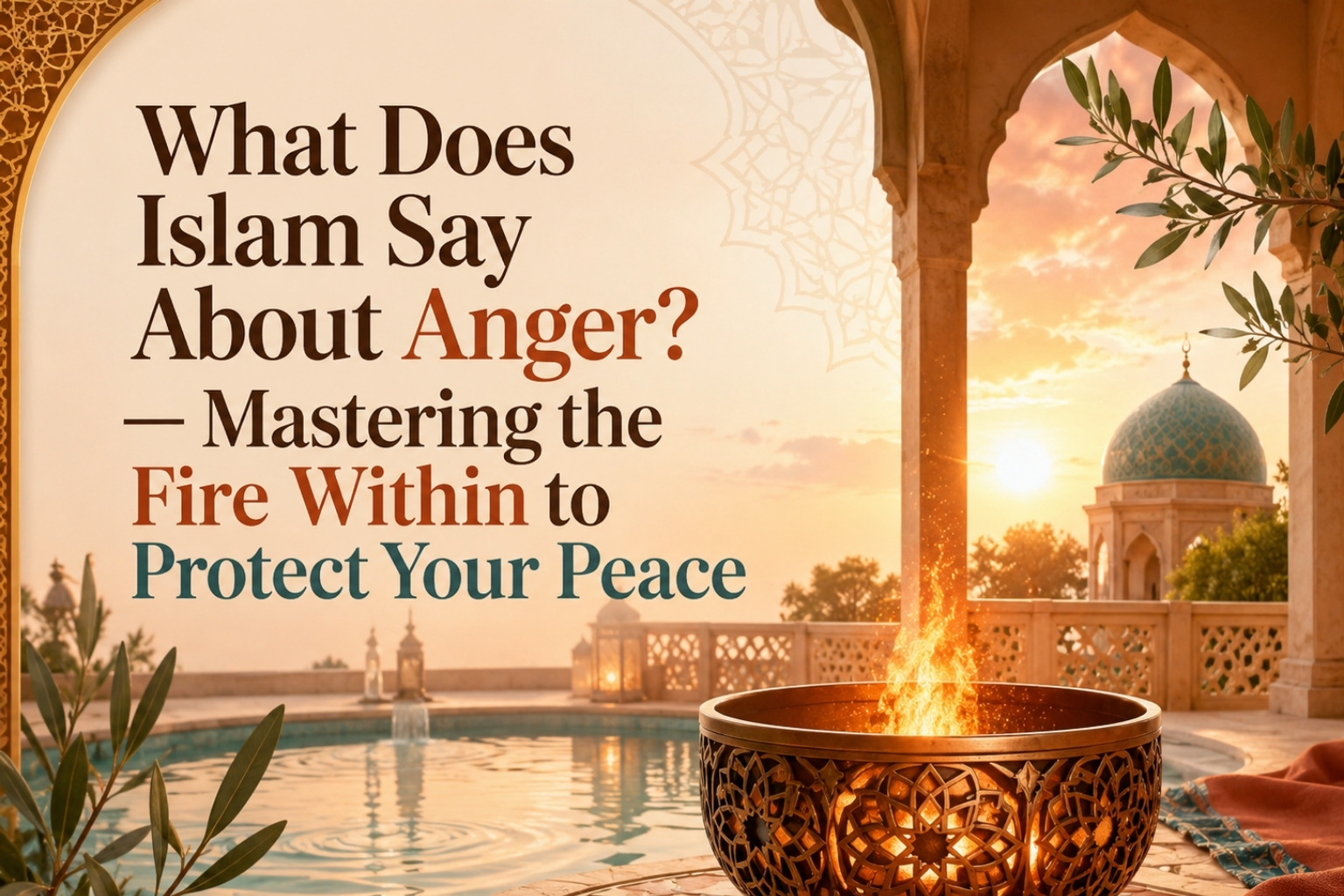
“Anger comes from the devil, the devil was created of fire, and fire is extinguished only with water; so when one of you becomes angry, he should perform ablution (Wudu).” — Sunan Abi Dawud, 4784
This is a beautiful masterclass in energy management. Fire is characterized by upward movement, heat, volatility, and destruction. When you feel a wave of fury overtaking you, your body temperature rises, your chest tightens, and your mind wants to “burn” everything down around it.
By instructing us to use Wudu (ablution), the Prophet introduces the element of water—coolness, weight, tranquility, and grounding. It is an immediate physical intervention that cools the boiling blood, snaps the brain out of its primitive fight-or-flight response, and reconnects the soul to its baseline of spiritual safety through trusting Allah’s plan.
Psychological Liberation: The Power of Emotional Interruption
When you consciously choose to master your anger for the sake of Allah, your mental health experiences an immediate, liberating transformation.
Anger and anxiety are deeply intertwined. A mind that is constantly reacting to every slight, insult, or inconvenience is a mind that lives in a state of permanent defensive panic. By implementing the Islamic framework of emotional restraint, you build an unshakeable shield around your mental well-being:
- Collapsing the Ego’s Trap: At the root of most disproportionate anger is the fragile ego (Nafs) demanding: “How dare they treat ME this way?” When you practice humility and anchor your self-worth entirely in your standing with Al-Khaliq (The Creator), you stop treating every human mistake or insult as an existential threat to your dignity.
- Reclaiming Your Cognitive Sovereignty: An angry person is incredibly easy to manipulate; their environment controls their behavior. When you train your soul to pause, breathe, and internalize how to trust Allah, you stop being a helpless puppet of your circumstances. You reclaim the freedom to choose a response that protects your peace and aligns with your long-term spiritual success.
A Prophetic Sequence for Emergency Anger Management
When anger hits, your rational brain is under siege. To help you navigate these critical moments, Islam provides a highly practical, step-by-step emergency protocol to de-escalate the fire within before it causes permanent damage.
1.Seek Refuge in Allah (Istighadhah):Immediate.
The moment you feel the flush of heat in your face or chest, say out loud: “A’udhu billahi minash-shaitanir-rajim” (I seek refuge in Allah from Satan the outcast). This shifts your focus from the external trigger to your ultimate Source of protection, interrupting the devil’s whisper.
2.Enforce Absolute Silence:Within 3 seconds.
The Prophet taught: “If one of you becomes angry, let him remain silent.” (Musnad Ahmad). Do not hit send on that text, do not reply to that comment, and do not open your mouth. Silence ensures you do not say words that your ego will love in the moment but your soul will regret forever.
3.Alter Your Physical Posture:Within 10 seconds.
Physically lower your center of gravity. The Prophet instructed: “If one of you becomes angry while standing, let him sit down… and if he is still angry, let him lie down.” (Sunan Abi Dawud). Moving closer to the earth lowers your blood pressure, disrupts the physical momentum of aggression, and forces a physiological pause.
4.Extinguish the Fire with Wudu:Within 2 minutes.
Go directly to the sink. Let the cool, refreshing water touch your face, hands, and arms. As the water cools your skin, visualize it washing away the volatile, fiery energy of the anger, leaving your mind clean, grounded, and perfectly integrated.
Actionable Steps to Build Long-Term Emotional Resilience
- Practice the 24-Hour Rule for Grievances: The next time a message, an email, or an interaction infuriates you, make a rock-solid pact with yourself to wait exactly 24 hours before delivering a final response. Use this buffer period to perform Istighfar (seeking forgiveness) and allow the emotional heat to fully dissipate. You will find that after a full night’s sleep, your response will be dramatically more balanced, strategic, and dignified.
- Shift Your Perspective from Opponent to Test: When a difficult person intentionally tries to provoke you, consciously reframe the entire interaction in your mind. Stop seeing them as an enemy who needs to be crushed, and start seeing them as a spiritual instrument sent by Allah to test and sharpen your patience (Sabr). Ask yourself: “Will I let this person break my standing with Allah, or will I use them to elevate my rank on my scales?”
- Implement the Daily Evening Slate-Clearing: Never go to sleep carrying the toxic charcoal of the day’s resentments. Before you close your eyes, perform a conscious mental audit. Forgive those who cut you off, ignored you, or treated you harshly. Clear the ledger completely so you can sleep with a soft, receptive heart, free from the heavy baggage of structural bitterness.
Conclusion
The profound, practical teachings regarding anger in Islam serve as a magnificent lifeline for the modern soul drifting in a culture of hyper-reactivity, toxic outrage, and emotional volatility. Islam reminds you that your human heart was never engineered to be a burning furnace for perpetual fury and defensive pride. You do not have to live your life as a fragile matchstick, ready to burst into flames at the slightest friction. You are a noble traveler operating under the calm, infinitely magnificent canopy of Allah’s supreme wisdom. When you choose to master the fire within, drop the exhausting armor of a hyper-reactive ego, and place your complete confidence in trusting Allah’s plan, the heavy fog of anger-driven anxiety completely evaporates—leaving your mind beautifully wrapped in an unshakeable state of profound safety, enduring tranquility, and everlasting spiritual success.