

We live in an era of unprecedented verbal output. Modern technology has turned every human being into a walking broadcasting station, giving us the power to transmit our thoughts, critiques, and judgments to an international audience with a single tap. We are conditioned to believe that having an opinion on everything is a virtue, that swift and sharp sarcasm is a sign of intellect, and that silence is equivalent to weakness or erasure.
This hyper-vocal environment carries a massive, hidden psychological tax. When our tongues or fingers are constantly moving without internal governance, our mental processing speed becomes shallow and frantic. The continuous output of unvetted words keeps our hearts in a state of perpetual unrest, directly fueling overthinking in Islam. Every careless word spoken or typed creates a subtle ripple of anxiety, leaving us exposed to the haunting question: “Should I have said that?”
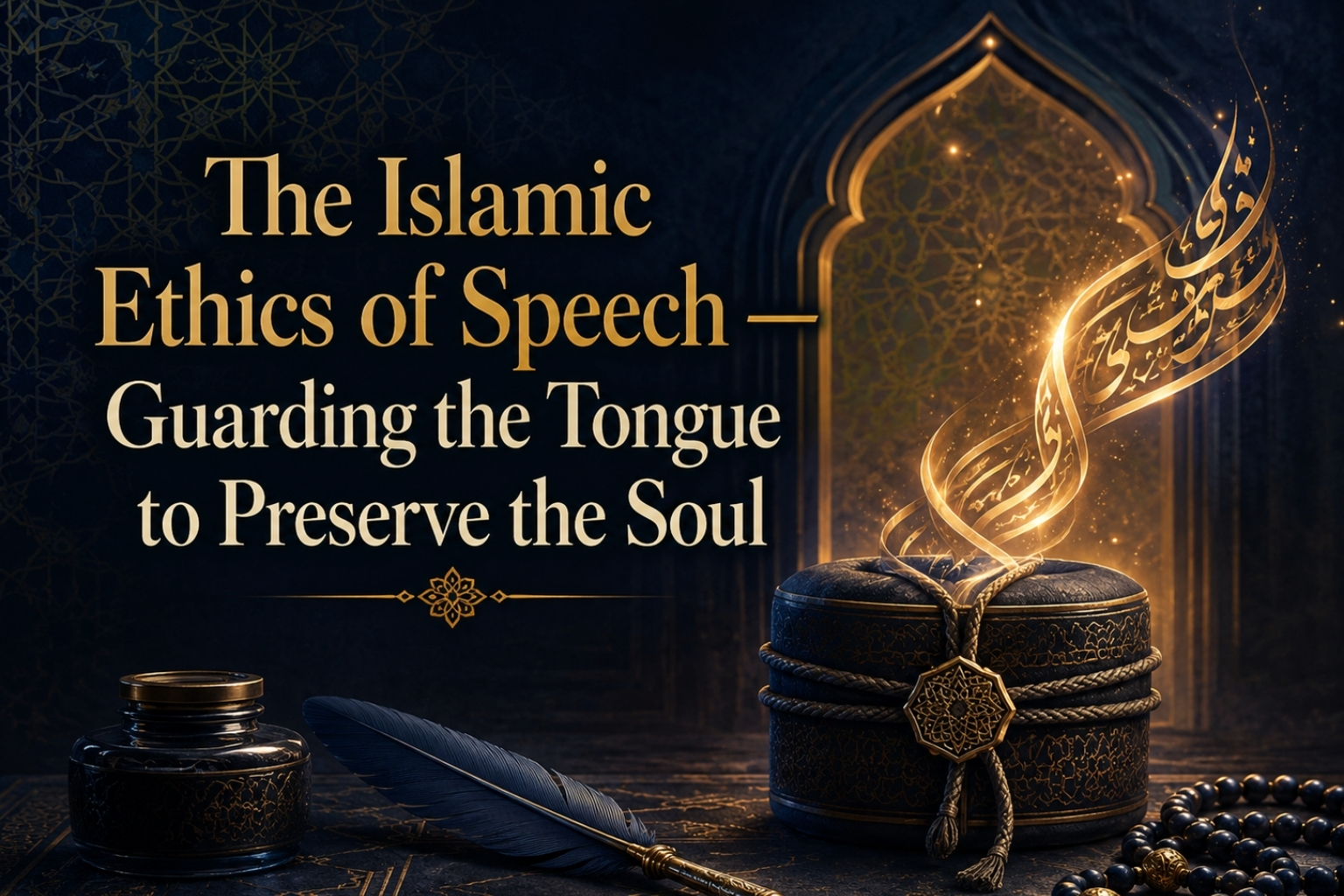
However, when we engage in Tadabbur (deep Quranic reflection), we find that Islam treats speech with extreme weight. The tongue is diagnosed as the absolute gateway to either spiritual elevation or spiritual ruin. By establishing a rigorous, beautiful code of verbal ethics (Adab al-Kalām), Islamic psychology offers an elite framework for anchoring the tongue, healing anxiety with the Quran, and securing an unshakeable state of internal peace of mind.
The Ultimate Filter: The Prophetic Matrix of Speech
In everyday life, society often views smooth talkers and aggressive debaters as powerful. However, the Prophet Muhammad dismantled this notion by linking verbal restraint directly to the absolute core of faith (Īmān) and psychological security:
“Whoever believes in Allah and the Last Day, let him speak good or remain silent.”
— Sahih al-Bukhari, 6018
According to this prophetic blueprint, speech is not free; it has an immense spiritual cost. Every phrase you utter is an investment of your energy. To help us navigate this, Islamic ethics provides a highly scannable, multi-tiered filter to evaluate our speech before it ever passes our lips:
The Core Types of Speech | The Definitive Islamic Guidance | The Psychological & Spiritual Target |
1. Beneficial (Al-Khayr) | Speech that comforts, educates, corrects an injustice kindly, reconciles people, or remembers Allah (Dhikr). | Obligatory or Recommended. Builds social cohesion and floods the heart with absolute tranquility. |
2. Harmless/Idle (Al-Laghw) | Mindless chatter, trivial gossip, or talking excessively about things that bring zero worldly or spiritual value. | Blameworthy. Drains emotional energy, desensitizes the heart, and breeds cognitive fog. |
3. Destructive (Al-Ḥarām) | Backbiting (Ghībah), slander (Buhtān), lying, mocking others, or using vulgar and abusive language. | Strictly Forbidden. Corrodes the soul, destroys relationships, and incurs immediate divine anger. |
This standard of speech is not a minor recommendation; it is a foundational pillar of human dignity. Allah highlights the immense creative and destructive power of a single word in a striking Quranic analogy:
“أَلَمْ تَرَ كَيْفَ ضَرَبَ اللَّهُ مَثَلًا كَلِمَةً طَيِّبَةً كَشَجَرَةٍ طَيِّبَةٍ أَصْلُهَا ثَابِتٌ وَفَرْعُهَا فِي السَّمَاءِ”
“Have you not considered how Allah presents an example, [making] a good word like a good tree, whose root is firmly fixed and its branches [high] in the sky?”
— Surah Ibrahim, 14:24
The Cosmic Recorder: The Weight of Every Syllable
One of the primary causes of social and internal anxiety is the illusion that our words disappear into thin air once spoken. We lash out, make promises we cannot keep, or casual remarks that wound others, assuming they carry no permanent weight.
Islam shatters this illusion by revealing the precise, real-time tracking of human speech:
“مَّا يَلْفِظُ مِن قَوْلٍ إِلَّا لَدَيْهِ رَقِيبٌ عَتِيدٌ”
“Man does not utter a single word except that with him is an observer, prepared.” — Surah Qaf, 50:18
When you deeply internalize this reality through Tadabbur, your relationship with language fundamentally shifts. You stop speaking to perform for a human audience, and you start speaking with the acute awareness that every syllable is being permanently logged by noble angelic scribes. This awareness is the ultimate remedy for verbal impulsivity, giving the intellect the fraction of a second it needs to filter out toxic, reactive words.
Psychological Liberation: The Restorative Power of Silence
When you intentionally master your speech for the sake of trusting Allah’s plan, your mental well-being undergoes a profound transformation.
Speech and the mind operate in a continuous loop: a chaotic tongue indicates a chaotic mind, and a chaotic mind feeds an unruly tongue. By locking down the gates of speech, you reclaim your internal sovereignty:
- Starving the Ego’s Need to Defend: A massive portion of our daily speech is spent defending our fragile ego (Nafs)—arguing to prove we are right, tearing down someone else to feel superior, or over-explaining ourselves to preserve our reputation. When you embrace prophetic silence, you drop this exhausting armor. You step off the treadmill of human validation and anchor your worth in how to trust Allah.
- Eliminating the Guilt Loop: The less you speak, the less you have to apologize for. By eliminating careless remarks, you completely bypass the grueling emotional hangover of regret, self-reproach, and social tension that follows verbal outbursts. This preservation of emotional capital is an essential strategy for maintaining long-term peace of mind.
The Four-Gate Protocol for Conscious Speech
To help you manage your words in a fast-paced world, practice passing your thoughts through this structured sequence before allowing them to become spoken reality.
1.Is it True? (Al-Ḥaqq):Gate 1.
Verify your facts completely before speaking. The Prophet warned that it is enough of a lie for a person to repeat everything they hear. Never spread rumors, unverified news, or assumptions as concrete truth.
2.Is it Necessary? (Al-Ḥājah):Gate 2.
Even if something is true, does it actually need to be said? Will sharing this piece of information solve a problem, or will it simply add to the surrounding noise and fuel idle chatter (Laghw)? If it adds no genuine value, let it go.
3.Is it Kind? (Al-Rifq):Gate 3.
Examine the tone and emotional delivery of your message. Truth delivered with cruelty or arrogance is rejected by the heart. Islam commands us to speak gently, using language that preserves human dignity and honors the listener.
4.Is the Timing Right? (Al-Waqt):Gate 4.
Assess the environment. A piece of advice given in front of a crowd can feel like a public humiliation, whereas the exact same words spoken in private become a gift of mercy. Ensure the recipient is in a psychological space to receive your words.
Actionable Steps to Cultivate Beautiful Speech
- Implement a Daily 10-Minute Conscious Silence Audit: Pick a window during your day—perhaps your daily commute or right after your morning prayer—and commit to complete, intentional verbal silence. Use this window to quietly track your internal thoughts without vocalizing them. This practice builds the underlying mental muscle required to interrupt impulsive verbal reactivity when you are under stress.
- Practice the Mirror Technique for Confrontation: The next time you find yourself entering a difficult conversation or a professional disagreement, make a conscious intention to never raise your voice above the level of your opponent. Lean heavily on clarity of thought rather than volume of delivery. Remind yourself: A soft answer breaks the bone.
- Close the Day with Verbal Istighfar: Before you sleep, conduct a brief review of your speech from the past 14 hours. Identify any moments where your words may have been sharp, dismissive, or unnecessary. Make a sincere session of Istighfar (seeking forgiveness), asking Allah to purify your scroll and heal any unintended hurt your words may have caused to His creation.
Conclusion
The profound, comprehensive framework governing the ethics of speech in Islam serves as an essential spiritual shield for a modern society drowning in verbal clutter and digital noise. Islam reminds you that your tongue was never engineered to be a weapon of casual destruction, a tool for endless vanity, or an outlet for trauma-driven anxiety. You are a noble Khalifah (steward) whose words should carry weight, purpose, and healing light. When you choose to master your speech, honor the majesty of silence, and place your absolute confidence in trusting Allah’s plan, the suffocating fog of verbal anxiety completely dissolves—leaving your mind beautifully wrapped in an unshakeable state of profound safety, enduring tranquility, and everlasting spiritual success.