
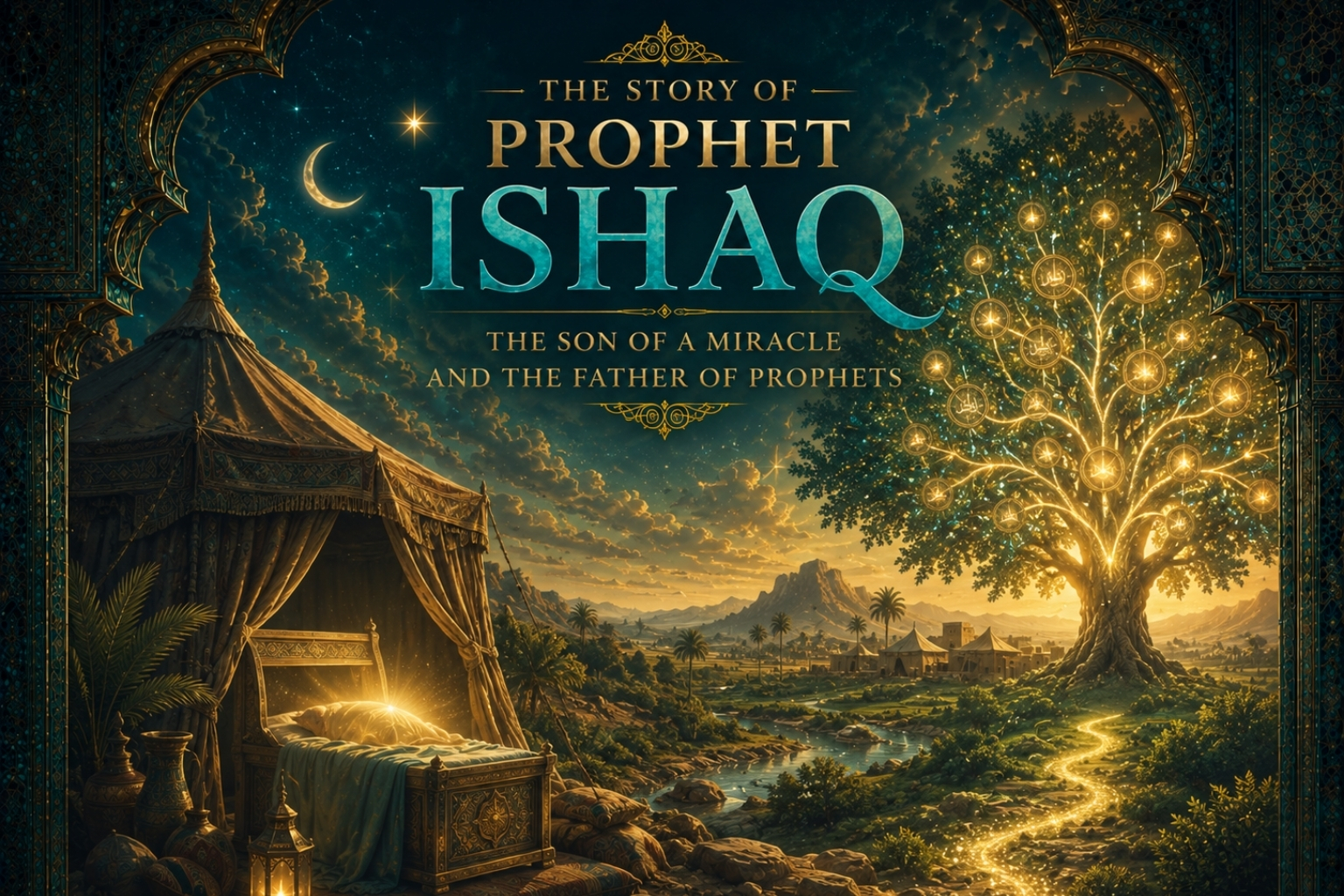

There are births that change a family. There are births that change a nation. And then there is the birth of Prophet Ishaq, peace be upon him — a birth that was announced by angels, laughed at by his mother, and promised by Allah when every biological possibility had long since passed.
Ishaq did not arrive quietly into history. He arrived as a miracle — the living proof that Allah’s promises are not bound by the laws of nature, not limited by age or circumstance, not dependent on human possibility. When Allah says “it will be” — it will be. Even if the mother laughs in disbelief. Even if the parents are a hundred years old. Even if the very idea seems impossible to every human mind that hears it.
His story in the Quran is brief — but what surrounds it is extraordinary. He is the son of the Friend of Allah. He is the father of Yaqub. He is the grandfather of Yusuf. He is the ancestor of Musa, Dawud, Sulaiman, Zakariyya, Yahya, and Isa. The entire prophetic lineage of Bani Israel flows through him.
And it all began with a laugh in a tent — and a promise that Allah kept.
Chapter One — The Announcement: Angels at the Door of Ibrahim
The story of Ishaq’s birth begins not with his mother, but with visitors. Three angels — sent by Allah — arrived at the home of Prophet Ibrahim, peace be upon him, in the form of men. Ibrahim, being the generous host he was, immediately prepared a roasted calf for them. But when the guests did not eat, Ibrahim felt uneasy — in the customs of that time and place, a guest who did not eat was a guest who bore ill intentions.
The angels reassured him — and then delivered the news:
Quran Verse:
وَلَقَدْ جَاءَتْ رُسُلُنَا إِبْرَاهِيمَ بِالْبُشْرَىٰ قَالُوا سَلَامًا ۖ قَالَ سَلَامٌ ۖ فَمَا لَبِثَ أَن جَاءَ بِعِجْلٍ حَنِيذٍ
“And certainly did Our messengers come to Ibrahim with good tidings; they said: ‘Peace.’ He said: ‘Peace,’ and did not delay in bringing a roasted calf.”
Surah Hud (11:69)
Then the glad tidings were given — a son, to be named Ishaq:
Quran Verse:
فَبَشَّرْنَاهُ بِإِسْحَاقَ نَبِيًّا مِّنَ الصَّالِحِينَ
“And We gave him good tidings of Ishaq — a prophet from among the righteous.”
Surah As-Saffat (37:112)
The announcement was not simply “you will have a son.” It was “you will have a son who will be a prophet from among the righteous.” Before Ishaq took his first breath, Allah had already written his prophethood into the announcement of his birth. His destiny was declared by angels before his mother’s womb had changed.
Chapter Two — The Laugh That Became Famous Across Eternity
Ibrahim’s wife — Sarah — was in the tent when the angels delivered this news. She was elderly. Ibrahim was elderly. The age of childbearing had passed for her decades ago. And so she responded in the most human way imaginable:
Quran Verse:
وَامْرَأَتُهُ قَائِمَةٌ فَضَحِكَتْ فَبَشَّرْنَاهَا بِإِسْحَاقَ وَمِن وَرَاءِ إِسْحَاقَ يَعْقُوبَ
“And his wife was standing, and she laughed. Then We gave her good tidings of Ishaq and after Ishaq, of Yaqub.”
Surah Hud (11:71)
She laughed. Not a laugh of mockery — but a laugh of disbelief, of shock, of the kind of involuntary reaction that comes when the mind cannot process what it is hearing. And her words that followed reveal the complete genuineness of her surprise:
Quran Verse:
قَالَتْ يَا وَيْلَتَىٰ أَأَلِدُ وَأَنَا عَجُوزٌ وَهَٰذَا بَعْلِي شَيْخًا ۖ إِنَّ هَٰذَا لَشَيْءٌ عَجِيبٌ
“She said: ‘Woe to me! Shall I give birth while I am an old woman and this, my husband, is an old man? Indeed, this is an amazing thing.'”
Surah Hud (11:72)
“Indeed, this is an amazing thing.” She was not being defiant. She was being human. She was expressing what every rational person in her position would express — that what was being promised seemed to fall outside the boundaries of what was possible.
The angels’ response is one of the most beautiful reminders of Allah’s nature in the entire Quran:
Quran Verse:
قَالُوا أَتَعْجَبِينَ مِنْ أَمْرِ اللَّهِ ۖ رَحْمَتُ اللَّهِ وَبَرَكَاتُهُ عَلَيْكُمْ أَهْلَ الْبَيْتِ ۚ إِنَّهُ حَمِيدٌ مَّجِيدٌ
“They said: ‘Are you amazed at the decree of Allah? May the mercy of Allah and His blessings be upon you, people of the house. Indeed, He is Praiseworthy and Honorable.'”
Surah Hud (11:73)
“Are you amazed at the decree of Allah?” — not a rebuke, but a gentle, loving reminder. The angels were not scolding Sarah for laughing. They were expanding her frame of reference. They were saying: you are measuring this promise against what is humanly possible. But you are dealing with Allah. And Allah is not limited by what is humanly possible.
This verse is a permanent answer to every person who has ever looked at their situation and said “this cannot change” or “this is impossible” or “it is too late.” The decree of Allah does not require your biological clock to be running. It does not require circumstances to be favorable. It requires only His word — and His word is enough.
Chapter Three — The Birth That Proved the Promise
Ishaq was born. Into a household already filled with the extraordinary — the father who had survived fire, who had built the Ka’bah, who had been called the Friend of Allah — Ishaq arrived as yet another sign that Allah’s promises are always kept.
Allah describes the blessing that flowed from this birth not just to Ibrahim and Sarah but to entire generations:
Quran Verse:
وَبَارَكْنَا عَلَيْهِ وَعَلَىٰ إِسْحَاقَ ۚ وَمِن ذُرِّيَّتِهِمَا مُحْسِنٌ وَظَالِمٌ لِّنَفْسِهِ مُبِينٌ
“And We blessed him and Ishaq. But among their descendants is the doer of good and the one who is clearly unjust to himself.”
Surah As-Saffat (37:113)
Allah blessed both Ibrahim and Ishaq — and then added an honest acknowledgment: among their descendants would be both the righteous and the wrongdoers. This is not a criticism of Ibrahim or Ishaq — it is Allah’s reminder that prophethood and righteousness are not inherited. Every soul in every generation makes its own choice. The blessing of a righteous lineage is an enormous gift — but it is not a guarantee.
Chapter Four — Ishaq as a Prophet: Continuing His Father’s Mission
Ishaq received prophethood and continued the mission his father Ibrahim had dedicated his life to — calling his people to the worship of Allah alone. He settled in the land of Canaan, in what is today Palestine, and his life became the bridge between the era of Ibrahim and the great prophetic lineage of Bani Israel that would follow.
Allah honors him consistently alongside the greatest prophets, making clear that his station is not diminished by the brevity of his Quranic narrative:
Quran Verse:
وَوَهَبْنَا لَهُ إِسْحَاقَ وَيَعْقُوبَ ۚ كُلًّا هَدَيْنَا ۚ وَنُوحًا هَدَيْنَا مِن قَبْلُ ۚ وَمِن ذُرِّيَّتِهِ دَاوُودَ وَسُلَيْمَانَ وَأَيُّوبَ وَيُوسُفَ وَمُوسَىٰ وَهَارُونَ ۚ وَكَذَٰلِكَ نَجْزِي الْمُحْسِنِينَ
“And We gave him Ishaq and Yaqub — all of them We guided. And Nuh We guided before, and among his descendants were Dawud and Sulaiman and Ayyub and Yusuf and Musa and Harun. And thus do We reward the doers of good.”
Surah Al-An’am (6:84)
Read the names in this verse — Dawud, Sulaiman, Ayyub, Yusuf, Musa, Harun — all of them flow from the lineage of Ishaq. The man born to elderly parents in a tent in Canaan became the root of a prophetic tree so vast that its branches cover the entire history of divine guidance to Bani Israel.
Allah also affirms the prophethood and divine guidance given specifically to Ishaq:
Quran Verse:
وَوَهَبْنَا لَهُ إِسْحَاقَ وَيَعْقُوبَ وَجَعَلْنَا فِي ذُرِّيَّتِهِ النُّبُوَّةَ وَالْكِتَابَ
“And We gave him Ishaq and Yaqub and placed in his descendants prophethood and scripture.”
Surah Al-Ankabut (29:27)
Prophethood and scripture — placed in the descendants of Ibrahim through Ishaq. Every revealed book, every prophet of Bani Israel, every divine message that came through that lineage — all of it traces back to the child born to a laughing mother and a father who had waited a lifetime.
Chapter Five — The Prayer of Ibrahim: A Father’s Du’a for His Sons
One of the most moving aspects of Ishaq’s story is the prayer his father Ibrahim made — a prayer that encompassed both Ismail and Ishaq and asked Allah for something that every parent’s heart yearns for:
Quran Verse:
رَبِّ اجْعَلْنِي مُقِيمَ الصَّلَاةِ وَمِن ذُرِّيَّتِي ۚ رَبَّنَا وَتَقَبَّلْ دُعَاءِ
“My Lord, make me an establishment of prayer, and from my descendants. Our Lord, and accept my supplication.”
Surah Ibrahim (14:40)
Ibrahim did not pray for his children to be wealthy, powerful, or famous. He prayed for them to establish prayer — to maintain their connection to Allah across generations. This is the prayer of a father who understood that the only inheritance worth leaving is the one that survives death.
And Allah answered. Through Ishaq and his descendants, the call to prayer echoed across centuries — carried forward by prophet after prophet, each one a living answer to Ibrahim’s du’a.
Chapter Six — Ishaq in the Company of the Greatest
Throughout the Quran, Ishaq is mentioned consistently in the company of the most honored prophets — a testament to his station before Allah. He is listed alongside Ibrahim, Ismail, Yaqub, Musa, Isa, and others in contexts of Allah’s highest praise:
Quran Verse:
قُلْ آمَنَّا بِاللَّهِ وَمَا أُنزِلَ عَلَيْنَا وَمَا أُنزِلَ عَلَىٰ إِبْرَاهِيمَ وَإِسْمَاعِيلَ وَإِسْحَاقَ وَيَعْقُوبَ وَالْأَسْبَاطِ
“Say: ‘We have believed in Allah and in what was revealed to us and what was revealed to Ibrahim, Ismail, Ishaq, Yaqub, and the descendants.'”
Surah Al-Imran (3:84)
And Allah describes the gift of Ishaq to Ibrahim as one of the crowning mercies of his old age — a comfort and a joy after a lifetime of trials:
Quran Verse:
الْحَمْدُ لِلَّهِ الَّذِي وَهَبَ لِي عَلَى الْكِبَرِ إِسْمَاعِيلَ وَإِسْحَاقَ ۚ إِنَّ رَبِّي لَسَمِيعُ الدُّعَاءِ
“Praise to Allah, who has granted to me in old age Ismail and Ishaq. Indeed, my Lord is the Hearer of supplication.”
Surah Ibrahim (14:39)
“The Hearer of supplication.” Ibrahim received two sons in his old age — one from Hajar, one from Sarah — and his response was not to take credit for his patience or his persistence in prayer. His response was pure gratitude, directing all praise to Allah and acknowledging that Allah hears every du’a, even the ones that seem to go unanswered for decades.
Hadith:
إِنَّ اللَّهَ اصْطَفَى مِنْ وَلَدِ إِبْرَاهِيمَ إِسْمَاعِيلَ، وَاصْطَفَى مِنْ وَلَدِ إِسْمَاعِيلَ بَنِي كِنَانَةَ، وَاصْطَفَى مِنْ بَنِي كِنَانَةَ قُرَيْشًا، وَاصْطَفَى مِنْ قُرَيْشٍ بَنِي هَاشِمٍ، وَاصْطَفَانِي مِنْ بَنِي هَاشِمٍ
“Indeed, Allah chose Ismail from the children of Ibrahim, and chose Banu Kinanah from the children of Ismail, and chose Quraysh from Banu Kinanah, and chose Banu Hashim from Quraysh, and chose me from Banu Hashim.”
Recorded in Sahih Muslim, Hadith No. 2276
The Prophet Muhammad ﷺ traced his lineage through Ismail — while the prophets of Bani Israel traced theirs through Ishaq. Both lines flow from Ibrahim. Both lines were blessed. Both lines produced prophets, messengers, and divine guidance for all of humanity. The two sons of Ibrahim became, together, the two great channels through which prophethood flowed to the world.
Timeless Lessons from the Story of Ishaq
- Allah’s promises are not limited by biological possibility Sarah laughed because what was promised seemed impossible. Ishaq was born anyway. There is no circumstance too old, no situation too far gone, no door too long closed for Allah to open. Never measure Allah’s promises against human limitations.
- Amazement at Allah’s decree is human — but expand your frame of reference Sarah’s laugh was not condemned — it was gently corrected. Allah does not rebuke us for feeling that something is impossible. He invites us to remember who we are dealing with. When something feels impossible, the reminder is: are you amazed at the decree of Allah?
- The blessing of a righteous lineage is a gift, not a guarantee Allah blessed Ibrahim and Ishaq — and then noted that among their descendants would be both the righteous and the wrongdoers. No lineage, no family, no upbringing automatically saves a person. Every soul chooses.
- Du’a for your children’s faith is the greatest parental prayer Ibrahim did not pray for wealth or power for his sons. He prayed that they would establish prayer. If you could ask Allah for one thing for your children — let it be that they maintain their connection to Him.
- Your role in history may be the bridge, not the destination Ishaq is not the most dramatic prophet in the Quran. His story does not fill chapters. But without him — without his birth, his prophethood, his descendants — the entire prophetic lineage of Bani Israel does not exist. Not every person is called to be the most visible part of the story. Some are called to be the bridge. That is not a lesser role — it is an essential one.
- Gratitude is the only appropriate response to answer du’a When Ibrahim received both Ismail and Ishaq, his response was “Praise to Allah… indeed my Lord is the Hearer of supplication.” When Allah answers your prayer — especially one you have carried for a long time — the first and only response is gratitude.
- What Allah places in a lineage outlives every individual in it Allah placed prophethood and scripture in the descendants of Ibrahim through Ishaq. That placement produced over a dozen prophets across millennia. What Allah puts into a family, a community, or a civilization through sincere faith and righteous action can outlast every individual who carries it by centuries.
Closing Reflection
A woman laughed in a tent in Canaan when angels told her she would have a son. That laugh — born of disbelief, of shock, of the collision between human limitation and divine promise — became one of the most famous moments in prophetic history.
And then Ishaq was born.
And from Ishaq came Yaqub. And from Yaqub came Yusuf, Musa, Harun, Dawud, Sulaiman, Ayyub, Zakariyya, Yahya, and Isa — a chain of light stretching across two thousand years of human history, each link a prophet, each prophet a mercy to his people, each mercy flowing back to the moment an old woman laughed and Allah answered:
Quran Verse:
أَتَعْجَبِينَ مِنْ أَمْرِ اللَّهِ ۖ رَحْمَتُ اللَّهِ وَبَرَكَاتُهُ عَلَيْكُمْ أَهْلَ الْبَيْتِ ۚ إِنَّهُ حَمِيدٌ مَّجِيدٌ
“Are you amazed at the decree of Allah? May the mercy of Allah and His blessings be upon you, people of the house. Indeed, He is Praiseworthy and Honorable.”
Surah Hud (11:73)
Whatever you are waiting for — whatever promise you have been carrying that still feels impossible — remember Sarah’s laugh. Remember Ishaq’s birth. And remember that Allah is not finished yet.
Tags: Prophet Ishaq · Ishaq in Islam · Isaac in Quran · Story of Isaac Islam · Children of Ibrahim · Prophets of Bani Israel · Sarah and Ibrahim · Miracle Birth Quran · Prophets of the Quran · Islamic Articles English · Quran Route · Prophets Series 09