
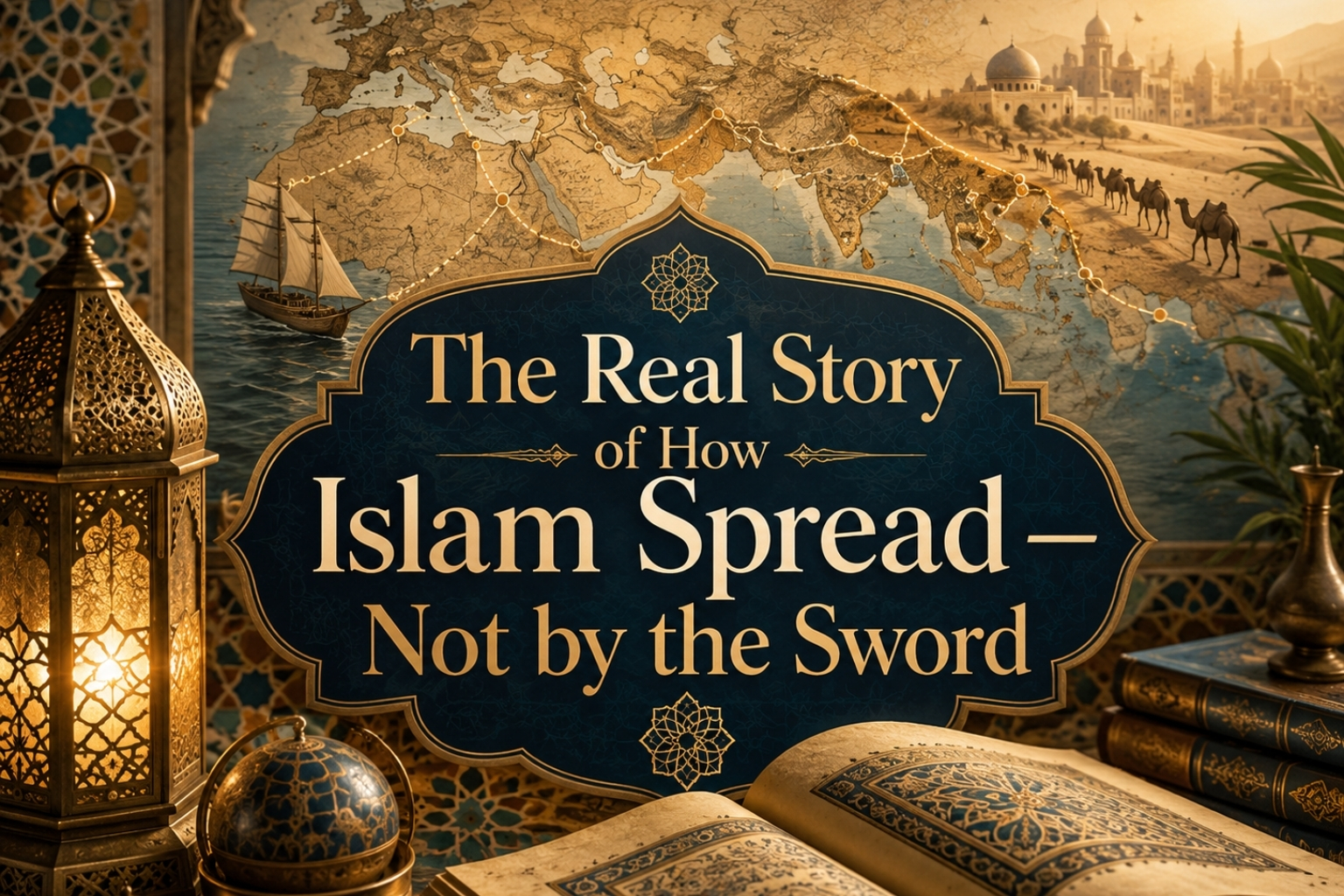

For decades, popular media and casual history textbooks have repeated a familiar, dramatic narrative: Islam spread across the globe like a sudden wildfire, carried entirely by horsemen charging out of the Arabian desert wielding flashing scimitars, forcing conquered populations to convert at the tip of a blade.
This “spread by the sword” caricature is not just a historical myth—it is a psychological distortion. It paints a picture of a faith forced upon an unwilling, terrified world through brutal coercion.
For many modern seekers and practicing believers, this inaccurate narrative creates a subtle barrier to achieving true peace of mind and confidence in their spiritual heritage. It triggers an unneeded sense of historical defensiveness or a lingering feeling of doubt that can feed into chronic overthinking in Islam.
However, when we rescue the historical record from orientalist tropes and examine the expansion of Islam through the objective lens of modern academic research, a completely different reality emerges. By analyzing actual historical timelines, economic treaties, and the theological principles of Tadabbur (deep Quranic reflection), we discover that the rapid growth of Islam was not a triumph of military coercion. Instead, it was an intellectual, economic, and spiritual awakening.
People did not accept Islam because they were forced to; they embraced it because it offered a profound social liberation, a pristine blueprint for Islamic psychology, and a deeply attractive lifestyle centered around trusting Allah’s plan.
The Golden Constitutional Rule: No Coercion in Faith
To understand how Islam actually spread, we must first look at the constitutional law governing conversion in the Quran itself. Unlike empires that demanded religious uniformity to maintain political control, the Quran laid down an absolute, unyielding legal boundary regarding individual conscience:
“لَا إِكْرَاهَ فِي الدِّينِ ۖ قَد تَّبَيَّنَ الرُّشْدُ مِنَ الْغَيِّ”
“There is no compulsion in religion. The right direction is now distinct from error.” — Surah Al-Baqarah, 2:256
THE QURANIC LAW OF RELIGIOUS FREEDOM | |
THE MYTH: | Early Muslim armies forced conquered populations to choose between accepting Islam or facing execution. |
THE LEGALITY: | Surah Al-Baqarah (2:256) strictly forbids forced conversion. Under Islamic law, a conversion forced by coercion is completely null, void, and invalid. |
THE EXECUTION: | Conquered populations were granted the status of Dhimmi (protected citizens), allowing them full freedom to maintain their religious practices and courts. |
Classical historians, both Muslim and non-Muslim, note that if early Muslims had used the sword to convert populations, the vast Christian, Jewish, and Zoroastrian communities of the Middle East would have been wiped out overnight. Yet, centuries after the Islamic conquests, these communities continued to live, thrive, and manage their own legal affairs right in the heart of the Muslim world.
The Historical Proof of Sluggish Conversion
The most damning piece of evidence against the “spread by the sword” myth is the actual timeline of conversion. If Islam had been forced upon people by military might, we would expect to see a massive, immediate spike in conversion numbers right after a territory was conquered.
But the historical data shows the exact opposite. Conversion to Islam was a slow, multi-generational process that took centuries to complete.
“Islamic expansion was political, not religious. Mass conversion was never the immediate goal of the early caliphate, nor was it forced upon the populations.” — De Lacy O’Leary, Islam at the Cross Roads
Take Egypt and Persia (Iran) as prime historical examples:
- Persia: Following the collapse of the Sasanian Empire in the 7th century, the vast majority of the population remained Zoroastrian for generations. Historical records show that it took nearly two to three centuries for Persia to become a Muslim-majority region.
- Egypt: After the Muslim forces’ entry into Egypt in 641 CE under Amr ibn al-Aas, the native Coptic Christian population remained the absolute majority for over three hundred years.
If the sword had been the primary instrument of conversion, these long centuries of slow growth simply wouldn’t exist. Conquered populations gradually chose Islam over generations because they observed its values, lived under its legal protections, and found its egalitarian social structures deeply compelling.
The Three True Catalysts of Islam’s Growth
If the sword didn’t do it, what did? Historical scholarship points to three primary, highly effective channels through which Islam naturally stole the hearts of millions:
1. Social Justice and the Destruction of Caste Systems
The regions surrounding Arabia in the 7th century were breaking under the weight of extreme social stratification. The Byzantine Empire heavily taxed its citizens and persecuted unorthodox Christian sects, while the Sasanian Empire ran a rigid, unyielding caste system.
When Islam arrived, it introduced a revolutionary social framework: all human beings are completely equal in the sight of God, regardless of race, wealth, or social class. The only measure of a person’s worth is their consciousness of God (Taqwa). For the oppressed peasants, heavily taxed farmers, and marginalized lower classes of the ancient world, embracing Islam was an act of radical social liberation.
2. The Honest Merchants of the Trade Routes
Some of the largest Muslim populations on earth today—including Indonesia, Malaysia, and parts of East and West Africa—never saw a single Muslim soldier or army. Islam reached these vast regions entirely through the character of Muslim merchants and traders.
These businessmen practiced their trade through the lens of Khalifah (divine stewardship). They were famous for their strict honesty, fair weights, and transparent deals. Local populations, accustomed to exploitative trade practices, were so deeply moved by the ethical behavior and personal integrity of these Muslim merchants that they began studying their faith, eventually adopting it en masse.
3. Spiritual Sufi Wisdom and Cultural Integration
Parallel to the trade routes, traveling scholars, spiritual teachers, and Sufi sages walked deep into distant lands. Instead of demanding that people completely erase their local cultures, these teachers used a beautiful methodology of Tadabbur and cultural integration.
They adopted local languages, respected harmless local traditions, and focused on purifying the inner spirit through the practice of Istighfar and mindfulness. They showed local communities how to integrate the peaceful rhythms of Islam into their daily lives, providing an immediate pathway to emotional security and communal harmony.
The Modern Parallel: Reclaiming Your Spiritual Identity
Understanding the true, peaceful history of Islam’s growth does more than just fix a historical record—it radically alters your personal relationship with your faith today.
When you realize that Islam won the hearts of millions through its intellectual clarity, its social justice, and its beautiful ethics, you can stop carrying the unneeded psychological weight of historical guilt or media-driven distortions.
You can step off the defensive treadmill and confidently embrace your identity as a Khalifah—an ambassador of divine light. You are part of a legacy that built a civilization based on spiritual safety, scientific inquiry, and absolute mercy. When you ground your understanding in historical truth and align your daily life with trusting Allah’s plan, the heavy, suffocating clouds of doubt and overthinking completely dissolve—leaving your mind beautifully wrapped in an unshakeable state of profound safety, enduring tranquility, and everlasting spiritual success.