

Among the most powerful and repeated concepts in the Quran is the word Taqwa.
It appears throughout the Quran in different verses and contexts, guiding believers toward a life of awareness, sincerity, and righteousness.
Although the word is often translated as “fear of Allah” or “piety,” 1 its meaning is much deeper and richer than a single English word can fully express.
Understanding Taqwa helps reveal the spiritual heart of Islam and explains how the Quran shapes the inner character of a person.
The Meaning of Taqwa
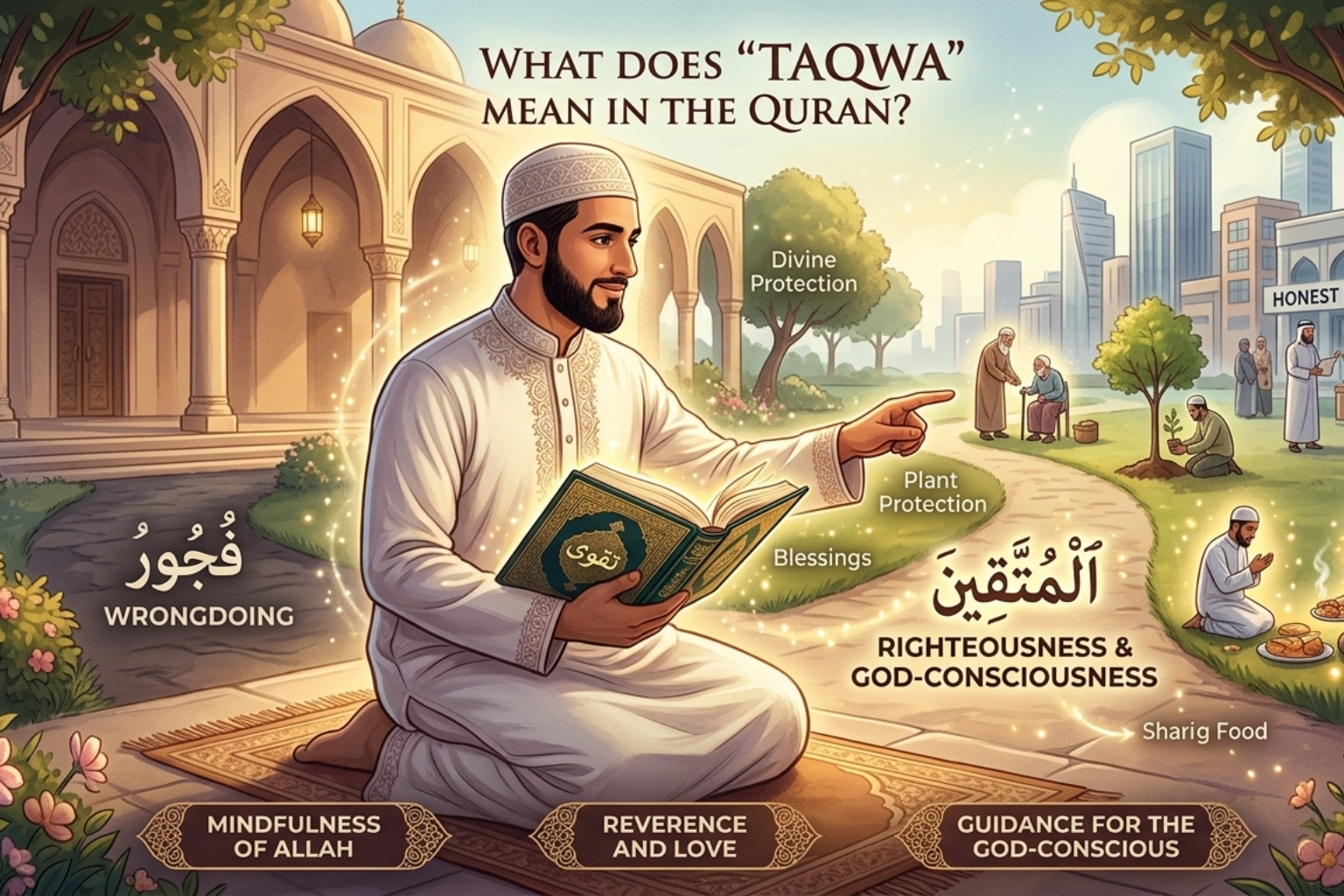
The Arabic word Taqwa 2 (تقوى) comes from the root word waqā, which means “to protect” or “to guard.”
In the Quranic sense, Taqwa means:
- Being conscious of Allah at all times
- Protecting oneself from sin and wrongdoing
- Living with sincerity 3 and moral awareness
- Obeying Allah out of love, respect, and faith
Taqwa is not simply fear in the ordinary sense.
It is a deep awareness that Allah sees, hears, and knows everything.
A person with Taqwa tries to choose what is right even when nobody else is watching.
Why Is Taqwa Important in the Quran?
The Quran repeatedly describes Taqwa as one of the greatest qualities a believer can have.
Allah mentions that guidance from the Quran benefits those who have Taqwa:
ذَٰلِكَ الْكِتَابُ لَا رَيْبَ ۛ فِيهِ ۛ هُدًى لِّلْمُتَّقِينَ
“This is the Book about which there is no doubt, a guidance for those conscious of Allah.”
— Surah Al-Baqarah (2:2)
Taqwa is connected to:
- Guidance
- Wisdom
- Forgiveness
- Mercy
- Success
- Paradise
The Quran teaches that true honor is not based on wealth, race, or status, but on Taqwa.
إِنَّ أَكْرَمَكُمْ عِندَ اللَّهِ أَتْقَاكُمْ
“Indeed, the most noble of you in the sight of Allah is the one with the most Taqwa.”
— Surah Al-Hujurat (49:13)
How Does a Person Develop Taqwa?
Taqwa grows through faith, worship, and sincere reflection.
Some of the ways believers strengthen Taqwa include:
Prayer
Regular prayer reminds a person of Allah throughout the day and helps protect the heart from wrongdoing.
إِنَّ الصَّلَاةَ تَنْهَىٰ عَنِ الْفَحْشَاءِ وَالْمُنكَرِ
“Indeed, prayer prohibits immorality and wrongdoing.”
— Surah Al-Ankabut (29:45)
Reading the Quran
The Quran increases spiritual awareness and teaches moral guidance.
وَنُنَزِّلُ مِنَ الْقُرْآنِ مَا هُوَ شِفَاءٌ وَرَحْمَةٌ لِّلْمُؤْمِنِينَ
“And We send down of the Quran that which is healing and mercy for the believers.”
— Surah Al-Isra (17:82)
Remembering Allah
Acts of remembrance (dhikr) 4 help keep the heart connected to faith.
أَلَا بِذِكْرِ اللَّهِ تَطْمَئِنُّ الْقُلُوبُ
“Verily, in the remembrance of Allah do hearts find rest.”
— Surah Ar-Ra’d (13:28)
Avoiding Sin
A person with Taqwa becomes careful about actions, words, and intentions.
وَمَن يَتَّقِ اللَّهَ يَجْعَل لَّهُ مَخْرَجًا
“And whoever fears Allah – He will make for him a way out.”
— Surah At-Talaq (65:2)
Sincerity
Taqwa is not about appearing religious in front of people.
It begins inside the heart.
The Prophet Muhammad ﷺ said:
إِنَّ اللَّهَ لَا يَنْظُرُ إِلَىٰ صُوَرِكُمْ وَأَمْوَالِكُمْ وَلَٰكِنْ يَنْظُرُ إِلَىٰ قُلُوبِكُمْ وَأَعْمَالِكُمْ
“Indeed, Allah does not look at your appearance or wealth, but He looks at your hearts and deeds.”
— Sahih Muslim, Hadith 2564
Taqwa and Daily Life
Taqwa affects every part of a Muslim’s life.
It influences:
- Honesty in business
- Kindness toward others
- Patience during hardship
- Humility 5 during success
- Responsibility in private and public actions
A person with Taqwa understands that faith is not limited to rituals alone.
It is a way of living with constant awareness of Allah.
فَمَن يَعْمَلْ مِثْقَالَ ذَرَّةٍ خَيْرًا يَرَهُ
“So whoever does an atom’s weight of good will see it.”
— Surah Az-Zalzalah (99:7)
The Relationship Between Taqwa and the Heart
The Quran places great importance on the condition of the heart.
The Prophet Muhammad ﷺ explained that Taqwa begins internally before it appears in actions.
التَّقْوَىٰ هَاهُنَا
“Taqwa is here,” and he pointed to his chest three times.
— Sahih Muslim, Hadith 2564
Someone may speak beautifully or appear outwardly righteous, but true Taqwa is connected to sincerity, humility, and obedience to Allah from within.
Because of this, Taqwa transforms not only behavior, but also intentions and character.
Common English Translations of Taqwa
There are many words in English that express the meaning of piety.:
- God-consciousness
- Piety
- Mindfulness of Allah
- Fear of Allah
- Reverence
- Righteous awareness
Each translation reflects part of the meaning, but the Quranic concept combines all of them together.
Conclusion
Taqwa is one of the central spiritual concepts in the Quran.
It means living with awareness of Allah, protecting oneself from sin, and striving to do what is right with sincerity and faith.
The Quran presents Taqwa as the path to guidance 6, wisdom, inner peace, and success in both this life and the Hereafter 7.
وَتَزَوَّدُوا فَإِنَّ خَيْرَ الزَّادِ التَّقْوَىٰ
“And take provisions, but indeed, the best provision is Taqwa.”
— Surah Al-Baqarah (2:197)
Rather than being limited to fear alone, Taqwa is a continuous state of spiritual awareness that shapes the heart, actions, and character of a believer.