
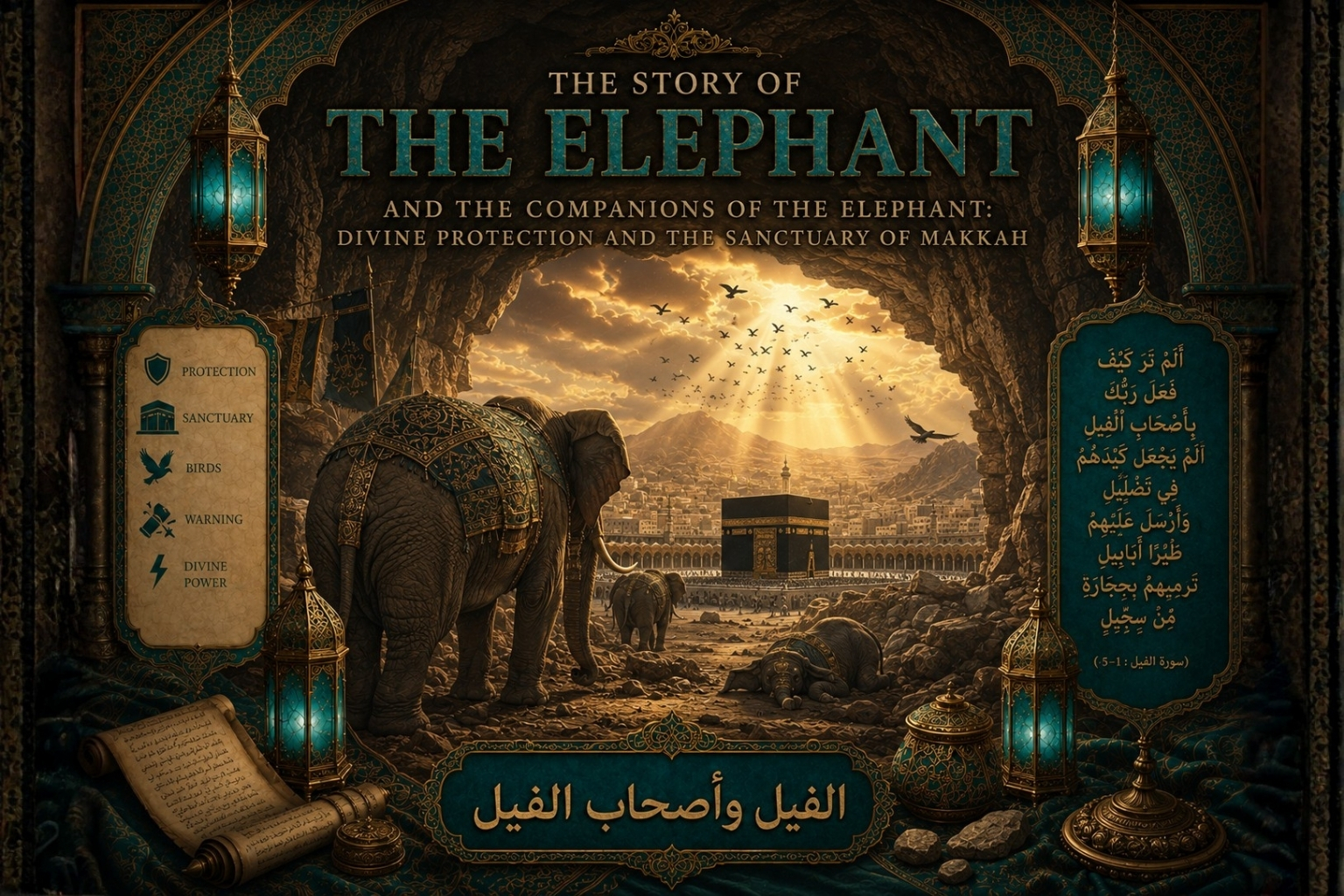

Among the most historically pivotal, geopolitically massive, and structurally spectacular narratives recorded in Islamic history is the chronicle of Ashab al-Fil (The Companions of the Elephant). Immortalized inside the concise yet intensely powerful verses of Surah Al-Fil (The Elephant, Chapter 105), this cataclysmic event took place in the year 570 CE—a watershed moment in human history universally known in Islamic tradition as ‘Am al-Fil (The Year of the Elephant), which directly coincided with the birth of the Prophet Muhammad.
Revealed by Allah to demonstrate the absolute, inviolable sanctity of the Ka’bah, the story of the Elephant in Islam serves as an eternal testament to the reality that no earthly military machine, no matter how advanced or technologically terrifying, can ever dismantle a sanctuary protected by the Sovereign of the universe.
The Geopolitical Rivalry: Abrahah’s Al-Qullays
The narrative unfolds in the 6th century, during a time when Arabia was fractured into various tribal domains, caught between the imperial spheres of the Byzantine and Sasanian Empires. In the southern kingdom of Yemen, a powerful, ruthless Christian viceroy named Abrahah al-Ashram ruled under the authority of the Kingdom of Aksum (Abyssinia).
Abrahah witnessed with immense economic jealousy how thousands of Arab tribesmen from every corner of the peninsula migrated annually to Makkah to perform pilgrimage around the ancient, simple stone structure of the Ka’bah.
Driven by political ambition and a desire to redirect the massive trade routes of Arabia toward Yemen, Abrahah commissioned the construction of a breathtaking, colossal cathedral in the city of Sana’a called Al-Qullays. It was an architectural marvel of its time, adorned with glittering gold, imported marble, and brilliant mosaics.
Despite its material grandeur, the Arab tribes completely ignored Abrahah’s cathedral, remaining fiercely loyal to the ancient sanctuary built by Prophet Ibrahim (Abraham). The geopolitical tension reached a boiling point when a member of an Arab tribe traveled to Sana’a, entered Al-Qullays secretly during the night, and intentionally defiled its altar to show complete contempt for Abrahah’s political trap.
The Imperial March: Mobilizing the Colossus
Furious at this public humiliation, Abrahah took a binding oath to march north and completely erase the Ka’bah from the face of the Earth. He mobilized a massive, professional army of sixty thousand elite soldiers.
To ensure absolute psychological terror and unstoppable destructive force, Abrahah reinforced his infantry with an element entirely foreign to the rugged desert terrain of Arabia: a squadron of massive war elephants. At the front of this armored division was a particularly colossal, highly trained elephant named Mahmud, intended to break through the defensive fortifications of Makkah.
As this unstoppable war machine advanced toward the north, various brave Arab tribes attempted to launch guerrilla counter-attacks to defend the holy sanctuary. However, Abrahah’s imperial army systematically crushed all resistance, taking their leaders captive and marching directly onto the outskirts of Makkah, setting up camp in the valley of Mughammas.
The Negotiation: The Lord of the Camels
Upon arriving, Abrahah’s soldiers plundered the surrounding valleys, seizing the livestock of the Makkans, including two hundred camels belonging to Abdul-Muttalib, the grandfather of the Prophet Muhammad and the chief custodian of Makkah.
Abrahah summoned Abdul-Muttalib to his tent, expecting to meet a desperate military commander begging for a peace treaty. Instead, Abdul-Muttalib stepped forward with immense dignity and calm authority. When Abrahah asked him what his demands were, Abdul-Muttalib replied calmly: “I want my two hundred camels returned to me.”
Abrahah was stunned and openly mocked him, saying: “You speak to me about two hundred camels while I have brought an army to destroy the very temple that represents your religion and your ancestors’ honor?”
Abdul-Muttalib delivered a historic, chilling response that perfectly encapsulated the metaphysical reality of the situation:
“I am the lord of the camels. As for the House (the Ka’bah), it has its own Lord, and He will surely protect it.” — Abdul-Muttalib to Abrahah
The Rebellion of Mahmud: The Rebellion of the Beast
Abdul-Muttalib returned to Makkah, ordered the entire population to evacuate the city and take refuge safely within the high mountain peaks surrounding the valley to avoid the impending slaughter. He then stood at the iron gates of the Ka’bah, holding its lock, and made an intense, tearful supplication to Allah to defend His sanctuary.
On the dawn of the fateful day, Abrahah ordered his army to prepare for the final assault. They turned the giant elephant, Mahmud, directly toward the Ka’bah and whipped it to charge and tear down its walls.
Suddenly, a supernatural intervention occurred. Mahmud, the highly trained war beast, dropped heavily to his knees, refusing to take a single step forward toward the Ka’bah.
No matter how brutally the soldiers beat him or prodded him with iron hooks, the elephant remained frozen like a stone monument. Yet, the moment the soldiers turned Mahmud’s body facing south toward Yemen or east toward Syria, the elephant would instantly leap to his feet and begin running cheerfully. The moment they turned him back toward Makkah, he collapsed to his knees.
The Ababil: The Aviation of Divine Wrath
As Abrahah’s army stood in complete administrative confusion, shouting and beating the frozen elephant, the sky above Makkah suddenly darkened. It was not a storm cloud, but a massive, synchronized flock of unique, migratory birds known in the Quran as Tayran Ababil (birds in flying squadrons).
Sent directly by Allah from the coast, these birds flew in dense formations over the valley. Each individual bird carried three small stones made of baked, petrified clay (Sijjil)—one in its beak and one in each of its claws—no larger than a chickpea or a lentil.
“أَلَمْ تَرَ كَيْفَ فَعَلَ رَبُّكَ بِأَصْحَابِ الْفِيلِ أَلَمْ يَجْعَلْ كَيْدَهُمْ فِي تَضْلِيلٍ وَأَرْسَلَ عَلَيْهِمْ طَيْرًا أَبَابِيلَ تَرْمِيهِم بِحِجَارَةٍ مِّن سِجِّيلٍ فَجَعَلَهُمْ كَعَصْفٍ مَّأْكُولٍ”
“Have you not seen, [O Muhammad], how your Lord dealt with the companions of the elephant? Did He not make their plan into misguidance? And He sent against them birds in flocks, striking them with stones of hard clay, and He made them like eaten straw.” — (Surah Al-Fil, 105:1-5)
The birds unleashed their payload, dropping the stones precisely onto the gathering army below. Despite their small size, these stones possessed a miraculous, terrifying kinetic velocity. The moment a stone struck an armored soldier, it pierced cleanly through his helmet, his iron armor, and his body, exiting out through the ground below.
The entire elite army of sixty thousand men was instantly thrown into a state of absolute, graphic destruction. The Quran beautifully visualizes the horrific aftermath using a striking agricultural metaphor: they were reduced to “eaten straw” (‘Asfin m’akul)—shattered, trampled, and hollowed out like the chewed-up husks of corn or wheat left behind by cattle.
Abrahah himself survived the initial bombardment, but his body began to physically fracture and decay as his remaining soldiers carried him in absolute humiliation back to Sana’a, where his chest split open and his heart failed, bringing his tyrannical empire to a permanent end.
Core Spiritual Lessons from Ashab al-Fil
- The Fallacy of Material Supremacy: Abrahah possessed the ultimate military technology of his era—war elephants, iron armor, and thousands of disciplined troops. The Makkans had nothing but a valley of empty homes. Allah proved that when a society aligns its military machine against divine boundaries, their massive infrastructure can be completely dismantled by the smallest elements of creation (tiny birds carrying pebbles).
- The Sacred Architecture of Peace: The miraculous preservation of the Ka’bah cemented its status as a permanent sanctuary of peace (Aman). It sent a permanent shockwave through the ancient world, proving that this simple stone structure was directly anchored to the cosmos, protected by an authority that far outranked the empires of Rome, Persia, or Abyssinia.
- The Spiritual Prelude to Prophethood: The Year of the Elephant was not an accidental occurrence; it was a profound historical clearing of the stage for the arrival of the Prophet Muhammad, who was born just a few months later. By purging the region of a brutal foreign invader and demonstrating the living reality of divine intervention, Allah prepared the hearts of the Arabs to receive the final message of monotheism.
- Trusting the Sovereignty of the Creator: The absolute certainty demonstrated by Abdul-Muttalib serves as a profound lesson in reliance upon Allah (Tawakkul). When facing structural crises that are completely beyond your human capacity to fight or manage, do your basic duty, protect your family, and hand the keys of the crisis over to Allah, knowing that the True Guardian of the universe never sleeps.
Conclusion
The monumental history of Ashab al-Fil stands as an eternal, comfort-inducing shield of hope for every oppressed community and every individual facing overwhelming systemic tyranny. It serves as a reminder to contemporary global empires that human arrogance, economic greed, and military expansionism have a definitive, unyielding boundary line monitored by the Almighty. By anchoring our hearts to the values of absolute monotheism, operating with the unwavering confidence of Abdul-Muttalib, and respecting the sacred boundaries established by Allah, we align our lives with a power that cannot be defeated, converting our moments of absolute vulnerability into historic milestones of divine victory and absolute eternal success.