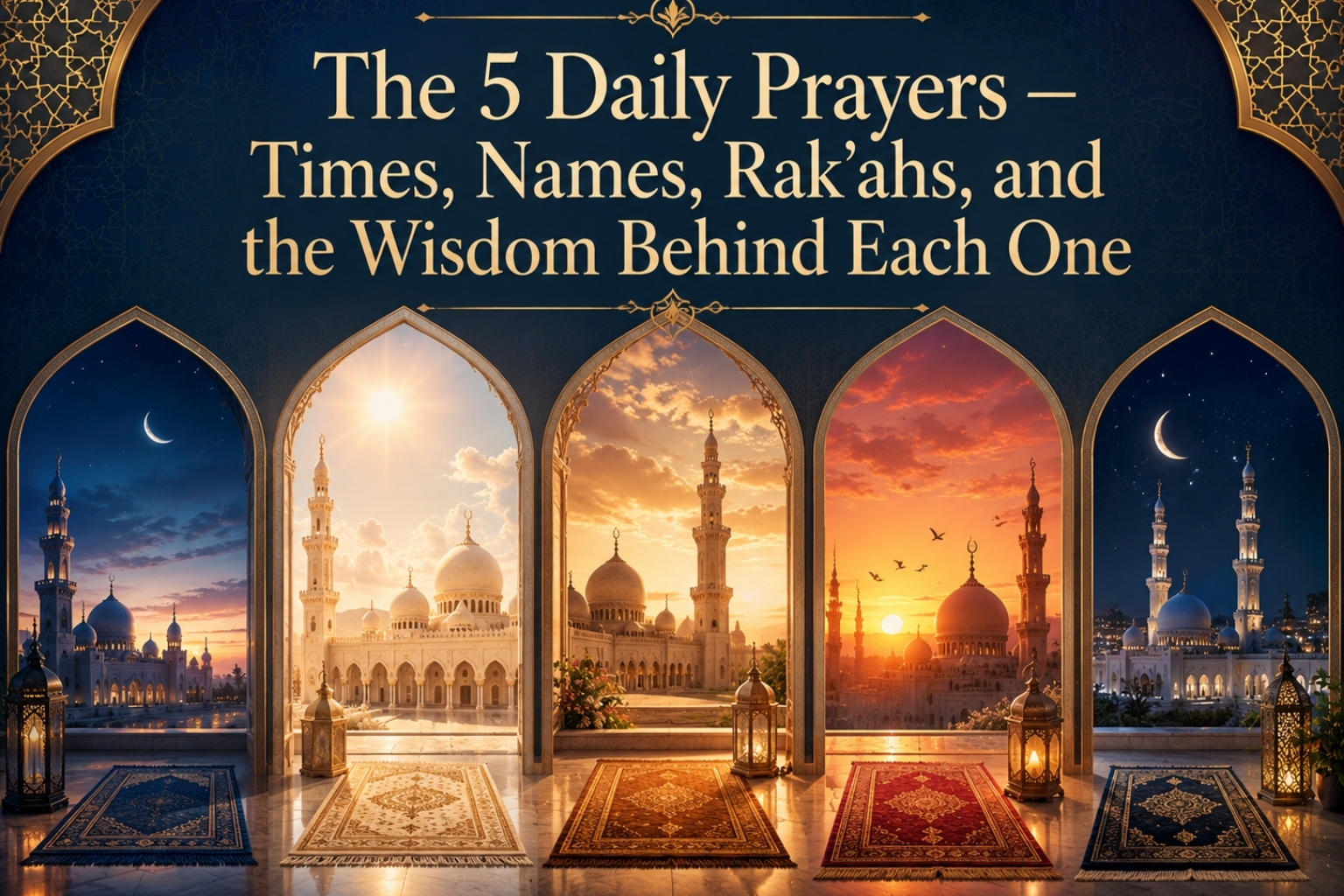


The five daily prayers: positions, what to say, and how to build this practice from the very beginning
The Most Important Thing You Will Do Every Day
Of all the practices in Islam, none is more central to a Muslim’s daily life than Salah — the formal prayer performed five times each day. It is the second Pillar of Islam, and it is the one act of worship that was not simply revealed through the Angel Jibreel but was given directly to the Prophet Muhammad ﷺ during his miraculous night journey to the heavens — the Isra wal Mi’raj.
The original obligation was fifty prayers a day. At the intercession of the Prophet ﷺ, God reduced it to five — while preserving the reward of fifty. This is not a small detail. It tells you something about what prayer is: not a burden imposed from above, but a gift offered from a God who wanted His servants close, and then made it easy for them to be so.
This guide is written for the new Muslim who has never prayed before. It will walk you through everything — the preparation, the positions, what to say, and how to build this into your life one prayer at a time.
Before You Pray: Three Conditions
Before standing for prayer, three conditions must be met:
1. Purity of the Body — Wudu
You must be in a state of ritual purity, achieved through wudu. If your wudu has been broken since the last time you performed it, renew it before praying. (See the companion article: How to Perform Wudu — Step by Step)
2. Purity of the Place
The place where you pray must be clean. A prayer mat is the most practical solution — it provides a clean, designated surface wherever you are. If you do not have a prayer mat, any clean surface works: a clean towel, a clean area of carpet or floor.
3. Facing the Qibla
All prayers are performed facing the Qibla — the direction of the Kaaba in Mecca. From most parts of Europe and North America, the Qibla is roughly southeast. From South and East Asia, it is roughly west or northwest.
The easiest way to find the Qibla is through a smartphone app such as Muslim Pro, Qibla Finder, or the built-in compass feature of many Islamic prayer apps. Once you know the direction, a small mark or object placed in front of you helps maintain consistent orientation.
The Prayer Times
The five daily prayers each have a prescribed time window. Prayer performed outside its window without a valid reason requires making it up (qada):
Prayer | Window |
Fajr | From the first light of dawn until just before sunrise |
Dhuhr | From just after midday until mid-afternoon |
Asr | From mid-afternoon until just before sunset |
Maghrib | From just after sunset until the red glow leaves the sky |
Isha | From the disappearance of twilight until midnight (or dawn) |
Prayer apps calculate these times automatically based on your location. The Adhan — the call to prayer — announces the beginning of each prayer time.
The Structure of Prayer: Key Terms
Before learning the steps, familiarize yourself with these terms:
- Rakah (plural: Raka’at) — one complete unit of prayer, consisting of standing, bowing, two prostrations, and sitting
- Takbir — saying Allahu Akbar (“God is the Greatest”), used to begin prayer and to move between positions
- Qiyam — the standing position
- Ruku — the bowing position
- Sujood — prostration (forehead on the ground)
- Tashahhud — the sitting position in which a testimony of faith is recited
- Tasleem — the greeting of peace that concludes the prayer
How Many Raka’at Per Prayer?
Each of the five prayers consists of a set number of raka’at:
Prayer | Raka’at |
Fajr | 2 |
Dhuhr | 4 |
Asr | 4 |
Maghrib | 3 |
Isha | 4 |
What to Wear
For men
The body must be covered from the navel to the knee at minimum. It is recommended to be more fully covered — a shirt and trousers or a thobe is ideal. The head does not need to be covered, though wearing a kufi (cap) is a recommended sunnah.
For women
The entire body must be covered except the face and hands. A loose abaya or modest loose clothing with a headscarf covering the hair and neck is appropriate. The feet should also be covered.
Clothing must be clean and free of images of animated beings according to the majority scholarly position.
The Complete Prayer — Step by Step
We will walk through a two-rakah prayer (such as Fajr) in full detail. Once you understand two raka’at, you simply add more for the longer prayers.
Before You Begin: The Intention (Niyyah)
Stand facing the Qibla. In your heart, form the intention: I intend to pray [name of prayer] for the sake of God.
The intention does not need to be spoken aloud. It lives in the heart. What matters is that you are conscious of what you are doing and why.
Opening Takbir — Takbirat al-Ihram
Raise both hands to the level of your shoulders or earlobes, palms facing forward, and say:
اللَّهُ أَكْبَرُ Allahu Akbar “God is the Greatest.“
With these words, the prayer begins. The world outside is set aside. You have entered the presence of God.
Lower your hands and place them on your chest — right hand over left hand.
Opening Supplication (Optional Sunnah)
After the opening Takbir, it is recommended to recite quietly:
Subhanakal-lahumma wa bihamdika wa tabarakasmuka wa ta’ala jadduka wa la ilaha ghairuk. “Glory be to You, O God, and praise. Blessed is Your name and exalted is Your majesty. There is no god but You.”
Seek Refuge and Begin
Say quietly:
A’udhu billahi minash-shaytanir-rajeem “I seek refuge in God from the accursed Satan.”
Then:
Bismillahi ar-rahmani ar-raheem “In the name of God, the Most Gracious, the Most Merciful.”
Recite Surah Al-Fatiha
Al-Fatiha is recited in every single rakah of every prayer. It is the most essential passage in the Quran to memorize.
بِسْمِ اللَّهِ الرَّحْمَٰنِ الرَّحِيمِ Bismillahi ar-rahmani ar-raheem In the name of God, the Most Gracious, the Most Merciful.
الْحَمْدُ لِلَّهِ رَبِّ الْعَالَمِينَ Alhamdu lillahi rabbil ‘alamin All praise is for God, Lord of all the worlds.
الرَّحْمَٰنِ الرَّحِيمِ Ar-rahmani ar-raheem The Most Gracious, the Most Merciful.
مَالِكِ يَوْمِ الدِّينِ Maliki yawmid-deen Master of the Day of Judgement.
إِيَّاكَ نَعْبُدُ وَإِيَّاكَ نَسْتَعِينُ Iyyaka na’budu wa iyyaka nasta’een You alone we worship, and You alone we ask for help.
اهْدِنَا الصِّرَاطَ الْمُسْتَقِيمَ Ihdinas-siratal mustaqeem Guide us to the straight path —
صِرَاطَ الَّذِينَ أَنْعَمْتَ عَلَيْهِمْ غَيْرِ الْمَغْضُوبِ عَلَيْهِمْ وَلَا الضَّالِّينَ Siratal-ladhina an’amta ‘alayhim ghayril-maghdubi ‘alayhim wa lad-dalleen The path of those You have blessed — not of those who have earned anger, nor of those who are astray.
After Al-Fatiha, say quietly: Ameen.
Recite an Additional Surah or Verses
After Al-Fatiha in the first two raka’at, recite any passage from the Quran. For a new Muslim, Surah Al-Ikhlas is an excellent choice:
Qul huwa Allahu ahad. Allahu as-samad. Lam yalid wa lam yulad. Wa lam yakun lahu kufuwan ahad.
With practice, you will add more passages as you memorize them. In the third and fourth raka’at of longer prayers, only Al-Fatiha is recited — no additional surah.
Bowing — Ruku
Raise both hands to shoulder level and say Allahu Akbar, then bow forward, placing your hands firmly on your knees, back flat, head in line with the spine — not raised or lowered.
In this position, say at least three times:
سُبْحَانَ رَبِّيَ الْعَظِيمِ Subhana rabbiyal ‘adheem “Glory be to my Lord, the Magnificent.”
Rising from Ruku
Rise from bowing, returning to a full standing position. As you rise, say:
Sami’Allahu liman hamidah “God hears whoever praises Him.”
Once standing fully upright, say:
Rabbana wa lakal hamd “Our Lord, all praise is Yours.”
First Prostration — Sujood
Say Allahu Akbar as you descend. Go down to the ground in this order: knees, then hands, then forehead and nose.
In sujood, seven body parts must touch the ground:
- The forehead and nose
- Both palms
- Both knees
- The toes of both feet
Place the forehead on the ground. Do not rest your arms on the floor — keep them raised, elbows off the ground, fingers pointing toward the Qibla.
In this position, say at least three times:
سُبْحَانَ رَبِّيَ الْأَعْلَىٰ Subhana rabbiyal a’la “Glory be to my Lord, the Most High.”
Sujood is the closest a servant comes to God. The Prophet ﷺ said: “The closest a person is to their Lord is when they are in prostration — so make much supplication in it.” After the formal words, you may add any personal supplication in any language.
Sitting Between the Two Prostrations
Rise from the first prostration saying Allahu Akbar, and sit briefly on your left foot with the right foot upright. Say:
Rabbighfirli, rabbighfirli “My Lord, forgive me. My Lord, forgive me.”
Second Prostration
Perform the second prostration exactly as the first — Allahu Akbar as you descend, Subhana rabbiyal a’la three times, then rise saying Allahu Akbar.
One Rakah is now complete.
Begin the Second Rakah
Rise to a standing position. The second Rakah follows the same sequence:
- Recite Al-Fatihah
- Recite an additional surah (in the first two raka’at)
- Ruku
- Rise from ruku
- First sujood
- Sitting between prostrations
- Second sujood
The Final Sitting — Tashahhud
After completing the last rakah, instead of rising again, remain seated. Sit on your left foot with the right foot upright, right index finger raised.
Recite the Tashahhud:
التَّحِيَّاتُ لِلَّهِ وَالصَّلَوَاتُ وَالطَّيِّبَاتُ، السَّلَامُ عَلَيْكَ أَيُّهَا النَّبِيُّ وَرَحْمَةُ اللَّهِ وَبَرَكَاتُهُ، السَّلَامُ عَلَيْنَا وَعَلَى عِبَادِ اللَّهِ الصَّالِحِينَ، أَشْهَدُ أَنْ لَا إِلَٰهَ إِلَّا اللَّهُ وَأَشْهَدُ أَنَّ مُحَمَّدًا عَبْدُهُ وَرَسُولُهُ
At-tahiyyatu lillahi was-salawatu wat-tayyibat. As-salamu ‘alayka ayyuhan-nabiyyu wa rahmatullahi wa barakatuh. As-salamu ‘alayna wa ‘ala ‘ibadillahis-salihin. Ashhadu an la ilaha illallah wa ashhadu anna Muhammadan ‘abduhu wa rasuluh.
“All greetings, prayers, and good words are for God. Peace be upon you, O Prophet, and the mercy of God and His blessings. Peace be upon us and upon the righteous servants of God. I bear witness that there is no god but God, and I bear witness that Muhammad is His servant and messenger.”
Sending Blessings on the Prophet ﷺ — Salawat
After the Tashahhud, recite:
اللَّهُمَّ صَلِّ عَلَى مُحَمَّدٍ وَعَلَى آلِ مُحَمَّدٍ، كَمَا صَلَّيْتَ عَلَى إِبْرَاهِيمَ وَعَلَى آلِ إِبْرَاهِيمَ، إِنَّكَ حَمِيدٌ مَجِيدٌ
Allahumma salli ‘ala Muhammadin wa ‘ala ali Muhammad, kama sallayta ‘ala Ibrahima wa ‘ala ali Ibrahim, innaka Hamidun Majeed.
“O God, send blessings upon Muhammad and upon the family of Muhammad, as You sent blessings upon Ibrahim and the family of Ibrahim. Verily, You are Praiseworthy and Glorious.”
Concluding the Prayer — Tasleem
Turn your head to the right and say:
السَّلَامُ عَلَيْكُمْ وَرَحْمَةُ اللَّهِ As-salamu ‘alaykum wa rahmatullah “Peace be upon you and the mercy of God.”
Then turn your head to the left and repeat the same words.
The prayer is complete.
For Prayers of Three or Four Raka’at
For Maghrib (3 rakaat) and Dhuhr, Asr, and Isha (4 raka’at), the structure is as follows:
- After the second rakah, perform the Tashahhud (the shorter version only — up to wa ashhadu anna Muhammadan ‘abduhu wa rasuluh), then rise for the third rakah
- In the third and fourth rakaat, recite only Al-Fatiha — no additional surah
- After the final Rakah, perform the full Tashahhud including the Salawat, then conclude with Tasleem
After the Prayer — Post-Prayer Remembrance
After the Tasleem, it is strongly recommended to spend a few moments in remembrance of God:
Say Astaghfirullah (I seek forgiveness from God) three times.
Then recite:
- Subhanallah (“Glory be to God”) — 33 times
- Alhamdulillah (“All praise is for God”) — 33 times
- Allahu Akbar (“God is the Greatest”) — 33 times
Then once:
La ilaha Illal Lahu wahdahu la sharika lah, lahul mulku wa lahul hamdu wa huwa ‘ala kulli shay’in qadeer. “There is no god but God, alone, with no partner. His is the dominion and His is the praise, and He is over all things capable.”
The Prophet ﷺ said that whoever recites these after every prayer will have their sins forgiven even if they are as many as the foam of the sea.
A Realistic Word for New Muslims
Your first prayers will be imperfect. You will forget words. You will lose track of which Rakah you are on. You may stumble over the Arabic pronunciation. The positions may feel unfamiliar.
This is completely normal, and it does not invalidate your prayer.
The Prophet ﷺ said: “Pray as you have seen me pray.” He did not say: pray perfectly, pray without error, pray only when you know everything. He said: do what you can see being done, and keep going.
A few practical suggestions for your first weeks:
- Start with Fajr and Maghrib. These two-rakah and three-rakah prayers are shorter and an easier entry point.
- Use a prayer guide app. Apps like Pillars or Learn to Pray walk you through every step with audio and visual guidance.
- Pray with someone. If you have access to a Muslim who can pray with you or demonstrate, take that opportunity. Watching someone pray is worth a hundred descriptions.
- Do not delay until you know everything. Begin now, with what you have. The prayer that is prayed imperfectly is infinitely more valuable than the perfect prayer that waits for a readiness that never quite arrives.
The Heart of Prayer
All of this — the positions, the Arabic, the timing, the sequence — is the body of the prayer. But the soul of it is something simpler and harder: presence.
The Arabic word for the inner quality of prayer is Khushu — a word that carries humility, stillness, and the awareness of standing before something infinitely greater than yourself.
Khushu is not something you manufacture. It comes with time, with practice, with returning to prayer again and again even on the days it feels mechanical. Each prayer is a conversation. And like any relationship, depth comes not from a single extraordinary exchange but from the accumulated weight of showing up — day after day, five times a day, for a lifetime.
“Recite what has been revealed to you of the Book and establish prayer. Indeed, prayer prohibits immorality and wrongdoing, and the remembrance of God is greater. And God knows what you do.” — Surah Al-Ankabut (29:45)
Stand up. Face the Qibla. Say Allahu Akbar.
Everything else will come.