

There is a surah in the Quran that was revealed because Allah missed His prophet.
That is not a theological statement most people expect to encounter. Allah does not need anything. He is Al-Ghani — the Self-Sufficient, the One entirely free of all need. And yet — the occasion of Surah Ad-Duha’s revelation, documented across multiple classical sources, describes a period in which revelation had stopped. For days — some narrations say two weeks, some say longer — Jibreel ﷺ did not come. The Quran was silent.
And the Prophet Muhammad ﷺ was desolate.
The people of Makkah, who had watched the revelations come with astonishing regularity, seized on the silence. They said: Muhammad has been abandoned by his Lord. His Lord has forsaken him. The connection has been cut. The mockery was aimed precisely at the most painful place — the relationship between the prophet and the One who had sent him.
And then Jibreel ﷺ came. With eleven verses. Verses that did not announce a new law, describe a new story, or address the persecution of the believers. Verses that spoke — with the intimacy of a parent addressing a child, of a friend speaking to the one they love — directly to the interior of a man who was hurting.
Surah Ad-Duha is the Quran’s most personal surah. It is addressed entirely to the Prophet Muhammad ﷺ — to his specific situation, his specific pain, his specific history, his specific future. And yet, because the Quran is a book for every human being across all time, every believer who has ever felt abandoned by Allah, every person who has ever sat in a silence that felt like divine withdrawal, every soul that has wondered whether Allah is still there — has found, in these eleven verses, a direct address to their own situation.
Allah was not absent from His Prophet ﷺ during the silence. He was not absent from you during yours.
This is the complete tafsir. Every verse. Every word. Every layer of meaning in the surah that Allah revealed to tell His prophet — and through him, every believer — that the pause was never abandonment.
The Full Surah: Arabic and English
وَالضُّحَىٰ ﴿١﴾ وَاللَّيْلِ إِذَا سَجَىٰ ﴿٢﴾ مَا وَدَّعَكَ رَبُّكَ وَمَا قَلَىٰ ﴿٣﴾ وَلَلْآخِرَةُ خَيْرٌ لَّكَ مِنَ الْأُولَىٰ ﴿٤﴾ وَلَسَوْفَ يُعْطِيكَ رَبُّكَ فَتَرْضَىٰ ﴿٥﴾ أَلَمْ يَجِدْكَ يَتِيمًا فَآوَىٰ ﴿٦﴾ وَوَجَدَكَ ضَالًّا فَهَدَىٰ ﴿٧﴾ وَوَجَدَكَ عَائِلًا فَأَغْنَىٰ ﴿٨﴾ فَأَمَّا الْيَتِيمَ فَلَا تَقْهَرْ ﴿٩﴾ وَأَمَّا السَّائِلَ فَلَا تَنْهَرْ ﴿١٠﴾ وَأَمَّا بِنِعْمَةِ رَبِّكَ فَحَدِّثْ ﴿١١﴾
“By the morning brightness — and the night when it covers with darkness — your Lord has not forsaken you, nor has He detested you. And the Hereafter is better for you than the first life. And your Lord is going to give you, and you will be satisfied. Did He not find you an orphan and give shelter? And He found you lost and guided you. And He found you poor and made you self-sufficient. So as for the orphan, do not oppress. And as for the petitioner, do not repel. And as for the favor of your Lord — speak of it.”
Surah Ad-Duha (93:1–11)
The Context: The Silence That Broke a Heart
The scholars of Asbab al-nuzul record that Surah Ad-Duha was revealed after a period known as fatrat al-wahy — the interruption of revelation. Revelation had come consistently since the first verses of Surah Al-‘Alaq were revealed in the cave of Hira. And then — it stopped.
The narrations vary in the duration: some say fifteen days, some say twelve, some say up to forty days. What is consistent across the sources is the effect on the Prophet Muhammad ﷺ: profound distress. He had come to depend on the revelation — not merely as information, but as the presence of Allah in his life. The silence felt like withdrawal. Like abandonment.
Imam Al-Bukhari records that the wife of Abu Lahab — one of the most hostile enemies of the Prophet ﷺ — came to him and said mockingly: “I think your devil has left you. I have not seen him come to you for two or three nights.” The word “devil” was her contemptuous reference to Jibreel ﷺ.
The narration captures precisely the social and spiritual environment the silence created: the enemies of Islam interpreted it as proof that Allah had withdrawn, that the message was exposed as a fraud, that the prophet had been abandoned. And the Prophet ﷺ — who knew none of this was true, but who felt the absence of revelation like the absence of breath — had no response except to wait.
And then Jibreel ﷺ came with Surah Ad-Duha.
The scholars note: the first word Allah chose to say, after the silence, was not a command. Not a revelation of law. Not a description of what the believers must do or what the unbelievers will face. The first thing Allah said, when the silence broke, was a denial: ma wadda’aka Rabbuka wa ma qala — your Lord has not forsaken you, nor has He detested you.
Allah began by addressing the fear directly. Not gradually. Not by working up to it. The first content of the revelation, after the oath — straight to the wound: I did not leave you.
The Oath: By the Morning Light and the Settled Night
وَالضُّحَىٰ ﴿١﴾ وَاللَّيْلِ إِذَا سَجَىٰ ﴿٢﴾
“By the morning brightness — and the night when it covers with darkness.”
Surah Ad-Duha (93:1–2)
Allah begins with an oath — sworn by two phenomena of the natural world that are opposites of each other. Al-duha — the morning brightness, the first light of day expanding into full daylight. Al-layl idha saja — the night when it settles, when it becomes still and dark and complete in its covering.
The scholars identify the wisdom in these two specific images as the foundation of the surah’s entire message.
Al-duha — the morning brightness — is the symbol of revelation, of Allah‘s presence, of the light that had been coming and had now paused. It is the state the Prophet ﷺ had known: light, guidance, the constant arrival of Quranic revelation illuminating every question.
Al-layl idha saja — the night when it settles — is the symbol of the silence. The period of the fatrat al-wahy. The darkness that had covered everything when the revelation stopped.
Allah swears by both. By the light of revelation and by the darkness of its pause. By the state the Prophet ﷺ loved and by the state that was causing him pain. The oath itself is the first answer: both states are under Allah‘s sovereignty. Both are created by Allah. Both are within Allah‘s design. The morning comes because Allah brings it. The night settles because Allah allows it. Neither is outside His control.
The scholars note an additional dimension: al-duha in Arabic refers specifically to the mid-morning brightness — not the first light of dawn, but the light that has grown and brightened after sunrise. It is the light that has returned after the darkness of night. Every morning begins with night giving way to brightness. Allah swears by the returning light — signaling: this is what is coming. The darkness of the silence is the night before the morning that is already on its way.
Verse Three: The Denial That Heals
مَا وَدَّعَكَ رَبُّكَ وَمَا قَلَىٰ
“Your Lord has not forsaken you, nor has He detested you.”
Surah Ad-Duha (93:3)
This is the theological center of the entire surah — and one of the most intimate verses in the Quran.
Ma wadda’aka Rabbuka — your Lord has not forsaken you. Wadda’a — to bid farewell, to leave permanently, to cut off. The word carries the sense of a final departure — not a temporary absence but a permanent abandonment. Allah is denying the worst interpretation of the silence: this was not a farewell. Your Lord did not leave you. He did not bid you goodbye.
Wa ma qala — nor has He detested you. Qala — to dislike, to hate, to feel aversion toward. The word is even stronger than wadda’a. Not only did Allah not leave — He does not hate you. He does not feel aversion toward you. The silence was not evidence of divine contempt for the Prophet ﷺ. It was not Allah withdrawing His love or His approval.
The scholars reflect on the two denials together: they address the two fears the silence had produced. The first fear: Allah has left me (abandoned, departed). The second fear: Allah has left me because He is displeased with me (contempt, aversion). Both fears denied. Emphatically. With ma — the negation that removes every possibility of the thing being negated.
Rabbuka — your Lord. Not “the Lord.” Your Lord. The possessive that makes the denial personal: your specific Lord, the One who is in a relationship with you specifically, has not left you. Has not come to hate you.
The scholars also note what Allah does not say: He does not explain the silence. He does not give the Prophet ﷺ a reason for why the revelation paused. He simply denies the darkest interpretation and moves forward. This is itself a lesson in how Allah addresses human pain: not always with explanation, but always with the assurance of relationship. I did not leave you. That is enough. The reason why can wait.
Verse Four: The Hereafter is Better
وَلَلْآخِرَةُ خَيْرٌ لَّكَ مِنَ الْأُولَىٰ
“And the Hereafter is better for you than the first life.”
Surah Ad-Duha (93:4)
Wa lal-akhiratu khayrun laka min al-ula — and the Hereafter is better for you than the first life.
After denying abandonment and detesting, Allah shifts the frame of the conversation. The silence was painful in this world. The mockery of the enemies was painful in this world. The isolation and difficulty of the prophetic mission in Makkah was painful in this world. And Allah responds to all of it with a reorientation of perspective: what is coming is better than what is now. What is ahead is superior to what is present.
Khayrun Laka — better for you. Not better in general, not better in abstract theological terms — better specifically for you, the Prophet Muhammad ﷺ. The next life, with its proximity to Allah, its resolution of every difficulty, its reward that no earthly condition can match — that is what awaits.
The scholars note that this verse was revealed not only for the Prophet ﷺ but as a principle for every believer who finds themselves in the difficulty of this world. Every hardship the believer endures, every silence they sit in, every trial that seems to have no visible purpose — the frame for receiving it is this: al-akhiratu khayrun laka. What comes is better. The present difficulty is the night before a morning that is permanently bright.
This verse also functions as an implicit answer to the enemies’ mockery: they were taunting the Prophet ﷺ about his worldly standing — the hardship, the rejection, the pause in revelation. Allah answers not by addressing the worldly standing but by declaring that the measure by which the Prophet ﷺ is being judged is the wrong measure. The Hereafter is the correct measure. And by that measure, he has already won everything worth having.
Verse Five: The Promise of Satisfaction
وَلَسَوْفَ يُعْطِيكَ رَبُّكَ فَتَرْضَىٰ
“And your Lord is going to give you, and you will be satisfied.”
Surah Ad-Duha (93:5)
Wa la-sawfa yu’tika Rabbuka fa-tarda — and your Lord will give you until you are satisfied.
The grammatical emphasis here is layered: lam of oath + sawfa (will/going to) — both together creating a statement of absolute future certainty. Not “perhaps your Lord will give you.” Not “we hope your Lord will give you.” Your Lord will give you — the lam of oath removing every possibility of exception.
Yu’tika — will give you. What will He give? The verse does not specify. The scholars have always seen the unspecified quality of the giving as itself a form of generosity in the language: Allah is not naming a specific gift or a specific amount. He is promising the totality — giving until satisfaction is reached. Not giving a portion and stopping. Giving until tarda — until you are pleased, satisfied, content. The measure of the giving is not a quantity Allah sets — it is the state of the receiver. The giving continues until the one receiving it is fully satisfied.
The scholars discuss what this promise encompasses: it includes the worldly gifts Allah gave the Prophet ﷺ — the spread of Islam, the Hijra, the establishment of the Muslim community, the conquest of Makkah. It includes the extraordinary gifts of the next world — the Maqam Mahmud, the praised station on the Day of Judgment from which the Prophet ﷺ will intercede for the entire ummah, the spring of Kawthar, the intercession that will be given to him and to no one else at the same level.
And it includes the gift that the Prophet ﷺ cared about above all worldly rewards: the guidance of his people. The spread of the message he carried. The entry of humanity into the mercy of Allah through the door he opened. Of all the things Allah gave him — the scholars have always said — this was what satisfied him most. Not the conquests. Not the worldly honor. The guidance of the human beings he loved.
Ibn Al-Qayyim writes: and the greatest of what Allah will give him on the Day of Judgment, when the intercession is opened, is that the people he loved — his ummah — will enter Allah‘s mercy in waves. That is when fa-tarda — you will be satisfied — reaches its fullest meaning.
Verses Six, Seven, Eight: The Three Gifts Already Given
أَلَمْ يَجِدْكَ يَتِيمًا فَآوَىٰ ﴿٦﴾ وَوَجَدَكَ ضَالًّا فَهَدَىٰ ﴿٧﴾ وَوَجَدَكَ عَائِلًا فَأَغْنَىٰ ﴿٨﴾
“Did He not find you an orphan and give shelter? And He found you lost and guided you. And He found you poor and made you self-sufficient.”
Surah Ad-Duha (93:6–8)
After the promise of what is coming — Allah turns to the past. And this movement from future promise to past evidence is the surah’s most psychologically precise moment.
Allah is doing something specific: He is asking the Prophet ﷺ to look at the evidence of Allah‘s involvement in his life that already exists. Before the future is trusted — look at the past. Look at what I have already done. Use that track record as your evidence for the promise I am making about what is coming.
Three states. Three divine responses. Three completed acts of Allah‘s care — each described with the same structural formula: Wajadaka (He found you) + state + fa (and then) + divine action.
The Orphan
Alam yajidka yatiman fa-awa — did He not find you an orphan and give you shelter?
The Prophet Muhammad ﷺ was born to a father who had died before his birth. He lost his mother Aminah when he was six years old. He was raised first by his grandfather Abd Al-Muttalib, who died when he was eight, and then by his uncle Abu Talib. He knew the specific, irreplaceable loss of early childhood without parents — the Yutm, the orphan-state, the condition of being without the most fundamental form of human shelter.
Fa-awa — and He gave you shelter. The word awa means to take someone in, to shelter them, to make them feel they have a home and a place and a belonging. Allah gave the orphan child shelter — not just through the grandfather and the uncle, but through His own divine care, through the attention He was directing toward this child from birth in preparation for the mission that was coming.
The rhetorical question alam — did He not? — is the form that expects the answer: of course He did. You know He did. The question is a memory prompt. Remember that He found you in that state. Remember what He did.
The Lost
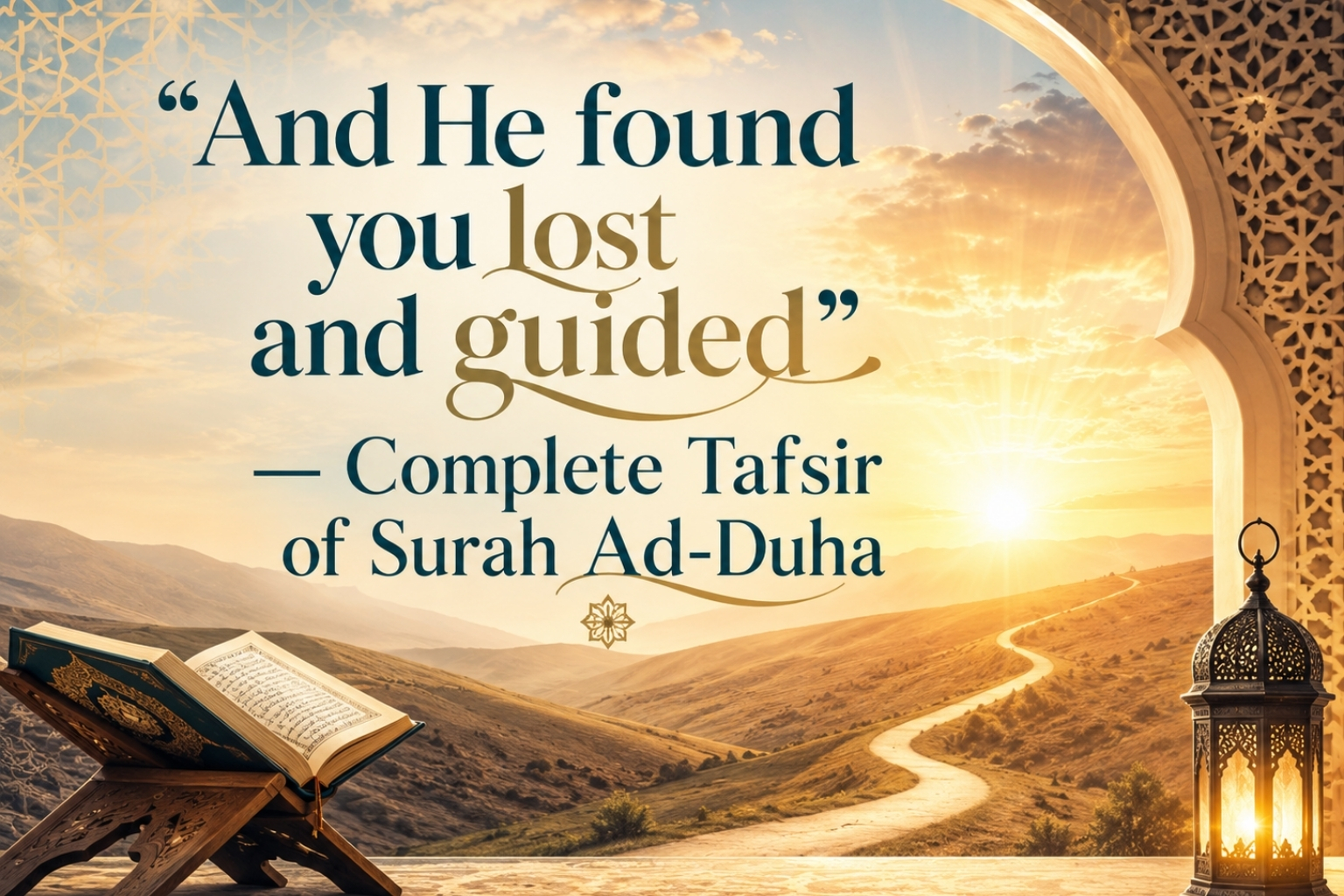
Wa Wajadaka dallan Fa-hada — and He found you lost and guided you.
Dallan — the Arabic word for lost, wandering, without clear direction. This is the verse that gives this article its title — and it is the verse that has produced the most scholarly reflection and theological discussion in the surah.
What does it mean that Allah found the Prophet Muhammad ﷺ — the most guided of all creation, the one who would bring guidance to all of humanity — dallan? Lost?
The scholars offer several interpretations:
The first and most widely held interpretation: dall here does not mean morally lost or spiritually deviant. It means unaware of the path — not yet in possession of the revelation that was coming. The Prophet ﷺ before the first revelation was a man of pure character — he never worshipped idols, never engaged in the immorality of his society, was known as Al-Amin (the Trustworthy) — but he did not yet have the Quran, did not yet know the details of the divine law, did not yet have the guidance that would define his mission. He was dall in the sense of searching — a sincere seeker who had not yet received what he was seeking.
The second interpretation (supported by Imam Al-Tabari): dall here means he was unknown to his people as a prophet — lost to the world in the sense that the world did not yet know what he carried. Allah found him in that state of obscurity and guided — made known — both him and his message.
The third interpretation (minority position): dall refers to the specific incident described in Surah Al-Kahf (18:17) — the young Muhammad ﷺ getting lost on a journey and being found by divine guidance. A literal lost-ness resolved by Allah‘s specific care.
The scholars who hold the first interpretation — the most widely accepted — note that the Quran itself supports it:
وَكَذَٰلِكَ أَوْحَيْنَا إِلَيْكَ رُوحًا مِّنْ أَمْرِنَا ۚ مَا كُنتَ تَدْرِي مَا الْكِتَابُ وَلَا الْإِيمَانُ
“And thus We have revealed to you a spirit of Our command. You did not know what the Book was, nor what faith was.”
Surah Ash-Shura (42:52)
Before revelation — he did not know what the Book was. He was dall in the sense of seeking what he did not yet have. And then fa-hada — Allah guided him. Gave him the revelation. Give him the Quran. Transformed the seeker into the guide.
For every believer who reads this verse — the scholars have always noted its personal application: every human being before Allah‘s guidance reaches them is Dall. The guidance that arrived — through the Quran, through Islam, through the hidayah Allah directed toward you specifically — is Allah finding you in your state of searching and guiding you to what you were looking for without knowing its name.
The Poor
Wa Wajadaka ‘a’ilan fa-aghna — and He found you poor and made you self-sufficient.
‘A’ilan — needy, poor, without sufficient means. Before Khadijah RA — before the marriage that transformed his material circumstances — the Prophet ﷺ was not a man of means. He worked as a trader on behalf of others. He did not own property or accumulate wealth.
Fa-aghna — and He made you self-sufficient. Through Khadijah RA‘s wealth, through the material support the early Muslim community provided, through Allah‘s direct provision — the one who had been poor was given sufficiency.
The scholars note that Aghna does not mean wealthy in the worldly sense. It means ghina — sufficiency, contentment, freedom from need. Allah did not promise the Prophet ﷺ the accumulation of wealth — He promised, and delivered, the state of not needing. There is a difference between having much and needing little. Allah gave the Prophet ﷺ the latter — the inner freedom that comes from not being at the mercy of material lack.
The Structure: Three States, Three Responses, One Pattern
The scholars have always noted the profound structural symmetry of verses 6–8 — and what that symmetry teaches about Allah‘s relationship with the human being in difficulty.
The formula: Allah found you in a state of vulnerability + Allah acted. Found you orphaned — gave shelter. Found you without guidance — guided. Found you without means — provided sufficiency.
The three verses together establish the pattern of Allah‘s involvement in the Prophet ﷺ‘s life: He was always there. In every state of need — before the need was articulated, before a prayer was made for relief, before the person even fully knew what they were lacking — Allah found them and acted.
The scholars read this pattern as Allah‘s answer to the fear the silence had produced. The silence seemed like Allah had stopped showing up. These three verses say: look at your history. Has Allah ever not shown up? He found you orphaned — He showed up. He found you without guidance — He showed up. He found you without means — He showed up. Why would the One who has shown up every time you needed Him suddenly stop?
The rhetorical question that opens verse 6 — alam Yajidka — did He not find you? — is the question Allah is asking the believers of every generation: did I not find you? In whatever state your dall or your Yutm or your ‘a’il takes — did I not find you and act?
Of course he did. He always did.
Verses Nine, Ten, Eleven: From Receiving to Giving
فَأَمَّا الْيَتِيمَ فَلَا تَقْهَرْ ﴿٩﴾ وَأَمَّا السَّائِلَ فَلَا تَنْهَرْ ﴿١٠﴾ وَأَمَّا بِنِعْمَةِ رَبِّكَ فَحَدِّثْ ﴿١١﴾
“So as for the orphan, do not oppress. And as for the petitioner, do not repel. And as for the favor of your Lord — speak of it.”
Surah Ad-Duha (93:9–11)
The surah now turns from the theology of divine care to its practical consequence. The movement is exact: because Allah found you in these states and gave to you — now you must reflect that giving outward.
The logic is stated with the fear of consequence. Fa-amma al-yatima — so, therefore, as a result of what has been said — the orphan. The connection between theology and ethics is not accidental. It is the entire point: the person who has received Allah‘s gifts is now obligated to channel those gifts toward others.
Do Not Oppress the Orphan
Fa-amma al-yatima fa-la taqhar — so as for the orphan, do not oppress him.
Taqhara — to overpower, to dominate by force, to crush by the weight of superior position. The prohibition is not merely against cruelty — it is against using power against the powerless. The orphan is the paradigmatic vulnerable person: without parental protection, without the social leverage that family provides, at the mercy of those more powerful.
The Prophet ﷺ was himself an orphan — Allah reminded him of that in verse 6. And now, having received shelter, he is commanded: do not do to orphans what could have been done to you. Do not use your position of power against those in the position of vulnerability you once occupied.
The scholars extend the command beyond literal orphans: it is the command of protection for all those who are vulnerable, all those who have no one to defend them, all those whose weakness makes them targets for the strong.
Do Not Repel the One Who Asks
Wa amma al-sa’ila fa-la tanhar — and as for the petitioner, do not repel him.
Al-sa’il — the one who asks. It encompasses two categories: the person asking for material provision (the poor, the beggar), and the person asking for knowledge or guidance (the seeker of understanding).
La Tanhar — do not rebuff, do not push away, do not respond with the harsh dismissal that sends the petitioner away feeling worse for having asked.
The Prophet ﷺ had been found without means (‘a’ilan) — Allah provided. Now the command mirrors the gift: when someone comes to you without means, do not turn them away empty.
And he had been found without guidance (dallan) — Allah guided. When someone comes seeking understanding, do not dismiss them. The seeker who asks about Islam, who asks about the Quran, who reaches toward guidance — do not repel them. You were once where they are. Allah found you. Now be the instrument through which Allah finds them.
Speak of the Favor of Your Lord
Wa amma bi-ni’mati Rabbika fa-haddith — and as for the favor of your Lord — speak of it, narrate it, tell of it.
Ni’mah — blessing, favor, gift. Rabbika — of your Lord. Speak of the blessing your Lord has given you.
The scholars identify the theological depth in this final command: after two prohibitions (do not oppress, do not repel), the surah closes with a positive obligation — speak. Tell people about Allah‘s gifts. Speak of His favor.
This is the command of Haddith — to narrate, to speak openly, to share. Not to conceal the gifts out of false humility or to hoard the guidance out of privacy. To speak. To tell. To let the favor of Allah be known — as a form of gratitude, as a form of witness, as a form of inviting others toward the Source of the favor.
The scholars note the connection to shukr: gratitude in the Quran is not a private emotion. It is also a public declaration. Fa-haddith — tell of Allah‘s favor — is the Quranic command that links the inner gratitude of the heart to the outward expression of the tongue. The believer who has received Allah‘s guidance does not keep it quietly. They speak of it — not in self-promotion, but in testimony to the One who gave it.
The Surah as a Complete Conversation
When Surah Ad-Duha is read as a single, continuous statement — eleven verses forming one unbroken address — the message becomes luminously clear.
Allah begins by establishing His sovereignty over both states the surah addresses — the light and the darkness — and swears by both to establish that both are under His control.
Then He denies the worst fear directly: I did not leave you. I do not hate you.
Then He redirects the horizon: what is coming is better than what is present.
Then He makes a promise: I will give you until you are satisfied.
Then He provides the evidence that the promise is reliable: I already showed up when you were orphaned. I already showed up when you were without guidance. I already showed up when you were without means. The track record of My care for you predates your awareness of it.
Then He gives the practical instruction that flows from having received all of this: pass it forward. Protect the vulnerable. Receive the seeker. Speak of My favor.
The surah is a complete arc: from pain and fear, through divine denial of abandonment, through promise and evidence, to the practical ethics of a life that has been shaped by receiving Allah‘s gifts. The person who reaches the end of the surah having received it fully is not the same person who began it in silence.
What the Silence Was Really About
The scholars have reflected at length on why Allah allowed the pause in revelation — and while the Quran does not provide an explicit reason, the effect the pause produced reveals something important.
The pause forced the Prophet ﷺ to experience what it felt like to be without the revelation — to genuinely feel its absence in a way that its constant presence would never have produced. The longing that the fatrat al-wahy created in him became the frame within which the revelation’s return carried a fullness it could not have carried without the absence.
The same principle applies to every believer who has experienced a period of spiritual aridity — when prayer feels empty, when the Quran does not land, when Allah seems distant. The silence is not abandonment. It is the deepening of the thirst that makes the return of water an experience of a different quality than ordinary drinking.
The Prophet Muhammad ﷺ never took revelation for granted after the fatrat al-wahy. How could he? He had felt its absence. And every believer who has felt Allah‘s presence return after a period of spiritual distance knows what the surah is describing: the relief, the gratitude, the understanding that what had felt like abandonment was the preparation for a return that felt like homecoming.
Ma wadda’aka Rabbuka wa ma qala.
Your Lord did not leave you. He was preparing the return.
A Final Reflection: Found in Every State
There is a person reading this article right now who is in the fatrat — the pause. Not necessarily a pause in Quranic revelation. A pause in their own spiritual life. A period when Allah seems silent. When prayer goes up and nothing seems to come back. When the brightness of duha has given way to the settled darkness of night.
Surah Ad-Duha was revealed for that person.
Not for the Prophet Muhammad ﷺ only — for every person across every generation who has sat in a spiritual silence and wondered whether Allah was still there, whether the connection had been cut, whether the pause was permanent.
Allah swears by the morning brightness and the settled night — by both, because both are His — and says:
I did not leave you. I do not hate you. What is coming is better. I will give you until you are satisfied.
And then he points to the evidence: I found you. In whatever state you were in — I found you. And I acted.
He found the Prophet ﷺ orphaned and gave shelter. He found him without guidance and guided him. He found him without means and gave sufficiency.
And He finds you — in whatever your dall is, in whatever your yutm is, in whatever your ‘a’il is — and He acts. He has always acted. The track record of His care in your life is the evidence for the promise of His care in what is coming.
The morning brightness follows every settled night.
مَا وَدَّعَكَ رَبُّكَ وَمَا قَلَىٰ
“Your Lord has not forsaken you, nor has He detested you.”
Surah Ad-Duha (93:3)
He was never absent. The silence was never abandonment. He was there — finding you — in every state you have ever been in.