

Section: The Quran for Beginners · Beginner level
If you have just embraced Islam, you will quickly discover that the Quran occupies a place unlike any other book in the lives of Muslims. It is recited in every prayer, quoted in daily conversation, and treated with a reverence that can seem striking to someone encountering it for the first time. This article explains what the Quran is, where it came from, how it is structured, and why Muslims around the world hold it so dear.
What the Quran Is — and What It Is Not
The Quran is the sacred scripture of Islam. Muslims believe it is the literal word of God (Allah), revealed in Arabic to the Prophet Muhammad ﷺ over a period of approximately 23 years, beginning around 610 CE and concluding shortly before his death in 632 CE.
It is important to understand what the Quran is not. It is not a biography of the Prophet Muhammad ﷺ — that is found in the Seerah (his life story) and the Hadith (his recorded sayings and actions). It is not a history book, though it contains historical narratives. It is not a legal manual, though it establishes foundational principles of Islamic law. The Quran is, at its heart, a direct communication from God to humanity — a guide for how to live, what to believe, and how to return to Him.
How the Quran Was Revealed
The revelation began in the Cave of Hira, near Mecca, when the Angel Jibreel (Gabriel) appeared to Muhammad ﷺ and commanded him to “Read” (in Arabic: Iqra). This first revelation became the opening verses of Surah Al-Alaq (Chapter 96).
From that moment, verses continued to be revealed over two decades. Some were revealed in response to specific events. Others were revealed gradually to strengthen the hearts of the early Muslim community. Some came during peaceful moments; others during times of great difficulty and persecution.
The Prophet ﷺ would recite the revealed verses to his companions, who memorised them immediately and wrote them down on whatever was available — parchment, bones, palm leaves. This oral transmission alongside written recording meant the Quran was preserved from its very first moments.
After the Prophet’s death, his close companion Abu Bakr, the first Caliph, commissioned a formal compilation of the written verses. A standardised written copy was then distributed during the reign of the third Caliph, Uthman ibn Affan. These measures ensured a single, unified text across the growing Muslim world.
The Structure of the Quran
The Quran is divided into 114 chapters, called Surahs. Each Surah is made up of individual verses, called Ayat (singular: Ayah), which literally means “signs.” In total, the Quran contains approximately 6,236 verses.
The Surahs are not arranged chronologically — that is, not in the order they were revealed. The longer chapters appear first and the shorter ones toward the end, with some important exceptions. The very first Surah, Al-Fatiha (The Opening), is seven verses long and serves as the essential prayer recited in every unit of the daily prayers.
The Quran is also divided into 30 equal parts, called Juz (plural: Ajzaa). This division was created to help Muslims read the entire Quran over the course of a month, reading one Juz per day — a practice especially common during Ramadan.
The Language of the Quran
The Quran was revealed in classical Arabic, and Muslims around the world consider this original Arabic text to be the Quran itself. Translations into other languages — English, French, Urdu, Indonesian, and hundreds more — are understood to be interpretations of its meaning, not the Quran in the full religious sense.
This is why you will see Muslims recite their prayers in Arabic, even if Arabic is not their native language. There is a profound belief that the words of the Quran carry a divine weight and beauty that cannot be fully replicated in translation.
As a new Muslim, you do not need to learn Arabic before benefiting from the Quran. Reading a reliable English translation alongside the Arabic is an excellent way to begin. Many Muslims spend a lifetime deepening their understanding of Quranic Arabic, and this journey itself is considered an act of worship.
How the Quran Has Been Preserved
One of the most remarkable aspects of the Quran is its preservation. The text that Muslims recite today is identical to the text recited by the companions of the Prophet Muhammad ﷺ over 1,400 years ago. This is verifiable through the oldest known Quranic manuscripts — some of which date back to within decades of the Prophet’s lifetime — and through the unbroken chain of memorisation that continues to this day.
There are millions of people around the world, known as Huffaz (singular: Hafiz), who have memorised the entire Quran from cover to cover — every word, every letter. This living tradition of memorisation has acted as an additional layer of preservation across generations and continents.
This extraordinary preservation is itself referenced within the Quran: “Indeed, it is We who sent down the Reminder, and indeed, it is We who will preserve it.” (Quran 15:9)
The Themes of the Quran
While the Quran covers a vast range of topics, several core themes run through its pages:
The Oneness of God (Tawhid). The central and most repeated message of the Quran is that God is One — without partners, without equals, without physical form. Everything else flows from this.
The purpose of human life. The Quran teaches that human beings were created to worship God and to act as stewards of the earth. Life is a test, and death is not an end but a transition.
Stories of the Prophets. Adam, Noah, Abraham, Moses, Jesus (peace be upon them all) and many others appear throughout the Quran. Their stories carry moral lessons and reinforce the consistency of God’s message across time.
Accountability and the Hereafter. The Quran describes the Day of Judgement, Paradise (Jannah), and Hell (Jahannam) in vivid detail — not to create fear alone, but to instil purpose and responsibility.
Guidance for daily life. From justice and kindness to family, business dealings, and treatment of others — the Quran provides principles that cover the full range of human experience.
How Muslims Relate to the Quran
For Muslims, the Quran is not simply a text to be studied intellectually. It is a living presence. Muslims recite it in prayer five times a day. They turn to it in times of grief, confusion, and joy. They begin significant undertakings with the Bismillah — the opening phrase of the Quran: “In the name of God, the Most Gracious, the Most Merciful.”
Handling the Quran itself carries its own etiquette. It is traditionally recommended to be in a state of purity (having performed wudu) before touching the Arabic text, to place it in a high and respected position, and never to set it on the floor. These practices reflect the Muslim belief that the Quran is not an ordinary book.
Where to Begin as a New Muslim
You do not need to read the Quran from cover to cover on your first attempt. Here are a few practical suggestions:
Start with Al-Fatiha. These seven verses are the heart of every prayer. Read their meaning slowly and reflect on each line. You will recite them many times every day for the rest of your life.
Read the short chapters at the back. Surahs 112, 113, and 114 (Al-Ikhlas, Al-Falaq, and An-Nas) are short, powerful, and among the most important chapters in the Quran. Understanding them gives you an immediate foundation.
Use a reliable translation with commentary. Translations by scholars such as Abdullah Yusuf Ali, Saheeh International, or Dr. Mustafa Khattab (The Clear Quran) are widely respected and accessible in English.
Do not rush. The Prophet Muhammad ﷺ encouraged deep reflection over the Quran rather than racing through it. Even a single verse understood well is more valuable than many verses read without comprehension.
A Final Word
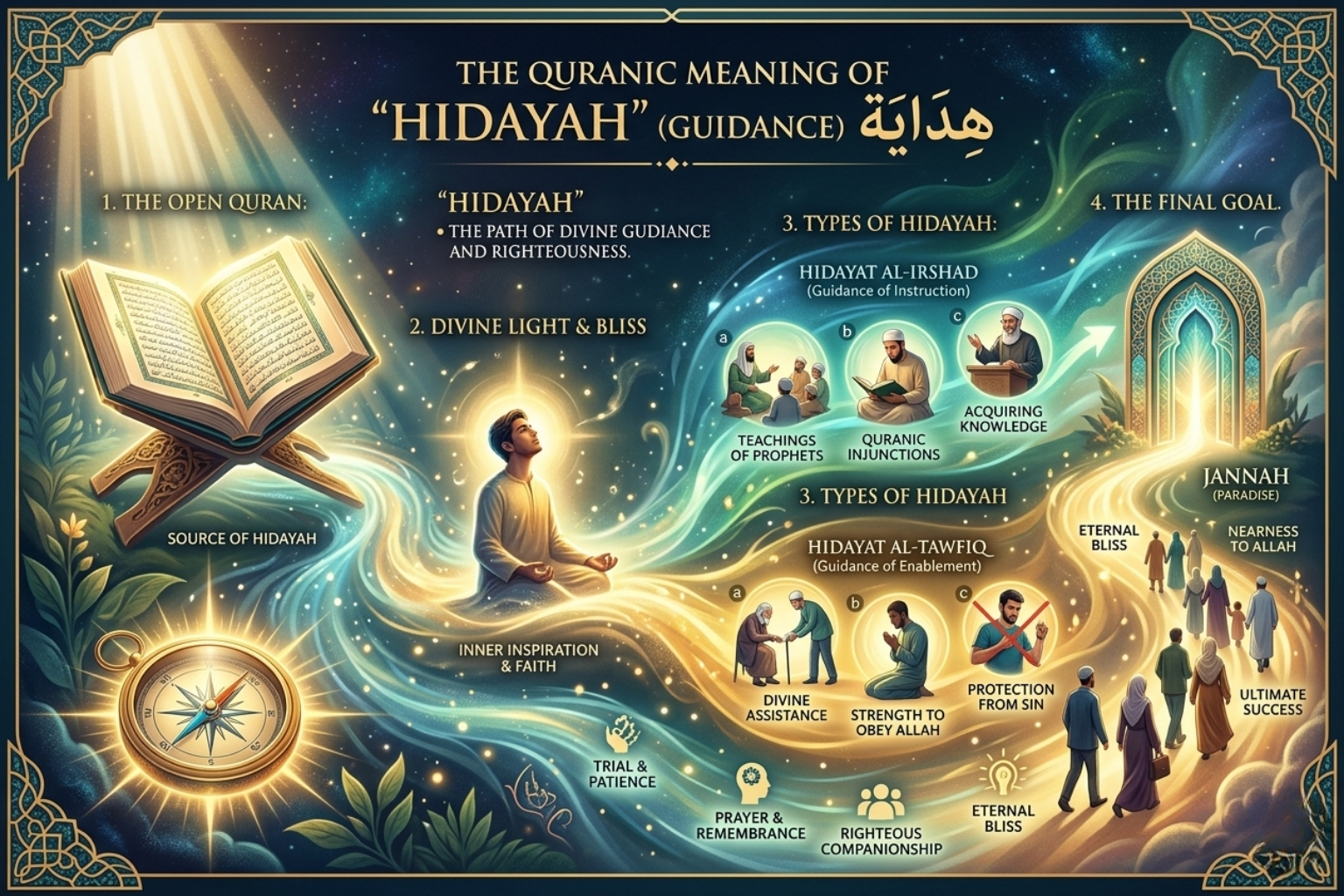
The Quran describes itself as “a guidance for the people and clear proofs of guidance and criterion” (Quran 2:185). As a new Muslim, you are at the beginning of what many describe as the most enriching relationship of their lives — a lifelong conversation with the word of God.
You do not need to understand everything at once. You do not need to know Arabic today. What you need is an open heart, a willingness to reflect, and the intention to keep returning to its pages. The Quran meets you where you are.