

We live in an era that treats time as a resource to be aggressively mined. From the moment our morning alarms go off, we enter an unyielding grid of calendar invites, project deadlines, and urgent notifications. This modern hyper-productivity model conditions the human mind to operate like an uninterrupted processor, moving from one task to the next without a moment of pause.
This mechanical approach to time carries a staggering psychological cost. When our minds are forced to run continuously without structural breaks, our brains default to a state of chronic hyper-vigilance, directly fueling severe overthinking in Islam. We sprint through months and years trying to stay ahead of our schedules, completely exhausting our emotional capital. We are told that taking a break is a luxury we can only afford after the work is completely done.
However, when we apply Tadabbur (deep Quranic reflection) to the rhythm of Islamic worship, we discover that Allah did not leave our relationship with time to be dictated by the frantic pace of the worldly marketplace. Instead, He anchored the human soul to the revolving geometry of the cosmos through the 5 daily prayers (Salah).
Salah is a divine intervention across your day, deliberately designed by Al-Khaliq (The Creator) to disrupt the momentum of worldly stress. It is a mandatory boundary line ensuring that your mind is never left to drift too far into anxiety before being pulled back into an oasis of absolute tranquility, securing permanent internal peace of mind.
The Cosmic Rhythm: The Master Architecture of Time
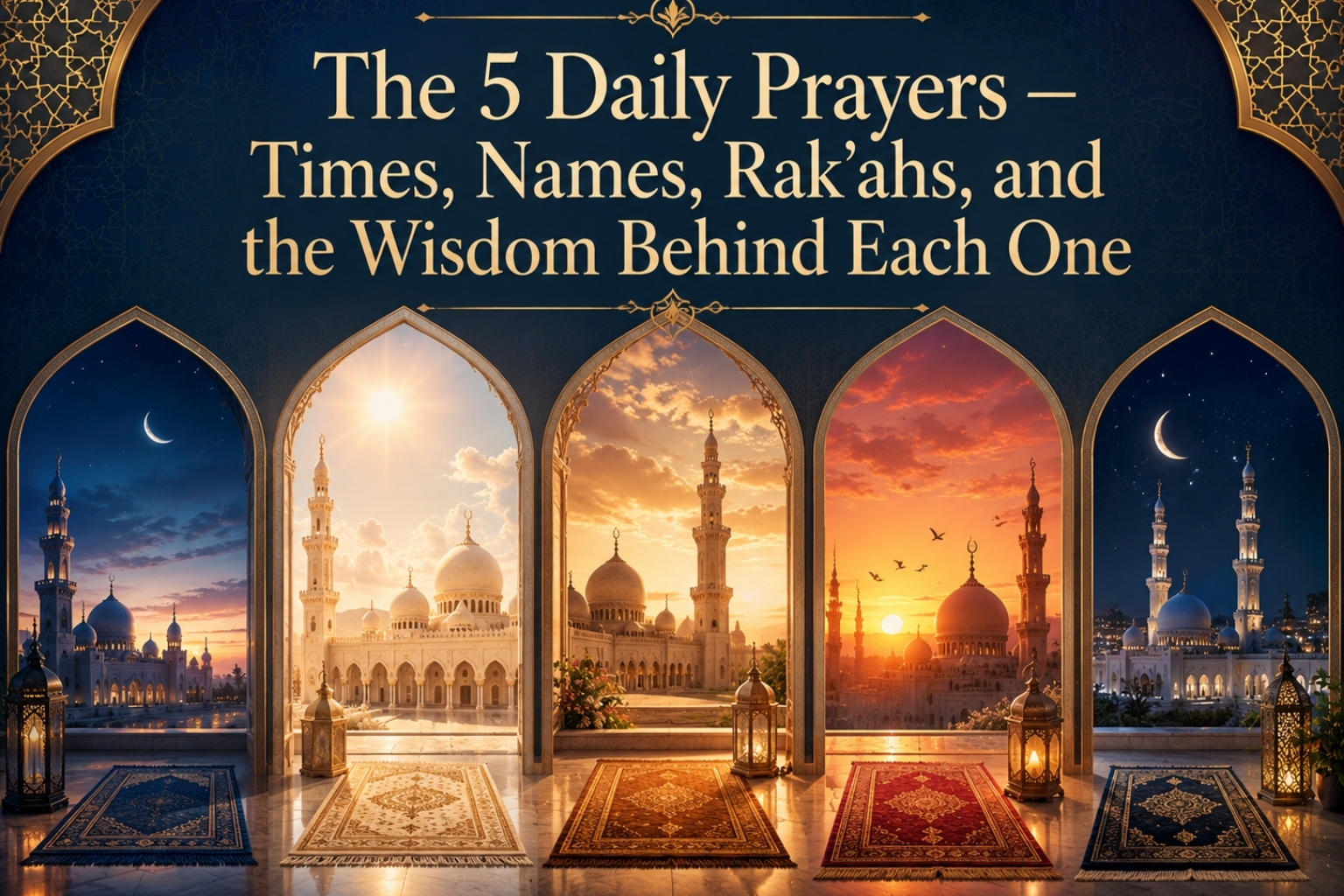
In secular life, time is completely arbitrary—split into rigid, artificial hours that ignore the natural state of the earth. In contrast, Islam anchors the five compulsory prayers directly to the journey of the sun across the sky.
Allah reveals this intimate relationship between celestial movement and human alignment in the Quran:
“أَقِمِ الصَّلَاةَ لِدُلُوكِ الشَّمْسِ إِلَىٰ غَسَقِ اللَّيْلِ وَقُرْآنَ الْفَجْرِ ۖ إِنَّ قُرْآنَ الْفَجْرِ كَانَ مَشْهُودًا”
“Establish prayer at the decline of the sun [from its meridian] until the darkness of the night and [also] the Quran of dawn. Indeed, the recitation of dawn is ever witnessed.”
— Surah Al-Isra, 17:78
By tracking the sun, every prayer becomes a profound lesson in Islamic psychology—reminding the overthinking mind that just as the sun must rise, peak, decline, set, and vanish, every trial and anxiety you face in this world is entirely temporary, moving through a perfect cycle under trusting Allah’s plan.
The Comprehensive Ledger of the Five Daily Prayers
To help you build a structured, flawless relationship with your daily appointments, the entire framework of the five prayers—including names, windows, units (Rak’ahs), and internal objectives—is presented below:
The Prayer Name | The Cosmic Window | Obligatory Units (Fard) | The Deep Wisdom & Psychological Target |
1. Fajr (Dawn) | From the first appearance of white light at dawn until just before the sun breaks the horizon. | 2 Rak’ahs | The Reset of Intention. Waking up before the world active-scans for threats allows you to claim the morning for Allah. It builds a protective barrier around your mind before the day’s chaos can touch your nervous system. |
2. Dhuhr (Midday) | Starts just after the sun passes its highest vertical noon point (Zawal) and extends until afternoon. | 4 Rak’ahs | The Interruption of the Matrix. Placed precisely at the peak of corporate or domestic hustle. It forces you to drop your tools, log off your screens, and remind your ego that your provision (Rizq) comes from Allah, not your labor. |
3. Asr (Afternoon) | From the time an object’s shadow equals its length until the sun begins to turn yellow and sink. | 4 Rak’ahs | The Guarding of Capital. The most dangerous window for fatigue and complacency. Pausing when the day is winding down prevents emotional exhaustion and protects your deeds from being lost in evening weariness. |
4. Maghrib (Sunset) | Begins immediately after the sun completely disappears below the horizon until red twilight fades. | 3 Rak’ahs | The Transition of Gratefulness. As the physical light departs from the earth, you return to your home and sanctuary. It is an intentional transition designed to wrap the day in deep Shukr (gratitude) and family cohesion. |
5. Isha (Night) | From the complete disappearance of the evening red twilight until the true beginning of dawn. | 4 Rak’ahs | The Final Unburdening. The ultimate closure before sleep. It functions as a clean mental sandbox where you hand all your unparsed worries, anxieties, and incomplete tasks back over to the custody of the Creator. |
The Neurobiology of Prophetic Timing
One of the primary drivers of modern anxiety is cognitive hyper-loading—the practice of carrying a mental problem for 12 to 14 hours straight without a structural pause. When you do this, your brain stays locked in a sympathetic flight-or-fight response, releasing continuous doses of cortisol that cloud your judgment and burn out your body.
The 5 daily prayers function as a natural, divine antidepressant by breaking this loading cycle every few hours. The Prophet Muhammad explicitly revealed how this cyclical cleansing works to heal the human spirit:
“When the time for a mandatory prayer comes, if any Muslim performs its ablution beautifully, and maintains its humility and bowing, it will be an expiation for his past sins, so long as he does not commit a major sin—and this applies for all time.” — Sahih Muslim, 228
Through healing anxiety with the Quran, Salah changes the operational architecture of your brain. By forcing you into a mandatory state of physical stillness (Tuma’ninah) and deep breathing five times a day, it systematically lowers your heart rate, downregulates your nervous system, and breaks the momentum of negative thought spirals. It forces you to practice mindfulness not as a vague concept, but as a structured, embodied reality.
The Four-Gate Strategy for Transforming Your Salah Routine
If your daily prayers currently feel like an empty, mechanical chore that you quickly rush through to tick a box, use this structured sequence to restore profound internal presence to your practice:
1.The Cognitive Transition (The Break):2 Minutes Before.
Stop working or scrolling two minutes before the prayer time begins. Sit quietly on the edge of your seat or at your desk. Let your heart rate normalize. Mentally announce to your soul: “I am about to leave the creation completely, and step directly into the court of the absolute King.”
2.The Physical De-Compression:During Wudu.
Approach the sink with complete deliberation. As you wash each limb during Wudu, visualize the water physically rinsing away the anxieties, micro-stressors, and worldly residue that accumulated over the last few hours. Step onto the prayer mat feeling light and unburdened.
3.The Sonic Anchor (Slowing Down):During Recitation.
When you recite Surah Al-Fatiha, force an absolute pause at the end of every single verse. Do not blend the words together. Listen to the sound of your own voice echoing the divine text. This acoustic feedback acts as a powerful anchor, instantly pulling an easily distracted mind back into the room.
4.The Final Ledger Drop:Post-Taslim.
Do not fold your prayer mat the split-second you finish your greetings of peace. Stay seated for 60 seconds. Keep your hands open, make a sincere session of Istighfar (seeking forgiveness), and visually hand over your unresolved problems to Al-Wakil (The Best Disposer of Affairs) before walking back into the world.
Actionable Steps to Master Daily Consistency
- Establish the “First-Window” Rule: Train your brain to view the entry of a prayer time as an immediate, high-priority appointment. Commit to performing the prayer within the first 15-30 minutes of its window opening, rather than pushing it to the final edge. This habit eliminates the low-level, ambient anxiety of carrying an unfulfilled duty in the back of your mind while trying to work.
- Anchor Your Spaces Visually: Create a dedicated, physically pristine zone in your home or workplace exclusively for prayer. Keep a clean, high-quality prayer mat permanently laid out or highly accessible, free from clutter and digital distractions. This spatial boundary signals to your subconscious mind that the moment you cross that line, you are entirely safe from the demands of the world.
- Utilize the Micro-Prayer Strategy for Overwhelmed Days: On days when your schedule completely explodes and you feel paralyzed by extreme time panic, refuse the temptation to skip prayer. Remind yourself that the bare minimum obligatory units (Fard) take less than four minutes to complete. Strip away the extra voluntary prayers for that moment, step onto the mat, and use those four minutes as a clean, highly protected psychological timeout to regroup under how to trust Allah.
Conclusion
The profound, beautifully engineered grid of the 5 daily prayers in Islam stands as the ultimate spiritual anchor for a human race drowning in a sea of commercial performance, hyper-connectivity, and existential unrest. Islam reminds you that your precious mind was never built to serve as a permanent furnace for worldly worries without an ongoing, regular lifeline to the Divine. You do not have to carry the terrifying weight of your entire life on your own fragile shoulders. You are a profoundly valued servant operating under the constant, loving oversight of Al-Sami’ (The All-Hearing) and Al-Basir (The All-Seeing). When you choose to honor your appointments on the mat, respect the sacred wisdom behind each cosmic window, and anchor your lifestyle firmly in trusting Allah’s plan, the suffocating fog of chronic overthinking completely clears away—leaving your soul beautifully wrapped in an unshakeable state of absolute security, deep internal stillness, and everlasting success.