
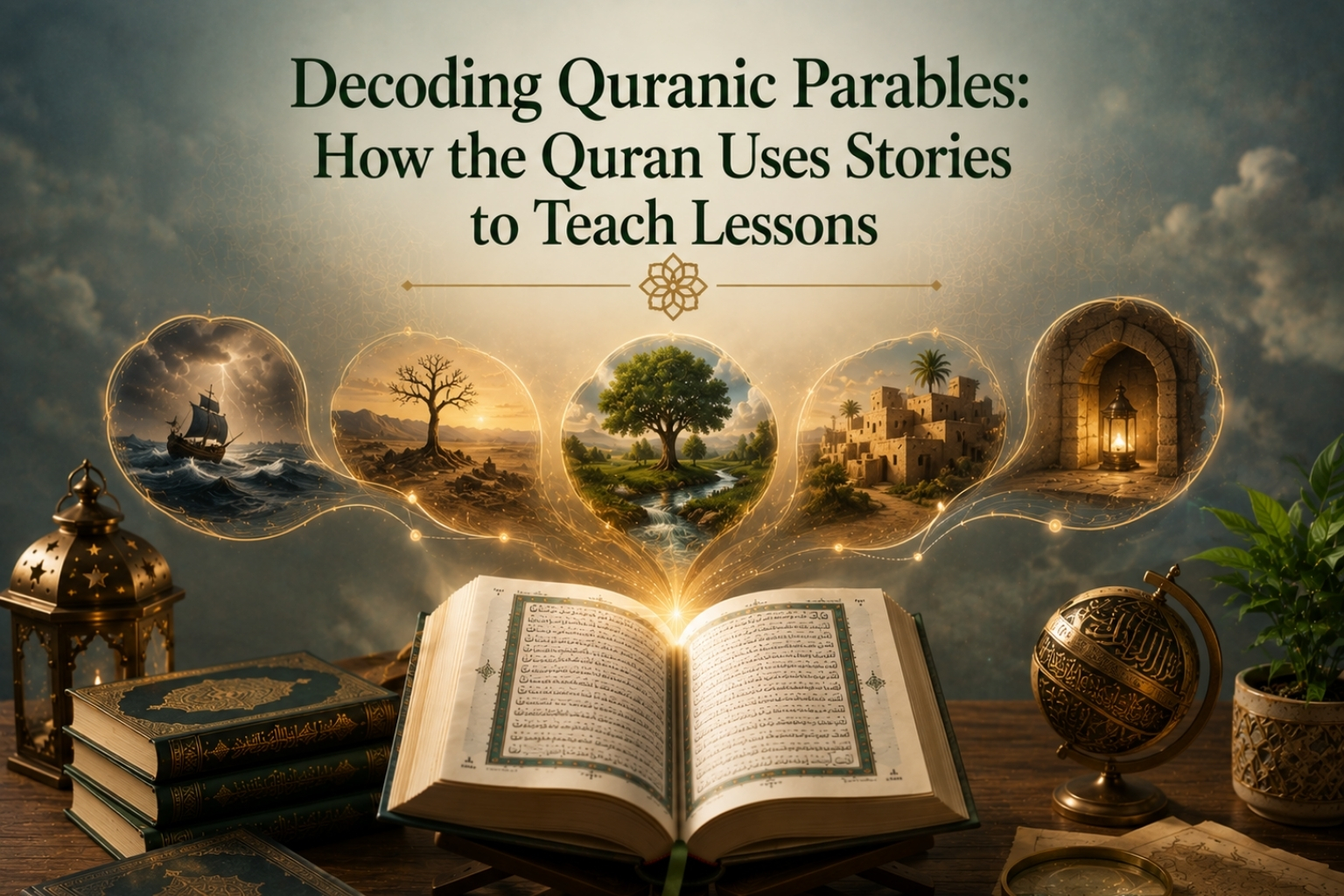

Human beings are naturally wired for stories. Long before the existence of modern textbooks, humanity preserved history, passed down moral values, and explored deep philosophical truths through the art of storytelling. The Holy Book honors this natural human trait. Rather than presenting abstract philosophical concepts or dry legal lists, it frequently teaches through vivid narratives and metaphors.
A significant portion of the text relies on Stories in the Quran and a powerful literary tool known as Quranic parables (Amthal). Learning how to decode these divine parables is one of the most rewarding ways to shift your study from passive reading to deep, life-changing comprehension.
What is a Quranic Parable?
A parable is a short, realistic story or comparison used to illustrate a deeper moral or spiritual lesson. The Quranic approach to parables is unique: it takes everyday, tangible human experiences—things like rain, crops, seeds, mirrors, spiders, and light—and uses them to explain profound, invisible realities like faith, hypocrisy, time, and the human soul.
The scripture itself highlights the purpose behind this method: “And these similitudes We put forward for mankind, but none will understand them except those who have knowledge.” (Surah Al-Ankabut, 43). Parables are designed to bridge the gap between the physical world we see and the spiritual world we feel.
The Power of Visual Learning in Revelation
Why does the text use metaphors instead of just stating the rules directly? There are three core reasons why decoding these parables changes how we learn:
1. They Make Abstract Concepts Tangible
Concepts like “the danger of relying on worldly wealth” can feel abstract. To make it unforgettable, the text presents the parable of the Spider’s Web (Surah Al-Ankabut, 41). It compares those who take protectors other than the Creator to a spider building a house. It looks like a complex, beautifully engineered home, but it is actually the flimsiest, most fragile structure in existence. One sweep of a hand destroys it. Instantly, the abstract concept of worldly fragility becomes a vivid mental image.
2. They Bypassing Emotional Defenses
When people are told directly that they are doing something wrong, they often become defensive. A story or a parable bypasses those intellectual defenses. It allows you to look at a situation objectively through characters or metaphors, recognize the moral truth, and then naturally realize: “Wait, this story is actually describing me.”
3. They Ensure Universal Accessibility
A highly academic philosophical argument can only be understood by a few. A parable about a seed growing into a strong tree, or rain bringing dead earth back to life, can be understood by a professor in a university, a businessman in a city, or a farmer in a rural village. It makes spiritual lessons universally accessible across all cultures and generations.
3 Steps to Decode a Quranic Parable
When you encounter a parable or a metaphorical story in your English translation, use this simple three-step framework to extract its deeper meaning:
- Step 1: Identify the Physical Element: What is the literal image being described? (e.g., A grain of corn growing seven ears, with a hundred grains in every ear).
- Step 2: Find the Spiritual Equivalent: What spiritual concept is this physical image representing? (In this case, Surah Al-Baqarah, 261 uses this image to represent how the Creator multiplies the spiritual reward of charity).
- Step 3: Apply the Personal Lesson: Ask yourself: How should this change my behavior today? If charity multiplies like a growing seed, it means I should never look down on giving even a very small amount, because its ultimate growth is in the hands of the Divine.
Conclusion: Turning Verses into Mental Images
The parables of the revelation are not just decorative literary devices; they are profound tools for transformation. They turn the text into a gallery of vivid mental images that stay with you long after you close the book.