

We live in a culture that treats desire as an emergency. Modern life conditions us to expect instant fulfillment—we click a button and our food arrives, we swipe a screen and our entertainment plays, we send a text and expect an immediate response. This hyper-accelerated reality trains the human mind to believe that if we want something, we should have it right now.
This obsession with control carries a steep psychological price. When we apply this same transactional, instant-gratification model to our spiritual lives, we become deeply fragile. We raise our hands to pray for a specific outcome—a career breakthrough, a healed relationship, financial relief—and if the universe doesn’t shift within forty-eight hours, we spiral. This sense of cosmic delay directly fuels chronic overthinking in Islam. We begin to ask: Is Allah even listening to me? Did I say something wrong? Why does everyone else get their prayers answered while I remain stuck? This doubt rapidly erodes our emotional resilience and shatters our internal peace of mind.
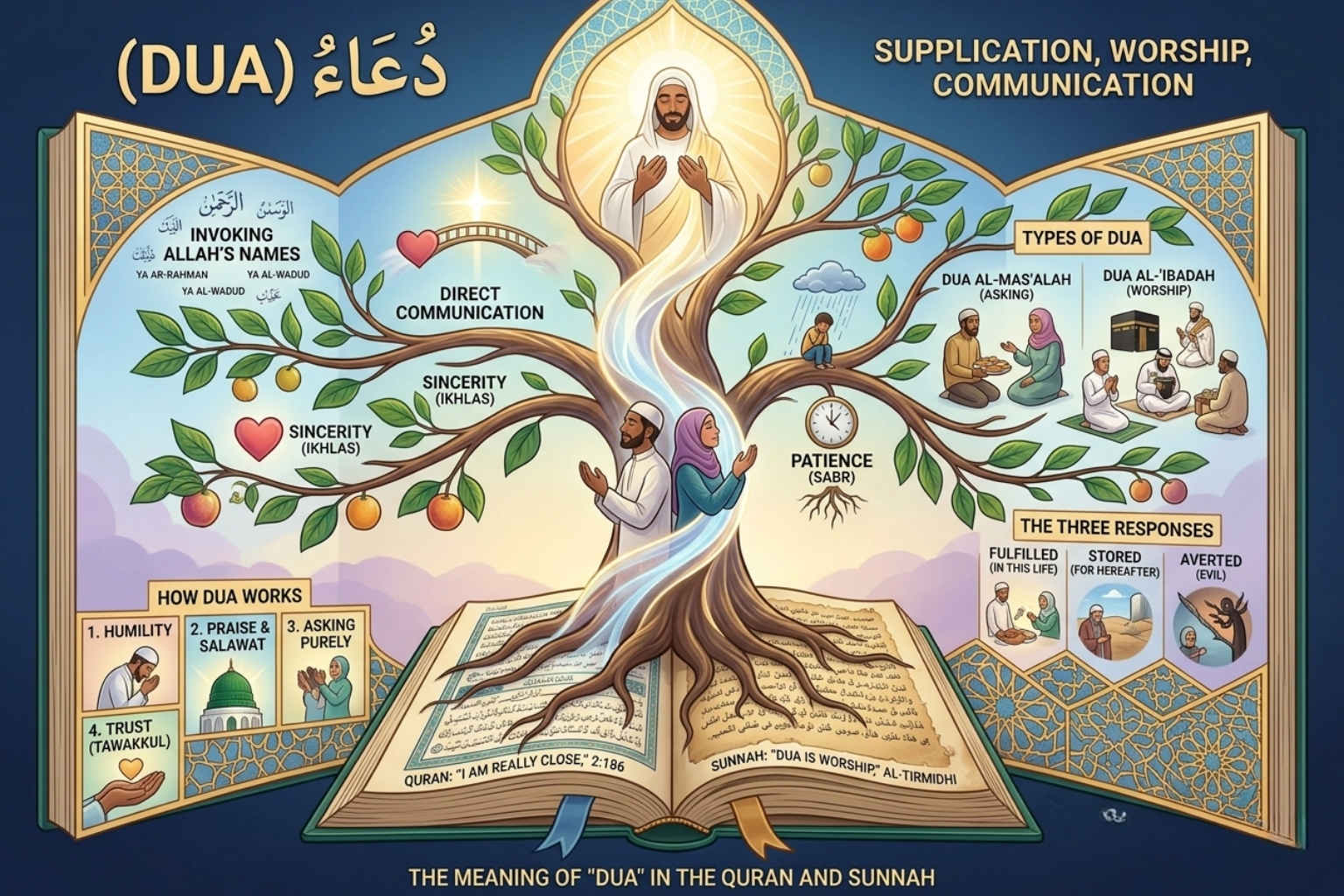
However, when we engage in Tadabbur (deep Quranic reflection), we find that Islam turns this frantic, transactional relationship with prayer upside down. Dua (supplication) is not a cosmic vending machine where you insert a phrase and expect a product; it is an elite system of psychological unburdening and spiritual intimacy. In the framework of Islamic psychology, Dua is the ultimate weapon of the believer—a direct, unedited line of communication with the Owner of the universe, designed by Al-Khaliq (The Creator) to heal anxiety, cultivate deep humility, and build an unshakeable foundation for trusting Allah’s plan.
The Core Blueprint: The Brain of Worship
Linguistically, the Arabic word Du‘ā’ means to call out, to summon, or to intensely invite. It is far more than a casual wish; it is an active, vocal expression of human dependency on a Higher Power.
The Prophet Muhammad elevated this practice to the absolute pinnacle of religious life, stating clearly:
“Dua is the very essence of worship.” — Sunan At-Tirmidhi, 3371
Allah explicitly commands humanity to utilize this direct line of communication, promising a guaranteed response. He bypasses all intermediaries, placing the invitation to connect directly into the heart of the text:
“وَقَالَ رَبُّكُمُ ادْعُونِي أَسْتَجِبْ لَكُمْ ۚ إِنَّ الَّذِينَ يَسْتَكْبِرُونَ عَنْ عِبَادَتِي سَيَدْخُلُونَ جَهَنَّمَ دَاخِرِينَ”
“And your Lord says, ‘Call upon Me; I will respond to you.’ Indeed, those who disdain My worship will enter Hell [rendered] contemptible.”
— Surah Ghafir, 40:60
To help a beginner or an experienced believer master the correct etiquette (Adab) of a high-vibrancy supplication, the prophetic blueprint for making Dua is organized below into a clear, scannable format:
The Step of the Ritual | The Physical & Vocal Action | The Deep Psychological Shift |
1. The Praise | Begin by raising your hands to chest level and passionately praising Allah using His Beautiful Names (Asma al-Husna). | The Scale Calibration. Shifts your focus away from the intimidating size of your problem and anchors your intellect in the infinite majesty of the Creator. |
2. The Connection | Send blessings and peace upon the Prophet Muhammad (Salawat). | The Protocol of Honor. Aligns your prayer with the most beloved creation, establishing a spiritual baseline of respect before introducing your personal needs. |
3. The Confession | Make a sincere session of Istighfar (seeking forgiveness), explicitly naming your faults and limitations. | The Radical Vulnerability. Rips away the social ego, clearing out subconscious guilt and preparing the heart for true spiritual transformation. |
4. The Core Ask | State your specific needs clearly, persistently, and with absolute conviction (Yaqīn), repeating each request three times. | The Focus Integration. Forces you to articulate your deepest vulnerabilities, turning vague worries into clear, actionable spiritual requests. |
5. The Seal | Conclude by sending blessings upon the Prophet once more and wiping your damp hands across your face. | The Act of Closure. Visually and physically signals to your nervous system that the burden has left your custody and is now with Al-Wakil. |
The Three Divine Responses: Dismantling the Trap of “Unanswered” Prayers
One of the most dangerous drivers of spiritual anxiety is the false assumption that an answered Dua must result in the immediate, physical arrival of the exact object you requested. When this objective manifestation fails to appear, the overthinking mind defaults to despair.
Islamic theology completely neutralizes this psychological trap by expanding our definition of how a response occurs. The Prophet Muhammad revealed that Allah always answers the sincere supplication of a believer, but He does so through three distinct, perfectly calculated strategies:
“There is no Muslim who supplicates with a Dua that does not involve sin or cutting family ties, except that Allah gives him one of three things: He hastens the answer in this world, He stores it as a reward for him in the Hereafter, or He averts an equivalent evil from him.”
— Musnad Ahmad, 11133
When you internalize this reality through healing anxiety with the Quran, your chronic impatience dissolves into profound relief. You realize that you cannot lose. If you ask for a specific job and you don’t get it, it doesn’t mean your prayer failed; it means Al-Hakim (The All-Wise) either deflected an unseen corporate disaster away from your life, or is preserving that energy to grant you something infinitely superior in the next realm. This realization is the ultimate foundation for learning how to trust Allah.
High-Leverage Time Windows: Capitalizing on Cosmic Geometry
While you can make Dua at any second of the day in any language, there are specific celestial and physical windows where the veil between the creation and the Creator becomes exceptionally thin. Optimizing your prayers during these high-leverage windows dramatically enhances your focus and certainty:
- The Last Third of the Night: During the voluntary night prayer (Tahajjud), when the rest of the world is completely asleep and the Divine descent occurs.
- The Prostration (Sujud): The physical apex of your ritual prayer. The Prophet taught: “The nearest a servant is to his Lord is when he is in prostration, so increase your supplications therein” (Sahih Muslim).
- The Window Between the Adhan and Iqamah: The brief quiet window between the first call to prayer and the actual start of congregational worship.
- While Fasting and at the Moment of Breaking Fast (Iftar): As detailed in the comprehensive protocols of Ramadan, the physical discipline of the fast amplifies your spiritual vibrancy.
- During Rain: When the physical mercy of Allah drops down from the clouds to revive the dead earth, it signals a matching downpour of spiritual responses.
The Four-Step Protocol to Build a Bulletproof Dua Routine
If your current prayers feel weak, distracted, or clinically robotic, use this structured sequence to restore profound internal presence and efficacy to your supplications:
1.The Physical Positioning and Intention:2 Minutes Before.
Isolate yourself from all digital noise. Find a quiet space, face the direction of prayer (Qiblah), and raise your open hands to your chest. Sit in this position for 30 seconds before speaking. Allow your nervous system to register the posture of a humble petitioner.
2.The Scale Switch (Praise & Salawat):The First 3 Minutes.
Do not immediately speak about your problems. Dedicate the opening minutes exclusively to declaring the greatness of Allah. State vocally: “Ya Rahman, Ya Razzaq, Ya Alim.” Follow this by sending slow, deliberate Salawat upon the Prophet, anchoring your mind in the grandeur of the court you have entered.
3.The Absolute Vulnerability Dump:The Core Window.
Pour out your requests without any formal editing or hesitation. Speak in your native language. If you are exhausted, state: “O Allah, I am completely overwhelmed by this situation, and I have no strength left.” Demand what you need with fierce insistence, completely banishing phrases like “Answer me if You want to.” You must speak with absolute Yaqīn (certainty) that the response is already moving toward you.
4.The Custody Transfer (The Seal):Post-Supplication.
Conclude by wiping your hands over your face. As your hands touch your skin, mentally declare a total release of custody. Affirm to your overthinking intellect: “I have officially handed this problem over to Al-Wakil. It is no longer my job to worry about how it will be solved. I will do my daily work and trust His perfect timing completely.”
Actionable Steps to Master Supplication
- Build a Personalized “Dua Blueprint” Document: Do not rely on your memory during moments of intense stress or during peak times like the final third of the night. Take twenty minutes this week to write out a structured list of your highest-priority goals across four specific domains: Spiritual growth, Character refinement, Worldly milestones (career/family), and Protections from anxiety. Review and read this document during your high-leverage prayer windows.
- Eliminate the Speed Trap in Sujud: The next time you perform your mandatory prayers, pick at least one Sujud to deliberately prolong by an extra sixty seconds. After reciting the standard glorifications, stay down on the ground and make a quiet, focused request for your most urgent current mental or physical need. This habit transforms a fast physical routine into a deeply intimate sandbox for emotional release.
- Combat Intrusive Doubts with Immediate Action: Whenever your brain drops an intrusive, anxiety-inducing thought into your mind—such as a sudden panic about job security or family health—refuse to engage in an internal debate. Instantly raise your hands or make a silent internal Dua for that exact issue. It transforms a potential anxiety spiral into an immediate trigger for divine connection.
Conclusion
The profound, beautifully designed, and deeply therapeutic architecture of Dua in Islam serves as an essential spiritual compass for a human generation drowning in superficial speed, systemic isolation, and intense mental exhaustion. Islam reminds you that you were never designed to function as an isolated machine, carrying the crushing weight of your future entirely on your own fragile shoulders. You are a valued servant operating under the constant, loving oversight of Al-Wadud (The Loving) and Al-Sami’ (The All-Hearing). When you choose to master the correct etiquette of your supplications, embrace the three divine models of response, and anchor your lifestyle firmly in trusting Allah’s plan, the suffocating fog of chronic overthinking completely clears away—leaving your mind beautifully wrapped in an unshakeable state of absolute security, deep internal stillness, and everlasting success.