

Among the many remarkable passages in the Qur’an, few stand out historically as clearly as the prophecy concerning the defeat and future victory of the Romans. What makes this prophecy1 extraordinary is not only that it predicted a future political event, but that it did so during a moment when such an outcome appeared completely impossible.
At the beginning of the 7th century, the Byzantine2 Romans suffered devastating3 military losses against the Persian Empire. Entire territories4 collapsed, major cities were conquered, and the Roman Empire appeared to be approaching total destruction. To outside observers, there was little reason to believe the Romans would recover.
Yet during this exact period of overwhelming defeat, the Qur’an declared that the Romans would eventually rise again and achieve victory within a specified number of years.
For many Muslims, the fulfillment of this prophecy remains one of the clearest historical signs of the divine origin of the Qur’an.
The Historical Background
To fully appreciate the significance of this prophecy, it is important to understand the political situation at the time.
Two superpowers dominated much of the known world:
- The Byzantine Roman Empire
- The Persian Sassanian Empire
The conflict between them was intense and long-lasting. Around the early 7th century, the Persians achieved a series of crushing victories against the Romans. Important Byzantine territories fell rapidly, including regions connected to Christian religious significance.
The defeat shocked surrounding nations.
In Makkah, many pagan Arabs sympathized5 with the Persians because they were not followers of divine scripture6, while many Muslims felt closer to the Romans because they were People of the Book.
At that moment, nearly everyone believed the Roman Empire was collapsing permanently.
The Qur’anic Prophecy
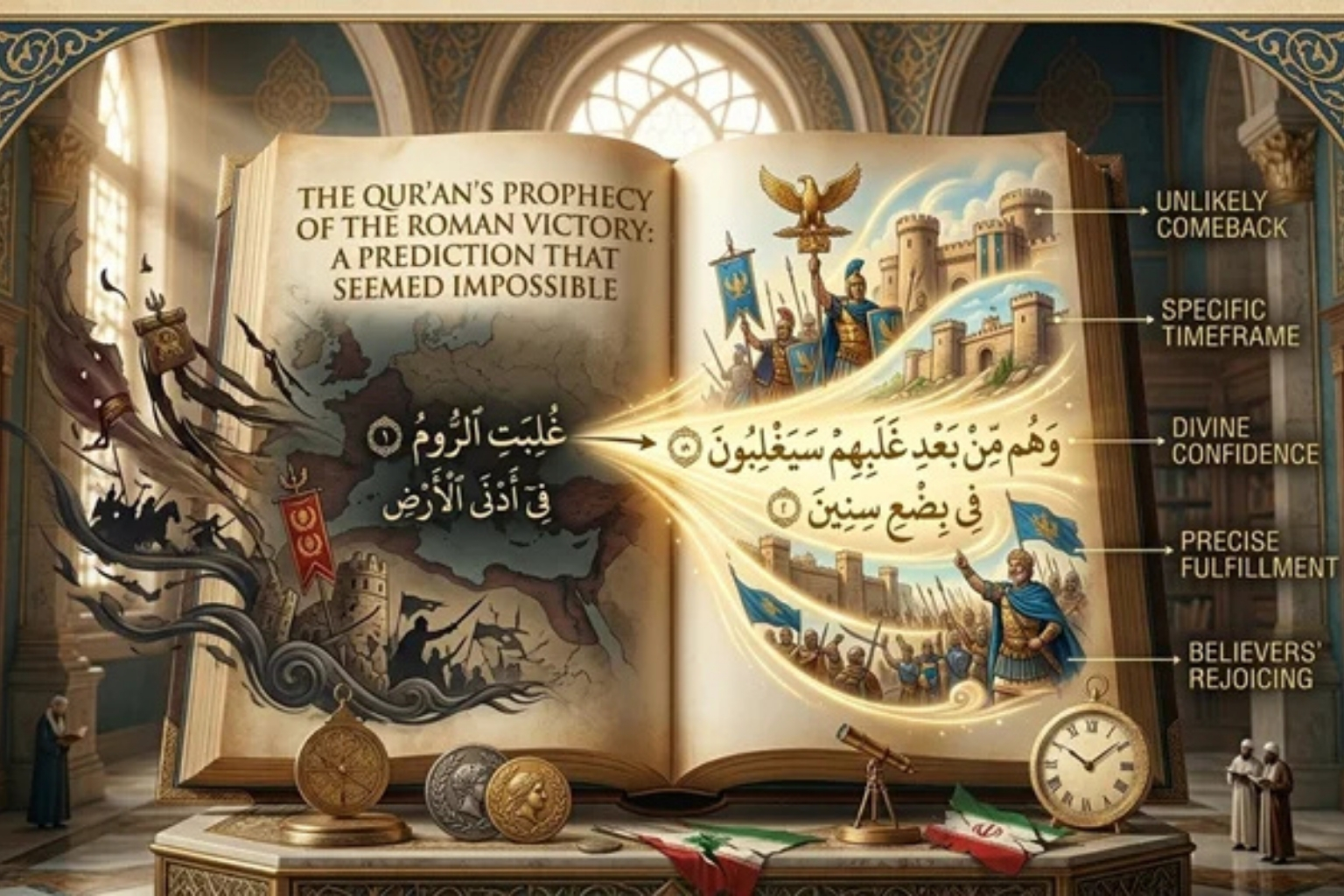
During this period of severe Roman defeat, the Qur’an revealed the following verses:
“غُلِبَتِ الرُّومُ فِي أَدْنَى الْأَرْضِ وَهُم مِّن بَعْدِ غَلَبِهِمْ سَيَغْلِبُونَ فِي بِضْعِ سِنِينَ”
“The Romans have been defeated in the nearest land. But after their defeat, they will soon be victorious within a few years.”
— Surah Ar-Rum (30:2–4)
At the time these verses were revealed, this prediction appeared highly unlikely.
The Roman Empire was militarily exhausted, politically weakened, and suffering continuous defeats. From a purely human perspective, predicting a Roman comeback during such circumstances would have seemed extremely risky.
Yet the Qur’an confidently announced that the Romans would return to victory within “a few years.”
Why This Prediction Was So Extraordinary
What makes this prophecy remarkable is that it was publicly announced while events were moving in the opposite direction.
Human beings usually make predictions when signs of success are already visible. The Qur’an, however, made this declaration during a moment of apparent disaster.
The Arabic phrase:
“فِي بِضْعِ سِنِينَ”
“Within a few years”
typically refers in Arabic to a period between three and nine years.
Historically, the Byzantine Emperor Heraclius eventually reorganized the Roman forces and launched successful counterattacks7 against the Persians. Within the timeframe8 indicated in the Qur’an, the Romans achieved significant victories and reversed the course of the war.
The prediction was fulfilled with remarkable precision.
Could This Have Been a Coincidence?
For believers, the accuracy of this prophecy raises an important question:
How could such a prediction have been made confidently during a time when the Roman Empire appeared close to destruction?
At the time:
- There were no modern political forecasting systems
- No advanced intelligence networks
- No global communication technologies
- No reliable way for people in Arabia to predict the future of distant empires with certainty
Yet the Qur’an described not only the Roman defeat, but also their future recovery.
For Muslims, this supports the belief that the Qur’an originates from divine knowledge rather than human speculation9.
The Qur’an and Historical Accuracy
One reason the prophecy of the Romans continues to attract attention is because it connects revelation with verifiable10 historical events.
Unlike vague predictions that can be interpreted in many ways, the Qur’anic prophecy included:
- A specific people
- A real military conflict
- A predicted reversal
- A limited time frame
The fulfillment of these details gave early Muslims greater confidence in the truth of the Qur’an.
Allah says:
“وَيَوْمَئِذٍ يَفْرَحُ الْمُؤْمِنُونَ بِنَصْرِ اللَّهِ”
“And on that day the believers will rejoice in the victory of Allah.”
— Surah Ar-Rum (30:4–5)
The verses connected the Roman victory with hope and reassurance for believers facing hardship themselves.
More Than a Political Prediction
The prophecy of the Roman victory was not merely about politics or warfare. It also carried a spiritual message.
At the time Muslims in Makkah were facing persecution11, weakness, and opposition. The Roman defeat may have seemed like proof that truth and faith were losing in the world.
But the Qur’an reminded believers that circumstances12 can change unexpectedly. Power belongs ultimately to Allah, and defeat is not always permanent.
The prophecy therefore became a lesson about:
- Patience
- Hope
- Trust in Allah
- The temporary nature of worldly power
A Sign That Continues to Inspire Reflection
More than fourteen centuries later, the prophecy of the Roman victory remains one of the most discussed historical passages in the Qur’an.
For many readers, its precise fulfillment strengthens the argument that the Qur’an contains knowledge beyond human capability. Others reflect on the broader lesson that history itself remains under the control of Allah.
Regardless of perspective, the prophecy continues to stand as one of the most fascinating intersections13 between the Qur’an and recorded history.
Conclusion
The Qur’an’s prophecy concerning the victory of the Romans remains one of the most striking historical signs within Islamic tradition. Revealed during a time of overwhelming Roman defeat, the prediction appeared nearly impossible from a human point of view.
Yet history unfolded exactly as the Qur’an described.
For Muslims, this is far more than a political prediction successfully fulfilled. It is evidence that the Qur’an speaks with knowledge beyond the limits of human observation14 — a reminder that the One who controls history is also the One who revealed the Qur’an.