
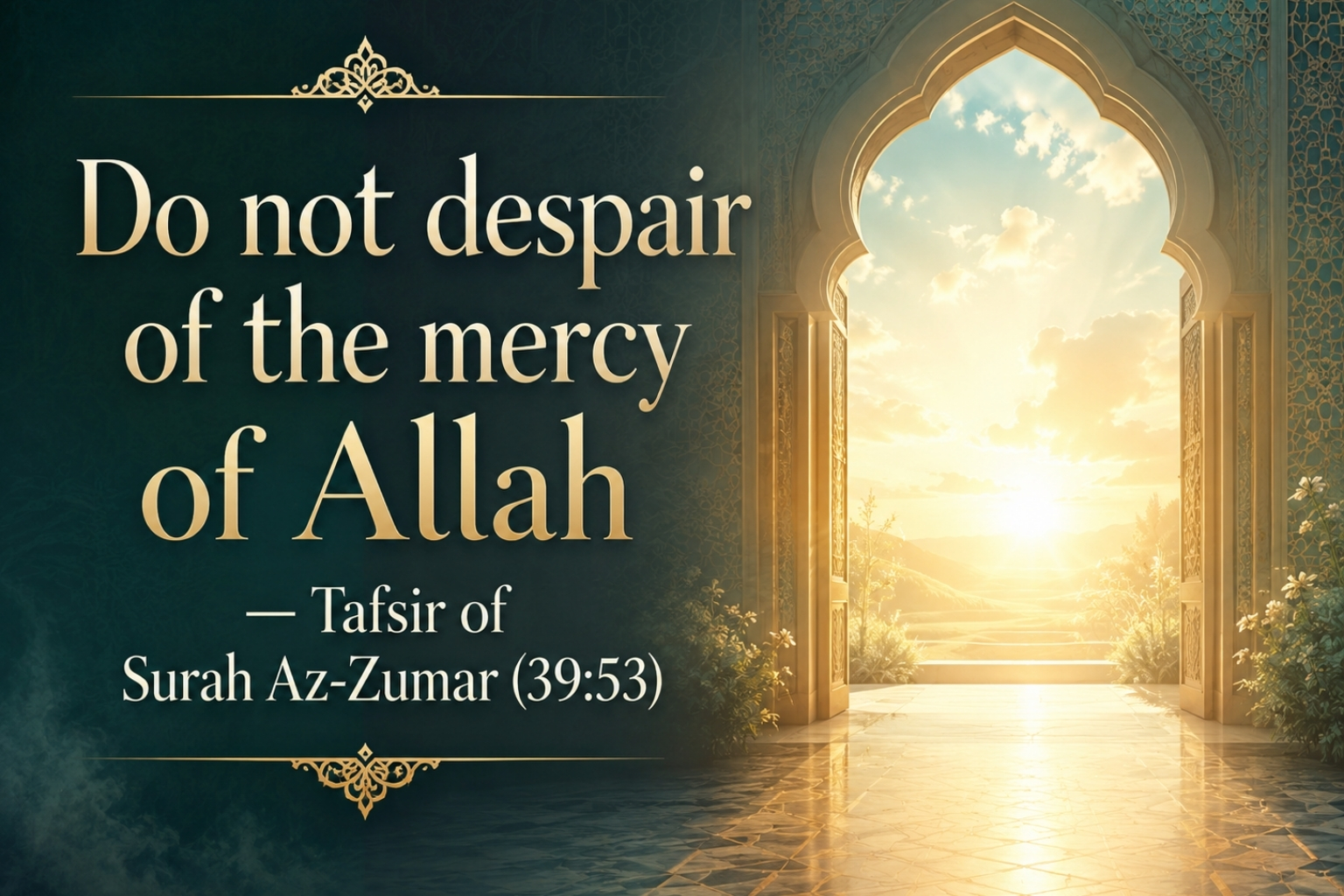

There is a verse in the Quran that the scholars have called the most hope-giving verse in the entire Book.
Not one of the most hope-giving. The most. Among all 6,236 verses of the Quran — verses about paradise, verses about Allah‘s mercy, verses about forgiveness and relief and ease — this specific verse has been identified by the classical scholars as the single most hope-giving verse that Allah revealed.
The companion Ibn Masud RA was asked: what is the most hope-giving verse in the Quran? He did not hesitate. He said: Surah Az-Zumar (39:53).
And when you understand what the verse actually says — not just the famous first phrase that everyone quotes, but the full verse in its complete form, with every phrase examined at depth — you understand why.
Because most people who know this verse know it as a verse of comfort. A beautiful statement of Allah‘s mercy. Something to say to someone who is struggling. And it is all of those things. But it is something more specific and more radical than a general statement of divine mercy. It is a verse addressed to a specific type of person — a person who has committed so many sins, of such severity, that they have concluded that Allah‘s mercy cannot possibly reach them. A person who has despaired of Allah‘s forgiveness not out of ignorance but out of a particular, painful, intimate knowledge of what they have done.
And Allah speaks to that person directly. Not through a general principle. In the first person. With His own voice. Directly to the one who has given up on His mercy — and says: do not despair of My mercy. I forgive all sins. All of them.
That is the verse. This is its complete tafsir.
The Full Verse: Arabic and English
قُلْ يَا عِبَادِيَ الَّذِينَ أَسْرَفُوا عَلَىٰ أَنفُسِهِمْ لَا تَقْنَطُوا مِن رَّحْمَةِ اللَّهِ ۚ إِنَّ اللَّهَ يَغْفِرُ الذُّنُوبَ جَمِيعًا ۚ إِنَّهُ هُوَ الْغَفُورُ الرَّحِيمُ
“Say: O My servants who have transgressed against themselves — do not despair of the mercy of Allah. Indeed, Allah forgives all sins. Indeed, it is He who is the Forgiving, the Merciful.”
Surah Az-Zumar (39:53)
The Surah: What Is Az-Zumar?
Surah Az-Zumar — “The Groups” — is the thirty-ninth chapter of the Quran, a Makkan surah revealed during the period when the fundamental questions of belief and accountability were being addressed to the Quraysh. The surah’s name comes from its description of the groups of people who will be driven to Hell and the groups who will be led to Paradise on the Day of Judgment — two processions described with vivid, dramatic imagery at the surah’s close.
Az-Zumar is a surah of stark contrasts: between the believer and the disbeliever, between gratitude and ingratitude, between those who respond to Allah‘s signs and those who turn away. It is a surah that takes the human being seriously — that presents the weight of the choices made in this life with full force.
And within this surah of serious contrasts and weighty accountability — verse 53 arrives as one of the most startling interruptions in the Quran. In the middle of a surah that is unsentimental about the consequences of turning away from Allah, Allah addresses the one who has turned away and says: come back. The door is open. All of your sins — all of them — are forgivable.
The scholars note: this is the Quran’s characteristic movement. It establishes the seriousness of accountability so that the reader does not become careless — and then, before the weight of that seriousness collapses into despair, it opens the door of mercy so wide that despair has no room to settle.
The Revelation Context: Who Was This Verse Revealed For?
The scholars of asbab al-nuzul record that this verse was revealed in response to a question — or in some narrations, a group of people — who believed their sins were too great to be forgiven.
One of the most moving narration contexts comes through the companion Ibn Abbas RA: a group of people who had committed grave sins, including murder and major transgressions, came to the Prophet Muhammad ﷺ or sent a message asking: is there any hope for us? Can our sins be forgiven? They had heard the warnings about accountability and could not see past their own record. They were not asking out of casual curiosity. They were asking out of genuine despair — the sincere, painful conviction that what they had done had placed them beyond Allah‘s mercy.
Allah revealed this verse in response. Not a general reassurance. A direct, specific, emphatic response: tell them — I forgive all sins. Come back to Me.
The scholars always note that the verse was revealed for specific people in a specific situation — and by being recorded in the eternal Quran, it becomes the answer for every person in every generation who has ever been in that same situation: overwhelmed by their own record, convinced that Allah‘s mercy cannot be for them specifically, standing at the edge of despair about their own standing before Allah.
The Opening Command: Say
قُلْ
“Say…”
The verse begins with a command to the Prophet Muhammad ﷺ: qul — say. This opening word is one of the most significant elements of the verse’s structure, and the scholars have always drawn attention to it.
Allah could have revealed this verse directly — as a statement about His own mercy, without the command qul. Instead, He commands the Prophet ﷺ to say it. Why?
Because the message is being delivered through the most trusted human being — and then the voice shifts to Allah Himself. The qul establishes the Prophet ﷺ as the carrier of the message. What follows is Allah‘s own speech, channeled through the Prophet’s voice, recorded for all time.
The scholars note a second dimension: the command qul creates a public proclamation. Allah is not telling the Prophet ﷺ to quietly reassure someone in private. He is commanding him to say this — to announce it, to make it known, to deliver it as the official message from Allah to every person who has transgressed and despaired. The verse is a public divine announcement: come back. The door is open. All sins are forgivable.
The Address: O My Servants
يَا عِبَادِيَ
“O My servants…”
Ya ‘ibadi — O My servants. Two words that contain an entire theology of relationship.
The ya — the vocative particle — signals that Allah is calling out to specific people. He is not addressing humanity in general, not issuing a universal principle. He is calling to a specific group.
‘Ibadi — My servants. The possessive — My — is the scholars’ primary focus in this phrase. Allah does not say “O you who have sinned.” He does not say “O the guilty.” He says ‘ibadi — My servants. These people — who have transgressed, who have accumulated sins, who have perhaps despaired of Allah‘s mercy — are still described by Allah as His.
Imam Ibn Rajab Al-Hanbali writes that the possessive ya ‘ibadi is itself the first act of mercy in the verse. Before the prohibition of despair, before the declaration of forgiveness, before the naming of Allah‘s names — Allah claims ownership of these people. They are His. They belong to Him. The relationship has not been severed by their transgression. The servant who has sinned is still Allah‘s servant.
The scholars compare this to the story of Yusuf ﷺ and his brothers — the brothers who had thrown him into a well, sold him into slavery, broken their father’s heart, and then, decades later, stood before the brother who had been their victim. And Yusuf ﷺ said:
لَا تَثْرِيبَ عَلَيْكُمُ الْيَوْمَ
“No blame will there be upon you today.”
Surah Yusuf (12:92)
Allah‘s ya ‘ibadi is a divine version of that moment: whatever you have done, you are still mine. The relationship is still intact. Come.
The Subject: Those Who Have Transgressed Against Themselves
الَّذِينَ أَسْرَفُوا عَلَىٰ أَنفُسِهِمْ
“…who have transgressed against themselves…”
Alladhina asrafu ‘ala anfusihim — those who have been excessive, extravagant, transgressing against their own souls.
Asrafu — from the root s-r-f — means to exceed limits, to go beyond bounds, to be wasteful or excessive. It is the word the Quran uses for the one who has gone further in sin than they should have — not just the ordinary failures of the human being, but the ones who have accumulated sins significantly, who have committed what they themselves recognize as transgressions of serious weight.
‘Ala anfusihim — against themselves. Not against Allah — though sin is always against Allah‘s commands. The address frames it from the human perspective: the person who has sinned has transgressed against their own soul. They have damaged themselves. The harm of sin falls on the sinner.
The scholars note the compassion embedded in this framing: Allah describes the sinner not as someone who has wronged Him — Allah is beyond being wronged — but as someone who has wronged themselves. The address positions Allah as the One who is calling back the person who has harmed themselves, not as an offended sovereign demanding justice. The tone is: you have hurt yourself. Come back. Let Me heal what you have damaged.
The verse does not specify which sins qualify. Asrafu is deliberately broad. The scholars read it as: any sin, any transgression, any excess — including the gravest. The verse’s audience is not the person who made minor mistakes. It is the person who has been excessive in transgression and knows it. The person who, if asked to assess their own spiritual state honestly, would say: I have done a great deal wrong. The verse is addressed to them specifically.
The Prohibition: Do Not Despair
لَا تَقْنَطُوا مِن رَّحْمَةِ اللَّهِ
“Do not despair of the mercy of Allah.”
La Taqnatu min rahmat Allah — do not despair, do not lose hope, do not give up on Allah‘s mercy.
Qunoot — despair — in the Quranic usage is not ordinary discouragement or sadness. It is the specific spiritual state of concluding that Allah‘s mercy cannot reach you — of giving up on divine forgiveness, of deciding that your case is the exception to Allah‘s compassion.
The scholars identify qunoot — despair of Allah‘s mercy — as one of the most serious spiritual conditions a person can be in, because it combines a sin (the sins that produced the despair) with a theological error (the belief that those sins have placed you beyond Allah‘s mercy) with a practical consequence (the person in despair stops seeking forgiveness, stops returning to Allah, stops trying — because they have concluded it is hopeless).
Despair of Allah’s mercy is itself a major sin. The scholars are unequivocal on this — and the reason is the theological error it contains. To despair of Allah‘s mercy is to implicitly believe that your sins are larger than Allah‘s mercy. That the finite is larger than the infinite. That what a created being has done can exceed what the Creator can forgive. This is not humility. It is, paradoxically, a form of arrogance — the placing of the self’s sin above Allah‘s capacity to forgive.
The Quran elsewhere confirms this:
إِنَّهُ لَا يَيْأَسُ مِن رَّوْحِ اللَّهِ إِلَّا الْقَوْمُ الْكَافِرُونَ
“Indeed, no one despairs of relief from Allah except the disbelieving people.”
Surah Yusuf (12:87)
Despair of Allah‘s mercy is characterized in Surah Yusuf (12:87) as the condition of those who do not believe — not because the person has intellectually rejected faith, but because despair is, at its root, a practical disbelief in the attribute of Allah‘s mercy. It is living as if Al-Rahman Al-Raheem is not real, or not real for you.
La Taqnatu — do not. The prohibition is emphatic. Allah is commanding the abandonment of this state. Not suggesting it. Not recommending it. Commanding: stop. This state of despair — no matter how it was arrived at, no matter how understandable it feels given what has been done — is not permitted. It must be given up.
The Declaration: The Most Absolute Statement of Forgiveness in the Quran
إِنَّ اللَّهَ يَغْفِرُ الذُّنُوبَ جَمِيعًا
“Indeed, Allah forgives all sins.”
Inna Allaha Yaghfiru al-dhunuba jami’an — this is the declaration that makes this verse the most hope-giving verse in the Quran. And its hope-giving quality is entirely in its specificity.
Inna — indeed, certainly. The emphatic particle that removes doubt.
Yaghfiru — forgives. Present continuous tense — not “forgave once” or “will forgive someday” but forgives — ongoing, habitual, the description of what Allah does as a characteristic of His being. Forgiveness is not an occasional act of Allah. It is what He does.
Al-dhunub — the sins. With the definite article al — the specific sins. Not sins in general. The sins. Your sins. The ones that have been weighing on you. The ones you were thinking about when the despair settled.
Jami’an — all of them. Every single one. Without exception.
The scholars have spent centuries on this phrase — because it is, grammatically and theologically, among the most absolute statements in the Quran.
Imam Al-Zamakhshari notes: the combination of al-dhunuba (the definite article making it specific) and jami’an (the quantifier meaning all/every) creates a statement of total comprehensiveness. Not “most sins.” Not “sins up to a certain severity.” Not “sins with certain conditions.” Al-dhunuba jami’an — all the sins, collectively, without remainder.
Imam Al-Razi notes in Mafatih Al-Ghayb: this verse is the most explicit statement in the Quran of the unlimited scope of divine forgiveness — because it uses the most inclusive possible language (jami’an — all, collectively) and applies it to the most comprehensive possible category (al-dhunub — the sins, all of them).
The scholars also note what the verse does not say. It does not say: Allah forgives all sins except the very grave ones. It does not say: Allah forgives all sins if they are not too many. It does not list categories, thresholds, or exceptions. Al-dhunuba jami’an — all the sins — with no qualification attached.
The one qualification the scholars identify is not stated in the verse but comes from the verse’s own condition — the condition of returning to Allah. The forgiveness is for the one who returns — who comes back, who repents, who leaves the sin and faces Allah. The verse is not saying that sins are automatically forgiven without turning back to Allah. It is saying that for the one who turns back — who leaves the despair, who stops concluding that their sins are unforgivable, who returns to Allah — there is no sin that is too great to be included in the forgiveness.
The Condition That Is Not in This Verse
The scholars note something important about what verse 53 does not say — and why it does not say it.
The verse does not explicitly mention tawbah — repentance. It does not say “return to Allah and He will forgive you.” It simply says: do not despair. Allah forgives all sins.
Why?
Because the verse is addressed to people who have despaired. And despair is precisely the state that makes tawbah seem impossible. The person in despair does not need to be told: do tawbah — they already believe that their tawbah will not be accepted, that the door is closed, that the effort is pointless.
So Allah addresses despair first. Before the tawbah. Before the conditions. Before the steps. He says: stop believing the door is closed. The door is open. I forgive all sins.
Once the despair is addressed — once the person stops concluding that their case is hopeless — the tawbah becomes possible. The return becomes conceivable. The very next verse (39:54) provides it:
وَأَنِيبُوا إِلَىٰ رَبِّكُمْ وَأَسْلِمُوا لَهُ
“And return to your Lord and submit to Him…”
Surah Az-Zumar (39:54)
The sequence is deliberate: first the demolition of despair (verse 53), then the invitation to return (verse 54). Allah removes the obstacle — the belief that return is pointless — before He extends the invitation to return. The verse’s mercy is in that sequence. It meets the person in their despair before it asks anything of them.
The Seal: Two Names That Complete the Promise
إِنَّهُ هُوَ الْغَفُورُ الرَّحِيمُ
“Indeed, it is He who is the Forgiving, the Merciful.”
The verse ends with two names of Allah — and their choice as the seal of this particular verse is not incidental. Every name of Allah placed at the end of a verse is the scholars’ invitation to reflect on why those names specifically were chosen to close that specific statement.
Al-Ghafur — the Ever-Forgiving, the One of vast, comprehensive, repeated forgiveness. The intensive form: not merely ghafir (one who forgives) but ghafur — the One whose forgiveness is a defining characteristic, immense in scale, wide in scope, repeatedly expressed. Al-Ghafur is the name of Allah that corresponds directly to the declaration yaghfiru al-dhunuba jami’an — the name that gives the declaration its authority. He forgives all sins because He is Al-Ghafur — the One for whom forgiveness is a quality of His being, not an occasional act.
Al-Raheem — the Especially Merciful toward the believers, the One whose mercy actively, specifically, continuously flows toward the one who turns to Him. After the forgiveness — mercy. After the erasure of the record — the active gift of divine care that follows. Al-Raheem is not merely the removal of punishment. It is the positive, flowing, sustained mercy that replaces what was there before.
Together: the sins are forgiven by Al-Ghafur, and the servant is then wrapped in the mercy of Al-Raheem. The verse does not end at the removal of harm. It ends at the reception of mercy. The complete restoration: forgiveness + mercy. Erasure + gift.
The scholars note that these two names together — Al-Ghafur Al-Raheem — appear at the end of numerous verses in the Quran, but nowhere more fittingly than here. The person who was drowning in their sins, who had concluded that Allah could not forgive them — they are being told: the One who is forgiving you is Al-Ghafur — the One for whom forgiveness is His nature. And what follows the forgiveness is not indifference but Al-Raheem — the mercy that pursues the servant who returns.
The Scholars on This Verse
Ibn Masud RA — the companion who identified this as the most hope-giving verse in the Quran — was not making an offhand comment. The scholars report that when he said this, he was drawing on deep familiarity with the Quran’s contents and theological weight. His identification of this verse above all others reflects the specific quality of its hope: it is not hope for easy circumstances, not hope for worldly improvement — it is hope for the person who has concluded that they are beyond hope. The person for whom all other hope-giving verses feel like they apply to someone else. This verse reaches that person specifically.
Imam Al-Qurtubi writes: this verse is the most expansive verse of hope in the Quran because it covers every category of sin without exception, addresses the most desperate category of sinner (those who have given up), and delivers the assurance in Allah‘s own voice directly to those who most need it.
Imam Ibn Kathir notes: the scholars unanimously agree that this verse, while it does not make repentance unnecessary, demonstrates that Allah‘s mercy is not limited by the severity or quantity of a person’s sins. The limitation is not on Allah‘s side. There is no threshold of sin beyond which Allah‘s forgiveness cannot reach. The only limitation is the human side — whether the person turns back.
Ibn Al-Qayyim in Al-Fawa’id writes one of the most penetrating reflections on this verse: despair of Allah‘s mercy is actually the most fitting response to a theology of a limited god — a god whose forgiveness has a ceiling, whose mercy can be exhausted, who gives up on the servant when the sins accumulate beyond a certain point. But Allah is not that god. Allah is Al-Ghafur Al-Raheem — the One for whom forgiveness is a nature, not a capacity that depletes. To despair of His mercy is to apply the logic of human limitation to the One who has no limitations. It is the theological error hidden inside what feels like humility.
The Verse and Hopelessness: What Despair Actually Is
The scholars have always been careful to distinguish between three states that can look similar from the outside but are theologically and spiritually very different:
Khawf — fear of Allah‘s punishment. This is healthy and required. The believer fears the consequences of their sins, fears standing before Allah with a heavy record, fears the Day of Judgment. This fear motivates repentance, motivates turning back, motivates the careful life. It is a feature of taqwa, not a disease.
Huzn — grief and sadness over sins. Also healthy and required in appropriate measure. The sincere believer grieves over what they have done against Allah‘s commands. This grief is the inner experience that accompanies genuine repentance — the heart’s response to the awareness of having failed the One it loves.
Qunoot — despair of Allah‘s mercy. This is the diseased state. The state that Surah Az-Zumar (39:53) is specifically prohibited. It is when the fear and grief cross a line: from “I have done wrong and I fear the consequences” to “I have done so much wrong that Allah cannot forgive me.” The crossing of that line is theological error — and it is also a practical trap, because despair stops the person from doing the only thing that would help them: turning back.
The verse is addressed to the person in the third state. Not to comfort the person whose fear is healthy. Not to undermine the grief that produces repentance. To address the specific, named disease of qunoot — and to demolish it with the most absolute declaration of divine forgiveness in the Quran.
The Most Sinful Person and the Most Forgiving Lord
The Prophet Muhammad ﷺ narrated a hadith that, read alongside this verse, forms one of the most complete pictures of Allah‘s mercy in the entire Islamic tradition:
لَوْ أَخْطَأْتُمْ حَتَّى تَبْلُغَ خَطَايَاكُمُ السَّمَاءَ، ثُمَّ تُبْتُمْ، لَتَابَ اللَّهُ عَلَيْكُمْ
“If you were to commit sins until your sins reached the sky, then you repented, Allah would accept your repentance.”
Recorded in Sunan Ibn Majah, Hadith No. 4248
Sins that reach the sky. The image is deliberately hyperbolic — to make the point that no accumulation of sin, however vast the image used to describe it, exceeds Allah‘s capacity to forgive the one who returns.
And in the famous Hadith Qudsi recorded in Sahih Muslim:
يَا ابْنَ آدَمَ، إِنَّكَ مَا دَعَوْتَنِي وَرَجَوْتَنِي غَفَرْتُ لَكَ عَلَى مَا كَانَ مِنكَ وَلَا أُبَالِي، يَا ابْنَ آدَمَ، لَوْ بَلَغَتْ ذُنُوبُكَ عَنَانَ السَّمَاءِ ثُمَّ اسْتَغْفَرْتَنِي غَفَرْتُ لَكَ
“O son of Adam, as long as you call upon Me and hope in Me, I will forgive you for what you have done, and I will not mind. O son of Adam, if your sins were to reach the clouds of the sky and then you asked My forgiveness, I would forgive you.”
Recorded in Sunan Al-Tirmidhi, Hadith No. 3540
Wa la ubali — and I will not mind. The scholars reflect on this phrase with reverence: Allah is saying that the forgiving of the servant’s sins, however vast, costs nothing on Allah‘s side. It does not diminish Him. It does not require effort. It does not come at a price. The forgiveness is given with la Ubali — without it being any kind of burden or consideration on Allah‘s side.
This hadith and verse 39:53 together form the same message: the ceiling on forgiveness is not on Allah‘s side. There is no ceiling on Allah‘s side. The only ceiling is whether the servant turns back — and the verse specifically addresses the person who has concluded that even turning back is pointless.
The People This Verse Was Written For
Every verse in the Quran has its primary audience — the people it was most directly addressing — and its universal audience, the every-generation readers who find themselves in the same situation. For Surah Az-Zumar (39:53), both audiences deserve to be named.
The primary audience: people who had committed major sins, who had heard the Quran’s descriptions of accountability, who had despaired. People who had perhaps done things that other people knew about, or things that only they and Allah knew about, but whose weight was crushing them. People who had concluded that the specific combination of sins they carried was too much for Allah‘s mercy to cover.
The universal audience across every generation: every person who has ever looked at their own record and thought: this is too much. Every person who has felt the specific, grinding weight of accumulated failure — not just today’s mistake, but the pattern of years, the repeated returns to the same sins, the private knowledge of what they have done and who they have been when no one was watching.
Every person who has prayed and felt like the prayer wasn’t going anywhere, not because they doubted Allah‘s existence but because they doubted that Allah‘s mercy could possibly be for them specifically.
Every person who has picked up the Quran in a moment of despair and found that the words about mercy and forgiveness seemed to apply to someone else — someone less far gone, someone with a cleaner record, someone more deserving.
Allah addressed them all in one verse. Ya ‘ibadi alladhina asrafu ‘ala Anfusihim — O My servants who have been excessive in transgression. That is the audience. If you recognize yourself in that description — this verse is for you. Specifically. By name. In Allah‘s own voice.
A Final Reflection: The Verse That Has No Except
The scholars have always pointed to one specific grammatical feature of this verse as its most remarkable quality: the absence of illa — except.
Allah could have said: Allah forgives all sins except [category]. He could have said: Allah forgives all sins if [condition is met]. He could have qualified, limited, carved out exceptions.
He did not.
Inna Allaha Yaghfiru al-dhunuba jami’an — indeed, Allah forgives all sins. The jami’an is the quantifier of completeness. And there is no illa, no in, no limiting particle that follows it. The statement stands absolute: all sins, with no exception stated.
The scholars note that this does not mean repentance is unnecessary — the surrounding verses make clear that the forgiveness is for the one who returns to Allah. But the point of the grammatical observation is: on Allah‘s side, there is no limitation. The limitation is not in Allah‘s capacity or Allah‘s willingness. The only variable is whether the servant turns back.
And that variable — the turning back — is exactly what the verse is inviting. The person in despair who reads la Taqnatu min rahmat Allah — do not despair of Allah‘s mercy — and feels the despair begin to loosen is already turning back. The engagement with the verse, if sincere, is itself the beginning of the return the next verse will invite.
Allah made the verse for that moment. The moment when a person picks up the Quran or hears someone recite it or remembers a phrase from childhood and something in them — despite everything, against everything the despair has been telling them — begins to open.
That opening is Allah calling ya ‘ibadi.
That softening is Allah saying la Taqnatu.
That hope beginning to stir in the chest is the beginning of what Allah ends the verse by naming: Al-Ghafur Al-Raheem — the Forgiving, the Merciful — already at work, already present, already holding the servant who has not yet finished the sentence of their return.
قُلْ يَا عِبَادِيَ الَّذِينَ أَسْرَفُوا عَلَىٰ أَنفُسِهِمْ لَا تَقْنَطُوا مِن رَّحْمَةِ اللَّهِ ۚ إِنَّ اللَّهَ يَغْفِرُ الذُّنُوبَ جَمِيعًا ۚ إِنَّهُ هُوَ الْغَفُورُ الرَّحِيمُ
“Say: O My servants who have transgressed against themselves — do not despair of the mercy of Allah. Indeed, Allah forgives all sins. Indeed, it is He who is the Forgiving, the Merciful.”
Surah Az-Zumar (39:53)
All of them. There is no exception. Turn back