

There is a kind of prayer that takes more courage than any other.
Not the prayer of the desperate — when you have nothing left and prayer is the only option remaining. Not the prayer of the relieved — when the crisis has passed and gratitude flows easily. But the prayer of the one who knows, by every rational measure, that what they are asking for is impossible — and asks anyway.
Not because they have convinced themselves it is likely. Not because circumstances have changed and the door suddenly seems open. But because they know who they are asking. And they know that the One they are asking is not bound by the same limitations that make the request seem impossible.
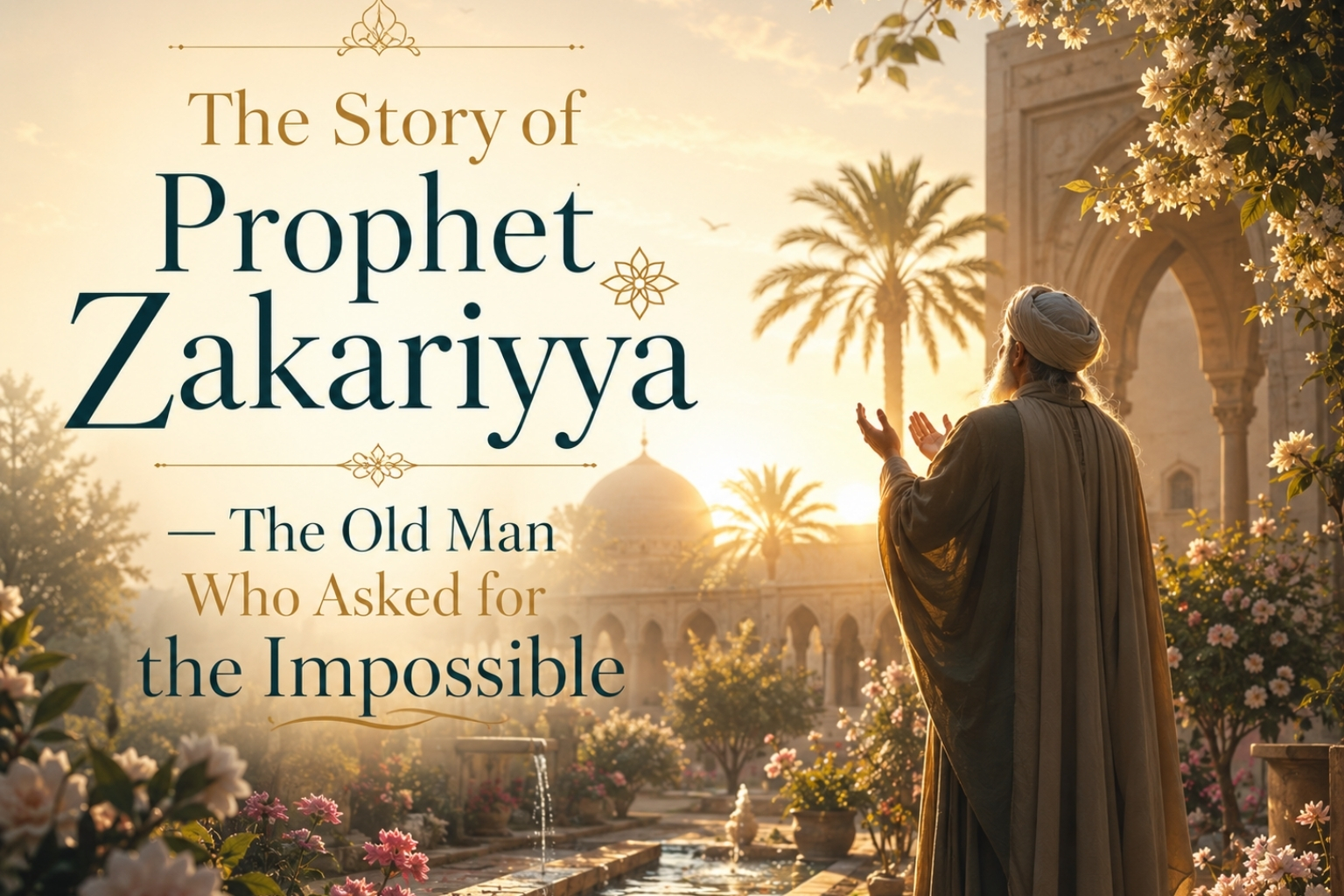
Prophet Zakariyya, peace be upon him, was an old man. His wife was barren. His body had reached the stage where even his bones had become weak from age. He had lived a long life of worship and service — and one longing had never left him: a son who would inherit his prophethood and continue the prophetic mission after him.
By the time he made his prayer — recorded in the Quran in two different chapters, each narration adding depth to the other — the request was, by any human measure, closed. The door had not just been shut. It had been locked, sealed, and the key had long since been lost.
He knocked anyway.
And the One who holds the keys to everything opened it.
Chapter One — The Guardian of Maryam: A Man Who Saw a Sign
Zakariyya, peace be upon him, was a prophet of Bani Israel — a priest of the Temple in Jerusalem, a man of extraordinary piety and learning who had dedicated his life to the worship and service of Allah. He was appointed as the guardian of Maryam, peace be upon her — the young woman who would later become the mother of Prophet Isa, peace be upon him — and it was in the context of this guardianship that the moment came which ignited his prayer.
Allah describes it:
Quran Verse:
كُلَّمَا دَخَلَ عَلَيْهَا زَكَرِيَّا الْمِحْرَابَ وَجَدَ عِندَهَا رِزْقًا ۖ قَالَ يَا مَرْيَمُ أَنَّىٰ لَكِ هَٰذَا ۖ قَالَتْ هُوَ مِنْ عِندِ اللَّهِ ۖ إِنَّ اللَّهَ يَرْزُقُ مَن يَشَاءُ بِغَيْرِ حِسَابٍ
“Every time Zakariyya entered upon her in the prayer chamber, he found with her provision. He said: ‘O Maryam, from where is this coming to you?’ She said: ‘It is from Allah. Indeed, Allah provides for whom He wills without account.'”
Surah Al-Imran (3:37)
Out-of-season fruit. Provision appears in Maryam’s chamber with no earthly explanation. Zakariyya — a man who had spent his life in the service of Allah, who understood divine power better than almost anyone alive — saw this and felt something shift inside him.
If Allah provides for Maryam without account — without limit, without the constraints of season or logic — then what is impossible for Allah? What prayer is too large for the One who sends summer fruit in winter to a young woman in a prayer chamber?
And the longing that had lived in Zakariyya’s heart for decades — the longing for a son — rose up and became a prayer.
Chapter Two — The Prayer in Secret: How Zakariyya Called Upon Allah
What Zakariyya did next is described in Surah Maryam in one of the most beautiful passages in the entire Quran — a window into the intimate, private prayer of a prophet who understood exactly who he was speaking to:
Quran Verse:
إِذْ نَادَىٰ رَبَّهُ نِدَاءً خَفِيًّا ﴿٣﴾ قَالَ رَبِّ إِنِّي وَهَنَ الْعَظْمُ مِنِّي وَاشْتَعَلَ الرَّأْسُ شَيْبًا وَلَمْ أَكُن بِدُعَائِكَ رَبِّ شَقِيًّا ﴿٤﴾ وَإِنِّي خِفْتُ الْمَوَالِيَ مِن وَرَائِي وَكَانَتِ امْرَأَتِي عَاقِرًا فَهَبْ لِي مِن لَّدُنكَ وَلِيًّا ﴿٥﴾ يَرِثُنِي وَيَرِثُ مِنْ آلِ يَعْقُوبَ ۖ وَاجْعَلْهُ رَبِّ رَضِيًّا
“When he called to his Lord a private call. He said: ‘My Lord, indeed my bones have weakened, and my head has filled with white hair, and never have I been in my supplication to You, my Lord, unhappy. And indeed, I fear the successors after me, and my wife has been barren, so give me from Yourself an heir — who will inherit me and inherit from the family of Yaqub. And make him, my Lord, pleasing to You.'”
Surah Maryam (19:3–6)
Read this prayer slowly. Every phrase is a masterclass in how to come before Allah:
“A private call” — nida’an khafiyyan — he did not pray loudly. He did not perform his prayer for others. He called Allah privately, quietly, in the intimacy of a conversation between a servant and his Lord. The Quran honors this quality of his prayer by describing it in the very first verse of the account.
“My bones have weakened” — He began by honestly naming his state. Not pretending to be stronger than he was. Not beginning with a declaration of his own worthiness. He laid the reality before Allah: I am old. My body is telling me it is late. I know it.
“My head is filled with white hair” — The physical evidence of age, named honestly. He was not hiding his circumstances from Allah — who already knew them — but engaging in the deeply human and deeply honoring act of bringing your complete reality to the One who can address it.
“Never have I been unhappy in my supplication to You” — This is the heart of the prayer’s spiritual architecture. I have called upon You my entire life, and You have never left me disappointed. Not claiming that everything he ever asked for was given in the form he requested. But claiming something deeper — that every time he came to Allah in prayer, he left in a state of contentment, because Allah always responded in the way that was best. This was his testimony of a lifetime’s relationship with Allah in prayer — and he offered it as the foundation for this, his most impossible request.
“My wife has been barren” — He named the specific obstacle. Not circumventing it, not pretending it did not exist. Allah already knew. But naming it was an act of complete transparency — coming to Allah with nothing hidden, not even the very thing that made the request seem impossible.
“Give me from Yourself an heir” — Min ladunka — from Yourself. This phrase is crucial. He was not asking Allah to work within the boundaries of what was biologically possible. He was asking Allah to act from His own divine resources — from the place where nothing is impossible because there is no limitation, no constraint, no boundary that applies.
“And make him pleasing to You” — The final and most important request. Not just a son. A son who pleases Allah. He asked for a child — and then immediately asked that the child be given the most important quality a human being can possess. The prayer was not ultimately about Zakariyya’s longing. It was about the continuation of Allah’s guidance.
Chapter Three — The Angels Answer: Good News in the Prayer Chamber
Zakariyya made his private prayer. And Allah answered — not after a long wait, not after years of renewed hoping, but immediately, while Zakariyya was still standing in prayer:
Quran Verse:
فَنَادَتْهُ الْمَلَائِكَةُ وَهُوَ قَائِمٌ يُصَلِّي فِي الْمِحْرَابِ أَنَّ اللَّهَ يُبَشِّرُكَ بِيَحْيَىٰ مُصَدِّقًا بِكَلِمَةٍ مِّنَ اللَّهِ وَسَيِّدًا وَحَصُورًا وَنَبِيًّا مِّنَ الصَّالِحِينَ
“So the angels called him while he was standing in prayer in the chamber: ‘Indeed, Allah gives you good tidings of Yahya, confirming a word from Allah and honorable, abstaining from women, and a prophet from among the righteous.'”
Surah Al-Imran (3:39)
The angels called to him while he was still praying. The answer came before he had even finished the conversation with Allah.
And the answer was not just “you will have a son.” It came with a full description of who this son would be:
“Confirming a word from Allah” — Yahya would confirm Isa, peace be upon him, who is called in the Quran “a word from Allah.” He would be a prophet whose mission was to prepare the way for Isa.
“Honorable” — Sayyidan — a leader, a master, a man of dignity and standing among his people.
“Abstaining” — Hasoorun — described by scholars as meaning he was free from the distractions of worldly desire, singularly focused on his worship and mission.
“A prophet from among the righteous” — The highest confirmation of his station.
Zakariyya had asked for an heir. Allah gave him a prophet.
Chapter Four — The Human Response: How Can This Be?
Even a prophet — even a man of complete faith who had spent his life trusting Allah — had a human moment when the announcement arrived. Zakariyya asked the question that is perhaps the most relatable moment in his entire story:
Quran Verse:
قَالَ رَبِّ أَنَّىٰ يَكُونُ لِي غُلَامٌ وَكَانَتِ امْرَأَتِي عَاقِرًا وَقَدْ بَلَغْتُ مِنَ الْكِبَرِ عِتِيًّا
“He said: ‘My Lord, how will I have a boy when my wife has been barren and I have reached extreme old age?'”
Surah Maryam (19:8)
“How will this be?” — Not a refusal. Not disbelief. Not the rejection of the promise. But the honest, human question of a man whose mind and body know what they know — and who is trying to understand how what Allah has promised will actually happen.
This moment is important because it is Allah’s permission for our humanity. Zakariyya was not rebuked for asking how. He was not told his question demonstrated insufficient faith. Allah answered him — directly, clearly, with a statement that closes the how question with the only answer that has ever been necessary:
Quran Verse:
قَالَ كَذَٰلِكَ قَالَ رَبُّكَ هُوَ عَلَيَّ هَيِّنٌ وَقَدْ خَلَقْتُكَ مِن قَبْلُ وَلَمْ تَكُ شَيْئًا
“He said: ‘It will be so. Your Lord says: It is easy for Me, for I created you before, while you were nothing.'”
Surah Maryam (19:9)
“It is easy for me.” — Three words that answer every “how.” The One who created Zakariyya from nothing does not find the creation of a child from two elderly parents difficult. The One who brought existence itself into being from absolute nothingness is not challenged by a biological limitation.
“I created you before, while you were nothing.” — Allah reminded Zakariyya of his own origin. Before Zakariyya existed, there was no Zakariyya — no bone, no breath, no heartbeat, no thought. And yet here he stood, fully formed, fully alive, asking how a child was possible. The question answered itself in the asker.
Chapter Five — The Sign and The Silence: Three Days Without Speech
After receiving the news, Zakariyya asked for a sign — a confirmation that the promise would be fulfilled:
Quran Verse:
قَالَ رَبِّ اجْعَل لِّي آيَةً ۖ قَالَ آيَتُكَ أَلَّا تُكَلِّمَ النَّاسَ ثَلَاثَةَ أَيَّامٍ إِلَّا رَمْزًا ۗ وَاذْكُر رَّبَّكَ كَثِيرًا وَسَبِّحْ بِالْعَشِيِّ وَالْإِبْكَارِ
“He said: ‘My Lord, make for me a sign.’ He said: ‘Your sign is that you will not speak to the people for three days except by gesture. And remember your Lord much and exalt Him in the evening and the morning.'”
Surah Al-Imran (3:41)
The sign was silence. For three days, Zakariyya would not be able to speak to people — not from illness, not from choice, but as a divine sign marking the period of the promise’s initiation. He could gesture. He could communicate non-verbally. But his voice — which had called people to Allah for his entire prophetic life — was suspended for three days as a marker of something extraordinary in process.
And in those three days of enforced silence — what was he told to do? “Remember your Lord much and exalt Him in the evening and the morning.”
No speech to people. Uninterrupted speech to Allah.
The sign was not just a confirmation for Zakariyya. It was a gift — three days of being unable to do anything except glorify Allah, remember Him, turn toward Him completely, with no other conversation possible.
Zakariyya went out to his people and communicated by gesture — and they understood:
Quran Verse:
فَخَرَجَ عَلَىٰ قَوْمِهِ مِنَ الْمِحْرَابِ فَأَوْحَىٰ إِلَيْهِمْ أَن سَبِّحُوا بُكْرَةً وَعَشِيًّا
“So he came out to his people from the prayer chamber and signaled to them to exalt Allah in the morning and evening.”
Surah Maryam (19:11)
Even in his silence, he was calling people to Allah. Even unable to speak, his first act was to gesture toward the glorification of Allah. This is the prophet’s nature — the mission does not pause because the voice is temporarily suspended. It finds another way.
Chapter Six — Yahya Is Born: The Gift That Answered the Prayer
Yahya, peace be upon him, was born. The impossible happened. An elderly man and his barren wife became the parents of a prophet — just as Ibrahim and Sarah had before them, just as Imran’s wife would later pray for a child and receive Maryam.
Allah describes the gift given to Yahya with words of extraordinary beauty and density:
Quran Verse:
يَا يَحْيَىٰ خُذِ الْكِتَابَ بِقُوَّةٍ ۖ وَآتَيْنَاهُ الْحُكْمَ صَبِيًّا ﴿١٢﴾ وَحَنَانًا مِّن لَّدُنَّا وَزَكَاةً ۖ وَكَانَ تَقِيًّا ﴿١٣﴾ وَبَرًّا بِوَالِدَيْهِ وَلَمْ يَكُن جَبَّارًا عَصِيًّا ﴿١٤﴾ وَسَلَامٌ عَلَيْهِ يَوْمَ وُلِدَ وَيَوْمَ يَمُوتُ وَيَوْمَ يُبْعَثُ حَيًّا
“O Yahya, take the scripture with determination. And We gave him judgement while still a boy — and affection from Us and purity — and he was fearing of Allah — and dutiful to his parents — and he was not a disobedient tyrant. And peace be upon him the day he was born and the day he dies and the day he is raised alive.”
Surah Maryam (19:12–15)
Every quality named here was an answer to a specific part of Zakariyya’s prayer:
“Take the scripture with determination” — He would be an inheritor of the prophetic mission, taking it seriously and with strength.
“Judgment while still a boy” — He would carry wisdom beyond his years — a sign of Allah’s direct gift rather than mere human development.
“Affection from Us” — Hanan — a divine warmth, a tenderness of heart that was itself a gift from Allah, not a product of upbringing alone.
“Fearing of Allah” — The quality Zakariyya had prayed for: a son who was righteous before Allah.
“Dutiful to his parents” — The child who had been given as an answer to a father’s longing honored that father with his obedience.
“Peace be upon him the day he was born and the day he dies and the day he is raised alive” — The divine salutation that marks Yahya as permanently, completely honored by Allah — in this life, in death, and in resurrection.
Chapter Seven — The Legacy of Zakariyya: Teaching Through the Act of Asking
Zakariyya did not only leave a son as his legacy. He left a prayer — and the courage to make it.
Allah preserved his prayer in two chapters of the Quran. He preserved the intimate details of how Zakariyya came before Him — privately, honestly, naming his weakness, remembering his history of answered du’a, asking from Allah’s own resources rather than from the boundaries of the possible. And He preserved Zakariyya’s human question — how will this be? — and His own answer — it is easy for Me.
Together, they form one of the most complete guides to prayer in the entire Quran:
Come privately. Come honestly. Name your weakness. Remind yourself and Allah of your history with Him. Ask from His resources, not from the limits of what seems possible. And when He answers — even when the answer is larger than the request — receive it with the same honesty that produced the prayer.
Hadith:
إِنَّ اللَّهَ يَسْتَحْيِي مِنْ عَبْدِهِ إِذَا رَفَعَ إِلَيْهِ يَدَيْهِ أَنْ يَرُدَّهُمَا صِفْرًا
“Indeed, Allah is shy to let His servant raise his hands to Him and then return them empty.”
Recorded in Sunan Abu Dawud, Hadith No. 1488, authenticated by Al-Albani
Allah is shy — yastahi — to return the hands of a praying servant empty. Zakariyya raised his hands in the most impossible-seeming prayer of his life. And Allah could not return those hands empty — because that is not who Allah is.
This hadith is the theological foundation of Zakariyya’s courage in asking. He knew — from a lifetime of prayer, from his testimony that he had never been unhappy in his supplication — that Allah does not leave raised hands unfilled. So he raised his hands. With his weakened bones. With his white hair. With his barren wife’s reality laid honestly before Allah.
And Allah filled them. With a prophet.
Timeless Lessons from the Story of Zakariyya
- The courage to ask for the impossible is itself a form of worship Zakariyya did not convince himself the prayer was reasonable before making it. He made it because he knew who he was asking. The willingness to bring your most impossible longing before Allah — without the false modesty of deciding it is too much to ask — is itself an act of faith that honors Allah’s capacity.
- Your history with Allah in prayer is itself a foundation for new prayers “Never have I been unhappy in my supplication to You.” He invoked his own history of answered prayer as part of the case for this one. Every time Allah has responded to your prayer in the past — every answered du’a, every difficulty resolved, every door opened — is material for your next prayer. Remember what Allah has already done. It strengthens the ground beneath your asking.
- Name your weakness before Allah — it is not a disqualification, it is an honest opening Zakariyya named his weakened bones, his white hair, his wife’s barrenness. He laid every obstacle before Allah rather than pretending they did not exist. Coming to Allah with your complete reality — including what makes the request seem impossible — is the most honest and most honored form of prayer.
- “How will this be?” is a valid question — and Allah answers it Zakariyya asked how. He was not rebuked. He answered: “It is easy for me.” You are permitted to ask Allah how the impossible will unfold. He will answer — not always with a detailed explanation, but with the reminder that His capacity is not bound by the limits that make your question necessary.
- Ask from Allah’s resources, not from the boundaries of the possible “Give me from Yourself” — min ladunka. This phrase transforms a prayer from a request within human possibility into a request from divine abundance. When you come to Allah, come asking from what He has — which is unlimited — not from what the circumstances permit — which is always limited.
- The sign of confirmation may be a gift in disguise Zakariyya asked for a sign and received three days of silence — which became three days of uninterrupted glorification of Allah. What Allah gives as a sign often contains a blessing beyond the confirmation itself. Receive the gifts hidden within the signs.
- A child who pleases Allah is worth more than a child who pleases the world Zakariyya asked for an heir — and then asked that he be pleasing to Allah. The second part of the request was the more important one. The legacy we build through our children is not primarily about what they inherit materially or professionally. It is about whether they inherit the relationship with Allah that makes everything else worthwhile.
Closing Reflection
An old man stood in a prayer chamber. His bones were weak. His hair was white. His wife had never been able to conceive. Every biological and rational indicator said: this chapter is closed.
He prayed anyway. Quietly. Privately. Honestly. With the confidence of a man who had spent a lifetime calling upon Allah and had never left a prayer without having been heard.
And the angels called to him — while he was still praying — with news of a son named Yahya, a prophet, a leader, a man of divine affection and extraordinary wisdom, honored with Allah’s own salutation across the three thresholds of existence: birth, death, and resurrection.
Zakariyya left us two things that will outlast every empire and every civilization:
A son — Prophet Yahya — whose story is its own chapter of the Quran, whose mission prepared the way for Isa, whose life was itself a miracle of divine mercy.
And a prayer — kept in Allah’s Book forever — that shows every believer in every generation how to stand before Allah when what you are asking for seems impossible:
Quran Verse:
رَبِّ إِنِّي وَهَنَ الْعَظْمُ مِنِّي وَاشْتَعَلَ الرَّأْسُ شَيْبًا وَلَمْ أَكُن بِدُعَائِكَ رَبِّ شَقِيًّا
“My Lord, indeed my bones have weakened and my head has filled with white hair, and never have I been in my supplication to You, my Lord, unhappy.”
Surah Maryam (19:4)
Whatever door looks closed to you — whatever request feels too large, too late, too impossible — remember an old man in a prayer chamber, his bones weak, his hair white, who had never stopped calling.
Allah answered him while he was still praying.
He will answer you too.