

There is a verse in the Quran that moves, in a single sentence, from the highest theological principle to the most intimate human relationship.
It begins with Allah — with His decree, with the absolute command that nothing in creation be worshipped except Him. It begins at the summit. The most fundamental truth in all of existence: la ilaha illa Allah. There is no deity but Allah. Worship belongs to Him alone.
And then, without pause, without transition, in the same verse — it descends to a specific person in a specific room. An elderly parent. Perhaps struggling to speak. Perhaps struggling to move. Perhaps struggling with the loss of the dignity they once had. And the verse descends all the way to that room, to that moment, and says: do not say uff to them. Do not let a single syllable of impatience escape you in their presence.
From the throne of divine sovereignty to the chair of an aging parent — in one verse.
This is Surah Al-Isra (17:23). And its architecture is not accidental. The scholars have spent centuries reflecting on why Allah chose to follow the greatest command with this specific human situation, what the connection between tawhid and the treatment of parents reveals about the nature of Islam, and what the verse says about the kind of religion Allah designed — one in which the highest spiritual truth and the most ordinary human relationship are not separate categories but a single, continuous act of worship.
This is the complete tafsir of that verse — its context, its grammar, its movement from theology to tenderness, and every layer of meaning that makes it one of the most complete statements about what it means to be a believing human being in the Quran.
The Full Verse: Arabic and English
وَقَضَىٰ رَبُّكَ أَلَّا تَعْبُدُوا إِلَّا إِيَّاهُ وَبِالْوَالِدَيْنِ إِحْسَانًا ۚ إِمَّا يَبْلُغَنَّ عِندَكَ الْكِبَرَ أَحَدُهُمَا أَوْ كِلَاهُمَا فَلَا تَقُل لَّهُمَا أُفٍّ وَلَا تَنْهَرْهُمَا وَقُل لَّهُمَا قَوْلًا كَرِيمًا
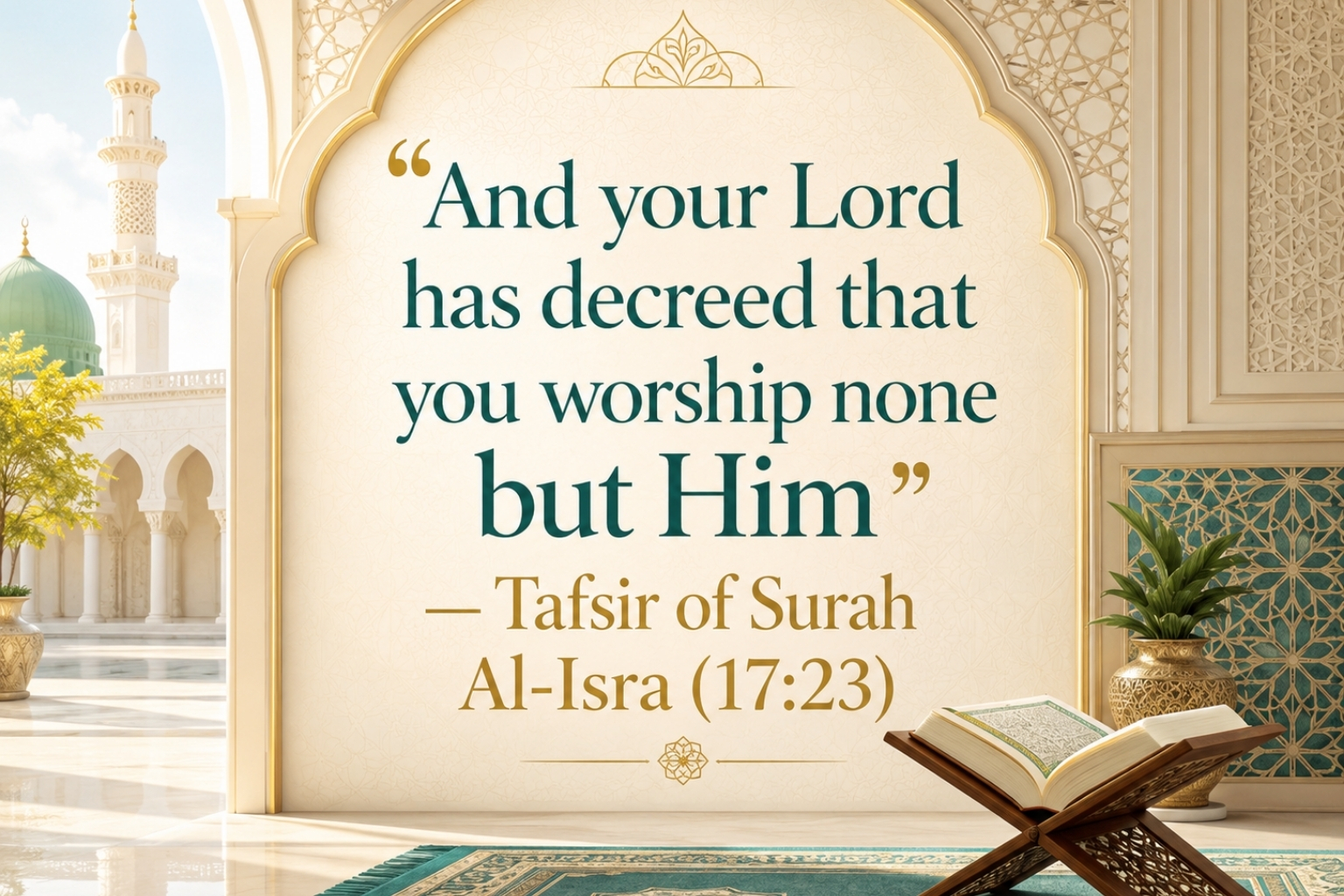
“And your Lord has decreed that you worship none but Him, and that you be dutiful to parents. Whether one or both of them reach old age while with you, say not to them a word of contempt nor repel them but address them in terms of honor.”
Surah Al-Isra (17:23)
The Surah: What Is Al-Isra?
Surah Al-Isra — “The Night Journey” — is the seventeenth chapter of the Quran, named after the miraculous night journey of the Prophet Muhammad ﷺ from Makkah to Jerusalem and then to the heavens, described in its opening verse. It is a Makkan surah, revealed during the late Makkan period — one of the most difficult phases of the prophetic mission, when the persecution of the believers was intense and the year of sorrow, in which the Prophet ﷺ had lost both Khadijah RA and Abu Talib, had just passed.
The surah addresses the Children of Isra’il ﷺ, reflects on the history of prophethood and its rejection, discusses the Quran and its nature, and contains a remarkable passage — beginning at verse 23 and continuing through verse 38 — that is one of the most comprehensive moral codes in the entire Quran. The scholars call it the Wasaya — the commandments — of Surah Al-Isra. It is the Quranic equivalent, in the depth and comprehensiveness of its moral instruction, of the Ten Commandments.
And this passage — the most concentrated moral teaching in a surah named after a miracle — begins not with the prohibition of murder or theft or false witness, but with these two things: the worship of Allah alone, and the treatment of parents.
The Context: Why These Two Together?
The pairing of tawhid — the oneness of Allah — with the rights of parents is not unique to this verse. It is a recurring structural feature of the Quran that the scholars have always treated as one of the most revealing facts about Islamic theology.
Allah describes the covenant taken from the Children of Isra’il ﷺ:
وَإِذْ أَخَذْنَا مِيثَاقَ بَنِي إِسْرَائِيلَ لَا تَعْبُدُونَ إِلَّا اللَّهَ وَبِالْوَالِدَيْنِ إِحْسَانًا
“And when We took the covenant of the Children of Israel: Worship none but Allah, and be good to parents…”
Surah Al-Baqarah (2:83)
Allah says:
وَاعْبُدُوا اللَّهَ وَلَا تُشْرِكُوا بِهِ شَيْئًا ۖ وَبِالْوَالِدَيْنِ إِحْسَانًا
“Worship Allah and associate nothing with Him, and to parents do good…”
Surah An-Nisa (4:36)
Allah says:
أَنِ اشْكُرْ لِي وَلِوَالِدَيْكَ
“Be grateful to Me and to your parents.”
Surah Luqman (31:14)
The scholars ask: why, consistently, across multiple surahs, does Allah place the rights of parents immediately after or directly alongside His own right of worship?
Imam Al-Qurtubi’s answer: because the parent is, in the human world, the closest analogue to the Creator. Allah brought the person into existence from nothing — the parent was the means through which that existence was channeled into the world. Allah sustains the person at every moment — the parent sustained the person through helplessness into capability. Gratitude to Allah and gratitude to parents flow from the same root: the acknowledgment of having received what you could not have given yourself.
Ibn Al-Qayyim adds a dimension that cuts even deeper: the connection between tawhid and the treatment of parents is a statement about the nature of worship itself. Worship is not merely the rituals of prayer and fasting. It is the orientation of the entire human being — every relationship, every interaction, every choice — toward Allah. The person who prays perfectly and treats their parents with contempt has not understood what worship means. The person who honors their parents as an act directed toward Allah — who understands that the care given to the aging parent is itself an act of worship — has understood something fundamental about how Islam integrates the vertical relationship with Allah and the horizontal relationships with people.
Word by Word: The Theology of Every Phrase
وَقَضَىٰ رَبُّكَ — “And your Lord has decreed”
Wa Qada Rabbuk — and your Lord has decreed. The word Qada is one of the weightiest verbs in the Arabic language. It means to judge, to decree, to determine with finality — with an authority from which there is no appeal and no exemption. When a human judge Qada — renders a verdict — it is binding within the domain of their authority. When Allah Qada — decrees — it is binding absolutely, universally, for all time.
The scholars note the significance of this word over the alternatives. Allah could have said amara — commanded. He could have said Awsaka — enjoined. He chose Qada — decreed — the word of supreme, unalterable finality. This is not a suggestion. Not a recommendation. Not a preference. A divine decree.
Rabbuka — your Lord. Not “the Lord.” Not “Allah” — though both would be accurate and powerful. Your Lord — the possessive that establishes a personal relationship. The decree comes from the One who is specifically, personally, your Lord. The One who created you, sustains you, guides you, and to whom you are returning. The authority behind the decree is not an impersonal divine governance — it is your specific Lord’s specific decree for you.
أَلَّا تَعْبُدُوا إِلَّا إِيَّاهُ — “That you worship none but Him”
Alla ta’budu illa iyyahu — that you not worship except Him.
Ta’budu — you worship. The root ‘ibadah’ in Arabic encompasses far more than the rituals of prayer. The scholars define ‘ibadah as every act — inward and outward — that Allah loves and is pleased with. It includes prayer, fasting, charity, remembrance, and recitation — but also honesty, patience, gratitude, fulfilling promises, treating people well, and — as the verse immediately demonstrates by its next phrase — honoring parents. All of these are ‘ibadah.
Illa iyyahu — except Him. The construction is emphatic: iyyahu places the pronoun at the end with a force that underlines exclusivity. Not “worship mainly Him” or “worship Him above others.” Except Him. The exclusion is total. Every other potential object of ultimate devotion, ultimate reliance, ultimate hope — eliminated. Only Allah.
وَبِالْوَالِدَيْنِ إِحْسَانًا — “And be dutiful to parents”
Wa bil-walidayni ihsana — and toward the two parents, ihsan.
The verse does not say “be good to parents” — as most translations render it — and leave the standard of goodness undefined. It uses a specific word: ihsan.
Ihsan is the highest word in Islamic ethics for excellence in conduct. It is the same word the Prophet Muhammad ﷺ used when Jibreel ﷺ asked him to define the peak of worship: Ihsan is that you worship Allah as if you see Him, and if you do not see Him, know that He sees you. It is the word of spiritual excellence, of doing the thing better than it needs to be done, of going beyond the minimum and approaching the ideal.
This is the standard Allah sets for the treatment of parents: not adequate care, not avoiding neglect, not meeting a minimum threshold. Ihsan — excellence. The best possible treatment. The treatment that reflects an awareness that this care is being given in Allah‘s sight, as an act of worship directed toward Him.
The scholars note that the verse does not specify what ihsan toward parents looks like in practice — because the details vary. What ihsan means for a parent who is healthy is different from what it means for a parent who is ill. What it means when a parent is far is different from when they are near. The standard — ihsan, excellence — is fixed. The expression of it in each specific situation is left to the believer to determine, guided by the surah’s subsequent verses.
The Old Age Clause: The Verse’s Emotional Heart
إِمَّا يَبْلُغَنَّ عِندَكَ الْكِبَرَ أَحَدُهُمَا أَوْ كِلَاهُمَا
“Whether one or both of them reach old age while with you…”
Surah Al-Isra (17:23)
The verse now descends from the principle to the specific scenario — and the scenario chosen is deeply revealing.
In ma Yablughanna ‘indaka al-kibara — if they reach old age while with you. The word kibara — old age — describes the condition of advanced age: diminished strength, perhaps diminished cognition, increased dependence, the reversal of the parent-child dynamic in which the child who was once entirely dependent is now the one upon whom the parent depends.
‘Indaka — with you. In your presence. In your home. In your care. The verse is describing the most demanding scenario — not the parent who lives independently and is visited occasionally, but the parent who is with you, in your space, in your daily life, requiring your attention and your patience.
Why does the verse specify old age rather than parents in general? Because old age is the test. The scholars are clear on this: it is relatively easy to honor parents when they are capable, independent, and at the height of their dignity. The real test — the situation that most taxes the human capacity for patience and ihsan — is when the parent is old. When they repeat themselves. When they need help with things they once did easily. When they have moods that are difficult. When the role reversal is complete and the child has become the caregiver of the person who once cared for them.
Allah chose this scenario — the hardest one — as the setting for the verse’s specific instructions. Not because the easier situations do not require ihsan, but because the harder ones require it most — and are most at risk of failing.
Uff: The Minimum Prohibition
فَلَا تَقُل لَّهُمَا أُفٍّ
“Say not to them a word of contempt…”
Surah Al-Isra (17:23)
Fa la taqul lahuma uff — so do not say to them uff.
Uff — this is the smallest unit of verbal disrespect in the Arabic language. It is the sound of exasperation, of impatience, the syllable a person makes when they are irritated. The sigh turned into a sound. The tsk of annoyance. In Arabic, it is the least significant possible verbal expression of displeasure.
And Allah prohibited it.
The scholars have always reflected on this with a sense of wonder: Allah prohibited the very minimum of disrespect. Not shouting — the minimum. Not insults — the minimum. Not neglect or cruelty — the minimum syllable of impatience.
The rule in Islamic jurisprudence is: when Allah prohibits the minimum, everything above the minimum is prohibited by implication. If Uff is forbidden — the sigh, the exasperated exhale, the single syllable of irritation — then raising the voice is more forbidden. Harsh words are more forbidden. Dismissiveness is more forbidden. Neglect is far more forbidden.
Allah did not need to list every form of disrespect. He prohibited the lowest denominator, and in that single prohibition enclosed everything that lies above it. No level of verbal or behavioral disrespect toward the parent in old age is permissible — because even the smallest, most instinctive, most socially normalized expression of impatience was prohibited by name.
The scholars also reflect on what makes Uff such a precise and revealing choice: it is the kind of disrespect that escapes without thinking. It is not a calculated insult. It is the reflexive response to being asked something for the tenth time, to being interrupted at a busy moment, to the inconvenience of the caregiving situation. It is the sound the human being makes when their patience runs out in a small way, before it has reached the level they would consciously control.
Allah went all the way down to that level. Even that — the automatic, reflexive, barely-conscious syllable of exasperation — is prohibited in the presence of aging parents.
وَلَا تَنْهَرْهُمَا — “Nor repel them”
Wa la tanharhuma — nor drive them away, rebuff them, push them off.
Nahara — to rebuff, to brush aside, to respond to a request with a rough dismissal. The parent who asks something and is told “not now, I’m busy” with a tone of dismissal. The parent who approaches and is waved off. The parent whose request is answered with an impatient “I already told you that.”
The verse prohibits both the sound (uff) and the action (nahara). The interior expression of impatience and the exterior behavioral expression of it. Both are forbidden. The full range of dismissiveness — from the reflexive syllable to the active rebuff — is closed.
وَقُل لَّهُمَا قَوْلًا كَرِيمًا — “But address them in terms of honor”
Wa qul lahuma qawlan karima — and speak to them a speech that is karim.
Karim — noble, generous, honorable, dignified. The same word used in the Quran for Allah‘s noble Throne, for the noble Quran, for the noble angel Jibreel ﷺ. A word of the highest register of honor.
The verse does not simply say: be polite. It says: speak to them with the speech that befits their dignity. Qawlan kariman — the speech of nobility, of honor, of genuine respect given to someone whose station in your life is immense.
The scholars note the movement of the verse: from the prohibited (uff, rebuffing) to the commanded (qawlan kariman). It is not enough to simply avoid disrespect. The obligation is affirmative: speak to them with honor. The absence of bad speech is not sufficient — the presence of good speech is required. Ihsan toward parents is not merely the removal of harm but the active provision of goodness, honor, and tenderness in how they are addressed.
The Verse That Follows: Wings of Humility
The tafsir of verse 23 is incomplete without verse 24 — which continues and deepens everything established in the preceding verse:
وَاخْفِضْ لَهُمَا جَنَاحَ الذُّلِّ مِنَ الرَّحْمَةِ وَقُل رَّبِّ ارْحَمْهُمَا كَمَا رَبَّيَانِي صَغِيرًا
“And lower to them the wing of humility out of mercy and say: My Lord, have mercy upon them as they raised me when I was young.”
Surah Al-Isra (17:24)
Wakhfid lahuma Janaha al-dhull min al-rahmah — lower to them the wing of humility out of mercy. The image is of a bird lowering its wing to protect its young — an image of tender, enveloping care. Allah takes this image of parental tenderness — the protective lowering of the wing — and asks the adult child to direct it back toward the parent.
Min al-rahmah — out of mercy. Not out of obligation. Not out of social duty. Out of the same mercy the parent showed when the child was dependent. The child who was once helpless and was raised with mercy is now being asked to return that mercy — to lower their wing of humility not because they are required to but because they feel it, because the mercy that was given to them has produced mercy within them.
And then the prayer — one of the most beautiful prayers in the entire Quran:
Wa qul Rabbi irhamhuma kama rabbayani saghiran — My Lord, have mercy on them as they raised me when I was small.
Kama rabbayani saghiran — as they raised me when I was small. The child remembers. The adult who is now capable, independent, perhaps strong and established and successful — they were once small. Once entirely helpless. Once entirely dependent on these two people for survival. The remembrance of that smallness is the foundation of the mercy the verse asks for.
The prayer does not ask Allah to give the parents wealth or health or worldly comfort specifically. It asks for the most comprehensive possible divine gift: mercy. The same mercy that the parent gave in their own imperfect, human way — mirrored back to them from Allah, who does it perfectly and completely.
The scholars note that this prayer is one of the greatest gifts a child can give a parent — because it asks Allah directly to show them mercy. And Allah‘s mercy toward those for whom it is sincerely requested is among the most certain of divine responses.
The Hadith Dimension: What the Prophet ﷺ Added
The Prophet Muhammad ﷺ expanded on the teaching of this verse in multiple hadith that the scholars always read alongside the verse.
In the most famous of them:
جَاءَ رَجُلٌ إِلَى رَسُولِ اللَّهِ ﷺ فَقَالَ: يَا رَسُولَ اللَّهِ، مَنْ أَحَقُّ النَّاسِ بِحُسْنِ صَحَابَتِي؟ قَالَ: أُمُّكَ. قَالَ: ثُمَّ مَنْ؟ قَالَ: أُمُّكَ. قَالَ: ثُمَّ مَنْ؟ قَالَ: أُمُّكَ. قَالَ: ثُمَّ مَنْ؟ قَالَ: أَبُوكَ
“A man came to the Messenger of Allah ﷺ and said: O Messenger of Allah, who among people is most deserving of my good companionship? He said: Your mother. He said: Then who? He said: Your mother. He said: Then who? He said: Your mother. He said: Then who? He said: “Your father.”
Recorded in Sahih Al-Bukhari, Hadith No. 5971
Three times the mother. Then the father. The scholars reflect: the threefold repetition is not accidental. The mother endured three things the father did not: the difficulty of pregnancy, the pain of childbirth, and the labor of nursing. Three stages of specific, physical, irreplaceable sacrifice — each one responded to by the Prophet ﷺ with a mention of the mother’s right.
And in another hadith, the Prophet Muhammad ﷺ made the connection between honoring parents and the highest spiritual stakes explicit:
رِضَا الرَّبِّ فِي رِضَا الْوَالِدِ، وَسَخَطُ الرَّبِّ فِي سَخَطِ الْوَالِدِ
“The pleasure of the Lord is in the pleasure of the parent, and the anger of the Lord is in the anger of the parent.”
Recorded in Sunan Al-Tirmidhi, Hadith No. 1899
Allah‘s pleasure — the ultimate goal of every act of worship, the thing every prayer and fast and charity is directed toward — is found in the pleasure of the parent. The verse’s architecture — tawhid followed immediately by the rights of parents — is given its deepest explanation here: because Allah‘s pleasure itself is connected to how the parent is treated.
This is not metaphorical. The scholars treat it as a statement of real causal relationship: honor your parents with ihsan, and you are moving toward Allah‘s pleasure. Displease your parents through neglect or harshness, and you are moving away from it — regardless of how many prayers you have prayed.
What the Verse Says About the Nature of Islam
Among the most profound reflections in the tafsir of this verse is what it reveals about how Islam defines religion itself.
In many religious and philosophical traditions, the spiritual and the mundane are separated. It is sacred in the temple. The ethical is in the marketplace. The spiritual peak is the moment of prayer or meditation or ritual. The ordinary human relationships are separate — important, perhaps, but not sacred in the same sense.
Surah Al-Isra (17:23) collapses that separation completely.
Allah decrees the worship of Himself alone — the summit of Islamic theology — and in the same verse, in the same breath, moves to the treatment of aging parents. The implication is unmistakable: these are not two separate categories of human obligation. They are one continuous act. The worship of Allah expressed outward into how the human being treats the people around them — beginning with the people to whom the most is owed.
The person who worships Allah in their prayer and dismisses their aging parent with impatience has, in the view of this verse’s architecture, failed to understand what worship is. Because worship — ‘ibadah in its full Quranic meaning — is not the ritual alone. It is the entire life, directed toward Allah, expressed in every relationship and every choice.
The parent honored with ihsan — the aged mother addressed with qawlan kariman, the father given the wing of humility, the parent prayed over with Rabbi irhamhuma kama rabbayani saghiran — is a form of worship. Not a separate category from prayer. Prayer of the relational kind — the kind that expresses the love of Allah through the love of the people Allah commanded us to love.
A Final Reflection: From the Throne to the Chair
The verse begins at the throne: Your Lord has decreed — the language of divine sovereignty, the absolute decree of the Sovereign of the universe.
And it ends at a chair: the chair where an aging parent sits, in old age, dependent, perhaps difficult, perhaps confused, perhaps a test of everything the adult child has.
From the throne to the chair. From divine sovereignty to human tenderness. From the absolute decree that governs the universe to the single instruction — do not say uff to them — that governs a single moment in a single room.
This is what Allah considers connected. This is the moral universe Islam describes: one in which the highest spiritual truth and the most ordinary human moment are not on different planes but are part of a single, continuous fabric. A fabric in which every act of genuine care — every patient word, every tender address, every prayer made for the parent who is aging — is a thread that runs from the human being all the way to Allah.
The decree is divine. The expression is human. And the expression of it begins — as it begins in this verse — at home, with the person who first cared for you, in the moments when caring for them is the hardest.
وَقَضَىٰ رَبُّكَ أَلَّا تَعْبُدُوا إِلَّا إِيَّاهُ وَبِالْوَالِدَيْنِ إِحْسَانًا
“And your Lord has decreed that you worship none but Him, and that you be dutiful to parents.”
Surah Al-Isra (17:23)
The worship of Allah. The honor of parents. One decree. One verse. One continuous act of faith.