

There is a verse in the Quran that contains the most extraordinary exchange in the history of creation.
Not a transaction. Not a contract. Not a conditional agreement between unequal parties where one gives and the other receives. An exchange — mutual, reciprocal, personal — between Allah and the human being.
Allah speaks in the first person. He uses the singular imperative — you — addressing every human being who has ever or will ever read this verse directly and individually. And He makes a promise that, once understood, changes how a person approaches every moment of their waking life.
Remember Me — and I will remember you.
Four words in Arabic. Eight in the English translation. And within those four Arabic words — a theological depth that fourteen centuries of scholars have spent their lives exploring, a promise of divine reciprocity so staggering in its implications that the scholars have called it among the greatest gifts Allah has given to the human being in the entire Quran.
The verse does not promise wealth. It does not promise ease. It does not promise that hardship will be removed. It promises something that, once fully received, makes every other promise in the Quran feel accessible: that when you remember Allah, Allah remembers you. That the One who created the heavens and the earth, who is established above His Throne, whose Kursi encompasses the heavens and the earth — that One turns His attention specifically, personally, and completely toward you in the moment you turn toward Him.
That is the promise. This is its tafsir.
The Full Verse: Arabic and English
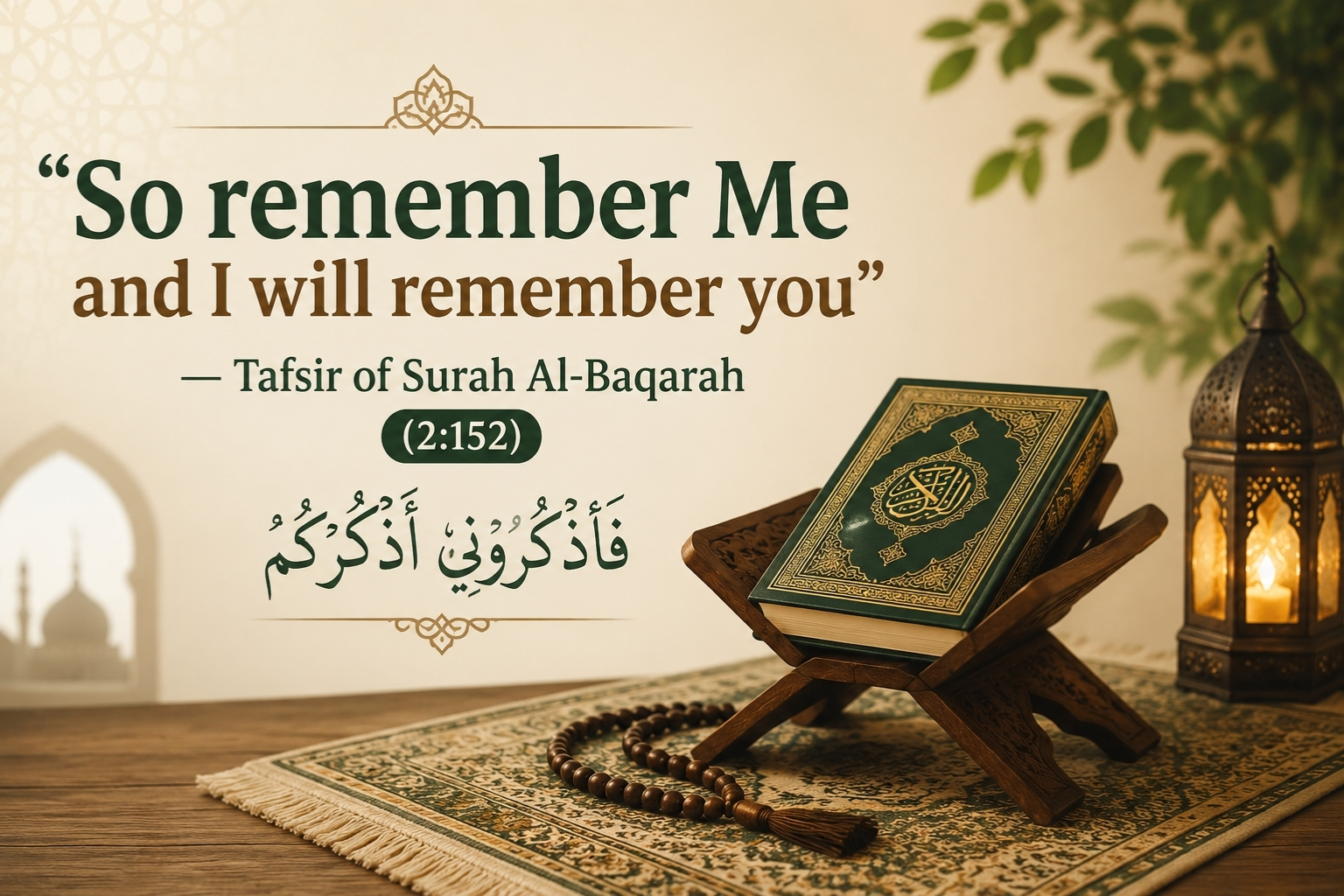
فَاذْكُرُونِي أَذْكُرْكُمْ وَاشْكُرُوا لِي وَلَا تَكْفُرُونِ
“So remember Me — I will remember you. And be grateful to Me and do not deny Me.”
Surah Al-Baqarah (2:152)
The Context: What Comes Before This Verse
Verse 152 of Surah Al-Baqarah does not arrive in isolation. It is the conclusion of a passage that begins at verse 150 — a passage about the Qibla, the direction of prayer.
Allah had just commanded the believers to turn their faces toward the Masjid Al-Haram in Makkah when they pray — a change from the previous direction of Jerusalem that was a significant trial for the early Muslim community. The hypocrites and the People of the Book used the change as an argument against the Prophet Muhammad ﷺ and the believers. The passage addresses this pressure and reassures the believers: the change was Allah‘s command, and the believer who follows it is under Allah‘s guidance.
Then comes verse 151 — the verse immediately before:
كَمَا أَرْسَلْنَا فِيكُمْ رَسُولًا مِّنكُمْ يَتْلُو عَلَيْكُمْ آيَاتِنَا وَيُزَكِّيكُمْ وَيُعَلِّمُكُمُ الْكِتَابَ وَالْحِكْمَةَ وَيُعَلِّمُكُمْ مَّا لَمْ تَكُونُوا تَعْلَمُونَ
“Just as We sent among you a messenger from yourselves reciting to you Our verses and purifying you and teaching you the Book and wisdom and teaching you that which you did not know.”
Surah Al-Baqarah (2:151)
Allah is reminding the believers of what He has already given them: a messenger who recites the verses, purifies the soul, teaches the Book and wisdom, and brings knowledge that did not exist before. These are immense gifts — the greatest gifts Allah could send to a people.
And then, having reminded them of what He has given — Allah makes a request. And the request is not worship, not sacrifice, not obligation in the legal sense. The request is: remember Me.
The fa — “so” — that opens verse 152 is the fa of consequence: because I have given you all of this, so remember Me. The remembrance is not payment for Allah‘s gifts — Allah needs nothing from His creation. It is the natural, fitting response of a heart that has received. You have been given the messenger. You have been given the Book. You have been given the purification and the wisdom and the knowledge you did not have. So — in light of all of that — remember Me.
Word by Word: The Grammar of an Exchange
فَاذْكُرُونِي — “So remember Me”
Fa-udhkuruni — the command form of dhikr, remembrance. The fa connects this command to everything that preceded it. The command is second-person plural — addressed to every believer, collectively and individually simultaneously.
The word dhikr in Arabic is far richer than the English “remember.” Its root dh-k-r encompasses: to recall, to mention, to keep present in the mind, to speak of, to invoke. Remembering Allah — dhikr Allah — is not a passive cognitive event, like remembering where you left your keys. It is an active, intentional act of keeping Allah present. It is the opposite of ghaflah — heedlessness, the state of forgetting, of moving through life without awareness of Allah.
The scholars identify dhikr as having multiple forms:
Dhikr of the tongue — the explicit verbal remembrance: subhanallah, alhamdulillah, Allahu akbar, la ilaha illa Allah, recitation of the Quran, supplication, the words of prayer.
Dhikr of the heart — the internal awareness: thinking of Allah, reflecting on His attributes, meditating on His signs, turning the mind toward Him in the quiet moments between words.
Dhikr of the limbs — the behavioral remembrance: every action performed in obedience to Allah, every act of worship, every choice made with the awareness of Allah‘s sight and pleasure. The person who gives charity remembering Allah is engaging in dhikr with their hand. The person who lowers their gaze for Allah‘s sake is engaging in dhikr with their eyes.
All three are intended by the command udhkuruni. Allah is not asking only for verbal utterance. He is asking for the orientation of the entire human being — heart, tongue, and limb — toward Him.
أَذْكُرْكُمْ — “I will remember you”
And then — the response. Adhkurkum — I will remember you. The same root. The same verb form. But the subject is now Allah.
The scholars have spent centuries on this single phrase — because the implications of Allah remembering a human being are beyond what any human being can fully comprehend.
What does it mean for Allah to remember you?
Imam Ibn Rajab Al-Hanbali writes that Allah‘s remembrance of the servant encompasses everything the servant could need: Allah mentioning the servant, Allah‘s attention directed toward the servant, Allah‘s mercy descending upon the servant, Allah‘s aid and support coming to the servant, Allah‘s forgiveness covering the servant. To be remembered by Allah is to be in the most complete possible state of divine care.
The Hadith Qudsi recorded in Sahih Al-Bukhari and Sahih Muslim makes this explicit:
أَنَا عِنْدَ ظَنِّ عَبْدِي بِي، وَأَنَا مَعَهُ إِذَا ذَكَرَنِي، فَإِنْ ذَكَرَنِي فِي نَفْسِهِ ذَكَرْتُهُ فِي نَفْسِي، وَإِنْ ذَكَرَنِي فِي مَلَإٍ ذَكَرْتُهُ فِي مَلَإٍ خَيْرٍ مِنْهُمْ
“I am as My servant thinks of Me. I am with him when he remembers me. If he remembers Me within himself, I remember him within Myself. If he remembers Me in an assembly, I remember him in an assembly better than it.”
Recorded in Sahih Al-Bukhari, Hadith No. 7405
The verse and this hadith are two expressions of the same reality. And the hadith adds a dimension of scale to the exchange: if you remember Allah privately, in the silence of your own chest, Allah remembers you within Himself — the most intimate divine response conceivable. If you remember Allah in an assembly of people, Allah remembers you in an assembly better than that — the assembly of the angels, the gathering of the heavenly host.
The exchange is not equal — it is in the servant’s favor. You give a private whisper of remembrance, and Allah responds with a mention in a better assembly than any you have ever sat in.
وَاشْكُرُوا لِي وَلَا تَكْفُرُونِ — “And be grateful to Me and do not deny Me”
The verse does not end with the exchange of remembrance. It adds a second command: be grateful to Me — and do not deny Me.
Ushkuru li — gratitude to Allah. The scholars always note the connection between dhikr and shukr — between remembrance and gratitude — because they are inseparable. The person who truly remembers Allah — who keeps His blessings, His gifts, His names and attributes present in their awareness — cannot help but be grateful. And the person who is genuinely grateful is in a constant state of remembering the One they are grateful to.
Allah joins them in this verse because they are two dimensions of the same orientation of the heart toward Him.
Wa la takfurun — and do not deny Me. The word kufr in this context carries both its theological meaning — disbelief — and its linguistic root: k-f-r means to cover, to conceal. To be kafir toward a blessing is to cover it, to deny it, to refuse to acknowledge it. Allah is asking: do not cover over My gifts with ingratitude. Do not act as though what I have given you was not given. Do not live in a way that treats My blessings as your own achievement or as simply the neutral background of existence.
The triad is complete: remember Me, be grateful to Me, do not deny Me. All three point to the same thing — a life lived with Allah present, acknowledged, and thanked.
The Five Dimensions of Divine Remembrance
The scholars, across multiple traditions of tafsir and spirituality, have identified five distinct ways in which the promise I will remember you is fulfilled. Each one is a form of divine remembrance that transforms the life of the one remembered.
First: Allah Mentions You Among the Angels
The hadith of the divine assembly — if you remember Me in an assembly, I remember you in an assembly better than it — is one of the most astonishing promises in all of Islamic theology. When a believer remembers Allah in a gathering, Allah mentions that believer by name among the angels.
The gathering of the angels is not a metaphor. It is the most elevated assembly in existence — beings of pure light who have never disobeyed Allah, who glorify Him perpetually, who intercede for the believers. To be mentioned among them by Allah is an honor that the human mind cannot fully contain.
The Prophet Muhammad ﷺ described the angels who specifically move through the earth seeking gatherings of dhikr — and when they find one, they surround it, call to one another, and report it to Allah. Allah, who already knows, asks them — as a form of honoring the gathering and those in it — what His servants are doing and saying. And the angels describe it. And Allah says: be witness that I have forgiven them.
إِنَّ لِلَّهِ مَلَائِكَةً يَطُوفُونَ فِي الطُّرُقِ يَلْتَمِسُونَ أَهْلَ الذِّكْرِ
“Indeed, Allah has angels who roam the roads seeking out the people of dhikr.”
Recorded in Sahih Muslim, Hadith No. 2689
The person sitting alone in their room saying subhanallah — Allah knows. The group gathered after Fajr remembering Allah together — the angels surround them, and Allah mentions them in the highest assembly.
Second: Allah’s Attention Directed Toward You
Allah‘s attention is not divided the way human attention is. He is Al-Qayyum — sustaining all of creation simultaneously, aware of every atom in the universe at every moment. And yet — the scholars affirm — there is a special quality of divine attention that is directed toward the servant who remembers Allah. It is not that Allah was inattentive before. It is that the relationship becomes active rather than passive. The servant who turns toward Allah in remembrance finds that Allah turns toward them in a manner that is felt — in the heart, in the quality of life, in the sense of nearness and support that the dhakir — the one who remembers — experiences as distinct from the ghafil — the heedless one.
Ibn Al-Qayyim describes this as the heart coming alive. The heart that remembers Allah is a living heart. The heart that forgets Allah is a dead heart. And Allah‘s remembrance of the servant is what brings life to the heart that was dying in heedlessness.
Third: Allah’s Forgiveness Covering You
Among the greatest manifestations of Allah remembering the servant is forgiveness — the covering of sins, the erasure of the record, the transformation of darkness into light. The hadith literature is filled with specific promises of forgiveness attached to specific forms of dhikr:
The Prophet Muhammad ﷺ said:
مَنْ قَالَ سُبْحَانَ اللَّهِ وَبِحَمْدِهِ فِي يَوْمٍ مِائَةَ مَرَّةٍ حُطَّتْ خَطَايَاهُ وَإِنْ كَانَتْ مِثْلَ زَبَدِ الْبَحْرِ
“Whoever says ‘Glory be to Allah and His is the praise’ one hundred times a day, his sins will be erased even if they are like the foam of the sea.”
Recorded in Sahih Al-Bukhari, Hadith No. 6405
The foam of the sea — the image is deliberate. Not a few sins. Not a manageable number. The vast, rolling, uncountable quantity of the sea’s surface foam — even that is covered by the remembrance of Allah one hundred times a day. This is Allah remembering the servant by covering what the servant would not want presented on the Day of Judgment.
Fourth: Allah’s Aid Coming to You
The servant who remembers Allah in ease is remembered by Allah in hardship. This is among the most practically important dimensions of the promise — and it comes directly from the Prophet Muhammad ﷺ:
تَعَرَّفْ إِلَى اللَّهِ فِي الرَّخَاءِ يَعْرِفْكَ فِي الشِّدَّةِ
“Know Allah in times of ease, and He will know you in times of hardship.”
Recorded in Musnad Ahmad, Hadith No. 2803
The word ta’arraf — to make yourself known to, to build a relationship with — is the language of relationship, of intimacy built over time. The person who remembers Allah consistently in the quiet ordinary days, in the times of ease when Allah‘s aid is not urgently needed — that person has built a relationship. And when the hardship comes — when the crisis arrives, when the test is beyond bearing — they do not approach Allah as a stranger. They approach the One who knows them, who has been listening, who has been remembering them in the good times, and who responds in the crisis with the fullness of that relationship already intact.
Fifth: Allah’s Pleasure Resting Upon You
Among the most beautiful of the manifestations of Allah remembering the servant is rida — divine pleasure. When Allah is pleased with a servant, the entire universe aligns in their favor:
إِذَا أَحَبَّ اللَّهُ عَبْدًا نَادَى جِبْرِيلَ: إِنَّ اللَّهَ يُحِبُّ فُلَانًا فَأَحِبَّهُ، فَيُحِبُّهُ جِبْرِيلُ، ثُمَّ يُنَادِي فِي السَّمَاءِ
“When Allah loves a servant, He calls out to Jibreel: ‘Allah loves so-and-so, so love him.’ So Jibreel loves him, and then calls out in the heavens…”
Recorded in Sahih Al-Bukhari, Hadith No. 3209
The remembrance of Allah is among the primary pathways to Allah‘s love and pleasure. The dhakir — the one who keeps Allah present — is building toward the most extraordinary possible outcome: being loved by Allah, mentioned by Allah to Jibreel ﷺ, and having the love of Allah spread throughout creation on their behalf.
What the Scholars Said About the Exchange
Imam Ibn Kathir writes in his tafsir that the promise I will remember you is one of the most generous promises Allah has made to His servants — because Allah‘s remembrance of the servant encompasses every form of divine care, mercy, forgiveness, and support. To be remembered by Allah is to lack nothing that Allah can give.
Imam Al-Qurtubi notes the grammatical precision of the verse: the command is in the plural (udhkuruni — you all remember Me) but the promise of divine remembrance is also personal and specific. Allah does not say “I will remember the community.” The structure implies: each one of you who remembers Me — I remember that one. The exchange is simultaneously communal and individual.
Imam Al-Sa’di identifies this verse as the foundation of the Quranic teaching on dhikr — all the specific hadith about particular phrases of remembrance, all the specific promises of reward, all the instructions about when and how to remember Allah — they all flow from the root established here: remember Me, and I will remember you. Everything else is detailed. This is the principle.
Ibn Al-Qayyim, in his extraordinary work Al-Wabil Al-Sayyib, devotes pages to this verse and its implications. He writes that dhikr is the life of the heart — that just as the body cannot live without air, the heart cannot live without the remembrance of Allah. A heart that does not remember Allah is technically alive and functionally dead — moving through the world without the animating awareness that makes life meaningful. And Allah‘s promise — I will remember you — is the promise that keeps the heart alive.
The Verse and the State of the Heart
Every human being has experienced the difference — even if they have never articulated it — between the state of dhikr and the state of ghaflah.
Ghaflah — heedlessness — is the default state of the human being who is not actively maintaining remembrance of Allah. It is not necessarily sinful. It is simply the state of absorption in the world — in tasks, in worries, in entertainment, in the relentless movement of ordinary life — without Allah present in the awareness. Most people spend most of their time in this state. It is the spiritual background noise of a life not organized around remembrance.
Dhikr — remembrance — is the interruption of that background noise. The moment of pausing and saying subhanallah when something beautiful is seen. The reflex of alhamdulillah when something good happens. The astaghfirullah in the quiet moment after a failure. The Fajr prayer that begins the day by orienting the heart toward Allah before the day absorbs it. The bismillah before food, before work, before beginning anything. La hawla wa la quwwata illa billah in the moment of difficulty.
Each of these is a moment of turning toward Allah. And the verse promises: in each of those moments — I am turning toward you.
The cumulative effect of consistent dhikr is described by the scholars as qurb — nearness to Allah. Not physical proximity — Allah is above His creation — but the relational nearness of a servant who has built, through consistent remembrance, a relationship with Allah that is alive, present, and felt. The person of consistent dhikr does not experience Allah as distant. They experience Him as the context of their life — the One in whose presence they are always already living, the One whose remembrance is the air their heart breathes.
The Connection to Gratitude: Why They Appear Together
The verse joins remembrance and gratitude in a single breath: remember Me and I will remember you — and be grateful to Me and do not deny Me. The scholars have always noted that this pairing is not accidental.
Allah‘s gifts are infinite. The ability to breathe, to see, to think, to love — each one is a gift so vast that no amount of gratitude could repay it. And yet Allah asks for gratitude — not because He needs it, but because the act of gratitude transforms the person who performs it.
The ungrateful person moves through life treating Allah‘s gifts as either their own achievement or as the neutral, taken-for-granted background of existence. They have eyes and do not say alhamdulillah for their sight. They have health and do not pause to thank the One who gave it. They have family, sustenance, safety — and all of it passes through their life without registering as a gift, without producing the response of gratitude.
The grateful person lives differently. Every gift, acknowledged, becomes an occasion of remembrance. Every alhamdulillah is a moment of turning toward Allah. Gratitude and dhikr are not two separate practices — they are the same orientation of the heart, expressed in different situations.
Wa la takfurun — and do not deny Me — is the warning of what happens when gratitude is absent. The Arabic kufr — covering, concealment — describes the heart that receives Allah‘s gifts and covers them over. Not necessarily with explicit denial. With the more ordinary, more common, more dangerous act of simply not noticing. Of living as though the gifts were not given. Of never pausing to say: this came from Him.
The scholars note that this is one of the functions of dhikr — it is the antidote to the covering of ingratitude. The person who remembers Allah consistently cannot remain ungrateful, because every moment of remembrance is also a moment of acknowledging that Allah is the source of everything they have.
Remembrance in Every State: What the Hadith Teaches
One of the most important clarifications in the tafsir of this verse is that the command to remember Allah has no exceptions of time, place, or state. Unlike the formal prayers, which have specific conditions and times, dhikr is commanded at every moment.
Allah says
فَإِذَا قَضَيْتُمُ الصَّلَاةَ فَاذْكُرُوا اللَّهَ قِيَامًا وَقُعُودًا وَعَلَىٰ جُنُوبِكُمْ
“And when you have completed the prayer, remember Allah standing, sitting, and lying on your sides.”
Surah An-Nisa (4:103)
Standing. Sitting. Lying down. Every posture. Every state. The command of dhikr covers the entire arc of human existence — not just the moments of formal worship, but the transitions between them, the ordinary moments, the busy moments, the tired moments, the moments of joy and the moments of grief.
The Prophet Muhammad ﷺ described the person who remembers Allah and the person who does not with one of the most vivid comparisons in the hadith literature:
مَثَلُ الَّذِي يَذْكُرُ رَبَّهُ وَالَّذِي لَا يَذْكُرُهُ مَثَلُ الْحَيِّ وَالْمَيِّتِ
“The example of the one who remembers his Lord and the one who does not is like the living and the dead.”
Recorded in Sahih Al-Bukhari, Hadith No. 6407
Living and dead. Not more alive and less alive. Not more spiritually engaged and less spiritually engaged. Living and dead. The person who moves through the world without remembering Allah is, in the most spiritually significant sense, not fully alive. And the person who remembers Allah — even in simple, brief, ordinary moments — is, in that same significant sense, truly living.
The Most Beloved Words to Allah
Among all the specific forms of dhikr, the Prophet Muhammad ﷺ identified four phrases as particularly beloved to Allah:
أَحَبُّ الْكَلَامِ إِلَى اللَّهِ أَرْبَعٌ: سُبْحَانَ اللَّهِ، وَالْحَمْدُ لِلَّهِ، وَلَا إِلَهَ إِلَّا اللَّهُ، وَاللَّهُ أَكْبَرُ
“The most beloved words to Allah are four: Subhanallah, Alhamdulillah, La ilaha illa Allah, and Allahu Akbar.”
Recorded in Sahih Muslim, Hadith No. 2137
Subhanallah — Glory be to Allah: the declaration that Allah is above every imperfection, every limitation, every attribute that belongs to creation.
Alhamdulillah — All praise is for Allah: the acknowledgment that every good, every beauty, every gift in existence traces back to Allah and belongs to Him.
La ilaha illa Allah — There is no deity but Allah: the foundation of faith, the declaration of divine singularity, the statement that eliminates every false object of worship and directs the heart toward Allah alone.
Allahu Akbar — Allah is the Greatest: the declaration that Allah is greater than anything in the servant’s mind, greater than any circumstance, greater than any fear, greater than any desire.
Four phrases. Each one takes less than two seconds to say. Each one, when said with awareness and sincerity, is an act of remembering Allah — and triggers the promise of this verse: I will remember you.
The scholars note: the weight of these phrases in Allah‘s sight is not diminished by their brevity. The Prophet Muhammad ﷺ said that saying subhanallah wa bihamdihi one hundred times in a day erases sins like the foam of the sea. The value is not in the length. It is in the turning of the heart toward Allah that the words express.
The Verse as a Way of Life
There is a before and an after to truly receiving Surah Al-Baqarah (2:152).
Before: the ordinary experience of dhikr as something that happens in designated moments — after prayer, in the morning and evening, in formal gatherings of remembrance — separated from the rest of life by invisible walls. Prayer is prayer. Work is work. Conversation is conversation. Allah is remembered in the religious moments and absent from the rest.
After: the awareness that fa-udhkuruni — so remember Me — has no qualifying clause. No “in prayer.” No “in the morning.” No “when you feel like it.” The command is absolute — remember Me — and the promise is proportional to the constancy of the remembrance. The more consistently the servant remembers Allah, the more consistently Allah remembers them. The relationship is always active — the question is only how actively the servant is participating in it.
The scholars describe the ideal as dawam al-dhikr — the continuity of remembrance — not the obsessive, intrusive, impossible standard of thinking of Allah to the exclusion of everything else, but the gentle, persistent, woven-throughout-life awareness of Allah that becomes the background of everything rather than the interruption of ordinary moments.
The morning adhkar that begins the day in Allah‘s remembrance. The bismillah before every action. The alhamdulillah that receives every blessing. The astaghfirullah that responds to every failure. The la hawla wa la quwwata illa billah that greets every difficulty. The subhanallah that responds to every wonder. The bedtime adhkar that ends the day by returning to Allah.
A life built on these moments is a life of continuous dhikr — not despite the ordinary tasks, but woven through them. And a life of continuous dhikr is, by the promise of this verse, a life in which Allah is continuously remembering you.
A Final Reflection: The Greatest Exchange
The theologians have always pointed out that this verse contains the most asymmetrical generosity in the history of creation.
The human being says subhanallah — a syllable-long declaration that takes less than two seconds. Allah mentions that person among the angels. The human being pauses in the middle of a busy day to say alhamdulillah with genuine feeling. Allah covers the sins accumulated since their last remembrance. The human being sits in a gathering of dhikr for an hour. Allah mentions them in an assembly better than any assembly in creation, declares His forgiveness over them, and wraps them in mercy.
The exchange is not equal. It cannot be equal — Allah is Allah, and the human being is a creature that owes its very next breath to Allah‘s permission. What the human being gives — a few syllables, a moment of attention, a turning of the heart — is in itself a gift from Allah to begin with, since Allah is the One who created the tongue, the mind, the heart that performs the remembrance.
And yet — Allah calls it an exchange. Remember Me and I will remember you. He dignifies the human being’s contribution by framing His infinite response as a response — as if the human being’s remembrance called it forth, as if the servant’s turning prompted the divine turning, as if the relationship is genuinely mutual.
This is among the greatest expressions of Allah‘s generosity in the Quran: He could simply command and not promise. He could simply receive the remembrance without naming what He gives in return. Instead, He frames the most asymmetrically generous relationship in existence as a mutual exchange — because in doing so, He gives the human being the dignity of being the One who initiates, the One whose turning prompts the divine response, the One who — in some meaningful sense — calls Allah‘s remembrance forth by their own.
فَاذْكُرُونِي أَذْكُرْكُمْ وَاشْكُرُوا لِي وَلَا تَكْفُرُونِ
“So remember Me — I will remember you. And be grateful to Me and do not deny Me.”
Surah Al-Baqarah (2:152)
He is already remembering you. The question is whether you are remembering Him.