

When you commit to a consistent reading routine of the Holy Book, you will inevitably experience moments of pure awe. You will find verses that perfectly mirror your emotions, comfort your anxieties, and provide immediate clarity to your life choices. But if you are reading honestly, you will also encounter moments of confusion.
You might come across a verse regarding law, history, or the afterlife that feels jarring, counterintuitive, or simply impossible to wrap your head around.
For many readers, especially those reading an English translation for the first time, this can trigger sudden anxiety or spiritual doubt. However, encountering a difficult passage is not a sign that your faith is weak; it is a natural part of intellectual and spiritual growth. The key to navigating these moments lies in practicing patience with the text and shifting your mindset from frustration to structured curiosity.
The Illusion of Immediate Comprehension
We live in a culture that demands instant gratification. If we don’t understand a concept immediately, we tend to get frustrated, swipe away, or dismiss it entirely. But the Holy Book is an ocean of infinite depth, revealed over more than two decades to a deeply complex society. Expecting to master its meanings on a single, casual read-through is simply unrealistic.
True faith does not demand that you have an immediate answer for every question; rather, it requires the intellectual humility to realize that your personal, finite mind cannot fully encompass infinite divine wisdom. When a verse challenges your worldview, it is an invitation to elevate your understanding, not to abandon the journey.
What to Do When You Encounter a Difficult Verse
The next time you face a passage that causes a mental roadblock or a sense of unease, do not panic. Instead, follow this healthy, step-by-step framework:
1. Pause and Breathe (Acknowledge Your Limits)
Remind yourself that your confusion does not mean the text is flawed; it simply means your current data pool is incomplete. The text itself praises those who are firmly grounded in knowledge—those who, when faced with complex or ambiguous matters, surrender their egos and trust the source.
The Holy Quran highlights the beautiful mindset of true scholars who, when encountering deep or complex matters, anchor themselves in absolute trust rather than slipping into doubt:
{وَالرَّاسِخُونَ فِي الْعِلْمِ يَقُولُونَ آمَنَّا بِهِ كُلٌّ مِّنْ عِندِ رَبِّنَا ۗ وَمَا يَذَّكَّرُ إِلَّا أُولُو الْأَلْبَابِ}
“And those firm in knowledge say, ‘We believe in it. All [of it] is from our Lord.’ And no one will be reminded except those of understanding.” [Surah Ali ‘Imran, 7]
2. Don’t Interpret on Your Own (The “Wait” Rule)
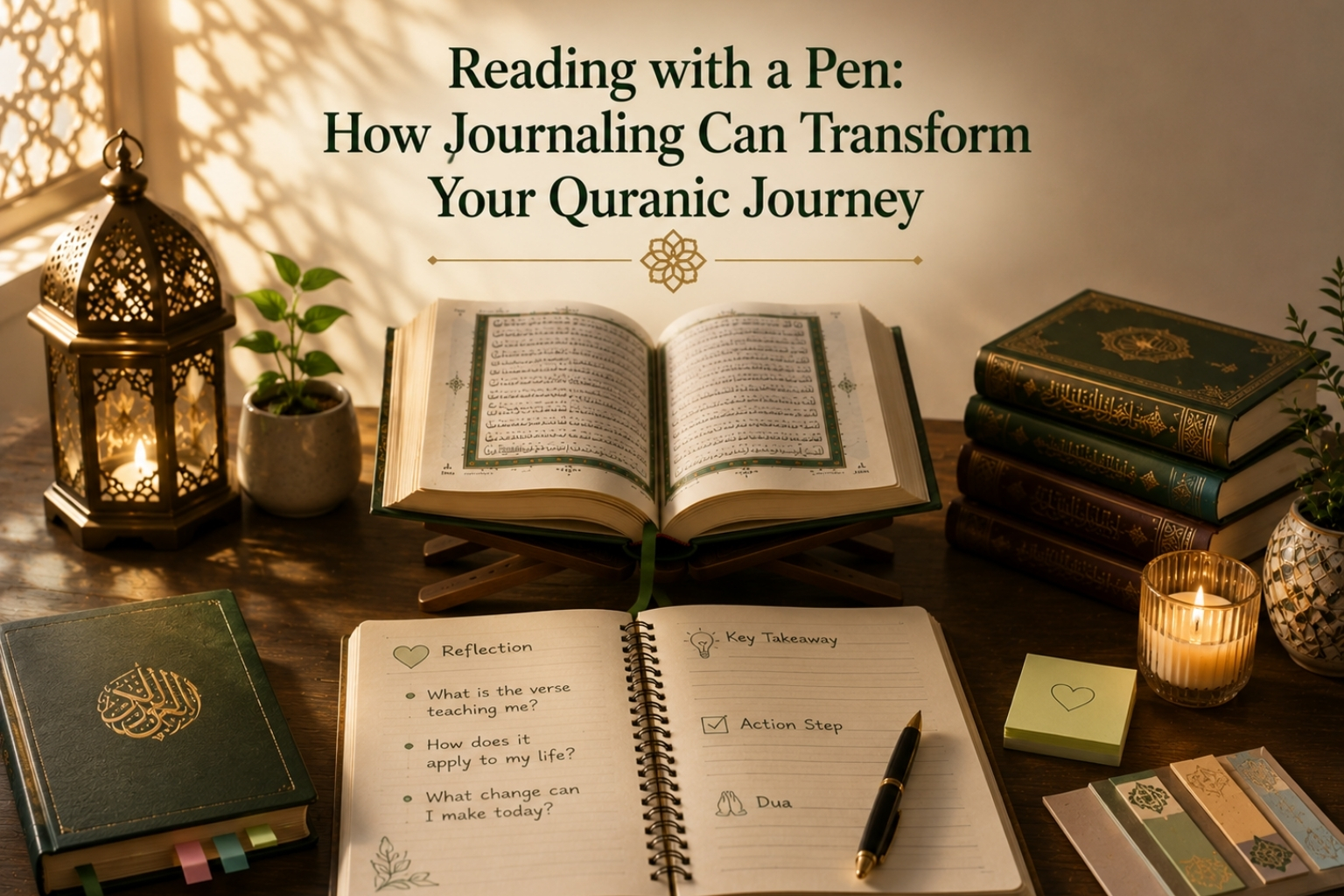
The biggest mistake you can make when confused is trying to force a logical conclusion using only your own assumptions or modern biases. If you don’t understand a medical prescription, you don’t guess what it means—you ask a pharmacist. Treat the scripture with the same professional respect. Put a bookmark on the verse, write a question mark next to it in your journal, and commit to researching it properly later.
3. Move from Translation to Commentary (Tafsir)
An English translation can only give you the surface-level meaning of classical Arabic words. It completely strips away the historical context, the reasons for revelation (Asbab al-Nuzul), and linguistic nuances. Open a reliable Quranic commentary book (like Tafsir Ibn Kathir or Ma’arif al-Quran) or look up a lecture by a verified contemporary scholar on that specific chapter. Nine times out of ten, the moment you read the context behind the verse, your confusion will instantly turn into clarity.
Doubt is a Doorway, Not a Wall
Many people feel guilty for having questions, viewing doubt as a spiritual sin. But in the Islamic intellectual tradition, a sincere question asked from a place of seeking truth is highly encouraged.
The Prophet Muhammad (peace be upon him) explicitly taught that the ultimate cure for confusion is not silence or blind following, but the brave act of asking questions with good manners and a humble heart.
The Prophet Muhammad (peace be upon him) beautifully pointed out the practical remedy for ignorance and intellectual confusion, encouraging people to actively seek answers:
عَنْ جَابِرٍ قَالَ: قَالَ رَسُولُ اللَّهِ صَلَّى اللَّهُ عَلَيْهِ وَسَلَّمَ: «إِنَّمَا شِفَاءُ الْعِيِّ السُّؤَالُ»
Narrated by Jabir: The Messenger of Allah (peace be upon him) said: “Verily, the only cure for ignorance (or confusion) is to ask.” [Sunan Abi Dawud, 336]
Conclusion: Let the Text Train Your Heart
Developing patience with the text is a profound spiritual exercise. It trains your heart to sit with uncertainty, cures the modern disease of intellectual arrogance, and forces you to become a rigorous seeker of knowledge rather than a lazy consumer.