
Imagine dedicating your entire life — every single day, for nearly a thousand years — to a single mission, and watching almost every person you ever spoke to walk away and refuse.
Imagine building something enormous, something that defies all logic in the eyes of everyone around you, in the middle of dry land, with people laughing at you as you work.
Imagine calling your own son to safety — and watching him choose the wave instead.
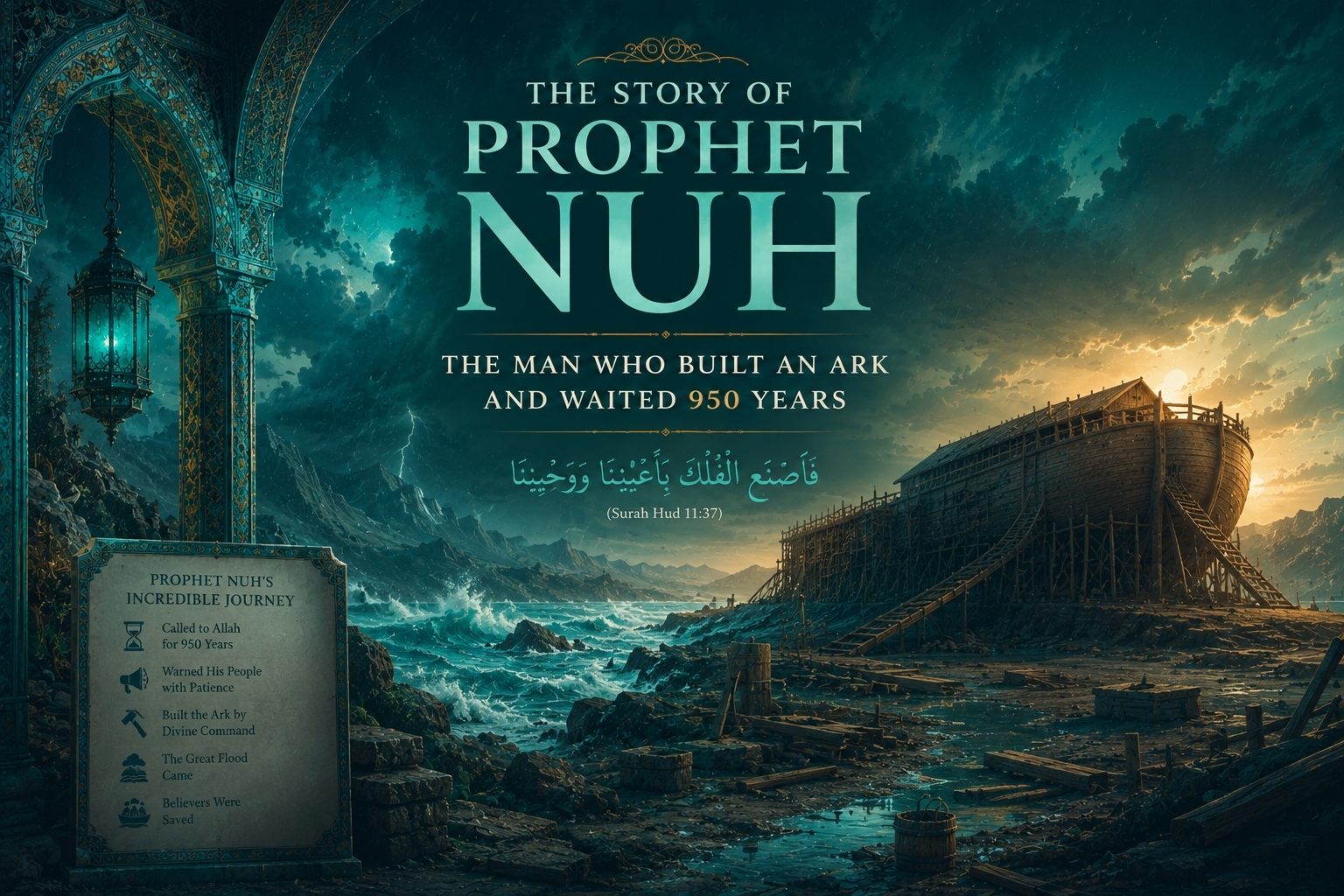
This is the story of Prophet Nuh (Noah), peace be upon him — the man Allah called one of the five greatest prophets who ever lived, the man who endured longer than any other prophet in history, and the man whose story the Quran honors with an entire chapter bearing his name.
His is not a story of spectacular miracles that dazzle in an instant. It is something far more demanding — a story of what it looks like to keep going when everything around you says stop.
Chapter One — The World Before Nuh: When Humanity First Lost Its Way
To understand Nuh, we must understand the world he was sent into. After Adam, humanity had spread across the earth — and gradually, the pure monotheism of the first prophet had been replaced by something else entirely.
The great scholar Ibn Abbas, may Allah be pleased with him, narrated that the people of Nuh had taken five righteous men from among them — Wadd, Suwa, Yaghuth, Ya’uq, and Nasr — and when these men died, Shaytan whispered to the people to erect statues in their memory, to keep their legacy alive. Generation after generation passed, and what began as remembrance became worship.
This is how idolatry entered the world — not through a dramatic rebellion against Allah, but through a gradual, well-intentioned drift that Shaytan patiently guided over decades.
Into this world, Allah sent Nuh.
Chapter Two — The Call That Lasted 950 Years
The Quran tells us something about Nuh’s mission that is almost impossible to fully absorb:
Quran Verse:
وَلَقَدْ أَرْسَلْنَا نُوحًا إِلَىٰ قَوْمِهِ فَلَبِثَ فِيهِمْ أَلْفَ سَنَةٍ إِلَّا خَمْسِينَ عَامًا فَأَخَذَهُمُ الطُّوفَانُ وَهُمْ ظَالِمُونَ
“And We certainly sent Nuh to his people, and he remained among them a thousand years minus fifty years, and the flood seized them while they were wrongdoers.”
Surah Al-Ankabut (29:14)
950 years. Not 950 years of comfort and acceptance — 950 years of rejection, mockery, and resistance. To put this in perspective: the entire recorded history of modern civilization spans roughly the same amount of time. Nuh called his people for longer than the distance between us and the fall of the Roman Empire.
And yet he did not stop. He did not give up. He did not water down his message to make it more palatable.
The entire chapter of Surah Nuh — 28 verses — is essentially Nuh’s own account of how he called his people, told directly to Allah. It is one of the most intimate and heartbreaking monologues in the entire Quran:
Quran Verse:
قَالَ رَبِّ إِنِّي دَعَوْتُ قَوْمِي لَيْلًا وَنَهَارًا ﴿٥﴾ فَلَمْ يَزِدْهُمْ دُعَائِي إِلَّا فِرَارًا ﴿٦﴾ وَإِنِّي كُلَّمَا دَعَوْتُهُمْ لِتَغْفِرَ لَهُمْ جَعَلُوا أَصَابِعَهُمْ فِي آذَانِهِمْ وَاسْتَغْشَوْا ثِيَابَهُمْ وَأَصَرُّوا وَاسْتَكْبَرُوا اسْتِكْبَارًا
“He said: ‘My Lord, indeed I invited my people night and day. But my invitation increased them in nothing but flight. And indeed, every time I invited them so that You might forgive them, they put their fingers in their ears, covered themselves with their garments, persisted, and were arrogant with great arrogance.'”
Surah Nuh (71:5–7)
Read this again slowly. They put their fingers in their ears. They pulled their garments over their faces so they would not have to see him. They turned and walked away — not once, not occasionally, but as a consistent, deliberate, generational response to his call.
And Nuh kept calling.
Chapter Three — Every Strategy, Every Approach
What makes Nuh’s perseverance even more extraordinary is that he did not simply repeat the same message in the same way for 950 years. He tried everything:
Quran Verse:
ثُمَّ إِنِّي دَعَوْتُهُمْ جِهَارًا ﴿٨﴾ ثُمَّ إِنِّي أَعْلَنتُ لَهُمْ وَأَسْرَرْتُ لَهُمْ إِسْرَارًا
“Then I invited them publicly. Then I announced to them and also confided to them secretly.”
Surah Nuh (71:8–9)
Public speeches. Private conversations. Group gatherings. One on one. Loudly. Quietly. With warnings. With glad tidings. With reminders of Allah’s blessings. With descriptions of His punishment. He exhausted every avenue of human communication available to him — across nearly ten centuries — and the response remained the same.
This is one of the most important lessons in the entire Quran for anyone who carries a message, raises a child, teaches a student, or tries to guide someone they love: your job is to deliver the message with complete sincerity and creativity. The response belongs to Allah alone.
Chapter Four — The Command to Build: Faith in the Face of Mockery
After centuries of calling, Allah finally revealed to Nuh that no more of his people would believe:
Quran Verse:
وَأُوحِيَ إِلَىٰ نُوحٍ أَنَّهُ لَن يُؤْمِنَ مِن قَوْمِكَ إِلَّا مَن قَدْ آمَنَ فَلَا تَبْتَئِسْ بِمَا كَانُوا يَفْعَلُونَ
“And it was revealed to Nuh that no one will believe from your people except those who have already believed, so do not be distressed by what they have been doing.”
Surah Hud (11:36)
Then came the command that would define his legacy forever — build an ark:
Quran Verse:
وَاصْنَعِ الْفُلْكَ بِأَعْيُنِنَا وَوَحْيِنَا وَلَا تُخَاطِبْنِي فِي الَّذِينَ ظَلَمُوا ۚ إِنَّهُم مُّغْرَقُونَ
“And construct the ship under Our observation and Our inspiration and do not address Me concerning those who have wronged; indeed, they are to be drowned.”
Surah Hud (11:37)
Build a ship. On dry land. Far from any sea. And the people — who had spent generations mocking his message — now had something new and visible to ridicule:
Quran Verse:
وَيَصْنَعُ الْفُلْكَ وَكُلَّمَا مَرَّ عَلَيْهِ مَلَأٌ مِّن قَوْمِهِ سَخِرُوا مِنْهُ ۚ قَالَ إِن تَسْخَرُوا مِنَّا فَإِنَّا نَسْخَرُ مِنكُمْ كَمَا تَسْخَرُونَ
“And he constructed the ship, and whenever an assembly of the nobles of his people passed by him, they ridiculed him. He said: ‘If you ridicule us, then we will ridicule you just as you ridicule.'”
Surah Hud (11:38)
There is quiet dignity in Nuh’s response. He does not beg for their acceptance. He does not defend himself with lengthy arguments. He simply says: time will tell. The man building what looks like madness on dry land is the one who will be standing when the water rises.
Chapter Five — The Flood: When the Earth Became a Sea
When the command finally came, it came through a sign:
Quran Verse:
حَتَّىٰ إِذَا جَاءَ أَمْرُنَا وَفَارَ التَّنُّورُ قُلْنَا احْمِلْ فِيهَا مِن كُلٍّ زَوْجَيْنِ اثْنَيْنِ وَأَهْلَكَ إِلَّا مَن سَبَقَ عَلَيْهِ الْقَوْلُ وَمَنْ آمَنَ
“Until when Our command came and the oven overflowed, We said: ‘Load upon it from every species two mates and your family — except those about whom the word has preceded — and whoever has believed.'”
Surah Hud (11:40)
Water erupted from the earth itself — from a clay oven, of all things — as a sign that the time had come. The skies opened. The seas rose. Everything that had mocked, everything that had turned away, everything that had put fingers in ears and pulled garments over faces — was now beneath the water.
And on that ark, Nuh called out to his son — one of the most heartbreaking moments in all of Quranic narrative:
Quran Verse:
وَنَادَىٰ نُوحٌ ابْنَهُ وَكَانَ فِي مَعْزِلٍ يَا بُنَيَّ ارْكَب مَّعَنَا وَلَا تَكُن مَّعَ الْكَافِرِينَ ﴿٤٢﴾ قَالَ سَآوِي إِلَىٰ جَبَلٍ يَعْصِمُنِي مِنَ الْمَاءِ ۚ قَالَ لَا عَاصِمَ الْيَوْمَ مِنْ أَمْرِ اللَّهِ إِلَّا مَن رَّحِمَ ۚ وَحَالَ بَيْنَهُمَا الْمَوْجُ فَكَانَ مِنَ الْمُغْرَقِينَ
“And Nuh called to his son who was apart: ‘O my son, come aboard with us and be not with the disbelievers.’ He said: ‘I will take refuge on a mountain to protect me from the water.’ He said: ‘There is no protector today from the decree of Allah, except for whom He gives mercy.’ And the waves came between them, and he was among the drowned.”
Surah Hud (11:42–43)
“I will take refuge on a mountain.” His son’s last words were a plan — a logical, human plan to save himself through his own means. And the wave came before the mountain could.
No parent who has ever watched a child choose the wrong path will read this passage unmoved. Nuh had called humanity for 950 years. He could not save his own son. This is one of the Quran’s most honest and painful truths: hidayah — true guidance — belongs to Allah alone. Even a prophet cannot place it in the heart of someone he loves.
Chapter Six — Nuh’s Prayer and Allah’s Response
After the flood, after the grief, after watching his son drown — Nuh turned to Allah with the raw pain of a father:
Quran Verse:
وَنَادَىٰ نُوحٌ رَّبَّهُ فَقَالَ رَبِّ إِنَّ ابْنِي مِنْ أَهْلِي وَإِنَّ وَعْدَكَ الْحَقُّ وَأَنتَ أَحْكَمُ الْحَاكِمِينَ
“And Nuh called to his Lord and said: ‘My Lord, indeed my son is of my family, and indeed Your promise is true; and You are the most just of judges.'”
Surah Hud (11:45)
Allah’s response is one of the most profound reframings in the entire Quran:
Quran Verse:
قَالَ يَا نُوحُ إِنَّهُ لَيْسَ مِنْ أَهْلِكَ ۖ إِنَّهُ عَمَلٌ غَيْرُ صَالِحٍ
“He said: ‘O Nuh, indeed he is not of your family; indeed, he is one whose work was unrighteous.'”
Surah Hud (11:46)
Family in the sight of Allah is not defined by blood. It is defined by faith and righteous action. This single verse dismantles every notion of inherited salvation, of automatic belonging, of the idea that proximity to a prophet guarantees anything. Your deeds define your family before Allah — not your lineage.
Nuh, to his eternal credit, responded with complete acceptance:
Quran Verse:
قَالَ رَبِّ إِنِّي أَعُوذُ بِكَ أَنْ أَسْأَلَكَ مَا لَيْسَ لِي بِهِ عِلْمٌ ۖ وَإِلَّا تَغْفِرْ لِي وَتَرْحَمْنِي أَكُن مِّنَ الْخَاسِرِينَ
“He said: ‘My Lord, I seek refuge in You from asking that of which I have no knowledge. And unless You forgive me and have mercy upon me, I will be among the losers.'”
Surah Hud (11:47)
Chapter Seven — The Landing and the New Beginning
When the water receded and the ark came to rest, Allah spoke to Nuh with words of honor and peace:
Quran Verse:
قِيلَ يَا نُوحُ اهْبِطْ بِسَلَامٍ مِّنَّا وَبَرَكَاتٍ عَلَيْكَ وَعَلَىٰ أُمَمٍ مِّمَّن مَّعَكَ
“It was said: ‘O Nuh, descend in peace from Us and blessings upon you and upon nations from those with you.'”
Surah Hud (11:48)
Every human being alive today is descended from those who were on that ark. Nuh is called “the second father of humanity” in Islamic tradition — because after the flood, all of human civilization traces back to the believers who survived with him.
The mockery is silent. The mountains that his son trusted are beneath the water. And the man who built a ship on dry land while everyone laughed is the ancestor of every person who has ever drawn breath since.
Hadith:
إِذَا مَاتَ الإِنْسَانُ انْقَطَعَ عَنْهُ عَمَلُهُ إِلَّا مِنْ ثَلَاثَةٍ: إِلَّا مِنْ صَدَقَةٍ جَارِيَةٍ، أَوْ عِلْمٍ يُنْتَفَعُ بِهِ، أَوْ وَلَدٍ صَالِحٍ يَدْعُو لَهُ
“When a person dies, his deeds come to an end except for three: a continuing charity, knowledge that is benefited from, or a righteous child who prays for him.”
Recorded in Sahih Muslim, Hadith No. 1631
Nuh’s da’wah — his call to Allah across 950 years — is perhaps the greatest example of a legacy that outlasted its maker. Every human being who has ever said La ilaha illa Allah “لا اله الا الله” carries, in some way, the echo of a man who refused to stop calling.
Timeless Lessons from the Story of Nuh
- Results are Allah’s responsibility — consistency is yours Nuh called for 950 years and only a handful believed. He was not a failure. He was the most successful prophet in terms of fulfilling his mission — because his mission was to deliver the message, not to control the response.
- Try every door before you conclude a door is closed Nuh called publicly and privately, loudly and quietly, with warning and with glad tidings. Before you give up on anyone or anything, ask yourself: have I truly tried every approach?
- Mockery is not evidence that you are wrong. The people laughed at an ark on dry land. The ark floated. The most ridiculed actions in history have often been the most correct ones. Do not let laughter determine your direction.
- You cannot guide those you love — only Allah can One of the hardest truths in the Quran. Nuh’s son heard the same message as everyone else — from his own father, a prophet. And he still chose the mountain. Your love for someone does not give you the power to open their heart. Make du’a. Keep the door open. Leave the rest with Allah.
- Family before Allah is defined by faith, not blood Allah told Nuh directly: your son is not of your family. This is not a harsh statement — it is a clarifying one. The bonds that matter in the sight of Allah are the bonds of shared faith and righteous action.
- Grief and submission can coexist. Nuh grieved his son. He brought his grief to Allah honestly. And then he submitted completely to Allah’s wisdom. He did not suppress his pain — he surrendered it. This is the model for every believer who has ever lost someone to a path they could not follow.
- Your legacy outlives your lifetime by centuries. Every person alive today exists because of what Nuh built and who Nuh was. You do not know how far the ripples of your sincerity will travel. Build the ark. Call the people. The rest belongs to Allah.
Closing Reflection
950 years. One mission. Near-total rejection. A son lost to the wave. And yet — when the Prophet Muhammad ﷺ ascended through the heavens on the Night Journey, he met Nuh in the second heaven, and Nuh welcomed him and prayed for him.
The man who was laughed at for building a ship on dry land was honored in the heavens.
The man whose people covered their ears rather than hear his voice now has his name recited by billions, in a Book that has never been changed, in a language that has never died.
The man who wept for his son at the edge of a wave is called by Allah:
Quran Verse:
إِنَّهُ كَانَ عَبْدًا شَكُورًا
“Indeed, he was a grateful servant.”
Surah Al-Isra (17:3)
Not a perfect servant. Not a servant whose mission succeeded by the world’s measure. A grateful one. In the end, perhaps that is the highest title any human being can earn.
Tags: Prophet Nuh · Noah in Islam · Noah’s Ark Quran · Story of Noah Islam · Prophets of the Quran · 950 Years Islam · Great Flood Quran · Islamic Articles English · Patience in Islam · Quran Route · Prophets Series 03