

There are civilizations that history remembers. And there are civilizations so completely erased that only Allah preserved their memory — not in stone, not in ruins, but in the eternal words of the Quran.
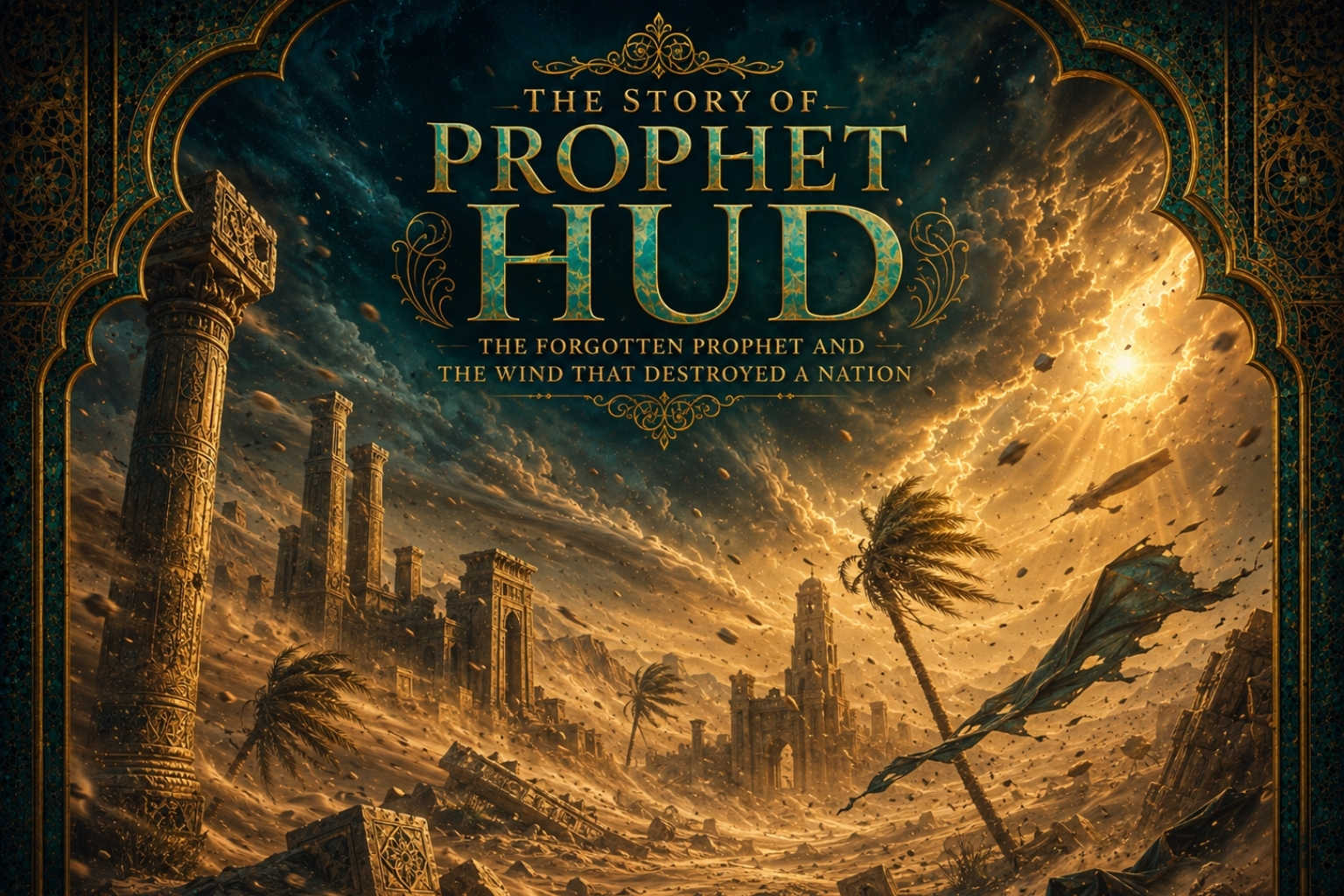
Prophet Hud, peace be upon him, was sent to one of the most powerful nations that ever walked this earth. A people of towering strength, extraordinary architecture, and absolute arrogance. A people who looked at the sky and said: who is more powerful than us?
They forgot to look up a little further.
Chapter One — The People of ‘Ad: Giants Who Forgot Their Creator
The people of ‘Ad were among the most remarkable civilizations of the ancient world. They lived in the region of Al-Ahqaf — believed to be in the southern Arabian Peninsula, in what is today Yemen or Oman. They were known for their extraordinary physical strength, their towering stature, and their architectural achievements that left the ancient world in awe.
Allah describes them in the Quran with a detail that captures both their greatness and their pride:
Quran Verse:
أَلَمْ تَرَ كَيْفَ فَعَلَ رَبُّكَ بِعَادٍ ﴿٦﴾ إِرَمَ ذَاتِ الْعِمَادِ ﴿٧﴾ الَّتِي لَمْ يُخْلَقْ مِثْلُهَا فِي الْبِلَادِ
“Have you not considered how your Lord dealt with ‘Ad — Iram of the pillars, the likes of which had never been created in the lands?”
Surah Al-Fajr (89:6–8)
The likes of which had never been created in the lands. Allah Himself acknowledged their extraordinary nature — which makes what happened to them all the more sobering. Greatness without gratitude is not a foundation. It is a countdown.
They worshipped idols. They oppressed the weak. They looked at their own strength and saw no need for a Lord above them. Into this civilization of power and pride, Allah sent one of their own — Prophet Hud, peace be upon him.
Chapter Two — Hud Among His People: A Brother Who Warned
One of the most striking aspects of Hud’s call is how the Quran introduces him — not as an outsider, not as a foreign messenger, but as a brother:
Quran Verse:
وَإِلَىٰ عَادٍ أَخَاهُمْ هُودًا ۗ قَالَ يَا قَوْمِ اعْبُدُوا اللَّهَ مَا لَكُم مِّنْ إِلَٰهٍ غَيْرُهُ ۚ أَفَلَا تَتَّقُونَ
“And to ‘Ad We sent their brother Hud. He said: ‘O my people, worship Allah; you have no deity other than Him. Will you not then fear Him?'”
Surah Al-A’raf (7:65)
Hud was one of them. He spoke their language, understood their culture, shared their lineage. Allah did not send a stranger — He sent someone who had every reason to simply enjoy the comfort of his civilization and say nothing.
But Hud could not stay silent. The same love that made him their brother made him unable to watch them walk toward destruction without raising his voice.
This is the nature of true concern — it speaks even when silence would be safer.
Chapter Three — The Response of ‘Ad: Arrogance Dressed as Logic
The response of the people of ‘Ad to Hud’s message was not confusion or curiosity. It was immediate, structured, and arrogant. They had three objections — and each one is a mirror of responses that echo across every generation:
First — You are just a human being like us:
Quran Verse:
قَالَ الْمَلَأُ الَّذِينَ كَفَرُوا مِن قَوْمِهِ إِنَّا لَنَرَاكَ فِي سَفَاهَةٍ وَإِنَّا لَنَظُنُّكَ مِنَ الْكَاذِبِينَ
“The eminent ones who disbelieved among his people said: ‘Indeed, we see you in foolishness, and indeed, we think you are of the liars.'”
Surah Al-A’raf (7:66)
Second — Our idols have cursed you:
Quran Verse:
إِن نَّقُولُ إِلَّا اعْتَرَاكَ بَعْضُ آلِهَتِنَا بِسُوءٍ
“We only say that some of our gods have afflicted you with evil.”
Surah Hud (11:54)
Third — We are stronger than anyone — who can possibly harm us?
Quran Verse:
وَقَالُوا مَنْ أَشَدُّ مِنَّا قُوَّةً
“And they said: ‘Who is greater than us in strength?'”
Surah Fussilat (41:15)
Three objections. Three forms of the same disease: the refusal to consider that strength, tradition, and collective agreement are not substitutes for truth.
Hud’s response to each was patient, direct, and free of desperation. He did not need their approval. He needed only to deliver what Allah had sent him to deliver:
Quran Verse:
قَالَ إِنِّي أُشْهِدُ اللَّهَ وَاشْهَدُوا أَنِّي بَرِيءٌ مِّمَّا تُشْرِكُونَ ﴿٥٤﴾ مِن دُونِهِ ۖ فَكِيدُونِي جَمِيعًا ثُمَّ لَا تُنظِرُونِ ﴿٥٥﴾ إِنِّي تَوَكَّلْتُ عَلَى اللَّهِ رَبِّي وَرَبِّكُمْ
“He said: ‘Indeed, I call Allah to witness, and witness yourselves, that I am free from what you associate with Allah besides Him. So plot against me all together; then do not give me respite. Indeed, I have relied upon Allah, my Lord and your Lord.'”
Surah Hud (11:54–56)
Plot against me all together. These are not the words of a man who is afraid. These are the words of a man whose trust in Allah is so complete that the combined threat of an entire civilization does not move him by a single step.
Chapter Four — The Promise of Increase: A Message the World Still Needs
Before warning his people of punishment, Hud offered them something extraordinary — he told them that returning to Allah would not just save them from destruction, it would multiply their blessings:
Quran Verse:
وَيَا قَوْمِ اسْتَغْفِرُوا رَبَّكُمْ ثُمَّ تُوبُوا إِلَيْهِ يُرْسِلِ السَّمَاءَ عَلَيْكُم مِّدْرَارًا وَيَزِدْكُمْ قُوَّةً إِلَىٰ قُوَّتِكُمْ
“And O my people, seek forgiveness of your Lord and then repent to Him. He will send rain upon you in abundance and increase you in strength added to your strength.”
Surah Hud (11:52)
This verse is one of the most overlooked gems in Hud’s story. He was not just warning them of loss — he was offering them more of the very thing they prized most: strength. Allah was not asking them to give up their power. He was offering to multiply it — on one condition: return to Him.
They refused the offer. And so they received what came instead.
Chapter Five — The Wind That Ended Everything
When the punishment came, it did not come as a flood like in the time of Nuh. It did not come as fire. It came as something that the people of ‘Ad would have looked at and initially felt nothing — a wind:
Quran Verse:
فَأَرْسَلْنَا عَلَيْهِمْ رِيحًا صَرْصَرًا فِي أَيَّامٍ نَّحِسَاتٍ لِّنُذِيقَهُمْ عَذَابَ الْخِزْيِ فِي الْحَيَاةِ الدُّنْيَا ۖ وَلَعَذَابُ الْآخِرَةِ أَخْزَىٰ ۖ وَهُمْ لَا يُنصَرُونَ
“So We sent upon them a screaming wind during days of misfortune to make them taste the punishment of disgrace in the worldly life; but the punishment of the Hereafter is more disgracing, and they will not be helped.”
Surah Fussilat (41:16)
Seven nights and eight days. The Quran describes it with devastating precision:
Quran Verse:
سَخَّرَهَا عَلَيْهِمْ سَبْعَ لَيَالٍ وَثَمَانِيَةَ أَيَّامٍ حُسُومًا فَتَرَى الْقَوْمَ فِيهَا صَرْعَىٰ كَأَنَّهُمْ أَعْجَازُ نَخْلٍ خَاوِيَةٍ
“Which He subjected upon them for seven nights and eight days in succession, so you would see the people therein fallen as if they were hollow trunks of palm trees.”
Surah Al-Haqqah (69:7)
Hollow trunks of palm trees. The most physically powerful people on earth — those who asked “who is greater than us in strength?” — were brought down by wind. Not swords. Not armies. Not earthquakes. Allah answered their question about strength with a breeze that carried His command.
The civilization that built structures “the likes of which had never been created in the lands” was erased so completely that for centuries, people doubted it had existed at all.
Chapter Six — Hud and the Believers: Saved by Mercy
While the wind swept everything away, Hud and those who believed with him were completely untouched:
Quran Verse:
وَلَمَّا جَاءَ أَمْرُنَا نَجَّيْنَا هُودًا وَالَّذِينَ آمَنُوا مَعَهُ بِرَحْمَةٍ مِّنَّا وَنَجَّيْنَاهُم مِّنْ عَذَابٍ غَلِيظٍ
“And when Our command came, We saved Hud and those who believed with him, by mercy from Us; and We saved them from a severe punishment.”
Surah Hud (11:58)
The same wind. The same location. Two completely different experiences — because the only variable that mattered was their relationship with Allah.
This is one of the Quran’s recurring and profound truths: the decree of Allah does not fall uniformly on everyone. Those connected to Him are held differently — not exempt from difficulty, but carried through it by mercy.
Hadith:
الدُّنْيَا سِجْنُ الْمُؤْمِنِ وَجَنَّةُ الْكَافِرِ
“The world is a prison for the believer and a paradise for the disbeliever.”
Recorded in Sahih Muslim, Hadith No. 2956
The people of ‘Ad had their paradise in this world — their strength, their towers, their dominance. Hud and his followers had their hardship here. But hardship in this world for the believer is not punishment — it is preparation.
Timeless Lessons from the Story of Hud
- Strength without gratitude is not a foundation — it is a countdown The people of ‘Ad were the most powerful nation of their time. Their power did not protect them — it became the very thing Allah used to demonstrate His own. Never mistake worldly strength for security.
- Speaking truth to those closest to you is the hardest and most important call Hud was their brother. He had everything to lose socially by speaking against them. He spoke anyway. The people you love most are sometimes the ones who most need to hear the truth from you.
- Tawakkul — complete trust in Allah — makes you immovable. When Hud said “plot against me all together” he was not being reckless. He was standing on a foundation that the combined force of his civilization could not shake. That foundation is available to every believer in every generation.
- Repentance and return to Allah is always an offer of increase, not just rescue Hud did not say “come back to Allah or lose everything.” He said “come back to Allah and gain everything.” The door of tawbah is not a door of retreat — it is a door of expansion.
- What Allah erases, only Allah preserves The people of ‘Ad were so thoroughly destroyed that their existence became mythological. Yet Allah preserved their story in the Quran — read by billions, in a language that has never died. Nothing is truly lost that Allah chooses to remember.
- The wind answers the question “who is more powerful?” Every generation produces people who look at their own strength — their technology, their armies, their economies — and ask the same question ‘Ad asked. The answer is always the same. And it does not always require a wind to deliver it.
Closing Reflection
The story of Prophet Hud is the story of a civilization that had everything — and chose pride over gratitude, tradition over truth, and collective arrogance over a single sincere act of return.
They are gone. Their towers are dust. Their strength is a footnote.
And Hud — the man they called foolish, the man they said their idols had cursed, the brother they rejected — his name is recited in the Quran until the end of time. A chapter of Allah’s eternal Book bears his name.
Allah says of him and those who believed with him:
Quran Verse:
وَتِلْكَ عَادٌ ۖ جَحَدُوا بِآيَاتِ رَبِّهِمْ وَعَصَوْا رُسُلَهُ وَاتَّبَعُوا أَمْرَ كُلِّ جَبَّارٍ عَنِيدٍ
“And that was ‘Ad. They rejected the signs of their Lord and disobeyed His messengers and followed the order of every obstinate tyrant.”
Surah Hud (11:59)
Three choices that ended everything: reject the signs, disobey the messengers, follow the tyrants.
Three choices that remain available — and dangerous — in every age.
The wind is not always literal. But the question it answers is always the same.
Tags: Prophet Hud · Hud in Islam · People of Ad Quran · Story of Ad Islam · Destroyed Nations Quran · Prophets of the Quran · Islamic Articles English · Tawakkul in Islam · Quran Route · Prophets Series 04