

For many people unfamiliar with Islam, one of the first things they notice about Muslims is prayer.
Wherever Muslims are in the world — at home, at work, in airports, universities, or mosques — they pause multiple times every day to pray.
To some observers, this may seem unusual or even difficult to understand. Why would someone interrupt their daily routine five separate times every single day?
In Islam, prayer is not viewed as a burden or a ritual performed without meaning. Prayer is one of the most important connections between the human being and Allah.
It is a moment where worldly distractions temporarily fade, allowing the believer to reconnect with the Creator, reflect on life, and remember what truly matters.
Prayer Is the Foundation of a Muslim’s Relationship with Allah
In Islam, prayer — known in Arabic as Salah — is considered one of the central pillars of the religion.
The Prophet Muhammad ﷺ said:
“رَأْسُ الْأَمْرِ الْإِسْلَامُ، وَعَمُودُهُ الصَّلَاةُ”
“The foundation of the matter is Islam, and its pillar is prayer.”
— Jami‘ at-Tirmidhi (2616)
Muslims believe human beings were created not only to eat, work, and pursue worldly goals, but also to worship Allah and maintain a relationship with Him.
Prayer keeps that relationship alive throughout the day.
Rather than worship being limited to one day each week, Islam spreads spiritual awareness across daily life itself.
Why Five Times Specifically?
The five daily prayers were commanded directly by Allah during a miraculous 1 event in the life of Prophet Muhammad ﷺ known as Al-Isra wal-Mi‘raj — the Night Journey and Ascension 2.
According to authentic narrations, Allah initially prescribed 3 fifty daily prayers. However, after mercy and reduction, the number became five prayers daily while retaining the reward of fifty.
The Prophet Muhammad ﷺ said:
“هِيَ خَمْسٌ وَهِيَ خَمْسُونَ”
“They are five, yet they are equal to fifty.”
— Sahih al-Bukhari (349), Sahih Muslim (162)
For Muslims, this reflects both the importance of prayer and the mercy of Allah.
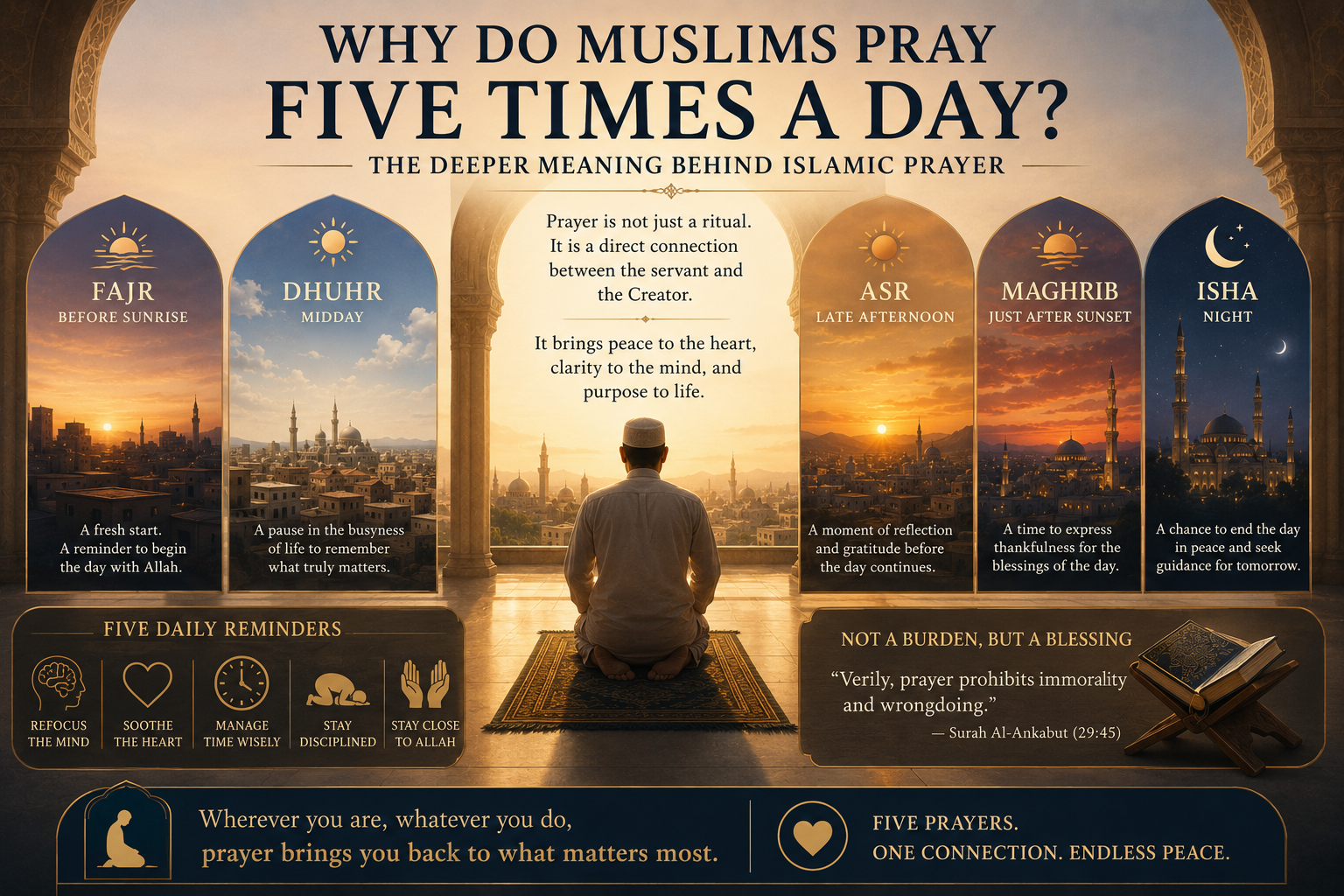
The five prayer times are distributed across the day:
- Before sunrise
- Midday
- Afternoon
- Sunset
- Night
This structure constantly renews spiritual awareness instead of allowing a person to become completely consumed 4 by worldly life.
Prayer Creates Constant Awareness of God
Modern life moves quickly.
People become overwhelmed by:
- Work
- Stress
- Money
- Social media
- Responsibilities
- Anxiety about the future
Islamic prayer interrupts this constant noise.
Five times daily, Muslims step away from distractions and stand before Allah in worship. This repeated connection creates what Muslims call taqwa — awareness and consciousness of Allah.
The Qur’an says:
“وَأَقِمِ الصَّلَاةَ لِذِكْرِي”
“Establish prayer for My remembrance.”
— Surah Ta-Ha (20:14)
Prayer reminds Muslims that life is temporary and that worldly success alone cannot satisfy the human soul.
Prayer Is More Than Physical Movements
To an outside observer, Islamic prayer may appear to be a sequence of standing, bowing, and prostrating.
But for Muslims, prayer carries deep spiritual meaning.
Every movement symbolizes humility before Allah.
During prayer:
- The tongue recites verses from the Qur’an
- The mind reflects
- The heart seeks peace
- The soul reconnects with its Creator
One of the most powerful moments in prayer is sujood — prostration 5 — when the forehead touches the ground.
The Prophet Muhammad ﷺ said:
“أَقْرَبُ مَا يَكُونُ الْعَبْدُ مِنْ رَبِّهِ وَهُوَ سَاجِدٌ”
“The closest a servant comes to his Lord is while prostrating.”
— Sahih Muslim (482)
For many Muslims, prayer becomes a source of emotional healing 6, inner peace, and spiritual stability.
Prayer Teaches Discipline
Praying five times daily requires consistency and self-discipline.
A Muslim cannot simply pray whenever convenient. Prayer trains believers to organize their lives around worship rather than placing worship at the bottom of their priorities.
This discipline 7 affects many areas of life:
- Time management
- Patience
- Responsibility
- Self-control
Islam teaches that spiritual discipline strengthens personal character.
The Qur’an says:
“إِنَّ الصَّلَاةَ تَنْهَىٰ عَنِ الْفَحْشَاءِ وَالْمُنكَرِ”
“Indeed, prayer prevents immorality and wrongdoing.”
— Surah Al-‘Ankabut (29:45)
Prayer is therefore not meant to be isolated from behavior. Its purpose is to transform the believer morally and spiritually.
Equality in Prayer
One remarkable aspect of Islamic prayer is equality.
In congregational prayer, Muslims stand shoulder to shoulder regardless of:
- Wealth
- Race
- Nationality
- Social status
A wealthy businessman may stand beside a poor laborer. A leader may stand beside an immigrant. All face the same direction and worship the same Creator.
This equality reflects one of Islam’s central teachings: human value is not measured by status or appearance, but by righteousness 8 and sincerity before Allah.
Why Muslims Pray in Arabic
Many people wonder why Muslims pray in Arabic even when they come from different cultures and languages.
Muslims believe the Qur’an is the literal word of Allah revealed in Arabic. Preserving prayer in its original language helps maintain:
- Accuracy
- Unity
- Consistency
- Preservation of meaning
At the same time, Muslims are encouraged to understand what they recite so prayer becomes meaningful rather than mechanical.
Today, millions of non-Arab Muslims around the world learn at least portions of Qur’anic Arabic for worship.
Prayer and Mental Peace
In recent years, many people have become increasingly interested in mindfulness 9, meditation, and mental wellness.
For Muslims, prayer has always served as a deeply spiritual form of reflection and inner calm.
When a believer disconnects temporarily from worldly pressures and focuses completely on Allah, the heart often experiences peace and relief.
The Qur’an says:
“أَلَا بِذِكْرِ اللَّهِ تَطْمَئِنُّ الْقُلُوبُ”
“Surely in the remembrance of Allah do hearts find peace.”
— Surah Ar-Ra’d (13:28)
For practicing Muslims, prayer is not simply obligation — it is refuge.
Conclusion
Muslims pray five times daily because prayer is far more than ritual movement. It is a direct connection between the human being and Allah — a connection repeated throughout the day to maintain faith, discipline, humility, and spiritual awareness.
In a fast-moving world filled with distraction and pressure, Islamic prayer continuously reminds believers of their purpose, their Creator, and the deeper meaning of life.
For Muslims, prayer is not an interruption to life. It is what gives life meaning.