

There is a grief that breaks people. And there is a grief that — in the hands of a soul connected to Allah — becomes something else entirely. Not a weakness. Not a collapse. But a long, aching, unshakeable refusal to stop hoping.
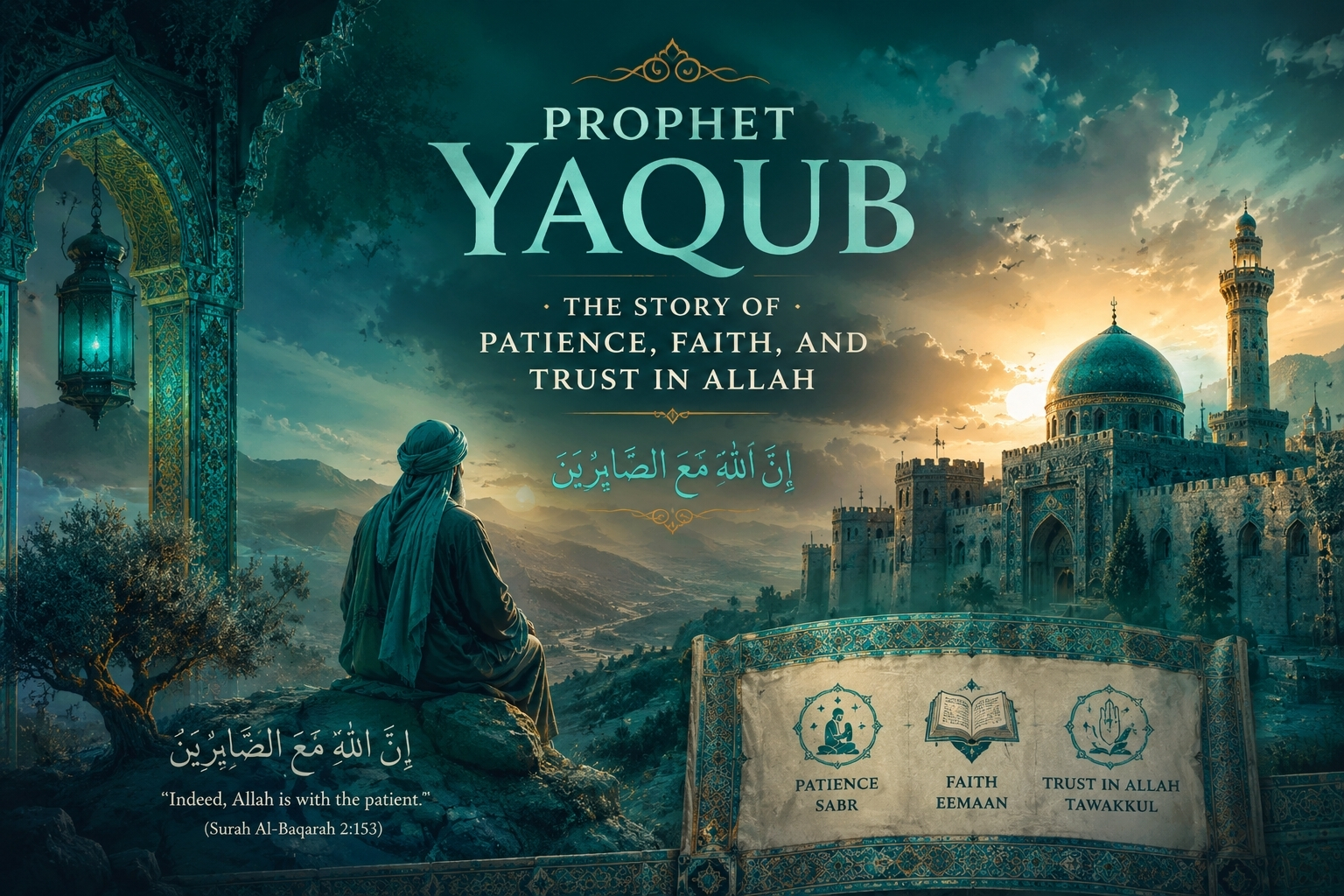
Prophet Yaqub, peace be upon him, lost his most beloved son for over twenty years. He wept so deeply and so continuously that the Quran tells us he lost his sight from grief. His own sons — watching their father’s pain — told him he was destroying himself. The world around him saw a broken old man.
But Yaqub himself knew something they did not. He knew that as long as Allah was alive — and Allah is always alive — the story was not over. He knew that hope in Allah is never irrational. It is never naive. It is never misplaced.
And in the end, after two decades of loss, Yaqub held his son again. His sight returned. His family was reunited. And Allah proved — through the life of this patient, weeping, never-surrendering prophet — that those who refuse to lose hope in Allah are never, ultimately, disappointed.
Chapter One — The Son of a Miracle, the Grandson of the Friend of Allah
Yaqub, peace be upon him, was the son of Prophet Ishaq and the grandson of Prophet Ibrahim. He was born into the most prophetically blessed lineage in human history — and he would himself become a prophet, continuing the chain of divine guidance that his grandfather had begun.
His very name carries significance. Yaqub — from the Arabic root connected to the word for “heel” — was named for the circumstances of his birth, being born holding the heel of his twin brother Esau. And Allah gave him another name that became the foundation of an entire religious identity:
Quran Verse:
كُلُّ الطَّعَامِ كَانَ حِلًّا لِّبَنِي إِسْرَائِيلَ إِلَّا مَا حَرَّمَ إِسْرَائِيلُ عَلَىٰ نَفْسِهِ
“All food was lawful to the Children of Israel except what Israel had made unlawful to himself.”
Surah Al-Imran (3:93)
Israel — the name Allah gave Yaqub — means “servant of Allah” or “the one who strives with Allah.” His twelve sons became the twelve tribes of Bani Israel — the Children of Israel — whose story occupies more of the Quran than any other nation in history. Every prophet sent to Bani Israel, every divine book revealed to them, every miracle shown to them — all of it flows from the twelve sons of this one man.
Yaqub was not just a prophet. He was the father of a nation chosen by Allah to carry His message for centuries.
Chapter Two — The Blessing Passed Down: A Family Built on Prophethood
Allah describes the gift given to Yaqub and his family in terms that reveal how extraordinary this lineage truly was:
Quran Verse:
وَوَهَبْنَا لَهُ إِسْحَاقَ وَيَعْقُوبَ وَجَعَلْنَا فِي ذُرِّيَّتِهِ النُّبُوَّةَ وَالْكِتَابَ وَآتَيْنَاهُ أَجْرَهُ فِي الدُّنْيَا ۖ وَإِنَّهُ فِي الْآخِرَةِ لَمِنَ الصَّالِحِينَ
“And We gave him Ishaq and Yaqub and placed in his descendants prophethood and scripture. And We gave him his reward in this world, and indeed he, in the Hereafter, will be among the righteous.”
Surah Al-Ankabut (29:27)
Prophethood and scripture — placed in the descendants of Ibrahim through Ishaq and Yaqub. This is Allah’s own testimony to the extraordinary nature of what flowed through this family. And Yaqub himself was deeply conscious of this blessing — so conscious that his final words to his sons, as he lay dying, were not about wealth or land or power. They were about the one thing that mattered:
Quran Verse:
أَمْ كُنتُمْ شُهَدَاءَ إِذْ حَضَرَ يَعْقُوبَ الْمَوْتُ إِذْ قَالَ لِبَنِيهِ مَا تَعْبُدُونَ مِن بَعْدِي قَالُوا نَعْبُدُ إِلَٰهَكَ وَإِلَٰهَ آبَائِكَ إِبْرَاهِيمَ وَإِسْمَاعِيلَ وَإِسْحَاقَ إِلَٰهًا وَاحِدًا وَنَحْنُ لَهُ مُسْلِمُونَ
“Or were you witnesses when death approached Yaqub, when he said to his sons: ‘What will you worship after me?’ They said: ‘We will worship your God and the God of your fathers — Ibrahim, Ismail, and Ishaq — one God. And we are Muslims submitting to Him.'”
Surah Al-Baqarah (2:133)
A father, on his deathbed, asking his children one question — not “who will inherit my wealth?” but “who will you worship after I am gone?” And his sons answering with the most complete declaration of faith: one God, and we are Muslims.
This is the legacy Yaqub cared about. This is what he considered his greatest responsibility as a father. Not the material inheritance — the spiritual one.
Chapter Three — The Dream of Yusuf: The Beginning of the Greatest Trial
The central trial of Yaqub’s life did not come from outside his family. It came from within it. His son Yusuf — the child he loved most deeply — came to him one morning with a dream:
Quran Verse:
إِذْ قَالَ يُوسُفُ لِأَبِيهِ يَا أَبَتِ إِنِّي رَأَيْتُ أَحَدَ عَشَرَ كَوْكَبًا وَالشَّمْسَ وَالْقَمَرَ رَأَيْتُهُمْ لِي سَاجِدِينَ
“When Yusuf said to his father: ‘O my father, indeed I have seen eleven stars and the sun and the moon; I saw them prostrating to me.'”
Surah Yusuf (12:4)
Yaqub understood immediately. He was a prophet — he could read the language of dreams. He knew this vision was from Allah. He knew it meant something extraordinary awaited his son. And he also knew, with the wisdom of a man who had seen how the world works, that this dream needed to be protected:
Quran Verse:
قَالَ يَا بُنَيَّ لَا تَقْصُصْ رُؤْيَاكَ عَلَىٰ إِخْوَتِكَ فَيَكِيدُوا لَكَ كَيْدًا ۖ إِنَّ الشَّيْطَانَ لِلْإِنسَانِ عَدُوٌّ مُّبِينٌ
“He said: ‘O my son, do not relate your vision to your brothers or they will contrive against you a plan. Indeed, Shaytan, to man, is a clear enemy.'”
Surah Yusuf (12:5)
Yaqub warned his son. He saw the danger. He tried to protect him. But some trials — those decreed by Allah for the elevation of those He loves — cannot be prevented by human precaution. They can only be endured with faith.
Chapter Four — The Shirt Returned with False Blood: The Day Everything Changed
Yaqub’s other sons, consumed by jealousy over their father’s love for Yusuf, plotted against their younger brother. They took him on a trip — and threw him into a well. Then they slaughtered a goat, stained Yusuf’s shirt with its blood, and returned to their father with a lie:
Quran Verse:
وَجَاءُوا أَبَاهُمْ عِشَاءً يَبْكُونَ ﴿١٦﴾ قَالُوا يَا أَبَانَا إِنَّا ذَهَبْنَا نَسْتَبِقُ وَتَرَكْنَا يُوسُفَ عِندَ مَتَاعِنَا فَأَكَلَهُ الذِّئْبُ ۖ وَمَا أَنتَ بِمُؤْمِنٍ لَّنَا وَلَوْ كُنَّا صَادِقِينَ ﴿١٧﴾ وَجَاءُوا عَلَىٰ قَمِيصِهِ بِدَمٍ كَذِبٍ
“And they came to their father at night, weeping. They said: ‘O our father, indeed we went racing each other and left Yusuf with our belongings, and a wolf ate him. But you would not believe us, even if we were truthful.’ And they brought upon his shirt false blood.”
Surah Yusuf (12:16–18)
Yaqub looked at the shirt. He looked at his sons. And he knew. The shirt was stained — but it was not torn. A wolf that devoured a boy would have torn the shirt. The blood was there — but the evidence did not match the story.
He did not accuse them directly. He said the words that would define his entire response to this trial — and to every trial that followed for the next twenty years:
Quran Verse:
قَالَ بَلْ سَوَّلَتْ لَكُمْ أَنفُسُكُمْ أَمْرًا ۖ فَصَبْرٌ جَمِيلٌ ۖ وَاللَّهُ الْمُسْتَعَانُ عَلَىٰ مَا تَصِفُونَ
“He said: ‘Rather, your souls have enticed you to something, so patience is most fitting. And Allah is the one sought for help against that which you describe.'”
Surah Yusuf (12:18)
Sabrun jamil — beautiful patience. Not bitter patience. Not reluctant patience. Not patience while complaining and despairing. Beautiful patience — the kind that is offered to Allah with dignity, with trust, with the understanding that He sees what we cannot see and knows what we do not know.
These two words — صَبْرٌ جَمِيلٌ — became one of the most quoted phrases in Islamic literature on grief and trial. They are Yaqub’s gift to every person who has ever faced a loss they could not explain and a pain they could not escape.
Chapter Five — Twenty Years of Grief: The Father Who Kept Hoping
Yusuf was gone. Years passed. Then more years. Yaqub did not know his son was alive. He did not know Yusuf had been sold into slavery in Egypt, had been imprisoned, had risen to become the most powerful man in the land after the king. He knew only that his son was gone — and that his sons had lied to him.
The grief was profound. The Quran describes what it did to him physically:
Quran Verse:
وَتَوَلَّىٰ عَنْهُمْ وَقَالَ يَا أَسَفَىٰ عَلَىٰ يُوسُفَ وَابْيَضَّتْ عَيْنَاهُ مِنَ الْحُزْنِ فَهُوَ كَظِيمٌ
“And he turned away from them and said: ‘Oh, my grief for Yusuf,’ and his eyes became white from sorrow, and he was a suppressor of grief.”
Surah Yusuf (12:84)
His eyes turned white. He lost his sight from the intensity of his weeping. This was not a man who had moved on, who had found peace, who had accepted his son’s loss with quiet resignation. This was a father in deep, unrelenting pain — pain so physical, so all-consuming, that it took his vision.
And yet — even in this state — Yaqub never lost something more important than his sight. He never lost his certainty in Allah.
His sons, watching their father grieve, grew frustrated:
Quran Verse:
قَالُوا تَاللَّهِ تَفْتَأُ تَذْكُرُ يُوسُفَ حَتَّىٰ تَكُونَ حَرَضًا أَوْ تَكُونَ مِنَ الْهَالِكِينَ
“They said: ‘By Allah, you will not cease remembering Yusuf until you become fatally ill or become of those who perish.'”
Surah Yusuf (12:85)
Their father was destroying himself. That was what they saw. A broken old man, weeping for a son who was almost certainly dead, refusing to let go, refusing to accept reality.
Yaqub’s response is perhaps the most powerful statement of hope in the entire Quran:
Quran Verse:
قَالَ إِنَّمَا أَشْكُو بَثِّي وَحُزْنِي إِلَى اللَّهِ وَأَعْلَمُ مِنَ اللَّهِ مَا لَا تَعْلَمُونَ
“He said: ‘I only complain of my suffering and my grief to Allah, and I know from Allah what you do not know.'”
Surah Yusuf (12:86)
Two statements that contain the entire philosophy of a believer’s relationship with pain:
First — “I only complain to Allah.” Not to people. Not through bitterness or despair or giving up. To Allah alone. He was not suppressing his grief — he was directing it to the only One who could actually do something about it.
Second — “I know from Allah what you do not know.” This is prophetic certainty speaking. Yaqub knew — through his connection to Allah, through the dream he had interpreted, through the knowledge Allah had given him — that his son was alive. That the story was not finished. That what looked like a permanent ending was still, in Allah’s hands, a story in progress.
Then he gave his sons an instruction that defied every rational assessment of the situation:
Quran Verse:
يَا بَنِيَّ اذْهَبُوا فَتَحَسَّسُوا مِن يُوسُفَ وَأَخِيهِ وَلَا تَيْأَسُوا مِن رَّوْحِ اللَّهِ ۖ إِنَّهُ لَا يَيْأَسُ مِن رَّوْحِ اللَّهِ إِلَّا الْقَوْمُ الْكَافِرُونَ
“O my sons, go and search for Yusuf and his brother and despair not of relief from Allah. Indeed, no one despairs of relief from Allah except the disbelieving people.”
Surah Yusuf (12:87)
“Despair not of relief from Allah.” After twenty years. After losing his sight. After his sons told him he was killing himself with grief. After every rational indicator said the search was hopeless — Yaqub sent his sons to look for Yusuf.
And then added the most extraordinary statement: “No one despairs of Allah’s relief except the disbelieving people.”
He was not speaking about optimism. He was not speaking about positive thinking. He was speaking about the nature of faith itself — that to give up hope in Allah is not merely sadness or despair. It is a failure of faith. Because Allah is alive. Allah is capable. And as long as Allah is Allah — there is always a possibility that has not yet been exhausted.
Chapter Six — The Reunion: When the Story Allah Was Writing Was Revealed
When Yaqub’s sons returned to Egypt and the truth finally unfolded — when Yusuf revealed himself to his brothers — a shirt was sent back to Canaan. The same shirt that had once been returned to Yaqub was stained with false blood. This time it carried something different:
Quran Verse:
اذْهَبُوا بِقَمِيصِي هَٰذَا فَأَلْقُوهُ عَلَىٰ وَجْهِ أَبِي يَأْتِ بَصِيرًا وَأْتُونِي بِأَهْلِكُمْ أَجْمَعِينَ
“Take this, my shirt, and cast it over the face of my father; he will become seeing. And bring me your family, all together.”
Surah Yusuf (12:93)
The shirt that had taken a father’s hope placed the shirt of Yusuf on his face — and his sight returned:
Quran Verse:
فَلَمَّا أَن جَاءَ الْبَشِيرُ أَلْقَاهُ عَلَىٰ وَجْهِهِ فَارْتَدَّ بَصِيرًا ۖ قَالَ أَلَمْ أَقُل لَّكُمْ إِنِّي أَعْلَمُ مِنَ اللَّهِ مَا لَا تَعْلَمُونَ
“And when the bearer of good tidings arrived, he cast it over his face, and he returned seeing. He said: ‘Did I not tell you that I know from Allah what you do not know?'”
Surah Yusuf (12:96)
“Did I not tell you?” — not with arrogance, but with the quiet vindication of a man who had held to his certainty for twenty years while everyone around him called it delusion. He had said “I know from Allah what you do not know” — and now they could see for themselves what he had always known: Allah had not abandoned Yusuf. Allah had not abandoned Yaqub. Allah had been writing a story that no human eye could read — and when the last page was turned, everything that had seemed like loss was revealed to have been preparation.
The family traveled to Egypt. Yusuf embraced his parents. The eleven brothers prostrated before him. And the dream that Yusuf had seen as a child — the eleven stars and the sun and the moon bowing to him — was fulfilled exactly as Allah had shown it:
Quran Verse:
وَرَفَعَ أَبَوَيْهِ عَلَى الْعَرْشِ وَخَرُّوا لَهُ سُجَّدًا ۖ وَقَالَ يَا أَبَتِ هَٰذَا تَأْوِيلُ رُؤْيَايَ مِن قَبْلُ قَدْ جَعَلَهَا رَبِّي حَقًّا
“And he raised his parents upon the throne, and they bowed to him in prostration. And he said: ‘O my father, this is the interpretation of my vision of before. My Lord has made it reality.'”
Surah Yusuf (12:100)
Twenty years. A well. A shirt soaked in false blood. Slavery. Prison. And then — a throne. And a father whose eyes had gone white from grief, seeing his son not just alive but elevated to the highest position in the most powerful nation on earth.
Allah had been writing this story the entire time.
Chapter Seven — The Final Prayer: A Man Who Knew What Mattered
When Yusuf finally held his family together — after everything — he made a prayer that reveals the depth of his understanding, an understanding shaped by everything his father Yaqub had taught him:
Quran Verse:
رَبِّ قَدْ آتَيْتَنِي مِنَ الْمُلْكِ وَعَلَّمْتَنِي مِن تَأْوِيلِ الْأَحَادِيثِ ۚ فَاطِرَ السَّمَاوَاتِ وَالْأَرْضِ أَنتَ وَلِيِّي فِي الدُّنْيَا وَالْآخِرَةِ ۖ تَوَفَّنِي مُسْلِمًا وَأَلْحِقْنِي بِالصَّالِحِينَ
“My Lord, You have given me of sovereignty and taught me of the interpretation of dreams. Creator of the heavens and earth, You are my protector in this world and in the Hereafter. Cause me to die a Muslim and join me with the righteous.”
Surah Yusuf (12:101)
A man who had survived a well, slavery, and prison — who now sat on the throne of Egypt — and his greatest prayer was: let me die as a Muslim. Join me with the righteous.
This is Yaqub’s legacy speaking through his son. A father who asked “what will you worship after I am gone?” raised a son who, at the height of worldly power, asked only to die in submission to Allah.
Hadith:
الْكَرِيمُ ابْنُ الْكَرِيمِ ابْنِ الْكَرِيمِ ابْنِ الْكَرِيمِ، يُوسُفُ بْنُ يَعْقُوبَ بْنِ إِسْحَاقَ بْنِ إِبْرَاهِيمَ
“The noble, son of the noble, son of the noble, son of the noble — Yusuf son of Yaqub son of Ishaq son of Ibrahim.”
Recorded in Sahih Al-Bukhari, Hadith No. 3382
Four generations. Four prophets. Each one is noble. Each one connected to the one before through faith, through patience, through the refusal to let go of Allah regardless of what the world placed between them and Him.
The Prophet Muhammad ﷺ honored Yaqub by honoring his son — acknowledging the nobility of a lineage that Allah Himself had described as blessed.
Timeless Lessons from the Story of Yaqub
- Beautiful patience is not the absence of pain — it is pain offered to Allah with dignity Yaqub wept until he lost his sight. He was in agony. Beautiful patience does not mean feeling nothing — it means carrying your grief to Allah rather than away from Him. The beauty is in the direction, not the absence of tears.
- Complain only to Allah — and then act “I only complain of my suffering to Allah.” He did not suppress his pain. He did not spread it among people who could not help him. He took it directly to the One who could — and then sent his sons to search. Faith is not passive. It weeps to Allah and then moves.
- “I know from Allah what you do not know” — trust your connection to Allah over the consensus of those around you. Everyone told Yaqub to give up. The rational assessment said Yusuf was dead. Yaqub held to something deeper — a prophetic certainty, a divinely given knowledge — that the story was not finished. When Allah has given you a promise, hold it even when no one around you can see what you see.
- Never despair of Allah’s relief — it is a matter of faith, not optimism. Yaqub did not say “don’t give up, things will get better.” He said “no one despairs of Allah’s relief except the disbelieving people.” Despair in Allah is not just sadness — it is a theological error. Allah is capable. Allah is alive. The story is never over while Allah is writing it.
- The greatest inheritance you can leave your children is the answer to one question Yaqub’s last words were: “What will you worship after I am gone?” His children answered: one God, and we are Muslims. Wealth can be lost. Property can be divided. But a child who knows who to worship and how to die — that is the inheritance that cannot be taken away.
- What looked like the worst day was actually the first page of the best chapter. The day Yusuf’s shirt came back soaked in blood was the worst day of Yaqub’s life. It was also the first day of Allah’s plan to reunite a family, elevate a prophet, and save a nation from famine. You cannot read the plan from a single page. Trust the Author.
- Patience has a return — and the return is always worth the wait of twenty years. Lost sight. Broken heart. And then — his son, alive, on a throne, his family reunited, the dream fulfilled. Allah does not forget the patience of His servants. He repays it — completely, perfectly, at exactly the right moment.
Closing Reflection
Yaqub stood between two shirts. The first was returned to him stained with false blood — the lie that took his son. The second was cast over his face — the truth that returned his sight.
Between those two shirts was twenty years of grief, of weeping, of refusing to give up, of saying “I only complain to Allah“ and “I know from Allah what you do not know” and “despair not of relief from Allah“ — even when every human indicator said the hope was finished.
He was not wrong to hope. He was never wrong to hope. And when the shirt of Yusuf touched his face and his sight returned, it was not just his eyes that were healed. It was the proof — laid out before his sons, before his family, before every generation that would read this story — that Allah honors the hope of those who refuse to stop placing it in Him.
Whatever shirt you are holding right now — whatever stain, whatever lie, whatever loss — the story is not finished. Allah is still writing.
Quran Verse:
وَلَا تَيْأَسُوا مِن رَّوْحِ اللَّهِ ۖ إِنَّهُ لَا يَيْأَسُ مِن رَّوْحِ اللَّهِ إِلَّا الْقَوْمُ الْكَافِرُونَ
“And despair not of relief from Allah. Indeed, no one despairs of relief from Allah except the disbelieving people.”
Surah Yusuf (12:87)
Hold on. He is still writing your story too.
Tags: Prophet Yaqub · Yaqub in Islam · Jacob in Quran · Story of Jacob Islam · Sabr Jamil Beautiful Patience · Children of Israel Quran · Yaqub and Yusuf · Hope in Allah Islam · Prophets of the Quran · Islamic Articles English · Quran Route · Prophets Series 10