

For the vast majority of Christians raised in the West, the conventional understanding of global religions is built upon a rigid, binary assumption: you are either a follower of Christ, or you belong to an entirely separate, non-Christian faith that dismisses him altogether. Popular cultural narratives often place Islam and Christianity on opposite sides of a deep theological divide.
For many Christian seekers looking into the Islamic faith, as well as practicing Muslims interacting with Christian peers, this assumed divide can create a profound sense of barrier. It triggers an unneeded state of hesitation, intellectual defensiveness, and a lingering anxiety that feeds directly into overthinking in Islam.
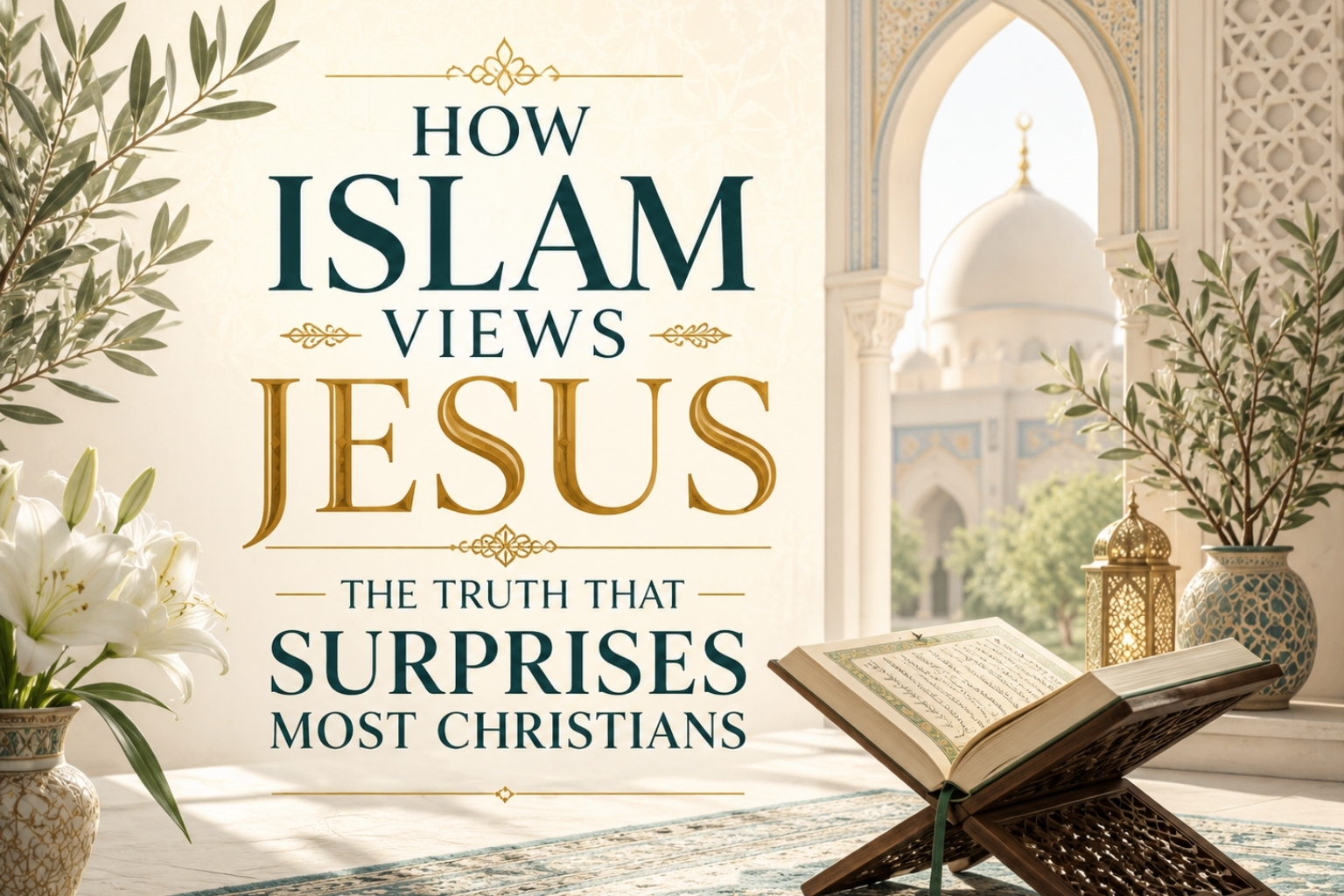
However, when we bypass modern cultural polarization and approach the source texts through Tadabbur (deep Quranic reflection), we stumble upon a reality that leaves most Christians completely stunned. Far from dismissing him, Islam considers Jesus (‘Isa ibn Maryam) to be one of the most elite, beloved, and central figures in the entire cosmic tapestry of revelation.
By analyzing the actual text of the Quran and the authentic prophetic legacy, we discover a pristine blueprint that elevates Jesus to the highest peaks of honor, offering true peace of mind and an unexpected bridge of spiritual clarity between the world’s two largest faiths.
The Ontological Reality: A Prophet of Elite Stature
The foundational truth that surprises most Christians is that it is a non-negotiable article of faith for every single Muslim on earth to believe in, love, and revere Jesus. In Islamic psychology and theology, a person cannot even call themselves a Muslim if they reject him.
The Quran mentions Jesus by name more times than it mentions the Prophet Muhammad, weaving his narrative into the very fabric of the final revelation.
Theological Angle | The Conventional Western View | The Quranic Reality |
The Birth | Muslims must reject the immaculate conception because they do not call Jesus the “Son of God.” | The Quran explicitly confirms the Virgin Birth. Maryam (Mary) is honored as a pure, chosen woman who conceived Jesus miraculously through the Divine command: “Be,” and he was. |
His Title | Jesus is viewed in Islam as just a regular, ordinary historical figure or historical teacher. | Jesus is uniquely given the titles of Al-Masih (The Messiah), Kalimatullāh (A Word from Allah), and Rūḥullāh (A Spirit from Him). |
His Rank | He holds a minor, secondary position behind the main narrative of the Old and New Testaments. | He is classified among the Ulu al-‘Azm—the five most elite, resolute Messengers in human history (alongside Noah, Abraham, Moses, and Muhammad). |
This pristine status is beautifully captured in Surah Ali ‘Imran, where the angels announce his grand entrance to Mary:
“إِذْ قَالَتِ الْمَلَائِكَةُ يَا مَرْيَمُ إِنَّ اللَّهَ يُبَشِّرُكِ بِكَلِمَةٍ مِّنْهُ اسْمُهُ الْمَسِيحُ عِيسَى ابْنُ مَرْيَمَ وَجِيهًا فِي الدُّنْيَا وَالْآخِرَةِ وَمِنَ الْمُقَرَّبِينَ”
“[And mention] when the angels said, ‘O Mary, indeed Allah gives you good tidings of a word from Him, whose name will be the Messiah, Jesus, the son of Mary — distinguished in this world and the Hereafter and among those brought near [to Allah].'”
— Surah Ali ‘Imran, 3:45
Deconstructing the Miracles: The Power of the Ultimate Creator
For a practicing Christian, the miracles of Jesus are the ultimate proof of his unique nature. What shocks most Christians when reading the Quran is that Islam doesn’t downplay these miracles—it actively expands upon them, documenting wonders that aren’t even found in the canonical New Testament.
Under the framework of trusting Allah’s plan, the Quran tracks the breathtaking signs given to Jesus from the very moments of his infancy down to his ultimate earthly departure:
The Quranic Miracle | The Theological Meaning & Context |
Speaking from the Cradle | As a newborn infant, Jesus spoke to the people to defend his mother Mary’s chastity, declaring his status as a servant and prophet of God (Surah Maryam, 19:30-33). |
Breathing Life into Clay Birds | He fashioned the shape of a bird out of clay, breathed into it, and it became a living, flying bird—explicitly by Allah’s permission (Surah Al-Ma’idah, 5:110). |
Healing and Resurrection | He cured the blind, healed the lepers, and raised the dead back to life, acting as a direct channel for divine healing and restoration. |
The crucial theological distinction in Islam is the source of this power. While mainstream Christianity views these miracles as proof of Jesus’ personal divinity, Islam explains that Jesus performed every single one of these wonders entirely through the authorization, power, and permission of Allah (Bi-idhnillāh).
He was a human instrument uniquely chosen to manifest the absolute supremacy of the Creator, proving that your logic-defying breakthroughs are always entirely dependent on trusting Allah’s plan.
The Ultimate Return: A Shared Cosmic Destination
The final, deeply comforting paradigm that unites Muslims and Christians regarding Jesus is his ultimate destiny and his role in the end of times. Islam completely rejects the narrative that Jesus was humiliated, tortured, or killed on the cross by his enemies.
Instead, the Quran states that Allah rescued His beloved messenger from harm, lifting him up physically and spiritually to the heavens:
“بَل رَّفَعَهُ اللَّهُ إِلَيْهِ ۚ وَكَانَ اللَّهُ عَزِيزًا حَكِيمًا”
“Rather, Allah raised him to Himself. And ever is Allah Exalted in Might and Wise.”
— Surah An-Nisa, 4:158
In Islamic psychology and eschatology, Jesus is not a figure of the distant past; he holds the keys to the future. Both faiths live in active anticipation of the Second Coming.
The prophetic traditions teach that Jesus will return to this earth in the final days to defeat deception, establish absolute global justice, and restore true peace to humanity. For anyone seeking healing anxiety with the Quran, this shared expectation acts as an eternal anchor—a magnificent reminder that no matter how chaotic, dark, or broken the modern world looks, the ultimate victory of truth, light, and divine alignment is an absolute mathematical certainty.
Conclusion
The stunning, deep reverence that Islam holds for Jesus serves as a powerful reminder of the importance of bypassing cultural filters to discover authentic scriptural truth. Islam does not strip away the majesty of Jesus, nor does it ignore his profound, world-altering impact. It places him exactly where he belongs: in the highest heavens as a master of spiritual clarity, a shining beacon of divine mercy, and a beloved brother to all the prophets. When you look at his story through the pure lens of Tadabbur and connect his legacy to the grand, unified timeline of Allah’s plan, the heavy, suffocating walls of religious misunderstanding completely dissolve—leaving your mind beautifully wrapped in an unshakeable state of profound safety, enduring tranquility, and everlasting spiritual success.