

For many people reading the Holy Book for the first time, especially in an English translation, the structure can feel deeply puzzling. You might start reading a chapter (Surah) that begins with legal rulings about marriage or charity, suddenly shifts into the historical story of an ancient Prophet, transitions into a description of the afterlife, and then returns to laws about business contracts.
To a reader accustomed to modern Western literature—where books are divided into neat, chronological chapters that stick strictly to one topic—this can feel disjointed. You might find yourself wondering: Why do Surahs switch topics so suddenly?
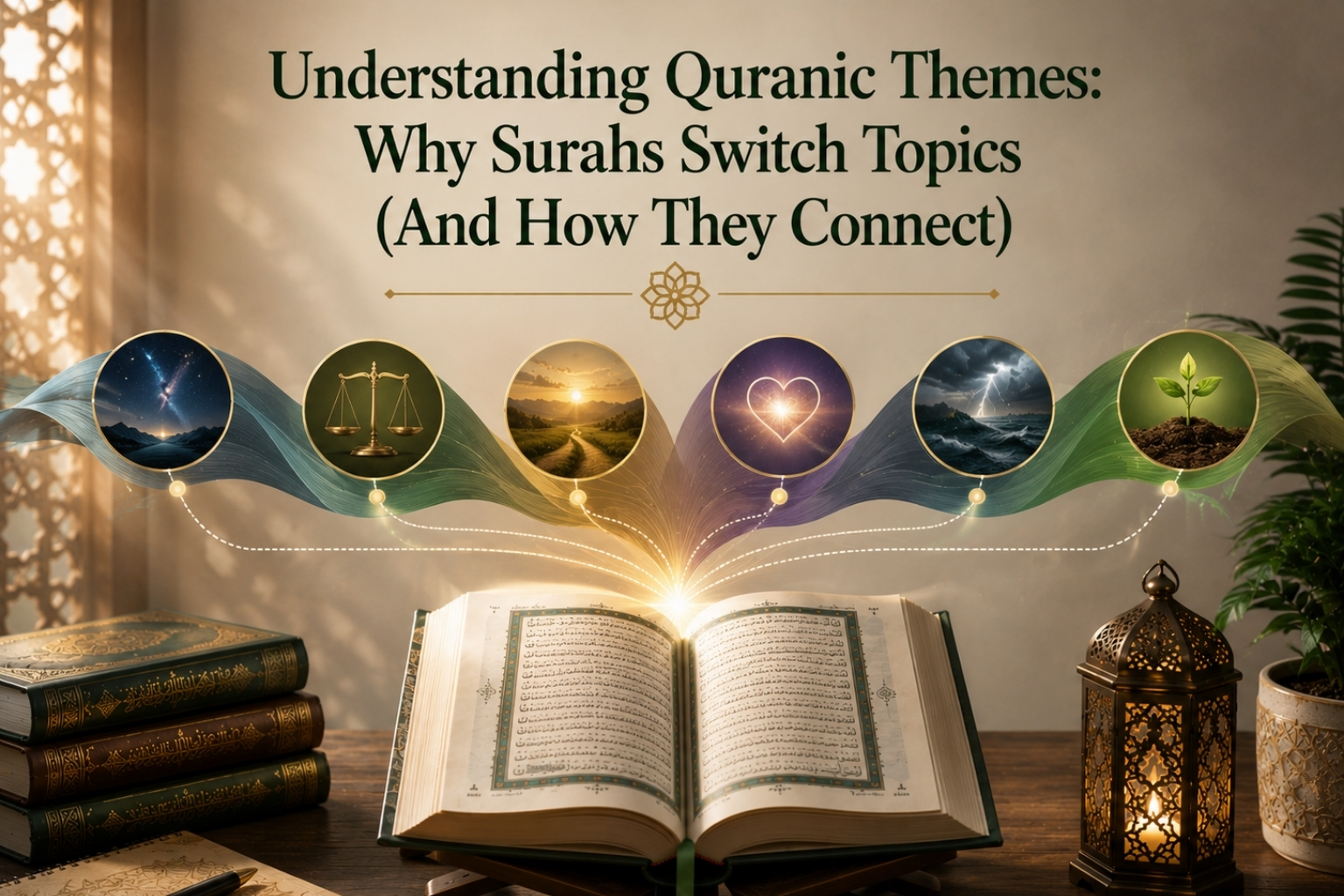
Understanding the unique literary style of the Quran and how its themes connect is the ultimate key to unlocking its flow. Once you learn the secret behind its structure, what felt like a chaotic jump from topic to topic reveals itself as a beautifully woven spiritual masterpiece.
The Quran is Not a Textbook
The first step in understanding Quranic themes is realizing what the book is not. It is not a textbook on law, a chronological biography, or a historical encyclopedia. If it were structured like a textbook, all the laws would be in one chapter, all the stories in another, and all the theology in a third.
Instead, the scripture is a living discourse revealed over 23 years to guide a living community. Its structure is designed for the human heart, not just academic categorization. In real life, human emotions, laws, spiritual needs, and histories do not exist in separate compartments—they are entirely intertwined. The structure of the Quran mirrors this human reality.
Why the Shifts Happen: The Psychology of the Revelation
The sudden transitions between topics serve profound psychological and educational purposes. Here are three main reasons why these shifts occur:
1. Connecting Law to Spirituality
Whenever the text introduces a strict legal ruling (such as rules regarding divorce or commercial trade), it almost always transitions immediately into a reminder about God’s absolute awareness, the day of judgment, or the importance of mercy.
- The Wisdom: Laws alone cannot change human behavior. By weaving spiritual reminders directly into legal frameworks, the text ensures that obedience comes from a place of love and consciousness (Taqwa), rather than just fear of punishment.
2. Relieving Mental Fatigue (Spiritual Cooldowns)
The human mind can easily become overwhelmed by intense theological arguments or heavy legal demands.
- The Wisdom: To relieve this mental fatigue, the text will seamlessly transition into a beautiful description of nature—like rain falling on dead earth, or the orbit of the sun and moon. These shifts act as a spiritual cooldown, refreshing the reader’s mind before returning to deeper concepts.
3. Ring Composition: The Symmetrical Structure
Modern linguistic research has discovered that many long Surahs use an ancient literary structure called Ring Composition. Instead of moving in a straight line (A → B → C), the themes are structured like a mirror or a circle (A → B → C → B → A). The beginning of the chapter connects to the end, the second section connects to the second-to-last section, and the absolute core message of the entire Surah is placed right in the exact middle.
Practical Tip: How to Find the Connection
When you are reading the Quran in English and you notice a sudden shift in topic, do not assume it is random. Instead, pause and play the role of a spiritual detective. Ask yourself:
- “What is the emotional or moral thread that ties these two topics together?”
- “How does the story I just read illustrate the legal or theological rule that came right before it?”
For example, if a Surah talks about the immense power of the Creator in nature, and then immediately switches to a story about a tyrant king being destroyed, the connection is clear: The same Divine power that controls the massive universe is fully capable of humbling any human oppressor.
Conclusion: The Grand Tapestry
The themes of the revelation are not isolated threads scattered randomly; they form a grand, beautifully designed tapestry. Every sudden shift is intentional, serving to balance your mind, soften your heart, and keep your attention fully engaged.