

There are two words that every Muslim utters more than almost any other words in their life.
More than their own name. More than the name of anyone they love. More times per day than they say “thank you” or “I’m sorry” or any of the other phrases that mark the rhythms of a human life.
Every Muslim who prays says these two words a minimum of seventeen times a day — once in every rak’ah of every obligatory prayer, in Surah Al-Fatiha. Those who recite additional sunnah prayers say them more. Those who begin anything they do with the Basmalah say them again. Add up the days of a lifetime and the number runs into the hundreds of thousands.
The two words are: Al-Rahman. Al-Raheem.
Most people translate them as “the Most Merciful, the Most Compassionate” — or some variation of that. Most people, when they recite them, move through them the way we move through the words of songs we have heard a thousand times: present but not really listening, saying without receiving.
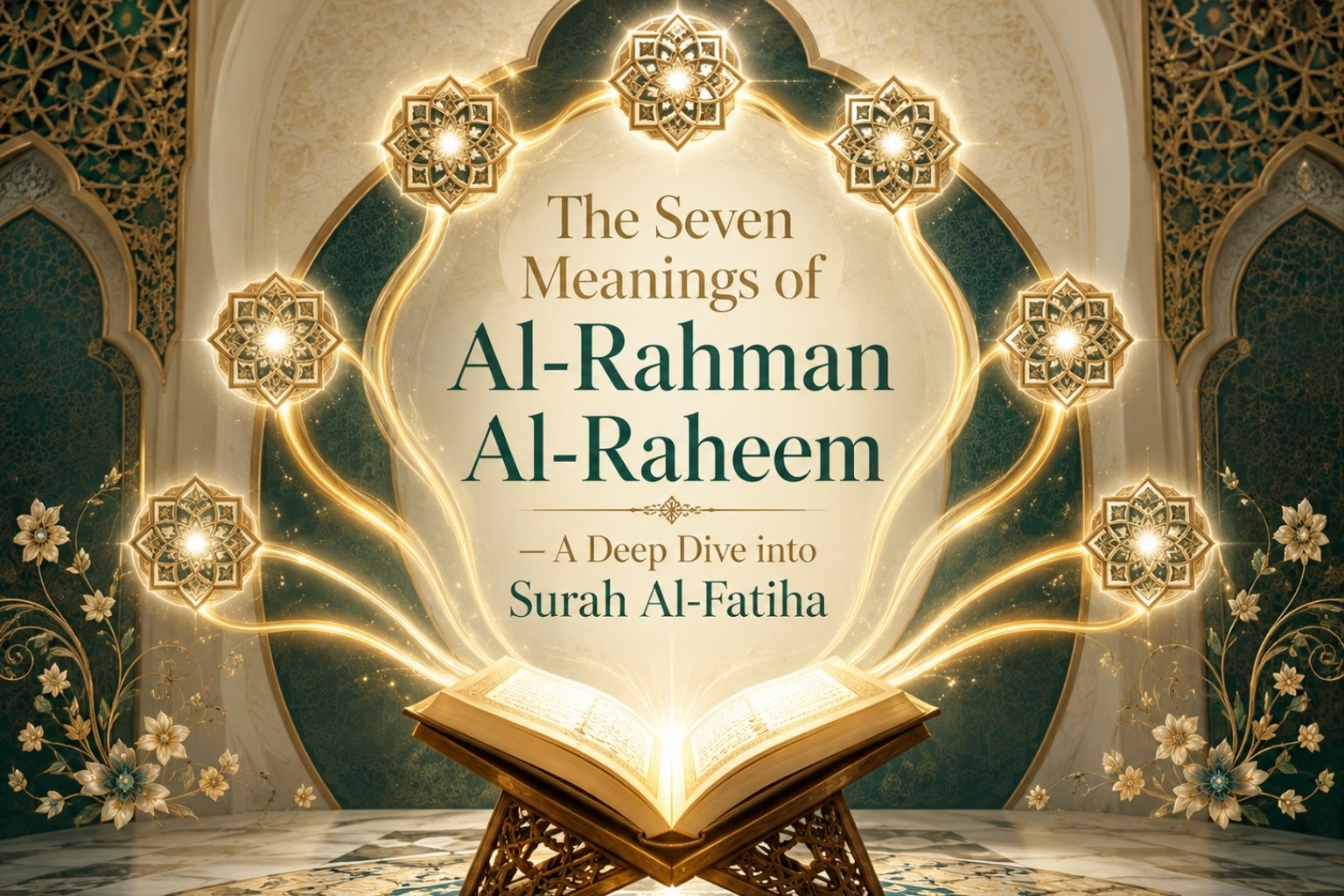
This article is an invitation to stop. To receive. To discover that these two words contain — according to fourteen centuries of Islamic scholarship — not one meaning, not two, but seven distinct layers of meaning. Seven depths that, once understood, change how you experience every prayer, every moment of divine mercy, and every difficulty you have ever wondered whether Allah sees.
The two words are an ocean. Most of us have only ever stood at the shore.
The Full Verse: Arabic and English
بِسْمِ اللَّهِ الرَّحْمَٰنِ الرَّحِيمِ ﴿١﴾ الْحَمْدُ لِلَّهِ رَبِّ الْعَالَمِينَ ﴿٢﴾ الرَّحْمَٰنِ الرَّحِيمِ ﴿٣﴾
“In the name of Allah, the Most Gracious, the Most Merciful. All praise is due to Allah, Lord of all the worlds. The Most Gracious, the Most Merciful.”
Surah Al-Fatiha (1:1–3)
Before the Meanings: What Is Surah Al-Fatiha?
Surah Al-Fatiha — “The Opening” — is the first chapter of the Quran. It is seven verses. It is the most recited passage in human history. Every single rak’ah of every prayer performed by every Muslim since the time of the Prophet Muhammad ﷺ has contained it. It is called Umm Al-Quran — the Mother of the Quran — because it contains within its seven verses the essence of everything the entire Book says.
The Prophet Muhammad ﷺ said:
لَا صَلَاةَ لِمَنْ لَمْ يَقْرَأْ بِفَاتِحَةِ الْكِتَابِ
“There is no prayer for the one who does not recite the Opening of the Book.”
Recorded in Sahih Al-Bukhari, Hadith No. 756
The surah begins with the Basmalah — Bismillah Al-Rahman Al-Raheem — and then, in verse three, repeats Al-Rahman Al-Raheem again. This repetition within a seven-verse surah is not accidental. Allah chose to introduce Himself to every human being who opens the Quran with these two names, before anything else, before any command or prohibition or narrative — only mercy.
The question the scholars have spent centuries asking is: what do these two names actually mean? Why two names for mercy rather than one? What does each add that the other does not? And what does it mean that Allah begins His Book and every prayer with them?
The Root: What Rahman and Raheem Share
Both names — Al-Rahman and Al-Raheem — come from the same Arabic root: r-h-m (ر ح م).
The root rahm in Arabic means the womb. The scholars of language have always noted this connection as foundational: divine mercy in Arabic is etymologically linked to the womb — to the most encompassing, unconditional, protective love that exists in human experience. A mother’s relationship with her child before it is even born. Before it has done anything. Before it has any qualities or achievements or failures. Purely because it exists and is hers.
This is where Allah‘s mercy begins — not in response to human goodness, but prior to it. The way a mother’s love for the child in her womb is prior to anything the child has done.
The Prophet Muhammad ﷺ made this connection explicit:
إِنَّ اللَّهَ خَلَقَ الرَّحْمَةَ يَوْمَ خَلَقَهَا مِئَةَ جُزْءٍ، فَأَمْسَكَ عِنْدَهُ تِسْعَةً وَتِسْعِينَ جُزْءًا، وَأَرْسَلَ فِي الْأَرْضِ جُزْءًا وَاحِدًا، فَمِنْ ذَلِكَ الْجُزْءِ تَتَرَاحَمُ الْخَلَائِقُ
“Allah created mercy in one hundred parts. He kept ninety-nine parts with Himself and sent one part down to earth. From that one part, all of creation shows compassion to one another.”
Recorded in Sahih Al-Bukhari, Hadith No. 6000
The totality of all the mercy that has ever existed on earth — every mother who has ever loved her child, every person who has ever shown kindness to another, every act of tenderness between any two creatures in the history of the world — is one percent of Allah‘s mercy. Ninety-nine percent remains with Him, reserved for His servants on the Day of Judgment.
Both Al-Rahman and Al-Raheem draw from this ocean. But they draw from it differently. And the difference is everything.
The First Meaning: Intensity vs. Continuity
The most fundamental distinction between the two names lies in Arabic grammar — in the difference between two types of intensive adjective (sifah mushabbahah and sighah mubalaghah).
Al-Rahman — fa’lan form — describes an attribute that is vast, overwhelming, and all-encompassing in its scope. It is like saying “utterly full of mercy” — mercy that is so complete it overflows in every direction simultaneously.
Al-Raheem — fa’il form — describes an attribute that is constant, continuous, and repeatedly expressed toward a specific recipient. It is like saying “ever-merciful toward you” — mercy that keeps returning to the same person, again and again, in an ongoing relationship.
The scholars summarize it this way: Al-Rahman is the breadth of Allah‘s mercy. Al-Raheem is the depth of it directed toward the believer.
Al-Rahman is the ocean. Al-Raheem is the river that flows from the ocean directly to you.
The Second Meaning: This World and the Next
The classical scholars — among them Imam Ibn Jarir Al-Tabari and Imam Ibn Al-Qayyim — established one of the most important distinctions in all of Quranic tafsir:
Al-Rahman refers to Allah‘s mercy that encompasses all of creation in this world — believers and disbelievers, humans and animals, the righteous and the sinful. The sun rises on everyone. Rain falls on the fields of the believer and the disbeliever alike. The body of every person — regardless of their faith — is sustained by intricate systems that sustain life without anyone asking or earning it. Health. The ability to see. The capacity to think. The warmth of the sun. The gift of sleep.
All of this is Al-Rahman — general, universal, unconditional mercy that reaches every created thing in this world.
Al-Raheem, by contrast, refers to Allah‘s mercy specifically for the believers — in this world and, above all, in the next. The mercy of guidance. The mercy of forgiveness. The mercy of answered prayers. The mercy of being admitted into Paradise and protected from the Fire.
وَكَانَ بِالْمُؤْمِنِينَ رَحِيمًا
“And He is ever, to the believers, Merciful (Raheem).”
Surah Al-Ahzab (33:43)
Allah specifically uses the name Al-Raheem — not Al-Rahman — when speaking of His mercy toward the believers. This is not a coincidence. Al-Raheem is the name of the mercy that follows you into the next life. Al-Rahman is the mercy that has surrounded you in this one.
The Basmalah, then — Bismillah Al-Rahman Al-Raheem — invokes both: Allah‘s mercy that encompasses all of creation, and His special mercy that He reserves for those who believe. Beginning with both means acknowledging both. Receiving both.
The Third Meaning: The Given and the Earned
Building on the distinction above, the scholars draw out a third layer — the difference between mercy that is given unconditionally and mercy that is sought through relationship.
Al-Rahman is mercy that precedes all action. Before you were born, Allah was Al-Rahman. Before you believed, before you prayed, before you did any good — the mercy of Al-Rahman was already sustaining you. You did not earn it. You cannot lose it by sin. It is a feature of existence itself: to exist is to be within the mercy of Al-Rahman.
Al-Raheem is mercy that responds — to repentance, to worship, to turning toward Allah, to the believer’s ongoing relationship with Him. It is not that the believer earns this mercy in a transactional sense. But it has a relational quality. It responds to the heart that seeks it. It intensifies for the person who draws near.
Ibn Al-Qayyim writes beautifully on this: the believer who understands both names lives between two realities simultaneously — the certainty that Al-Rahman will never abandon them regardless of their state, and the striving that Al-Raheem invites, the desire to draw closer, to receive more, to be among those whom Al-Raheem wraps in the mercy of the next world.
The combination of the two names is an antidote to two opposite diseases of the heart: despair and complacency. Al-Rahman answers with despair: no matter what you have done, you have not exited the mercy of Allah. Al-Raheem answers complacency: there is a deeper, more specific mercy available to you — and it responds to how you live.
The Fourth Meaning: The Name Only Allah Carries
Among all the names of Allah, Al-Rahman holds a unique status in Islamic theology: it is a name that belongs exclusively to Allah and cannot be attributed to any created being.
Al-Raheem — mercy, compassion — can be attributed to human beings. The Prophet Muhammad ﷺ himself is described in the Quran using this same form:
بِالْمُؤْمِنِينَ رَءُوفٌ رَّحِيمٌ
“To the believers he is kind and merciful (raheem).”
Surah At-Tawbah (9:128)
A human being can be raheem — merciful, compassionate, tender. But no human being is or can be Al-Rahman. The name is exclusive to Allah in a way that Al-Raheem is not.
The scholars note that this is why, in the Quran, Al-Rahman appears as a standalone name for Allah — used in exactly the same way as the name Allah itself:
قُلِ ادْعُوا اللَّهَ أَوِ ادْعُوا الرَّحْمَٰنَ ۖ أَيًّا مَّا تَدْعُوا فَلَهُ الْأَسْمَاءُ الْحُسْنَىٰ
“Say: Call upon Allah or call upon Al-Rahman — whichever you call upon, to Him belong the most beautiful names.”
Surah Al-Isra (17:110)
Al-Rahman is not an adjective describing Allah. It is a name of Allah — one that points to a quality so vast, so total, so beyond comparison that no created being shares it even partially. When you say Al-Rahman in your prayer, you are invoking a name that has never applied to anything other than Allah — a name of complete uniqueness.
The Fifth Meaning: Mercy as the Foundation of the Universe
Imam Ibn Al-Qayyim, in his masterwork Madarij Al-Salikin, argues that Al-Rahman is not merely one of Allah‘s attributes — it is the attribute from which the existence of the universe flows.
The heavens and the earth were created by Allah‘s mercy. The sending of the Prophets and the revelation of the Books is mercy. The sustaining of life is mercy. The forgiveness of sin is mercy. The creation of Jannah (Paradise) is mercy. Every act of Allah toward His creation is an expression of Al-Rahman.
وَرَحْمَتِي وَسِعَتْ كُلَّ شَيْءٍ
“And My mercy encompasses all things.”
Surah Al-A’raf (7:156)
Not some things. Not most things. All things. The mercy of Al-Rahman is the ocean in which the entire created universe floats. There is nothing in existence that is not, in some way, an expression of or sustained by the mercy of Allah.
This is why the Quran begins with Al-Rahman Al-Raheem before any other attribute. Before Allah tells us He is the Judge, before He tells us He is the All-Powerful, before He tells us He is the Avenger of wrongdoing — He tells us He is Al-Rahman Al-Raheem. Mercy is the frame. Everything else is read within that frame.
The scholars of usul (foundations) draw from this a principle of divine nature: Allah‘s power is immense, His justice is absolute, His wrath is real — but all of these are enclosed within mercy. Mercy is not one attribute among many. It is the atmosphere of all the others.
The Sixth Meaning: The Order Matters
Why does Al-Rahman come before Al-Raheem? Why not reverse them?
The scholars of Arabic rhetoric identify the placement as deliberate and significant. The general always precedes the specific. The universal frame is established before the particular detail is introduced.
Al-Rahman — the vast, universal, all-encompassing mercy — is mentioned first to establish the broadest possible context: whatever follows is within an ocean of mercy. Then Al-Raheem — the particular, relational, believer-specific mercy — is mentioned to specify: and within that ocean, there is a current directed specifically toward you.
Imam Al-Razi, in his encyclopedic tafsir Mafatih Al-Ghayb, adds another dimension to the order: Al-Rahman is the mercy of divine initiative — Allah reaching out to creation before they turn to Him. Al-Raheem is the mercy of divine response — Allah meeting the believer who has turned toward Him. The order reflects the sequence of the human journey: you are first enclosed in mercy you did not ask for (Al-Rahman), and then you turn toward Allah and receive the mercy that responds to that turning (Al-Raheem).
There is also a rhetorical effect in the order for the person reciting: beginning with the vast and moving to the personal makes the personal feel more intimate. By the time you reach Al-Raheem, you have already been reminded of the universal ocean — and then Allah says: and this is specifically for you. The movement from cosmic to intimate is the same movement found in Surah Al-Hadid when Allah moves from describing the creation of the heavens and earth to saying and He is with you wherever you are.
The Quran consistently does this: it establishes the vastness and then shows you your particular place within it. The order of the two names is an instance of that pattern.
The Seventh Meaning: Why They Are Repeated in Al-Fatiha
Al-Rahman Al-Raheem appears in Surah Al-Fatiha twice — once in the Basmalah (verse 1) and once in verse 3. In a seven-verse surah, this repetition commands attention.
The first mention — in the Basmalah — introduces Allah to the reader. It is the name you call upon before you begin. It is the identity of the One you are addressing. Before the praise, before the request, before the declaration of the path you are seeking — you begin by naming who you are speaking to. And the name you are given to use is: the One of boundless mercy, the One of specific mercy toward you.
The second mention — in verse 3, following “All praise is due to Allah, Lord of all the worlds” — arrives as a clarification of what kind of Lord He is. He is the Lord of all worlds — and lest that feel vast and distant and impersonal — Al-Rahman Al-Raheem. The Lord of all the worlds is not a detached sovereign. He is the Lord of all the worlds who is also, specifically and continually, merciful to you.
The repetition creates a frame within the surah itself. The prayer opens in the name of mercy and then, before any petition is made, reminds the one praying of the merciful nature of the One they are petitioning. You are not approaching a demanding judge. You are approaching Al-Rahman Al-Raheem — twice confirmed.
Imam Al-Sa’di writes that this double mention of mercy in a seven-verse surah — a surah that also mentions Allah‘s mastership of the Day of Judgment — is an intentional balance. The majesty and accountability of the Day of Judgment (verse 4) is surrounded on both sides by the mention of mercy. The frame of the prayer is mercy. The center of human accountability is enclosed within it.
What Fourteen Centuries of Scholars Agreed On
Across all schools of Islamic theology and jurisprudence, across all fourteen centuries of scholarship, there is a point of near-universal agreement about Al-Rahman Al-Raheem:
Allah‘s mercy precedes His wrath.
إِنَّ رَحْمَتِي سَبَقَتْ غَضَبِي
“My mercy has preceded My wrath.”
Recorded in Sahih Al-Bukhari, Hadith No. 7422
This is not a comforting metaphor. It is a theological statement about the nature of Allah. His mercy is the default. His wrath is the exception — real, but not the starting point. When Allah begins His Book with Al-Rahman Al-Raheem, He is not making a rhetorical choice. He is declaring His nature.
This has immense practical consequences for how a believer understands their relationship with Allah:
You do not approach Allah as a suspect approaching a judge. You approach Allah as a child approaching a parent whose love for you is immense, prior, and unconditional — while also being the most just and honest parent imaginable.
You do not live in perpetual anxiety about your standing with Allah. You live in a relationship with Al-Rahman Al-Raheem — one who has surrounded your existence with mercy before you had the awareness to receive it.
You do not despair when you sin. You return to Al-Rahman Al-Raheem — the One whose mercy preceded His wrath, who placed the door of repentance at your hand precisely because His mercy expects your return.
The Names and the Prayer: What Changes When You Understand
Every time you stand in prayer and recite Surah Al-Fatiha, you say Al-Rahman Al-Raheem twice. Seventeen times a day at minimum. Hundreds of thousands of times in a lifetime.
What does it mean to say them knowing what they mean?
It means pausing — even for a fraction of a second — to let the words land. To receive them as statements about the One you are addressing, rather than words you are producing.
Al-Rahman: the mercy that is already around you. The air you breathed before this prayer. The body that carried you to this prayer. The guidance that brought you to the prayer mat at all. The fact that you are here, now, aware of Allah, is itself an act of Al-Rahman — the mercy that reaches every person, that reached you before you turned toward it.
Al-Raheem: the mercy that responds to you being here. The mercy that meets you in this specific act of worship. The mercy that responds to your specific repentance, your specific petition, your specific turning toward Allah in this prayer. The mercy that does not generalize you but addresses you as an individual with a name and a history and a particular need in this particular moment.
When you say these two names — truly say them — the prayer changes from recitation to conversation. You are no longer sending words upward into an empty sky. You are addressing a specific Being with a specific nature: Al-Rahman Al-Raheem. The One of boundless mercy and the One of specific mercy toward you.
A Final Reflection: The Mercy That Finds You Before You Look for It
There is a detail about Al-Rahman that the scholars note with a sense of wonder.
In the Quran, Allah says:
الرَّحْمَٰنُ عَلَى الْعَرْشِ اسْتَوَىٰ
“The Most Merciful — established above the Throne.”
Surah Ta-Ha (20:5)
Allah chose to describe His establishment above the Throne — His sovereignty over all creation — not by the name of His power, not by the name of His majesty, not by the name of His greatness. But by the name of His mercy: Al-Rahman.
The sovereign of the universe introduces Himself from His Throne as: the One of boundless mercy.
This is who is in charge. This is whose hands hold the affairs of everything that exists. Not a distant, indifferent power. Not a demanding accountant. Al-Rahman — the One whose attribute of mercy is so vast that it is the first name He uses to describe His sovereignty.
And then He tells you — in the prayer you repeat seventeen times a day — to begin every act with the name of this Being. In the name of Allah, Al-Rahman Al-Raheem. Begin with mercy. Operate within mercy. Return to mercy.
The mercy of Al-Rahman found you before you were born. The mercy of Al-Raheem is waiting for you every time you turn.
The two names are not theology to be understood and filed away. They are a reality to be lived inside of — a reality in which every breath is a gift of Al-Rahman, and every prayer is met by Al-Raheem, and no person who truly knows these two names ever has to face anything in this world or the next entirely alone.
بِسْمِ اللَّهِ الرَّحْمَٰنِ الرَّحِيمِ
“In the name of Allah, Al-Rahman, Al-Raheem.”
Surah Al-Fatiha (1:1)
Say it again. This time, know what you are saying.