

The five essential acts that form the foundation of every Muslim’s life — what they are, why they matter, and how they work together
A Foundation, Not a Ceiling
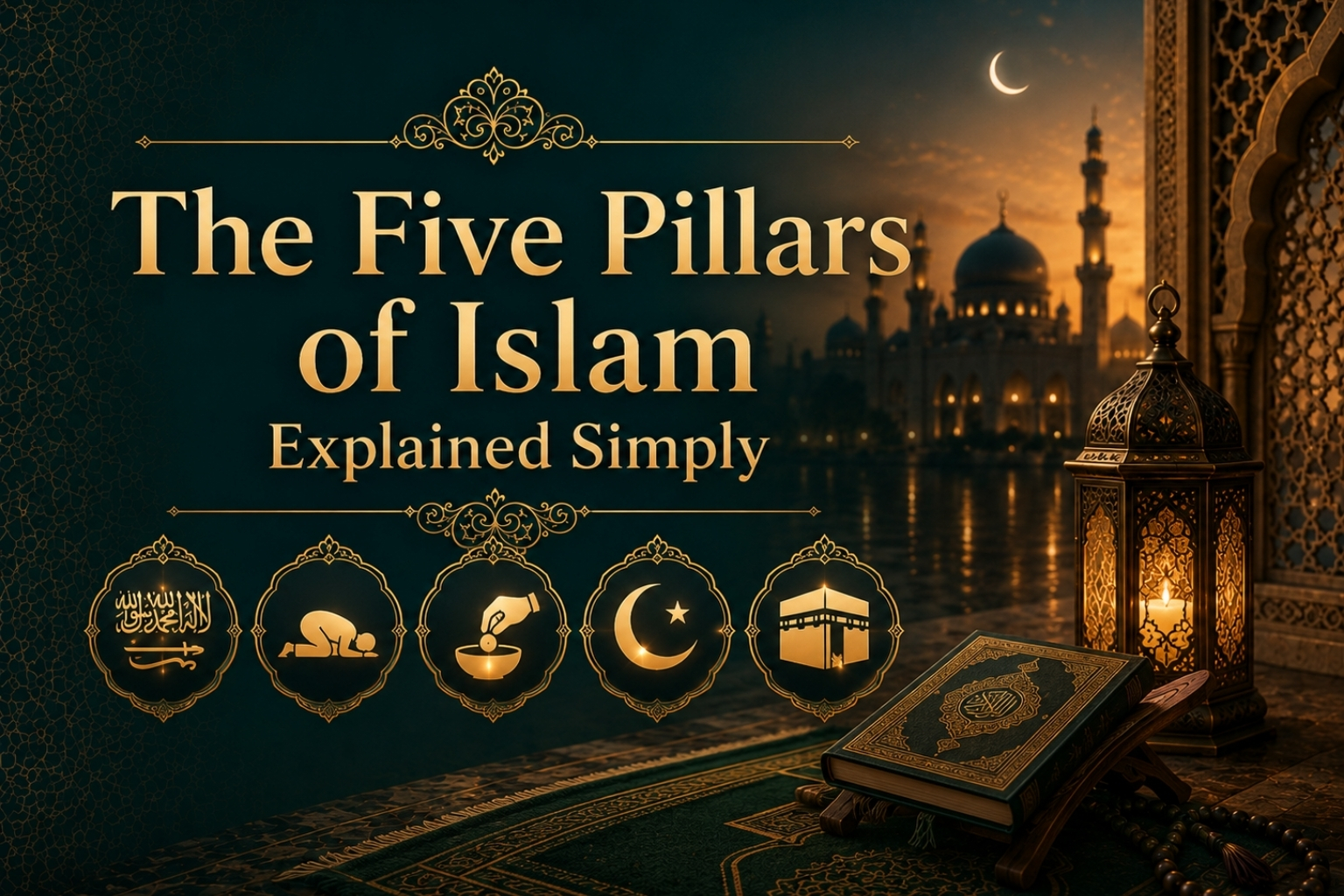
Every building needs a foundation. Without one, nothing built on top of it can stand — no matter how beautiful, how carefully constructed, how ambitious. The Five Pillars of Islam are that foundation. They are not the whole of Islam, but they are what everything else rests upon.
The Prophet Muhammad ﷺ described them clearly:
“Islam is built upon five things: the testimony that there is no god but God and that Muhammad is the messenger of God, establishing prayer, paying zakat, fasting Ramadan, and performing pilgrimage to the House.”
These five acts are not arbitrary rules. Each one is a complete world of meaning — a practice that, when understood and lived sincerely, shapes the way a Muslim thinks, feels, moves through time, and relates to God and to other people.
This article walks through each pillar simply and honestly, one at a time.
The First Pillar — Shahada (Declaration of Faith)
What it is
The Shahada is the declaration:
Ashhadu an la ilaha illa Allah, wa ashhadu anna Muhammadan rasul Allah. “I bear witness that there is no god but God, and I bear witness that Muhammad is the messenger of God.”
What it means
The Shahada is the entry point into Islam and the most fundamental statement a Muslim makes. It is not merely a phrase — it is a covenant, a testimony, and a worldview compressed into two sentences.
The first part — la ilaha illa Allah — is an act of liberation. It clears away every false object of worship: wealth, status, fear, desire, the approval of others. It leaves only One: God, the eternal, the self-sufficient, the one without partner or equal.
The second part — Muhammadan rasul Allah — establishes the path. God did not leave humanity without guidance. He sent prophets, and Muhammad ﷺ is the final prophet — the one through whom the Quran was revealed and whose example shows how the first part of the Shahada is actually lived.
Why it comes first
The Shahada is first because it is the root from which all other pillars grow. A person who truly understands and lives the Shahada will find that the other four pillars follow naturally — not as obligations imposed from outside, but as expressions of what the Shahada already means on the inside.
The Second Pillar — Salah (Prayer)
What it is
Salah is the formal prayer performed five times every day at prescribed times:
Prayer | Time |
Fajr | Before sunrise (dawn) |
Dhuhr | Midday (after the sun passes its peak) |
Asr | Mid-afternoon |
Maghrib | Just after sunset |
Isha | Night (after darkness falls) |
Each prayer consists of a set number of raka’at (units), involving standing, bowing, prostrating, and sitting — each position accompanied by specific words of remembrance and recitation from the Quran.
What it means
If the Shahada is a declaration, Salah is that declaration enacted with the whole body and the whole day.
Five times a day, a Muslim stops whatever they are doing — work, conversation, rest, worry — and turns to face the Qibla (the direction of the Kaaba in Mecca), and stands before God. The world does not disappear during those minutes, but it is put in its proper place.
The physical postures of prayer are themselves profound. Standing: a person before their Lord. Bowing (Ruku): submission and reverence. Prostrating (sujood): the lowest position the body can take, the forehead on the ground — the highest point of closeness to God. The Prophet ﷺ said: “The closest a servant is to his Lord is when he is in prostration.”
Why five times a day
The number is not arbitrary. It is a rhythm. Prayer distributed through the day means that no stretch of waking hours passes without a return to God. The morning prayer anchors the day before it begins. The night prayer closes it with gratitude and surrender. In between, three prayers interrupt whatever the world demands — a gentle, recurring reminder of what is actually real and what is actually temporary.
The Prophet ﷺ compared the five daily prayers to a river running past a person’s door — bathing in it five times a day leaves no dirt behind.
The Third Pillar — Zakat (Obligatory Charity)
What it is
Zakat is an annual financial obligation — a fixed percentage of a Muslim’s qualifying wealth, given to those in need. The standard rate is 2.5% of savings and assets that have been held for a full lunar year and exceed a minimum threshold called the nisab.
Zakat is distributed to eight categories of recipients defined in the Quran, including the poor, the destitute, those in debt, and those working to free themselves from hardship.
What it means
The word zakat in Arabic does not simply mean “charity.” It comes from a root meaning purification and growth. Giving zakat purifies the wealth that remains and causes it — spiritually and often practically — to grow.
This framing is deliberate. Zakat is not a tax reluctantly paid. It is a recognition that wealth does not ultimately belong to the one who holds it. God is the true owner of everything. What a person possesses has been entrusted to them — and a portion of that trust belongs to others.
The Quran places zakat alongside prayer more than 80 times — always together, always connected. Prayer is the relationship with God expressed vertically, upward. Zakat is that same relationship expressed horizontally, outward, toward other human beings. The two are inseparable.
Zakat and sadaqah
Zakat is obligatory — a pillar. But Islam also strongly encourages sadaqah — voluntary charity given at any time, in any amount. The Prophet ﷺ said that even a smile given to a fellow human being is an act of charity. Zakat sets the floor; generosity has no ceiling.
The Fourth Pillar — Sawm (Fasting in Ramadan)
What it is
Sawm is the fast observed throughout the month of Ramadan — the ninth month of the Islamic lunar calendar. From the first light of dawn until sunset, a fasting Muslim abstains completely from:
- Eating and drinking (including water)
- Smoking
- Sexual relations
- Any deliberate breaking of the fast
The fast is broken each evening at sunset with Iftar — traditionally begun with dates and water, following the practice of the Prophet ﷺ — and the night is marked by additional prayers called Tarawih.
What it means
Fasting is one of the most direct experiences of worship available to a human being. Every time hunger or thirst arises during the fast — which is often — the person who is fasting is reminded: I am doing this for God. No one else can see whether you eat or drink when you are alone. Fasting is, uniquely, between a person and God.
God says in a hadith qudsi — a divine saying conveyed through the Prophet ﷺ:
“Every deed of the son of Adam is for himself, except fasting — it is for Me, and I will reward it.”
Fasting also creates a lived experience of hunger that builds compassion for those who go without not by choice, but by circumstance. It strips away the noise of consumption and comfort, creating a clarity in which prayer, reflection, and the Quran feel more immediate and alive.
Ramadan is not only a month of fasting — it is the month in which the Quran was first revealed, and it carries a particular spiritual intensity that Muslims across every culture and continent feel as something distinct from the rest of the year.
Who fasts
Adults who are physically able are required to fast. Those who are ill, pregnant, nursing, traveling, or elderly and unable to fast are exempt — many making up missed days later or offering fidya (feeding a person in need for each missed day). Children are not required to fast, though many begin practicing voluntarily as they grow.
The Fifth Pillar — Hajj (Pilgrimage to Mecca)
What it is
Hajj is the pilgrimage to the city of Mecca in Saudi Arabia, performed during the first ten days of Dhul Hijjah — the twelfth and final month of the Islamic calendar. It is obligatory once in a lifetime for every Muslim who is physically and financially able to make the journey.
The rites of Hajj include:
- Entering a state of ritual purity and simplicity called ihram, wearing two plain white garments (for men)
- Circling the Kaaba seven times (tawaf)
- Walking between the hills of Safa and Marwa seven times (sa’i)
- Standing on the plain of Arafat in prayer and supplication — the spiritual heart of Hajj
- Spending the night in Muzdalifah
- Symbolic stoning of the pillars at Mina
- Sacrificing an animal and shaving the head as acts of devotion
What it means
Hajj is unlike anything else in religious practice. Every year, millions of Muslims from every nation on earth — speaking every language, from every background, rich and poor — converge on one place, wearing the same simple garments, performing the same rites, standing before God as equals.
The plain white ihram garments are not accidental. They remove every marker of wealth, nationality, and status. A king and a farmer stand together on the plain of Arafat indistinguishable from one another — both servants, both seeking the same forgiveness, both returning to the same God.
Hajj retraces the footsteps of Ibrahim (Abraham) and his family — their sacrifice, their trust, their absolute surrender to God. It is a physical enactment of the Shahada: there is only God, and everything else — comfort, possession, identity, the self — is laid down before Him.
The Prophet ﷺ said: “Whoever performs Hajj for the sake of God and does not commit any obscenity or sin, he returns as on the day his mother bore him.” Hajj, for those who perform it with sincerity, is a complete renewal.
How the Five Pillars Work Together
The Five Pillars are not five separate rules sitting side by side. They form a single, integrated practice — each one reinforcing and deepening the others.
The Shahada establishes the truth. Salah enacts that truth five times a day with the whole body. Zakat extends that truth outward into the lives of others. Sawm purifies the self and deepens the direct experience of God. Hajj completes the journey — once in a lifetime, every layer of worldly identity set aside, standing on the earth as nothing but a servant before the Creator.
Together they cover every dimension of human life: belief, time, wealth, body, and journey. A Muslim who lives these five pillars with understanding and sincerity does not practice them as obligations to be checked off. They become the shape of a life — the architecture within which everything else is built.
A Word to the New Muslim
You may not be able to perform all five pillars right now. Hajj requires the means and the journey. Zakat requires savings above a threshold. Fasting Ramadan comes once a year. And even Salah takes time to learn properly.
That is completely fine. Begin where you are. The Shahada you have already declared. Prayer can begin today, however imperfectly. The rest will come with time, with learning, and with God’s help.
The Prophet ﷺ said: “Religion is easy.“ He did not say it was simple — but he said it was easy, because God does not burden a soul beyond what it can bear. He knows you are new. He knows you are learning. What He asks for, before anything else, is sincerity — a turned heart, facing in the right direction.
That is where every pillar begins.