
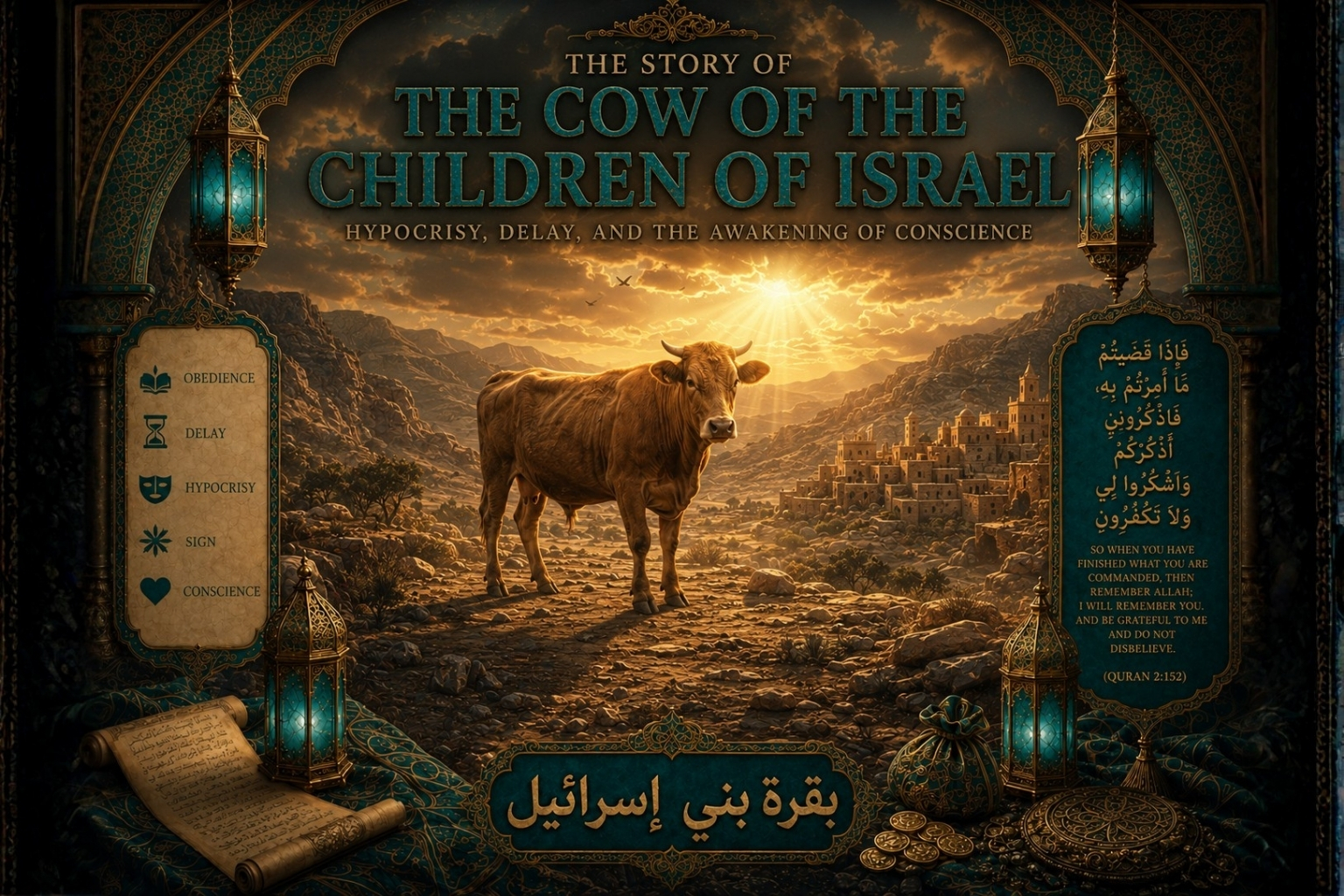

Among the most detailed, legally instructive, and psychologically profound narratives recorded in the Holy Quran is the history of Baqarat Bani Israel (The Cow of the Children of Israel). Found in the second and longest chapter of the Quran—explicitly named Surah Al-Baqarah in honor of this very event—this narrative chronicles a critical social and spiritual crisis that occurred during the leadership of Prophet Musa (Moses).
Revealed by Allah to expose the deep-seated hypocrisy, stubborn procrastination, and legalistic games played by a rebellious community, the story of the Cow in Islam serves as an eternal moral lesson on the necessity of swift obedience, the spiritual danger of questioning divine commands, and the absolute reality of the Resurrection.
The Catalyst: A Mysterious Crime and Social Chaos
The narrative begins within a wealthy community of the Children of Israel. A highly prominent, affluent old man who possessed immense riches was found brutally murdered and discarded on the highway. Because he had no direct heirs except a greedy nephew who was desperate to inherit his fortune immediately, suspicion and wild accusations fractured the society.
The different tribes began blaming and accusing one another, pushing the community to the brink of a violent civil war. To prevent bloodshed and uncover the absolute truth, the elders approached Prophet Musa, asking him to supplicate to Allah to identify the hidden killer.
The Divine Command and the Accusation of Mockery
Prophet Musa returned to his people with a direct, clear, and exceptionally simple command from Allah: to slaughter a cow.
Instead of executing the command immediately—which would have fulfilled the requirement regardless of what type of cow they chose—their rigid, hyper-rationalistic mindsets revolted. They viewed the command as completely disconnected from their forensic crisis, accusing their Prophet of playing a practical joke.
“وَإِذْ قَالَ مُوسَىٰ لِقَوْمِهِ إِنَّ اللَّهَ يَأْمُرُكُمْ أَن تَذْبَحُوا بَقَرَةً ۖ قَالُوا أَتَتَّخِذُنَا هُزُوًا ۖ قَالَ أَعُوذُ بِاللَّهِ أَنْ أَكُونَ مِنَ الْجَاهِلِينَ”
“And [remember] when Musa said to his people, ‘Indeed, Allah commands you to slaughter a cow.’ They said, ‘Do you take us in mockery?’ He said, ‘I seek refuge in Allah from being among the ignorant.'” — (Surah Al-Baqarah, 2:67)
The Spiral of Over-Questioning and Legalistic Procrastination
Because they lacked absolute submission (Taslim) and sought to delay the execution of the command, they initiated a spiral of unnecessary, hyper-specific questions regarding the physical characteristics of the cow. With every pedantic question they asked, Allah made the criteria stricter, narrowing their options and driving up the economic price of their compliance.
1. The Age of the Cow
They first asked Prophet Musa to clarify the exact age of the animal. Allah specified that it must be a prime adult—neither too old nor too young, but an intermediate age.
“قَالُوا ادْعُ لَنَا رَبَّكَ يُبَيِّن لَّنَا مَا هِيَ ۚ قَالَ إِنَّهُ يَقُولُ إِنَّهَا بَقَرَةٌ لَّا فَارِضٌ وَلَا بِكْرٌ عَوَانٌ بَيْنَ ذَٰلِكَ ۖ فَافْعَلُوا مَا تُؤْمَرُونَ”
“They said, ‘Call upon your Lord for us to make clear to us what it is.’ [Musa] said, ‘He says, “It is a cow which is neither old nor virgin, but median between that,” so do what you are commanded.'” — (Surah Al-Baqarah, 2:68)
2. The Color of the Cow
Still seeking to delay, they demanded to know its exact color. Allah made the condition exceptionally rare: it had to be a pure, bright, solid yellow cow, so vivid that it brought immediate joy to anyone who looked at it.
“قَالُوا ادْعُ لَنَا رَبَّكَ يُبَيِّن لَّنَا مَا لَوْنُهَا ۚ قَالَ إِنَّهُ يَقُولُ إِنَّهَا بَقَرَةٌ صَفْرَاءُ فَاقِعٌ لَّوْنُهَا تَسُرُّ النَّاظِرِينَ”
“They said, ‘Call upon your Lord for us to make clear to us what is its color.’ He said, ‘He says, “It is a yellow cow, bright in color, pleasing to the observers.”‘” — (Surah Al-Baqarah, 2:69)
3. The Function and Usability of the Cow
Driven by their own stubbornness into a corner, they claimed that cows all looked identical to them, asking for a final, definitive profile. Allah placed the ultimate restriction: the cow must be entirely unblemished, completely untamed, and must have never spent a single day of its life plowing fields or watering crops.
“قَالُوا ادْعُ لَنَا رَبَّكَ يُبَيِّن لَّنَا مَا هِيَ إِنَّ الْبَقَرَ تَشَابَهَ عَلَيْنَا وَإِنَّا إِن شَاءَ اللَّهُ لَمُهْتَدُونَ قَالَ إِنَّهُ يَقُولُ إِنَّهَا بَقَرَةٌ لَّا ذَلُولٌ تُثِيرُ الْأَرْضَ وَلَا تَسْقِي الْحَرْثَ مُسَلَّمَةٌ لَّا شِيَةَ فِيهَا ۚ قَالُوا الْآنَ جِئْتَ بِالْحَقِّ ۚ فَذَبَحُوهَا وَمَا كَادُوا يَفْعَلُونَ”
“They said, ‘Call upon your Lord for us to make clear to us what it is. Indeed, all cows look alike to us, and indeed we, if Allah wills, will be guided.’ He said, ‘He says, “It is a cow neither trained to plow the earth nor to irrigate the field, sound without blemish.” Cody said, “Now you have come with the truth.” So they slaughtered it, though they were near to not doing it.'” — (Surah Al-Baqarah, 2:70-71)
The Devout Orphan and the Miracle of Resurrection
Islamic historical tradition notes that because they narrowed down the criteria to such an impossible degree, there was only one single cow in the entire region that matched this divine description. It belonged to a highly righteous, orphan boy who had treated his late mother with unparalleled kindness and respect.
The community was forced to purchase this unique yellow cow from the orphan by filling its entire hide with solid gold, bankrupting their hoarded wealth to fulfill the command they had tried so hard to avoid.
Once the cow was slaughtered, Allah commanded Prophet Musa to take a specific piece of the dead animal and strike the lifeless body of the murdered old man with it.
When Prophet Musa did so, a breathtaking miracle occurred: the dead man instantly sat up alive, breathing normally. Prophet Musa asked him: “Who killed you?” The man pointed directly at his greedy nephew and said: “My nephew killed me for my wealth.” He then collapsed back down, returning to the state of death. The killer was exposed, justice was served, and the civil war was completely averted.
“فَقُلْنَا اضْرِبُوهُ بِبَعْضِهَا ۚ كَذَٰلِكَ يُحْيِي اللَّهُ الْمَوْتَىٰ وَيُرِيكُمْ آيَاتِهِ لَعَلَّكُمْ تَعْقِلُونَ”
“So We said, ‘Strike the slain man with part of it.’ Thus does Allah bring the dead to life, and He shows you His signs that you might reason.” — (Surah Al-Baqarah, 2:73)
The Prophet Muhammad heavily warned Muslims against falling into this exact psychological trap of over-complicating religion, urging his companions to accept divine rulings with simple, straightforward adherence.
“إِذَا أَمَرْتُكُمْ بِشَيْءٍ فَأْتُوا مِنْهُ مَا اسْتَطَعْتُمْ ، وَإِذَا نَهَيْتُكُمْ عَنْ شَيْءٍ فَدَعُوهُ”
“When I command you to do something, do it as much as you can; and when I forbid you from doing something, abandon it completely.” — (Sahih al-Bukhari & Sahih Muslim)
Core Spiritual Lessons from the Story of the Cow
- The Danger of Over-Questioning (Kثرة السؤال): Religion is designed to be a path of ease. Had the Children of Israel taken any random cow at the beginning and slaughtered it, their duty would have been completely discharged. By over-analyzing and demanding endless details, they brought unnecessary hardship upon themselves.
- The Cosmic Reward for Filial Piety (Birr al-Walidain): Allah enriched the poor orphan boy and brought financial ruin to the greedy elders specifically because the boy was exceptionally dutiful to his mother. Your private kindness to your parents can become the source of your worldly and spiritual prosperity.
- Forensic Truth Belongs to Allah: No matter how perfectly a criminal covers their tracks, hides evidence, or shifts blame onto others, they can never escape the surveillance of Allah. The truth will always be brought to light by divine decree.
- A Visual Proof of the Resurrection: The revival of the murdered man using a piece of a dead cow was a direct, living demonstration designed to humble the materialist mindsets of that era, proving that reviving a decayed body on the Day of Judgment is an effortless act for Allah.
Conclusion
The profound history of Baqarat Bani Israel serves as a permanent, timeless warning for every believer against religious evasion and intellectual pride. It demonstrates that true wisdom lies in swift, sincere execution of divine commands without seeking semantic loopholes or philosophical delays. By maintaining an obedient heart, refraining from pedantic argumentation, and trusting the ultimate justice of Allah, we protect our communities from spiritual hardening, transforming our daily religious practices into active channels of divine mercy and absolute clarity.