
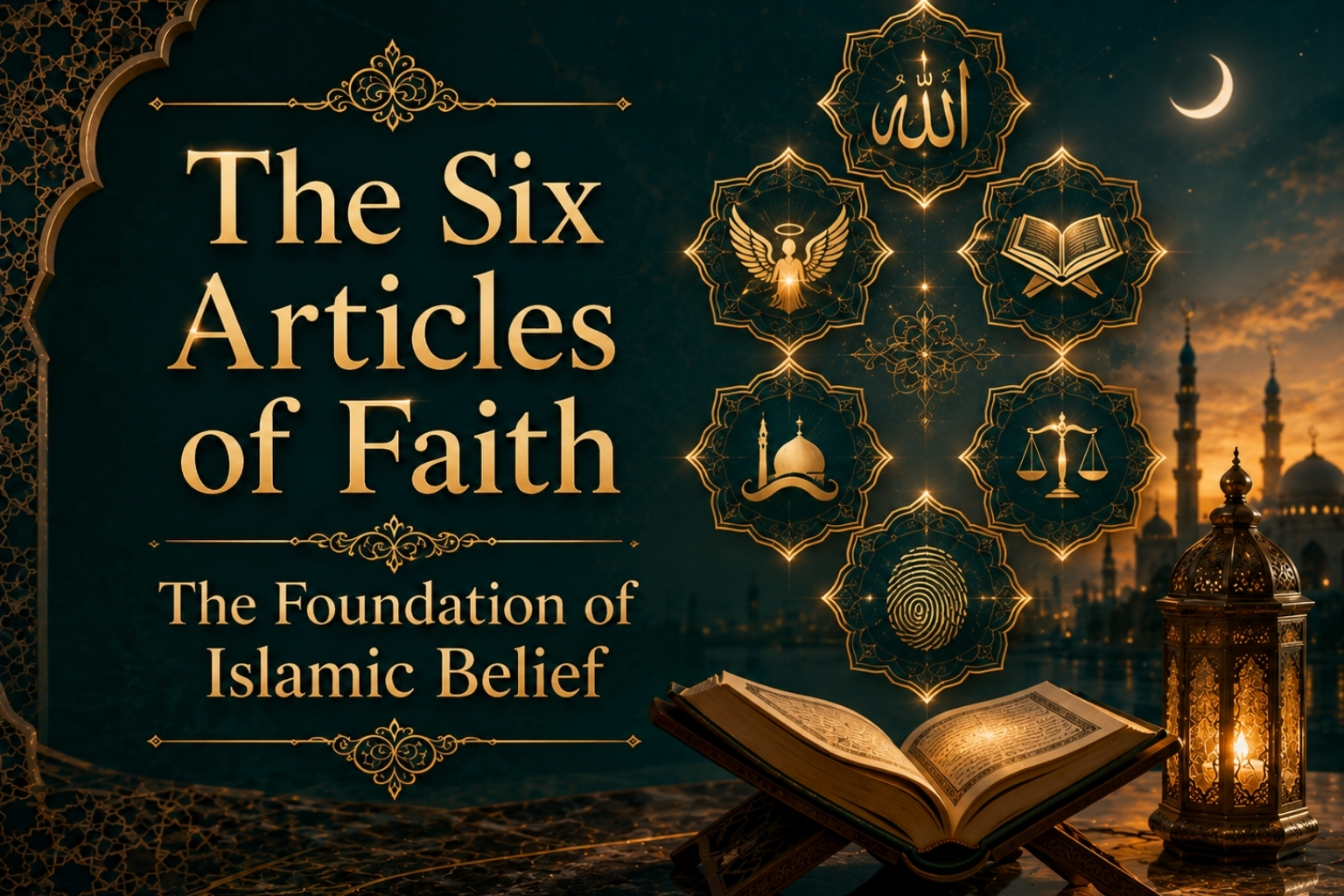

God, angels, scriptures, prophets, the Day of Judgement, and divine decree — the six realities that shape how a Muslim understands everything
Belief Is Not Simply an Opinion
In the modern world, belief is often treated as a personal preference — something held loosely, updated frequently, kept largely private. In Islam, belief is something altogether different. It is iman — a word that carries the weight of trust, conviction, security, and surrender all at once.
The root of iman in Arabic is the same root as amanah — trustworthiness — and aman — safety. To have iman is not merely to agree with a set of propositions. It is to place the full weight of one’s trust in a reality that is more solid than anything the eye can see.
That reality is described through six articles of faith — known in Arabic as arkan al-iman, the pillars of faith. These six are not a checklist. They are a map of existence — a description of what is real, what is at stake, and who God is in relation to the world He created.
The Prophet Muhammad ﷺ defined them when asked about iman:
“It is to believe in God, His angels, His revealed books, His messengers, the Last Day, and to believe in divine decree — both its good and its hardship.”
This article walks through each one, simply and carefully.
The First Article — Belief in God (Allah)
The foundation of everything
The first and most fundamental article of faith is belief in God — in Arabic, Allah. Not a vague spiritual force, not an abstract philosophical concept, but the One living God: eternal, self-sufficient, all-knowing, all-powerful, and intimately aware of every soul He has created.
Islam describes God through His names and attributes — known as Asma Allah al-Husna, the Most Beautiful Names of God. The Quran mentions many of them: Ar-Rahman (the Most Merciful), Ar-Raheem (the Most Compassionate), Al-Khaliq (the Creator), Al-Aleem (the All-Knowing), Al-Wadud (the Most Loving).
These are not metaphors. They are descriptions of who God actually is.
Tawheed — the oneness of God
The most essential dimension of belief in God is Tawheed — absolute monotheism. God is One. Not one among several. Not one with partners, children, or equals. Not divisible into parts or persons. Simply, completely, entirely One.
The Quran states it with extraordinary compression in Surah Al-Ikhlas:
“Say: He is God, the One. God, the Eternal Refuge. He neither begets nor is born. And there is nothing comparable to Him.” — Surah Al-Ikhlas (112:1–4)
Tawheed is not only a theological statement — it is a liberation. When God alone is ultimate, nothing else can hold ultimate power over a person. No fear, no craving, no authority on earth is truly absolute. This is why la ilaha illa Allah — there is no god but God — is experienced by those who truly grasp it not as a restriction but as a release.
The Second Article — Belief in the Angels (Mala’ikah)
What angels are
Angels — mala’ikah in Arabic — are real beings created by God from light. They are not human, they are not divine, and they are not the winged figures of popular imagination. They are servants of God, created to worship Him and to carry out His commands throughout the universe.
Angels do not eat, sleep, or have children. They do not disobey God — not because they are incapable of it, but because their very nature is one of complete, willing submission. The Quran describes them as beings who “do not disobey God in what He commands them, and they carry out what they are commanded.” (66:6)
Their roles
The Quran and the teachings of the Prophet ﷺ describe specific angels with specific roles:
- Jibreel (Gabriel) — the angel of revelation, who conveyed God’s word to all the prophets, including the Quran to Muhammad ﷺ
- Mikail (Michael) — entrusted with rain, provision, and the sustenance of creation
- Israfil — who will blow the trumpet to signal the end of the world and the beginning of the resurrection
- Izra’il (Azrael) — the angel of death, who receives souls at the moment of passing
- Munkar and Nakir — the two angels who question the soul in the grave
- The Kiraman Katibin — the two angels present with every human being, recording their deeds
Believing in angels means understanding that the world is not only what the eye can see. Creation is vast, layered, and populated with beings whose existence serves purposes far beyond human comprehension.
The Third Article — Belief in the Revealed Books (Kutub)
A long history of revelation
God did not speak to humanity only once. Across the long history of human existence, He sent guidance through prophets — and with many of those prophets, He sent scripture. These revealed books are real, and the obligation is to affirm them all.
The books mentioned in the Quran and Islamic tradition include:
- The Suhuf — the scrolls revealed to Ibrahim (Abraham) and other early prophets
- The Tawrat (Torah) — revealed to Musa (Moses)
- The Zabur (Psalms) — revealed to Dawud (David)
- The Injil (Gospel) — revealed to Isa (Jesus)
- The Quran — revealed to Muhammad ﷺ, the final messenger
The Quran as the preserved final word
While all these books are affirmed as genuine revelations from God, the earlier scriptures were not preserved in their original form. Over centuries of transmission, translation, and human interference, the original words were altered, added to, or lost entirely.
The Quran stands apart. God Himself guaranteed its preservation:
“Indeed, it is We who sent down the Reminder, and indeed, it is We who will preserve it.” — Surah Al-Hijr (15:9)
Fourteen centuries have passed since that promise was made. The Quran exists today — memorized by millions, recited in an unbroken oral chain from the Prophet ﷺ to the present — exactly as it was revealed. Not a word has changed. This is not a human achievement. It is the fulfillment of a divine promise.
The Fourth Article — Belief in the Prophets and Messengers (Anbiya)
God never left humanity without guidance
From the very beginning, God sent prophets to guide human beings — to remind them of their Creator, to show them how to live, and to warn them of the consequences of turning away. The Quran mentions 25 prophets by name, and Islamic tradition holds that God sent many thousands of messengers throughout human history to every people on earth.
Among the prophets mentioned in the Quran are figures also known from the Bible and Torah: Adam, Nuh (Noah), Ibrahim (Abraham), Ismail (Ishmael), Ishaq (Isaac), Yaqub (Jacob), Yusuf (Joseph), Musa (Moses), Dawud (David), Sulaiman (Solomon), Yahya (John the Baptist), and Isa (Jesus) — peace be upon them all.
The essential qualities of every prophet
Every prophet sent by God shared certain qualities: they were truthful, they were trustworthy, they conveyed God’s message completely without concealment, and they were intelligent. They were human beings — not divine — but they were the finest of human beings, chosen by God for the most demanding of all responsibilities.
Muhammad ﷺ — the seal of the prophets
The Prophet Muhammad ﷺ is the final prophet — Khatam an-Nabiyyeen, the Seal of the Prophets. After him, no new prophet will come. The message he delivered — the Quran and his Sunnah — is complete, preserved, and sufficient as guidance for all of humanity until the Last Day.
This is why his example matters so profoundly. It is not merely historical interest. It is a living guide.
To affirm the prophets is to affirm that God cares about humanity deeply enough to speak to it — again and again, in every age, in every language, through human beings chosen to carry the light.
The Fifth Article — Belief in the Last Day (Yawm al-Qiyamah)
This world is not all there is
The fifth article of faith is belief in the Last Day — Yawm al-Qiyamah, the Day of Resurrection, also called the Day of Judgement. It is the day when this world ends, all who have ever lived are raised from the dead, and every soul stands before God to be held accountable for its life.
The Quran describes this day at length — the sounding of the trumpet, the resurrection of bodies, the gathering of all humanity, the opening of the records of deeds, the crossing of the bridge, and the final entry of souls into either Paradise (Jannah) or the Fire (Jahannam).
Why the Last Day matters
Belief in the Last Day is not meant to inspire dread — though it does inspire seriousness. Its deeper purpose is justice and meaning.
In this world, justice is incomplete. The oppressor sometimes dies comfortable. The innocent sometimes suffer without relief. The good deed done in secret is seen by no one. If this life were all there is, the universe would be fundamentally unjust.
The Last Day is the completion of the moral order. Nothing is lost. No deed — however small, however hidden — goes unrecorded:
“So whoever does an atom’s weight of good will see it. And whoever does an atom’s weight of evil will see it.” — Surah Az-Zalzalah (99:7–8)
Belief in the Last Day also gives this life its proper weight. It is not eternal — but it is consequential. Every choice made here echoes there. This awareness does not make a Muslim paralyzed by fear. It makes them awake — alive to the meaning of ordinary moments in a way that pure materialism never allows.
The Sixth Article — Belief in Divine Decree (Al-Qadar)
The most profound and most personal article
The sixth article of faith is al-Qadar — divine decree, or what is sometimes called predestination. It is the conviction that God, in His infinite knowledge, knows all things — past, present, and future — and that nothing occurs in the universe outside of His will and His wisdom.
The Prophet ﷺ described four levels of qadar:
- God’s knowledge — He knows everything that has happened, is happening, and will happen
- The divine record — everything is written in Al-Lawh Al-Mahfuz, the Preserved Tablet
- God’s will — nothing occurs except by His permission
- God’s creation — everything that exists, He has created
The question people ask
The most common question about qadar is the hardest one: if God knows and wills everything, what is the point of human choice? Are we not simply acting out a script already written?
The answer is that qadar and human responsibility are not opposites — they coexist, as a mystery that the finite human mind cannot fully resolve but can genuinely live with. A person is fully responsible for their choices. The fact that God knew what they would choose does not make the choice less theirs. God’s foreknowledge does not compel — it observes.
Qadar as a source of peace
For the Muslim who truly grasps it, belief in qadar is not a fatalistic surrender — it is a profound source of peace.
When hardship comes — and it will come — the person of faith knows that it did not come by accident. It came through a decree from a God who is Ar-Rahman, the Most Merciful, and Al-Hakeem, the All-Wise. That does not remove the pain. But it removes the chaos. Suffering with meaning is endurable in a way that meaningless suffering is not.
The Prophet ﷺ said: “How remarkable is the affair of the believer! Everything is good for them. If something good happens to them, they are grateful — and that is good for them. If something harmful happens to them, they are patient — and that is good for them.”
This is what belief in qadar makes possible: a life that neither collapses under hardship nor becomes arrogant in ease, because both are understood as coming from the same wise, merciful hand.
The Six Articles as a Complete Picture
Taken together, the six articles of faith form a complete and coherent picture of reality:
God — who He is, that He is One, that He is real and present and near. Angels — that the seen world is held within a much larger unseen creation. Revealed books — that God speaks, that His guidance is accessible, that the Quran is that guidance preserved for all time. Prophets — that God loves humanity enough to send the finest of human beings to show the way. The Last Day — that this life is meaningful, accountable, and temporary — and what comes after is eternal. Divine decree — that nothing is random, that God is in control, and that trust in Him is the most rational response to existence.
A Muslim who holds these six realities close does not move through the world as a leaf blown by the wind. They move with a foundation, a direction, and a hand to hold when the road grows dark.
Living the Articles of Faith
Iman is not completed by reciting these six articles once and considering the matter settled. It is lived — tested, deepened, sometimes shaken, and renewed. The Quran describes faith as something that increases:
“It is He who sent down tranquility into the hearts of the believers that they would increase in faith along with their existing faith.” — Surah Al-Fath (48:4)
For the new Muslim, the articles of faith are a beginning. Each one contains a lifetime of exploration. Each one, when genuinely held, quietly reshapes the way the world looks — what matters, what passes, what endures, and who is always near.