

Is Islam Suitable for Every Time and Place? Understanding the Timeless Nature of Islam
One of the most common questions asked about Islam today is whether a religion revealed more than fourteen centuries ago can still guide modern humanity.
The world has changed dramatically since the time of Prophet Muhammad ﷺ:
- Technology transformed communication
- Societies became globalized 1
- Scientific discoveries reshaped human knowledge
- Cultures evolved rapidly
- New ethical and social challenges emerged
Because of this, some people wonder whether Islam belongs only to the past — or whether its teachings still remain relevant 2 today.
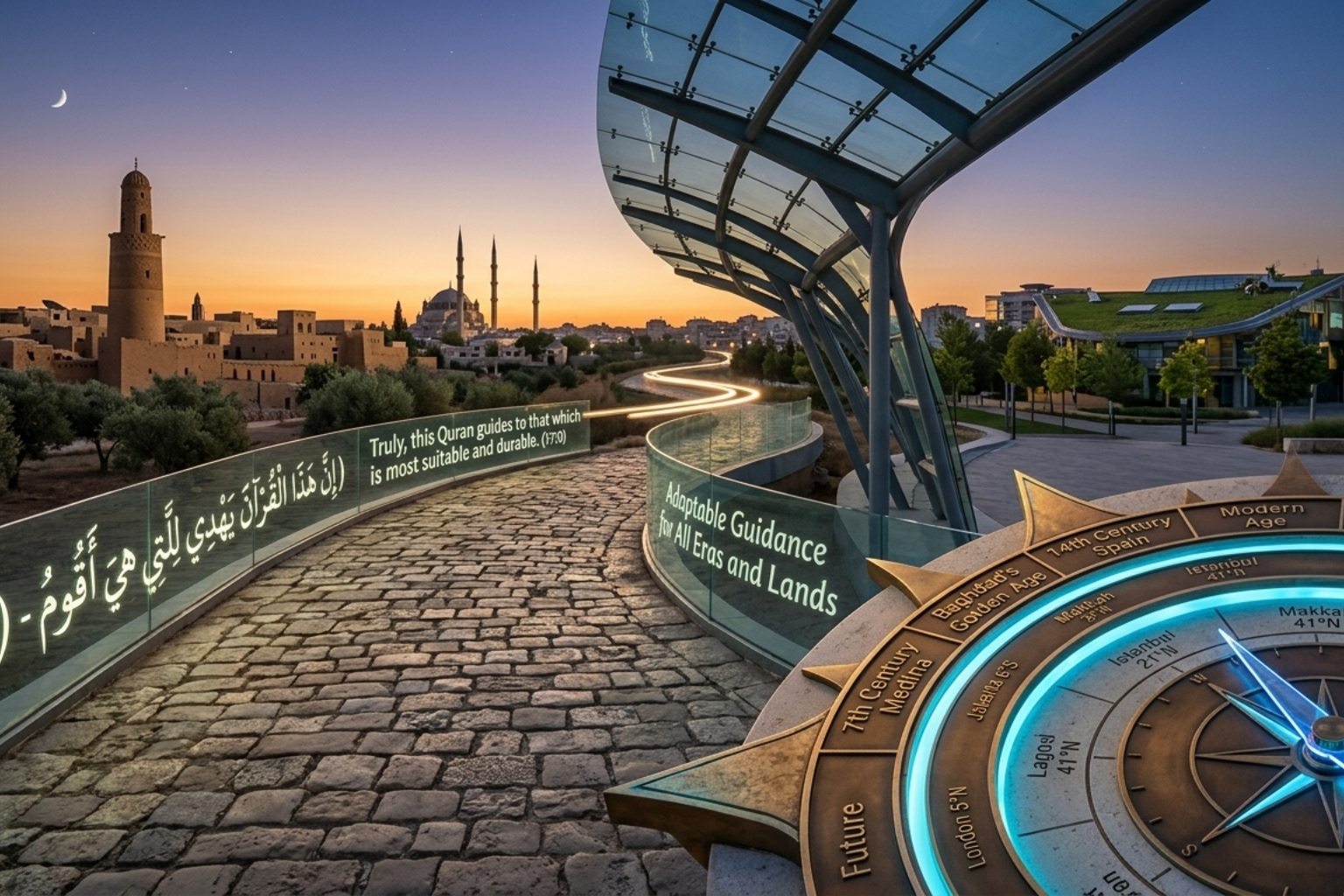
The message of the Qur’an was not revealed for one nation, one culture, or one historical era alone. It was revealed as guidance for humanity across generations.
The Qur’an says:
“وَمَا أَرْسَلْنَاكَ إِلَّا كَافَّةً لِّلنَّاسِ بَشِيرًا وَنَذِيرًا”
“We have not sent you except to all humanity as a bearer of glad tidings and a warner.”
— Surah Saba (34:28)
Islam therefore presents itself as a universal message intended for every time and place.
Islam Distinguishes Between Principles and Changing Circumstances
One reason Islam remains relevant is that it distinguishes between:
- Unchanging moral principles
- Flexible worldly matters
Core beliefs and moral foundations remain stable:
- Worship of Allah alone
- Justice
- Honesty
- Mercy
- Family values
- Human dignity
- Responsibility for actions
These principles do not lose importance with time.
At the same time, Islam allows flexibility in many worldly matters connected to culture, technology, business, language, and social customs as long as they remain within ethical boundaries.
This balance between stability and flexibility allows Islamic teachings to function across very different societies and historical periods.
Human Nature Has Not Changed
Although technology evolves rapidly, human nature remains remarkably similar throughout history.
People today still experience:
- Love
- Fear
- Greed
- Hope
- Anger
- Jealousy
- Anxiety
- Desire for meaning
Families still struggle with relationships. Societies still face injustice, corruption, inequality, and moral confusion.
Islam addresses these deeper human realities rather than focusing only on temporary trends.
For this reason, many of its teachings continue speaking directly to modern human experiences despite the passage of centuries.
The Qur’an Continuously Calls Humanity to Reflection
One remarkable feature of the Qur’an is its repeated invitation to think, reflect, and observe the world carefully.
The Qur’an says:
“أَفَلَا يَتَدَبَّرُونَ الْقُرْآنَ”
“Will they not reflect upon the Qur’an?”
— Surah An-Nisa (4:82)
And it says:
“إِنَّ فِي خَلْقِ السَّمَاوَاتِ وَالْأَرْضِ وَاخْتِلَافِ اللَّيْلِ وَالنَّهَارِ لَآيَاتٍ لِّأُولِي الْأَلْبَابِ”
“Indeed, in the creation of the heavens and the earth and the alternation of night and day are signs for people of understanding.”
— Surah Aal ‘Imran (3:190)
Islam does not present faith as blind imitation disconnected from thought. Instead, it repeatedly encourages:
- Reflection
- Learning
- Observation
- Seeking knowledge
This intellectual openness helped shape centuries of scientific, philosophical, and scholarly development within Islamic civilization.
Islam Provides Moral Stability in a Rapidly Changing World
Modern society changes constantly.
Ideas about morality, identity, family, and human purpose often shift rapidly from one generation to another. While progress can bring many benefits, constant change can also create confusion and instability.
Islam provides fixed moral foundations intended to protect human wellbeing regardless of time period.
For example, Islam strongly emphasizes:
- Honesty
- Respect for parents
- Protection of family
- Charity
- Justice
- Care for the vulnerable
- Personal responsibility
These values remain meaningful whether someone lives in the 7th century or the 21st century.
Islam Is Practiced Across Vastly Different Cultures
One powerful sign of Islam’s universality is the diversity of the Muslim world itself.
Islam is practiced by people from:
- Asia
- Africa
- Europe
- North America
- South America
- Indigenous communities
- Major global cities
- Rural villages
Muslims speak hundreds of languages and come from countless ethnic and cultural backgrounds.
Yet the core foundations of Islam remain shared worldwide:
- Prayer
- Fasting
- Charity
- Belief in Allah
- The Qur’an
- The teachings of Prophet Muhammad ﷺ
This global diversity demonstrates that Islam is not tied to a single race, nationality, or culture.
Islam and Modern Challenges
Modern life introduces issues previous generations never experienced directly:
- Artificial intelligence
- Social media
- Biotechnology
- Digital finance
- Global communication
Islamic scholarship addresses these new situations by applying timeless principles to modern realities.
Rather than requiring every detail to be mentioned explicitly centuries ago, Islam provides foundational guidance through:
- Ethics
- Justice
- Prevention of harm
- Preservation of human dignity
This allows Islamic teachings to engage with changing circumstances while remaining rooted in core principles.
Why Many People Still Turn to Islam Today
Despite living in an age of extraordinary technological progress, many people continue searching for:
- Meaning
- Stability
- Spirituality
- Moral clarity
- Inner peace
Material success alone often fails to answer deeper questions about existence and purpose.
Islam continues attracting people around the world because it addresses both:
- Spiritual needs
- Practical human life
It speaks about:
- Worship
- Family
- Morality
- Society
- Justice
- The purpose of existence
- Life after death
For many people, this balance between spirituality and practical guidance feels deeply relevant even in modern times.
The Finality of the Message
Islam teaches that Prophet Muhammad ﷺ was the final prophet sent to humanity.
The Qur’an says:
“مَّا كَانَ مُحَمَّدٌ أَبَا أَحَدٍ مِّن رِّجَالِكُمْ وَلَٰكِن رَّسُولَ اللَّهِ وَخَاتَمَ النَّبِيِّينَ”
“Muhammad is not the father of any of your men, but he is the Messenger of Allah and the seal of the prophets.”
— Surah Al-Ahzab (33:40)
Because Islam is understood as the final divine message, it is viewed as guidance intended to remain relevant until the end of human history.
Conclusion
Islam presents itself as a timeless message built upon unchanging moral truths while remaining flexible enough to address changing human circumstances.
Although societies evolve and technology advances, human beings continue searching for meaning, justice, peace, and guidance — the very questions Islam addresses at its core.
Through its balance of spiritual depth, moral principles, and practical guidance, Islam continues speaking to people across cultures, generations, and historical eras.
For millions around the world, Islam is not seen as a religion limited to the past, but as guidance capable of illuminating every age.