
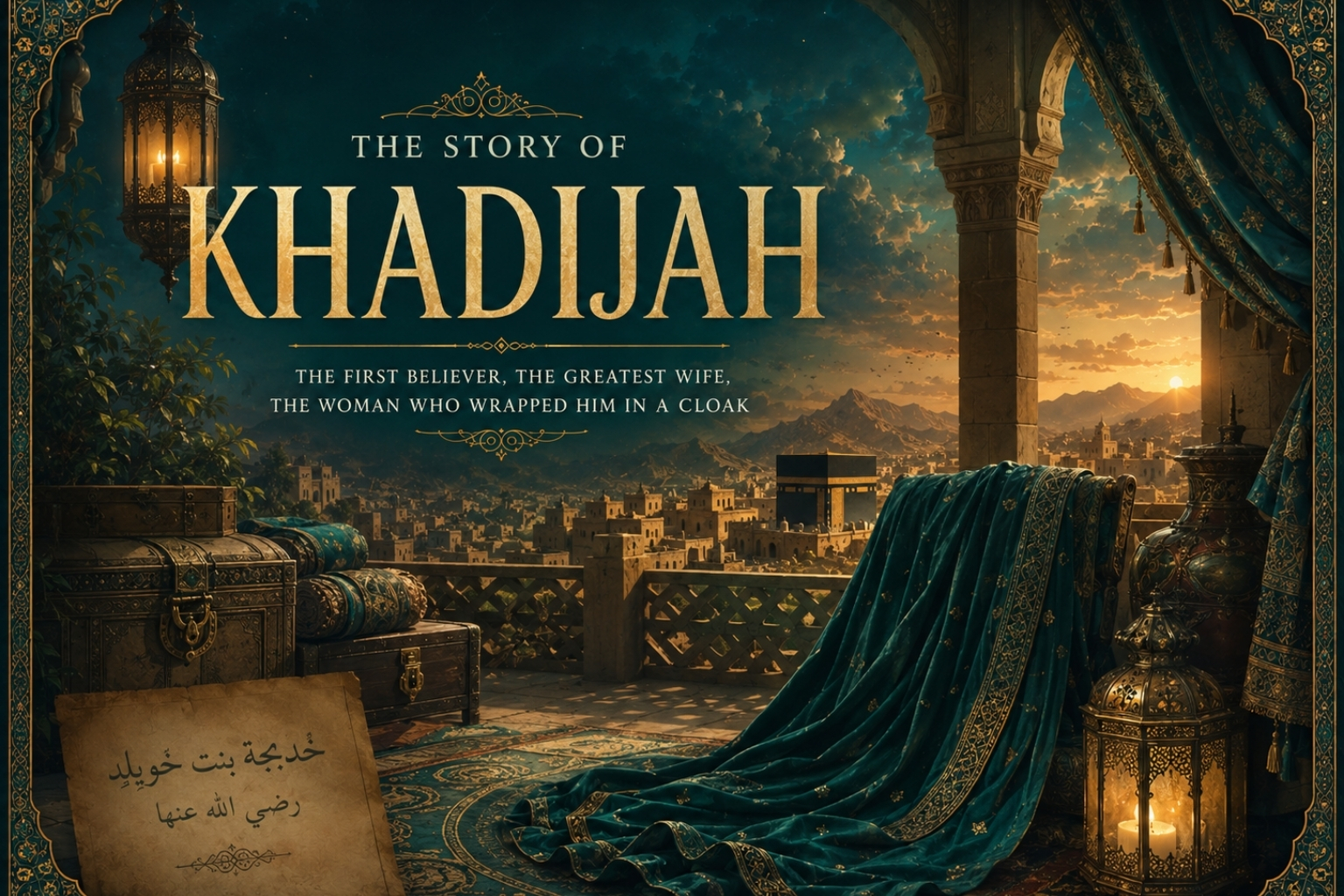

On the night that changed the world — the night a man ran trembling from a cave on a mountain outside Makkah, clutching his chest, convinced he was dying — there was one person waiting for him.
Not an angel. Not a prophet. Not a scholar of scripture who could place the experience in theological context.
A wife.
She wrapped him in a cloak. She held him until the trembling stopped. And then — before he could fully articulate what had happened, before the words of the first revelation had settled into meaning, before anyone in the world knew that history had just shifted on its axis — she said the words that became the foundation of everything that followed:
“Never, by Allah, Allah will never disgrace you.”
Khadijah bint Khuwaylid, may Allah be pleased with her, was the first Muslim. Before Abu Bakr. Before Ali. Before any man or woman who would ever carry the name of Islam. She was first — not because she happened to be nearby, not because she was the easiest convert, but because she knew the man she had married with a completeness that translated immediately into certainty about his experience.
She is not named in the Quran. She does not appear in a narrative chapter or a story of confrontation with a tyrant. Her mention in the Quran comes through Allah’s reminder to the Prophet Muhammad ﷺ of what he had been given — and she is among the most significant of those gifts:
Quran Verse:
وَوَجَدَكَ عَائِلًا فَأَغْنَىٰ
“And He found you poor and made you self-sufficient.”
Surah Ad-Duha (93:8)
Scholars of tafsir note that among the primary ways Allah made Muhammad ﷺ self-sufficient was through Khadijah — her wealth, her support, her unconditional belief at the moment when he needed it most. She was Allah’s provision for His prophet — not just financially, but in every dimension of human support.
Her story is the story of what it looks like to be the person a prophet comes home to. The person whose belief comes first — before evidence, before community, before any external validation — because they know the one they love well enough to need no other proof.
Chapter One — Before the Prophet: A Woman Who Had Already Built a Life
Khadijah was not a young woman waiting for her story to begin when Muhammad ﷺ entered her life. She was forty years old. She had been married twice before — both husbands had died — and she had children from those marriages. She had built a successful trading business of her own, managing caravans, employing workers, conducting commerce across the Arabian Peninsula with a reputation for integrity and intelligence that was widely respected.
She was known in Makkah as Al-Tahira — the Pure One — a title earned by her character, her nobility, her distance from the moral compromises that characterized much of Makkan society.
She was, in every worldly sense, complete. She did not need a husband for financial security or social status. She had both. When she sought a husband, she was not seeking provision or protection — she was seeking a person whose character matched what she had built.
She employed Muhammad ﷺ to lead one of her trade caravans to Syria. The man she sent to represent her goods came back with a profit double what others achieved — and with reports from her companion Nafisa about his conduct on the journey: his honesty, his trustworthiness, the quality of his character in every small decision.
Khadijah proposed to him.
She was forty. He was twenty-five. She was wealthier and more established. She held the social position. And she chose him — based on character, based on what she knew and what she had observed, based on something in her that recognized something in him.
The Prophet Muhammad ﷺ accepted. And what began was the most important marriage in prophetic history — not the most dramatic, not the most publicly discussed, but the one that provided the foundation for everything that followed.
Chapter Two — Twenty-Five Years: The Marriage That Held Everything
For twenty-five years — from the marriage until Khadijah’s death — Muhammad ﷺ took no other wife. In a society where polygamy was common, where powerful men accumulated wives as a matter of social status, where even the poorest man might have two or three wives — Muhammad ﷺ had one.
Khadijah.
This was not because Islamic law required it. It was because she was enough. She was, in every dimension of what a person needs from a life companion, complete.
She bore him six children — two sons who died in infancy, and four daughters: Zaynab, Ruqayyah, Umm Kulthum, and Fatimah — the last of whom would become one of the greatest women in Islamic history and one of the four greatest women who ever lived according to the Prophet ﷺ himself.
She was his home. In a world that increasingly made him uncomfortable — a man of extraordinary spiritual sensitivity living in a society of idol worship, injustice, and moral corruption — she was the place he returned to. The constant. The reliable. The person whose presence made endurance possible.
And then came the cave.
Chapter Three — The Night of the Cave: The First and Greatest Test
Muhammad ﷺ had been spending increasing amounts of time in the Cave of Hira — away from the noise and corruption of Makkah, in contemplation, in solitude, in a searching that he could not fully name. Khadijah knew about these retreats. She supported them. She sent provisions with him.
Then, in the month of Ramadan in the year 610 CE, Jibreel came.
The experience — the squeezing, the command to read, the words of the first revelation — left Muhammad ﷺ in a state of trembling terror. He ran from the cave. He ran to his wife.
The Prophet’s ﷺ own words, as preserved in Aisha’s narration, describe what happened:
Hadith:
فَرَجَعَ بِهَا رَسُولُ اللَّهِ ﷺ يَرْجُفُ فُؤَادُهُ، فَدَخَلَ عَلَى خَدِيجَةَ بِنْتِ خُوَيْلِدٍ رَضِيَ اللَّهُ عَنْهَا، فَقَالَ: «زَمِّلُونِي زَمِّلُونِي» فَزَمَّلُوهُ حَتَّى ذَهَبَ عَنْهُ الرَّوْعُ
“The Messenger of Allah ﷺ returned with his heart trembling. He entered upon Khadijah bint Khuwaylid, may Allah be pleased with her, and said: ‘Wrap me, wrap me.’ So they wrapped him until the fear left him.”
Recorded in Sahih Al-Bukhari, Hadith No. 3
“Wrap me.” — The man who would become the final prophet to all of humanity, who had just received the first words of the last divine revelation, who had just been squeezed by the angel of Allah until he reached his limit — ran home and asked to be wrapped.
Not to be given a theological interpretation. Not to be told what it meant. To be wrapped. To be held. To be made warm while the trembling worked its way out of his body.
And Khadijah wrapped him.
This is the first act of the Islamic era — not a sermon, not a declaration, not a theological statement. A wife wrapping her trembling husband in a cloak.
And then — when the fear had subsided enough for speech — he told her what had happened. He feared for himself. He feared he was going mad, that something had overtaken him, that he was in danger.
And she answered:
Hadith:
فَقَالَتْ خَدِيجَةُ: كَلَّا وَاللَّهِ مَا يُخْزِيكَ اللَّهُ أَبَدًا، إِنَّكَ لَتَصِلُ الرَّحِمَ، وَتَحْمِلُ الْكَلَّ، وَتَكْسِبُ الْمَعْدُومَ، وَتَقْرِي الضَّيْفَ، وَتُعِينُ عَلَى نَوَائِبِ الْحَقِّ
“Khadijah said: ‘Never, by Allah, Allah will never disgrace you. You maintain family ties, you carry the burden of the weak, you earn for those who have nothing, you honor your guests, and you help in the true calamities.'”
Recorded in Sahih Al-Bukhari, Hadith No. 3
Five sentences. Five qualities. A wife’s testimony about her husband that became, in that moment, the first articulation of why the first prophet deserved to be trusted.
She did not argue theology. She did not cite scripture. She did not perform a rational analysis of what he had described. She responded with what she knew — the twenty-five years of watching him, of knowing him in every small moment, of observing his character across the full range of ordinary and extraordinary circumstances.
You maintain family ties. — He honored his relatives, kept connections, did not sever what Allah had joined.
You carry the burden of the weak. — He took on the weight of those who could not carry their own. He was not a man who looked away from need.
You earn for those who have nothing. — His hands were productive and his productivity was generous — he worked so that others could have.
You honor your guests. — The ancient Arabian virtue of hospitality, lived not as performance but as genuine care for every person who came to his door.
You help in the true calamities. — When real difficulty came — not imagined difficulty, not minor inconvenience, but genuine hardship — he was there, present, helping.
And then she concluded with the theological certainty that these five qualities produced:
“Allah will never disgrace you.”
Now I think Allah won’t. Now I hope Allah won’t. Allah will never disgrace a man like this. The character evidence was so overwhelming that the theological conclusion was inevitable.
This was Khadijah’s faith. Not the faith of someone who heard an argument and was persuaded. The faith of someone who had been living alongside the evidence for twenty-five years and recognized it immediately when the moment of its meaning arrived.
Chapter Four — Waraqa ibn Nawfal: The Scholar Who Confirmed
Khadijah did not stop at her own assessment. She took him to her cousin Waraqa ibn Nawfal — an elderly scholar who had studied the previous scriptures, who had knowledge of the signs of prophethood from the Torah and the Injeel:
Hadith:
فَانْطَلَقَتْ بِهِ خَدِيجَةُ حَتَّى أَتَتْ بِهِ وَرَقَةَ بْنَ نَوْفَلٍ… فَقَالَ وَرَقَةُ: هَذَا النَّامُوسُ الَّذِي نَزَّلَ اللَّهُ عَلَى مُوسَى
“Khadijah went with him until she brought him to Waraqa ibn Nawfal… Waraqa said: ‘This is the guardian who Allah sent down to Musa.'”
Recorded in Sahih Al-Bukhari, Hadith No. 3
She took him. She arranged the meeting. She sought the confirmation not because she doubted her own assessment — her words “Allah will never disgrace you” had already been spoken — but because she understood that what had just happened was of such magnitude that every available source of knowledge should be consulted.
She was the first believer. And she was also a person of practical wisdom who understood the importance of seeking knowledge, of finding those with expertise, of building the foundation of a mission on more than one person’s certainty.
Waraqa confirmed everything. And he warned her of what was coming — the rejection, the persecution, the difficulty that always accompanies the delivery of truth to a world that does not want to hear it.
Khadijah went home knowing: her husband was the prophet of Allah. And she would stand beside him through everything that followed.
Chapter Five — The Years of Mission: What She Gave That Cannot Be Counted
For the thirteen years of the Makkan period of the prophetic mission — the years of persecution, of economic siege, of torture of companions, of social ostracism — Khadijah was the constant.
She spent her entire wealth in the service of Islam. The woman who had been Al-Tahira, the wealthy and established businesswoman of Makkah — gave everything she had to support the mission her husband had been entrusted with. Not reluctantly. Not with conditions. Everything.
The Prophet Muhammad ﷺ acknowledged this:
Hadith:
آمَنَتْ بِي إِذْ كَفَرَ بِي النَّاسُ، وَصَدَّقَتْنِي إِذْ كَذَّبَنِي النَّاسُ، وَوَاسَتْنِي بِمَالِهَا إِذْ حَرَمَنِي النَّاسُ، وَرَزَقَنِي اللَّهُ وَلَدَهَا إِذْ حَرَمَنِي أَوْلَادَ النِّسَاءِ
“She believed in me when the people disbelieved in me. She affirmed me when the people denied me. She supported me with her wealth when the people deprived me. And Allah blessed me with children through her when He deprived me of children from other women.”
Recorded in Musnad Ahmad, Hadith No. 25662, authenticated by Al-Albani
Four gifts — described in four parallel constructions that reveal the depth of what she gave:
“She believed in me when the people disbelieved.” — Her faith came first. In the moment of maximum isolation — when the entire world was against him — she was with him.
“She affirmed me when the people denied.” — Not just passive faith but active affirmation. She said yes, this is true when everyone else was saying no, this is madness.
“She supported me with her wealth when the people deprived me.” — Concrete, material, practical support. When the economic siege came — when the Quraysh organized to cut off trade with the Muslims — her wealth was what sustained the community.
“And Allah blessed me with children through her.” — His lineage continued through her. His daughters — including Fatimah, the mother of Al-Hasan and Al-Husayn — came from Khadijah. The prophetic lineage that carries to this day traces back through her.
Chapter Six — The Salutation From Heaven: When Allah Greeted Her
Khadijah’s station was so extraordinary that Allah sent her a personal greeting — through Jibreel — during her lifetime:
Hadith:
أَتَى جِبْرِيلُ النَّبِيَّ ﷺ فَقَالَ: يَا رَسُولَ اللَّهِ، هَذِهِ خَدِيجَةُ قَدْ أَتَتْ مَعَهَا إِنَاءٌ فِيهِ إِدَامٌ أَوْ طَعَامٌ أَوْ شَرَابٌ، فَإِذَا هِيَ أَتَتْكَ فَاقْرَأْ عَلَيْهَا السَّلَامَ مِنْ رَبِّهَا وَمِنِّي، وَبَشِّرْهَا بِبَيْتٍ فِي الْجَنَّةِ مِنْ قَصَبٍ، لَا صَخَبَ فِيهِ وَلَا نَصَبَ
“Jibreel came to the Prophet ﷺ and said: ‘O Messenger of Allah, here is Khadijah coming to you with a vessel containing food or drink. When she comes to you, convey to her the greetings of peace from her Lord and from me, and give her the glad tidings of a house in Paradise made of reeds — with no noise and no fatigue in it.'”
Recorded in Sahih Al-Bukhari, Hadith No. 3820
Allah — the Lord of the worlds — sent Khadijah His personal Salam. Not a general blessing. A greeting of peace, from Allah, delivered through Jibreel, carried by the Prophet ﷺ, to a woman who was walking toward her husband with a vessel of food.
The ordinary act — a wife bringing food to her husband — met with the extraordinary honor: peace upon you, from your Lord.
And the promise: a house in Paradise made of reeds — qasab — a house of purity and beauty and extraordinary nature — with no noise and no fatigue. After a lifetime of noise and fatigue — of carrying the weight of a mission that the world was trying to destroy, of spending her wealth and her energy and her social standing in the service of truth — she was promised a place where there was none of that weight.
Chapter Seven — The Year of Sorrow: When She Left
In the tenth year of the prophetic mission — the year that became known as ‘Am al-Huzn, the Year of Sorrow — Khadijah died.
She had already lived through the three-year siege in the valley — the economic blockade that the Quraysh imposed on the Muslims, when the community survived on leaves and roots, when children cried from hunger, when the physical toll of persecution was at its most extreme.
She had given everything she had — and then given more — and when death came, it found her spent and honored and beloved and certain.
She died in Makkah. Before the Hijrah. Before the prayer was established in its final form. Before the Muslim community had a home, a state, a future visible to human eyes.
And the Prophet Muhammad ﷺ grieved for her in a way that he grieved for no one else:
Hadith:
كَانَ النَّبِيُّ ﷺ إِذَا ذَكَرَ خَدِيجَةَ أَثْنَى عَلَيْهَا فَأَحْسَنَ الثَّنَاءَ
“The Prophet ﷺ, when he mentioned Khadijah, would praise her and praise her beautifully.”
Recorded in Sahih Al-Bukhari, Hadith No. 3818
Years after her death — after he had married other wives, after the community had grown, after the mission had succeeded in ways she never lived to see — he still praised her. When her name came up, he praised her beautifully.
Aisha, may Allah be pleased with her — the wife who came after Khadijah, the wife who loved the Prophet ﷺ deeply and was loved by him deeply — admitted with the honesty of a person who has sat with a difficult truth long enough to accept it:
Hadith:
مَا غِرْتُ عَلَى امْرَأَةٍ مَا غِرْتُ عَلَى خَدِيجَةَ، وَمَا رَأَيْتُهَا قَطُّ
“I was never jealous of any woman as I was jealous of Khadijah — and I never saw her.”
Recorded in Sahih Al-Bukhari, Hadith No. 3816
She had never met her. Khadijah died before Aisha entered the Prophet’s ﷺ life. And yet Aisha felt jealousy — of a woman she never saw — because of the way the Prophet ﷺ spoke of her, because of the space Khadijah still occupied in his heart, because of the love that had not diminished with death or time or the arrival of new relationships.
Aisha even complained — and the Prophet ﷺ responded with words that are among the most moving he ever spoke about his first wife:
Hadith:
إِنَّهَا كَانَتْ، وَكَانَتْ، وَكَانَ لِي مِنْهَا وَلَدٌ
“She was, and she was, and I had children from her.”
Recorded in Sahih Al-Bukhari, Hadith No. 3818
“She was.” Twice. The repetition of a verb that means everything — she was real, she was irreplaceable, she was what she was. The simplest and most complete way to say: there is no replacing this, there is no explaining this, there is only acknowledging that she existed and what her existence meant.
Chapter Eight — The Greatest Women: Her Place Among the Best
The Prophet Muhammad ﷺ placed Khadijah among the four greatest women who ever lived:
Hadith:
حَسْبُكَ مِنْ نِسَاءِ الْعَالَمِينَ مَرْيَمُ ابْنَةُ عِمْرَانَ، وَخَدِيجَةُ بِنْتُ خُوَيْلِدٍ، وَفَاطِمَةُ بِنْتُ مُحَمَّدٍ، وَآسِيَةُ امْرَأَةُ فِرْعَوْنَ
“Sufficient for you among the women of the worlds are: Maryam daughter of Imran, Khadijah daughter of Khuwaylid, Fatimah daughter of Muhammad, and Asiyah wife of Pharaoh.”
Recorded in Sunan At-Tirmidhi, Hadith No. 3878, authenticated by Al-Albani
Among the best of the women of Paradise:
Hadith:
خَيْرُ نِسَائِهَا خَدِيجَةُ بِنْتُ خُوَيْلِدٍ
“The best of its women is Khadijah, daughter of Khuwaylid.”
Recorded in Sahih Al-Bukhari, Hadith No. 3432
The best. Among all the women of Paradise — the garden that contains every righteous woman who ever lived — Khadijah is among the best.
The woman who wrapped a trembling man in a cloak. Who said Allah will never disgrace you. Who gave everything she had. Who received Allah’s personal Salam through Jibreel. Who was loved so completely and so permanently that a woman who never met her felt jealous of her years after her death.
Timeless Lessons from the Story of Khadijah
- True knowledge of a person produces true faith in them Khadijah believed in Muhammad ﷺ not because of a miracle or an argument but because she knew him. Twenty-five years of intimate knowledge of his character produced immediate, unshakeable certainty. The deepest faith — in Allah and in His prophets — grows from genuine, sustained, attentive knowledge.
- The first act of Islam was a wife wrapping her husband in a cloak before any sermon, before any declaration, before the community, before the mosque — the first act of the Islamic era was Khadijah providing warmth and safety to a trembling man. The foundation of the greatest mission in human history was built on the most ordinary act of love: I am here. You are safe. Let me hold you until the fear passes.
- Character evidence is the most powerful theological argument She did not argue about the nature of revelation or the signs of prophethood. She listed what she had witnessed: family ties, care for the weak, generosity to the needy, hospitality to guests, help in genuine hardship. And from these five qualities she drew the theological conclusion: Allah will never disgrace this man. The case for faith, built on a lifetime of observed character, was irrefutable.
- The first believer set the standard for what belief requires She was first. Not because she was the easiest person to convince but because she had the most evidence. Being first in faith — in any community, in any family, in any context — requires having done the work of knowing enough to believe before the crowd arrives. Khadijah had done that work across twenty-five years of marriage.
- Give what you have in full — and trust Allah with what remains She spent her entire wealth in the service of Islam. Not a portion. Not what she could spare. Everything. And Allah gave her, in return, a house in Paradise — with no noise and no fatigue. The exchange is always in Allah’s favor for the one who gives completely.
- Love that is real continues after death — and that is not a problem to solve The Prophet ﷺ loved Khadijah years after her death. His praise of her was beautiful and consistent. He did not apologize for it. He did not qualify for it. He did not manage it for the comfort of those who came after her. He loved her — and the love was part of the legacy. Real love does not expire. It does not become inappropriate. It does not need to be managed. It simply is.
- The private support of a believing spouse is among Allah’s greatest gifts Allah reminded the Prophet ﷺ of being made self-sufficient — and among the primary meanings of that self-sufficiency was Khadijah. A spouse who believes in you, who supports your mission, who provides what you need in the moments of your greatest vulnerability — is among Allah’s highest gifts. Recognize it. Cherish it. Do not take it for granted.
Closing Reflection
On the night the world changed — a man ran down a mountain trembling, ran home, said wrap me, and was wrapped.
And the wrapping was not just cloth. It was twenty-five years of knowing and being known. It was a woman who had observed a man across decades of small moments and large ones and had arrived at a certainty that no angel visit could shake and no rejection from the Quraysh could diminish.
She said: Never, by Allah, Allah will never disgrace you.
She said it before Jibreel confirmed it. She said it before any other human being believed. She said it in the moment when the Prophet of Allah himself was afraid — and she said it with the authority of a person who had been paying attention for twenty-five years.
She was first. She gave everything. She received Allah’s personal Salam. She was promised a house in Paradise with no noise and no fatigue. And she was loved — so completely, so permanently, so irreplaceably — that a woman who never met her was jealous of her for the rest of her life.
Khadijah. The Pure One. The first Muslim. The woman who wrapped him in a cloak.
The one who, when he needed it most, was already there.
Quran Verse:
وَوَجَدَكَ عَائِلًا فَأَغْنَىٰ
“And He found you poor and made you self-sufficient.”
Surah Ad-Duha (93:8)
Among the ways Allah made His prophet self-sufficient — He gave him Khadijah.
A woman who believed before anyone else did.
Who wrapped him when he trembled.
Who gave everything she had.
Who received peace from her Lord.
And who is, in the gardens that have no noise and no fatigue, among the best of their women.
May Allah be pleased with her.