

Rules, intentions, what breaks the fast, exemptions, and the spiritual heart of the holiest month in Islam
The Month That Changes Everything
Ask any Muslim to describe Ramadan and you will hear something surprising. Not reluctance, not resignation — but anticipation. A genuine longing for the month to arrive. Something in the rhythm of the fasting day, the breaking of the fast at sunset, the night prayers, the recitation of the Quran, the shared meals and the early mornings — something in all of this produces an experience that is difficult to describe to someone who has not lived it, and impossible to forget for someone who has.
Ramadan is the ninth month of the Islamic lunar calendar. It is the month in which the Quran was first revealed to the Prophet Muhammad ﷺ. And it is the month in which every adult Muslim who is able is obligated to fast — abstaining from food, drink, and other things from the first light of dawn until the sun sets.
This article explains everything a new Muslim needs to know to fast Ramadan with understanding, confidence, and the right intention.
What Fasting in Ramadan Means
The Arabic word for fasting is Sawm — and it appears in the Quran as one of the Five Pillars of Islam. God says directly:
“O you who have believed, fasting is prescribed for you as it was prescribed for those before you, so that you may become people of taqwa.” — Surah Al-Baqarah (2:183)
Taqwa — the word translated here as “God-consciousness” or “righteousness” — is the purpose. Not hunger. Not physical discipline for its own sake. The fast is a means to an end: the cultivation of a heart that is aware of God, mindful of its choices, and aligned with what is real and lasting rather than what is merely immediate and appetizing.
God also says, in a hadith qudsi — a divine saying conveyed through the Prophet ﷺ — something remarkable:
“Every deed of the son of Adam is for himself, except fasting — it is for Me, and I will reward it.”
Every act of worship has a defined reward. Fasting alone is left open — its reward is with God Himself, unlimited and unspecified. This is because fasting is the one act of worship that is entirely between the person and God. No one else can verify it. No one sees whether you eat or drink in private. The fast is kept only because God sees — and that awareness is itself the practice.
When Is Ramadan?
Ramadan follows the Islamic lunar calendar, which means it shifts approximately 10–11 days earlier each year relative to the Gregorian calendar. Over a lifetime, a Muslim fasts Ramadan in every season — long summer days and short winter days, in heat and in cold.
The beginning of Ramadan is determined by the sighting of the new crescent moon — either through physical sighting or astronomical calculation, depending on the scholarly position followed in different parts of the world. Most Muslim communities announce the start of Ramadan a day or two in advance, and the end of the month (Eid al-Fitr) is similarly determined.
What the Fast Involves
During the fasting hours — from Fajr (the first light of dawn) to Maghrib (sunset) — a fasting Muslim abstains completely from:
1. Eating and Drinking
This includes all food and all drinks — including water. Even a small amount of food or a sip of water deliberately consumed breaks the fast.
2. Smoking
Smoking in any form breaks the fast.
3. Sexual Relations
Intimacy between spouses breaks the fast and carries additional expiation if done intentionally.
4. Anything Deliberately Ingested
This includes medicine taken orally, chewing gum, and — according to the majority scholarly position — anything that reaches the stomach through the mouth or nose deliberately.
What Does NOT Break the Fast
A number of things are commonly misunderstood:
- Swallowing saliva does not break the fast
- Rinsing the mouth with water (such as during wudu) does not break the fast, provided water is not swallowed
- Injections and intravenous fluids — there is scholarly difference on this; many hold that injections that are not nutritive do not break the fast
- Unintentional eating or drinking — if someone forgets they are fasting and eats or drinks, the fast is not broken. The Prophet ﷺ said: “Whoever forgets that he is fasting and eats or drinks, let him complete his fast — it is God who fed him and gave him drink.”
- Tasting food without swallowing — such as a cook tasting food for seasoning — does not break the fast, though it should be avoided as much as possible
- Using a miswak (tooth stick) or toothbrush — the majority position is that this does not break the fast provided toothpaste is not swallowed
The Structure of the Fasting Day
Suhoor — The Pre-Dawn Meal
Before Fajr, Muslims wake to eat Suhoor — the pre-dawn meal. It is recommended, not obligatory, but the Prophet ﷺ strongly encouraged it:
“Take the suhoor meal, for in suhoor there is blessing.”
Suhoor does not need to be elaborate. Even a few dates and water carry the blessing. What matters is the intention: you are eating to sustain yourself for the fast ahead, for the sake of God.
The fast begins at Fajr — the moment of the first light of dawn, not sunrise. Most communities and apps indicate this time precisely. From that moment, all food, drink, and the other invalidators are abstained from.
The Fasting Hours
The long middle of the day is the body of the fast. Work continues, daily life continues, and the practice is simply: endure with patience and awareness. The physical sensation of hunger and thirst is a recurring teacher — every time it rises, it reminds you: I am doing this for God.
The Prophet ﷺ said: “When one of you is fasting and someone invites them to eat, let him say: I am fasting. And if someone argues with him or insults him, let him say: I am fasting — twice.” The fast is not only for the stomach. It is the whole self, restrained.
Iftar — Breaking the Fast at Sunset
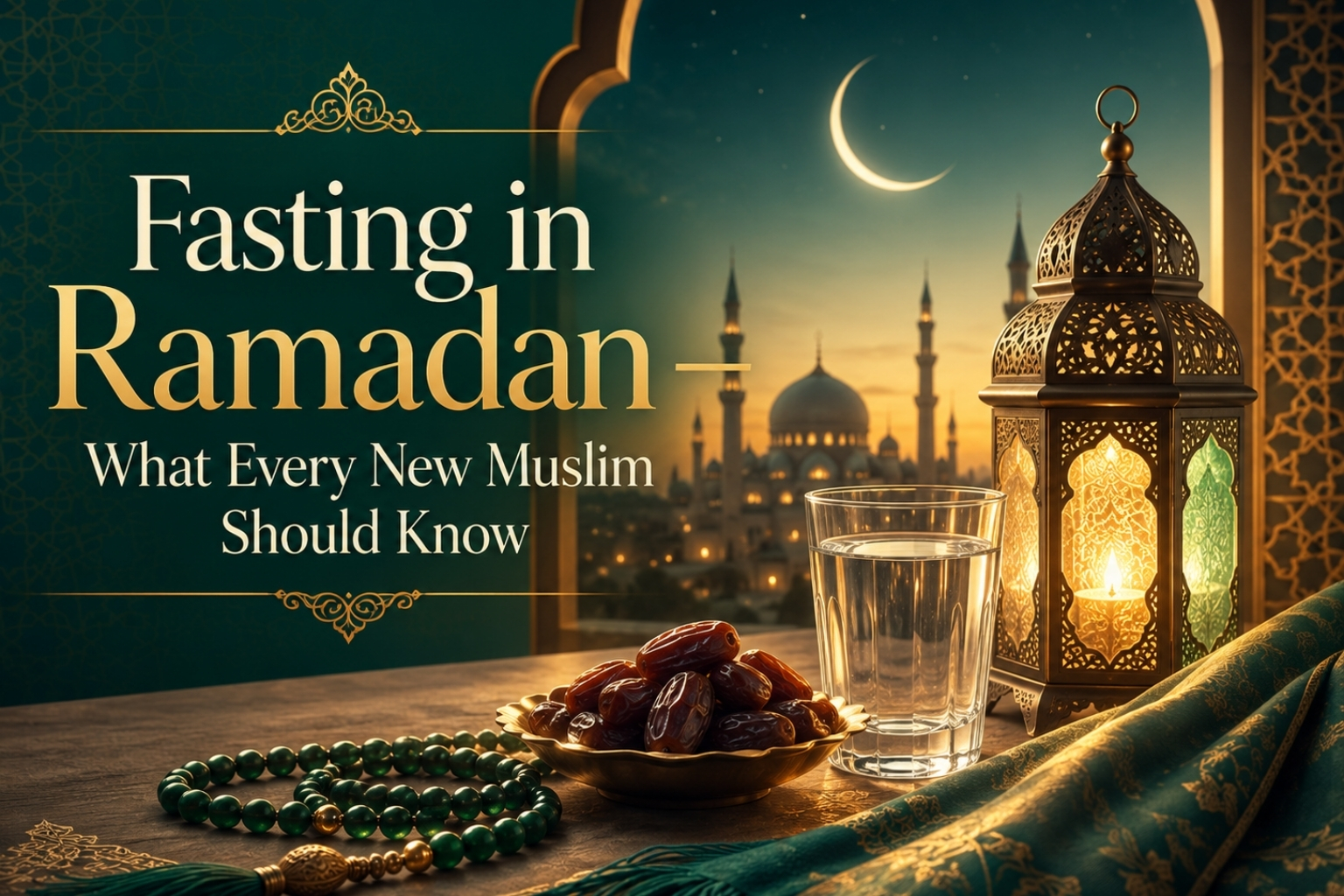
At Maghrib — the moment the sun sets — the fast is broken. This moment is called Iftar, and it is one of the most anticipated and beloved moments of the Muslim year.
The Sunnah is to break the fast immediately at sunset — not to delay — and to begin with dates and water, following the practice of the Prophet ﷺ. He said:
“When one of you breaks his fast, let him break it with dates — and if he cannot find dates, then with water. For water is purifying.”
Before eating, say:
اللَّهُمَّ لَكَ صُمْتُ وَعَلَى رِزْقِكَ أَفْطَرْتُ Allahumma laka sumtu wa ‘ala rizqika aftartu “O God, for You I fasted and upon Your provision I break my fast.”
The Prophet ﷺ also said: “The fasting person has two moments of joy: one when he breaks his fast, and one when he meets his Lord.”
The Night Prayers — Tarawih
One of the distinctive practices of Ramadan is the Tarawih — additional night prayers performed after Isha, usually in congregation at the mosque. They are not obligatory but are among the most beloved acts of the month.
The Prophet ﷺ said: “Whoever prays during the nights of Ramadan out of sincere faith and hoping for a reward from Allah, all his previous sins will be forgiven.”
Tarawih prayers typically consist of 8 or 20 raka’at, depending on the tradition followed, and in many mosques the Imam recites long portions of the Quran — covering the entire Quran across the 30 nights of the month. For a new Muslim, attending even part of the Tarawih is a powerful experience — the community gathered in the night, the Quran filling the space, the shared feeling of a month set apart from all others.
Laylat al-Qadr — The Night of Power
Within the last ten nights of Ramadan lies a night described in the Quran as:
“Better than a thousand months.” — Surah Al-Qadr (97:3)
Laylat al-Qadr — the Night of Power or Night of Decree — is the night on which the Quran was first revealed. Worship performed on this single night carries the reward of over 83 years of worship. The exact night is not specified, though the Prophet ﷺ said to seek it in the odd nights of the last ten days of Ramadan — particularly the 21st, 23rd, 25th, 27th, and 29th.
The recommended supplication for this night:
اللَّهُمَّ إِنَّكَ عَفُوٌّ تُحِبُّ الْعَفْوَ فَاعْفُ عَنِّي Allahumma innaka ‘afuwwun tuhibbul-‘afwa fa’fu ‘anni “O God, You are Pardoning and You love to pardon, so pardon me.”
Many Muslims spend the last ten nights in I’tikaf — a spiritual retreat in the mosque, dedicating the days and nights to prayer, Quran recitation, and remembrance of God.
Who Must Fast — and Who Is Exempt
Fasting in Ramadan is obligatory for every Muslim who is:
- Adult (having reached puberty)
- Sane
- Resident (not traveling)
- Physically able
Exemptions
The following are exempt from fasting:
The ill — anyone whose illness would be worsened by fasting, or who needs to take medication during the day, is exempt. They make up missed days after recovery.
Travelers — someone on a journey may break the fast and make up the days later. If the journey is comfortable and not strenuous, fasting while traveling is still permissible and carries reward.
Pregnant and nursing women — if fasting poses a risk to the mother or child, they may break the fast. They make up the days later, or — if unable to do so — offer fidya (feeding a poor person for each missed day).
The elderly — those who are old and permanently unable to fast are not required to do so, but should offer fidya for each day missed.
Women during menstruation or postnatal bleeding — fasting is not permitted during these periods. These days are made up after Ramadan.
Children — fasting is not obligatory before puberty, though many children choose to fast partial days as they grow and develop the habit gradually.
Making Up Missed Days — Qada
Any days missed during Ramadan with a valid excuse must be made up before the next Ramadan arrives. They can be fasted on any days throughout the year — consecutively or spread out.
Allah says:
“Whoever among you is ill or on a journey — then an equal number of other days.” — Surah Al-Baqarah (2:184)
If missed days are not made up before the following Ramadan without valid reason, the person must fast them and also offer Fidya — feeding a poor person for each day of delay.
The Inner Dimensions of the Fast
The physical abstention is the outer shell of Ramadan. Inside it is something deeper — a practice of restraint, awareness, and reconnection that extends far beyond the stomach.
Guarding the tongue
The Prophet ﷺ said: “Whoever does not give up false speech and acting upon it, God has no need of his giving up food and drink.” A fast that leaves the tongue free to backbite, argue, lie, and wound others is an incomplete fast. Ramadan is the training ground for the whole character — not only for hunger.
Increased Quran recitation
Ramadan is the month of the Quran. The Angel Jibreel would come to the Prophet ﷺ each night of Ramadan and review the entire Quran with him. The practice of reading, listening to, and reflecting on the Quran is intensified throughout the month. Many Muslims aim to complete the entire Quran at least once during Ramadan — and many complete it multiple times.
Increased charity
The Prophet ﷺ was described as being most generous in Ramadan — “more generous than a wind bringing rain.” Giving in Ramadan carries multiplied reward, and the month naturally opens the heart toward those who go without not by choice but by circumstance.
Breaking fast with others
The communal dimension of Ramadan — the shared Iftar tables, the mosques full for Tarawih, the particular warmth of breaking fast together — is not incidental. It is part of what the month is. If possible, share your Iftar. Invite someone. Accept invitations. The Prophet ﷺ said that whoever feeds a fasting person to break their fast will receive the same reward as the fasting person, without any reduction in the fasting person’s reward.
Eid al-Fitr — The Celebration at the End
When Ramadan ends, the Muslim world erupts in celebration. Eid al-Fitr — the Festival of Breaking the Fast — begins on the first day of the month following Ramadan, with a special congregational prayer in the morning, followed by a day of visits, meals, gifts, and gratitude.
Before the Eid prayer, every Muslim who is able is required to give Zakat al-Fitr — a small obligatory charity, equivalent to a staple food for one person, given on behalf of every member of the household. It must be given before the Eid prayer so that the poor can celebrate alongside everyone else.
Eid is not the end of what Ramadan built. It is the celebration of a month that — if received well — has left the person changed: more patient, more aware, more generous, more connected to God and to the community of faith.
A Word to the New Muslim Facing Their First Ramadan
Your first Ramadan will surprise you. It will be harder than you expect in some ways and easier than you expect in others. The hunger is real. The thirst — especially in long summer days — is real. The tiredness from waking for Suhoor is real.
And yet. Something else is also real: the clarity that arrives when the day’s consumption falls away. The sweetness of dates at Iftar is unlike anything tasted in ordinary eating. The mosque at night, full of people praying in the dark. The particular silence of the pre-dawn hours when it is just you and God, and the month feels like a gift rather than a test.
The Prophet ﷺ said: “When Ramadan enters, the gates of Paradise are opened, the gates of Hellfire are closed, and the devils are chained.”
Enter it with intention. Keep it with patience. Break it with gratitude. And know that every hour of it — every moment of thirst endured, every hunger felt and not indulged, every night prayer offered when the bed was calling — is seen, recorded, and preserved with the One who promised to reward it Himself.