
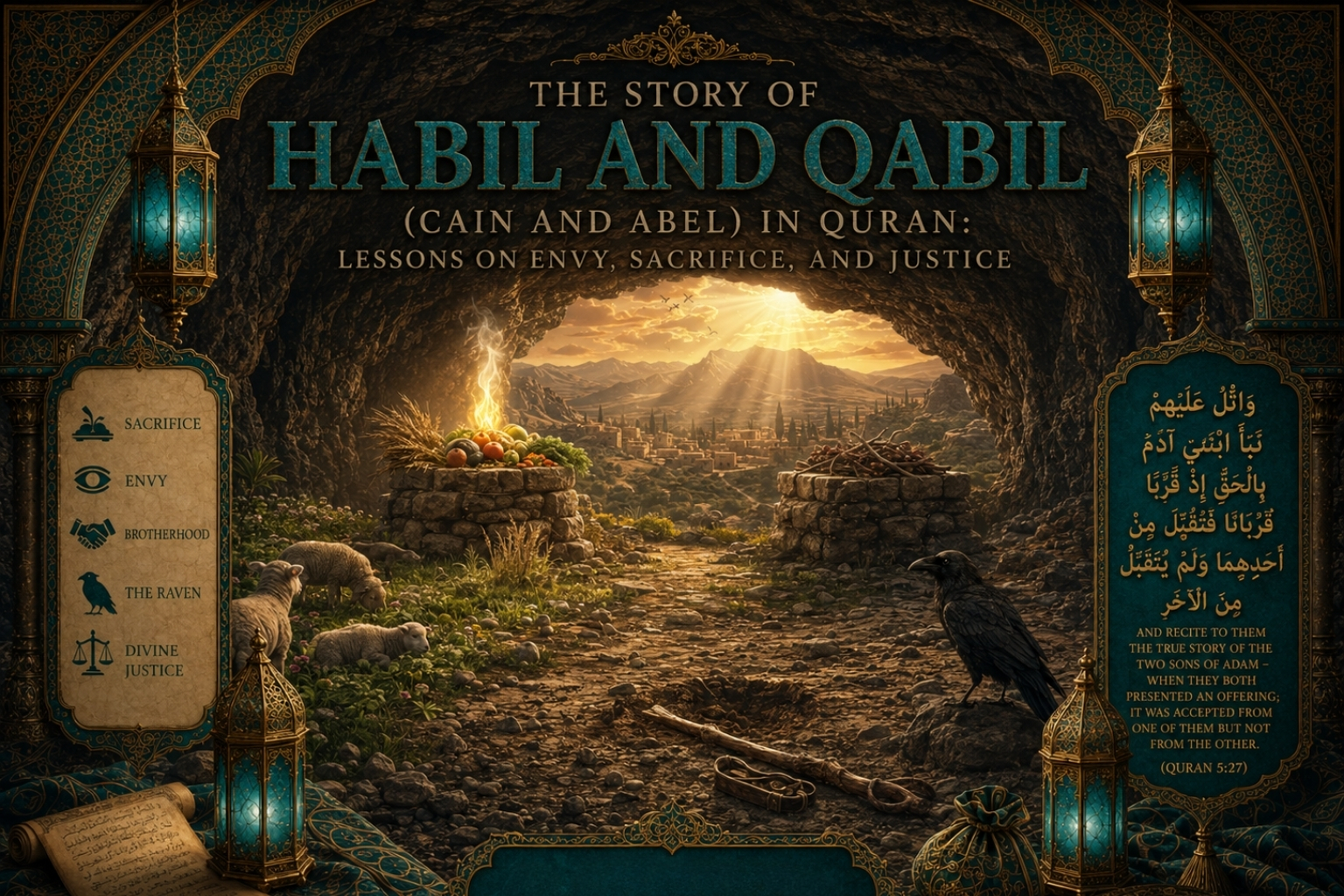

The history of humanity is filled with trials, triumphs, and profound lessons. Among the most pivotal narratives detailed in Islamic tradition is the Islamic story of Habil and Qabil (Cain and Abel), the two sons of Prophet Adam. Recorded in the Holy Quran, this narrative is not merely a historical account of the first murder in history; it serves as a timeless psychological and spiritual mirror reflecting the destructive power of envy (Hasad) and the ultimate triumph of piety (Taqwa).
For readers seeking to understand the deep moral framework of Islam, the story of the sons of Adam in the Quran provides foundational insights into human nature, accountability, and justice before Allah.
The Context: The First Family on Earth
After Prophet Adam and Hawa (Eve) were sent down to Earth, they were blessed with twins in each pregnancy—a boy and a girl. To populate the earth, Allah legislated that the brother from one pregnancy would marry the sister from another pregnancy.
Qabil, a farmer, was materialistic and stubborn, while Habil, a shepherd, was righteous, humble, and deeply conscious of Allah. A dispute arose when Qabil refused to accept the marriage decree ordained by Allah, desiring his own twin sister instead. To resolve this conflict, Prophet Adam suggested that both sons offer a sacrifice (Qurban) to Allah. The one whose sacrifice was accepted would have his claim validated.
The Test of Sacrifice and Piety
Habil chose the very best of his livestock, offering a healthy, plump ram out of pure love and devotion to Allah. Qabil, conversely, gathered a meager portion of his worst, spoiled crops, offering them reluctantly.
In those days, the acceptance of a sacrifice was manifested by a divine fire descending from heaven to consume the offering. The fire consumed Habil’s offering, while Qabil’s crops remained untouched. Allah accepted Habil’s sacrifice because of the purity of his intention and heart.
“وَاتْلُ عَلَيْهِمْ نَبَأَ ابْنَيْ آدَمَ بِالْحَقِّ إِذْ قَرَّبَا قُرْبَانًا فَتُقُبِّلَ مِنْ أَحَدِهِمَا وَلَمْ يُتَقَبَّلْ مِنَ الْآخَرِ قَالَ لَأَقْتُلَنَّكَ ۖ قَالَ إِنَّمَا يَتَقَبَّلُ اللَّهُ مِنَ الْمُتَّقِينَ”
“And recite to them the story of Adam’s two sons, in truth, when they both offered a sacrifice [to Allah], and it was accepted from one of them but was not accepted from the other. Said [the latter], ‘I will surely kill you.’ Said [the former], ‘Indeed, Allah only accepts from the righteous [who fear Him].'” — Surah Al-Ma’idah, 5:27
Jealousy and the First Murder in History
Blinded by intense envy and bruised pride, Qabil could not tolerate his brother’s spiritual elevation. Instead of repenting and rectifying his own relationship with Allah, he directed his malice toward his innocent brother, openly threatening to murder him.
Habil’s response is a masterclass in Islamic character. He refused to meet violence with violence, choosing instead to remind his brother of accountability in the Afterlife and the fear of Allah.
“لَئِن بَسَطتَ إِلَيَّ يَدَكَ لِتَقْتُلَنِي مَا أَنَا بِبَاسِطٍ يَدِيَ إِلَيْكَ لِأَقْتُلَكَ ۖ إِنِّي أَخَافُ اللَّهَ رَبَّ الْعَالَمِينَ”
“If you should raise your hand against me to kill me – I shall not raise my hand against you to kill you. Indeed, I fear Allah, Lord of the worlds.” — Surah Al-Ma’idah, 5:28
Tragically, Qabil allowed his base desires (Nafs) to overcome his conscience. He attacked Habil and committed the first homicide on Earth, instantly plunging his own soul into eternal regret and ruin.
The Raven and the Lesson of Remorse
After committing the heinous crime, Qabil was struck with panic and confusion. He did not know what to do with his brother’s lifeless body, carrying it around in despair. To teach him a lesson, Allah sent a visual manifestation of nature to guide him.
“فَبَعَثَ اللَّهُ غُرَابًا يَبْحَثُ فِي الْأَرْضِ لِيُرِيَهُ كَيْفَ يُوَارِي سَوْءَةَ أَخِيهِ ۚ قَالَ يَا وَيْلَتَا أَعَجَزْتُ أَنْ أَكُونَ مِثْلَ هَٰذَا الْغُرَابِ فَأُوَارِيَ سَوْءَةَ أَخِي ۖ فَأَصْبَحَ مِنَ النَّادِمِينَ”
“Then Allah sent a crow searching in the ground to show him how to hide the disgrace of his brother. He said, ‘O woe to me! Have I failed to be like this crow and hide the body of my brother?’ And he became of the regretful.” — Surah Al-Ma’idah, 5:31
Qabil buried his brother, but his remorse was not the saving repentance of a believer; it was the heavy, worldly grief of a man realizing the sheer magnitude of his loss and failure.
The Cosmic Weight of a Single Soul
The lessons from Habil and Qabil are so profound that Allah establishes this event as the baseline for the sanctity of human life. In Islam, taking a single innocent life is legally and spiritually equivalent to slaughtering the entirety of humanity.
The Prophet Muhammad emphasized the ongoing cosmic consequence of Qabil’s crime, highlighting how setting an evil precedent carries long-term spiritual liabilities.
“لا تُقْتَلُ نَفْسٌ ظُلْمًا إِلَّا كَانَ عَلَى ابْنِ آدَمَ الأَوَّلِ كِفْلٌ مِنْ دَمِهَا، لِأَنَّهُ كَانَ أَوَّلَ مَنْ سَنَّ القَتْلَ”
“No soul is killed unjustly except that the first son of Adam has a share of its sin, because he was the first to initiate murder.” — Sahih al-Bukhari & Sahih Muslim
Key Spiritual Lessons from Habil and Qabil
- Acceptance Lies in Taqwa (Piety): Allah does not look at the material value of our deeds, but rather the sincerity within our hearts. Outward rituals without inward devotion are hollow.
- The Destructive Nature of Envy (Hasad): Envy was the first sin committed in heaven (by Iblis) and the first sin committed on Earth (by Qabil). It blinds human reason and destroys good deeds.
- Pacifism vs. Cowardice: Habil’s refusal to initiate violence was not out of weakness, but out of a deliberate, conscious fear of Allah. He chose to be the oppressed rather than the oppressor.
- The Reality of Accountability: No crime hidden on Earth is hidden from Allah. The blood of the innocent leaves an indelible spiritual mark that will be answered on the Day of Judgment.
Conclusion
The tragic story of Habil and Qabil serves as a permanent warning for mankind. It shows that human conflict does not stem from a lack of resources, but from a disease of the heart. By studying the story of Cain and Abel in Islam, we are reminded to constantly purify our intentions, guard our hearts against jealousy, and strive to emulate the righteousness of Habil, seeking nothing but the pleasure of Allah.