
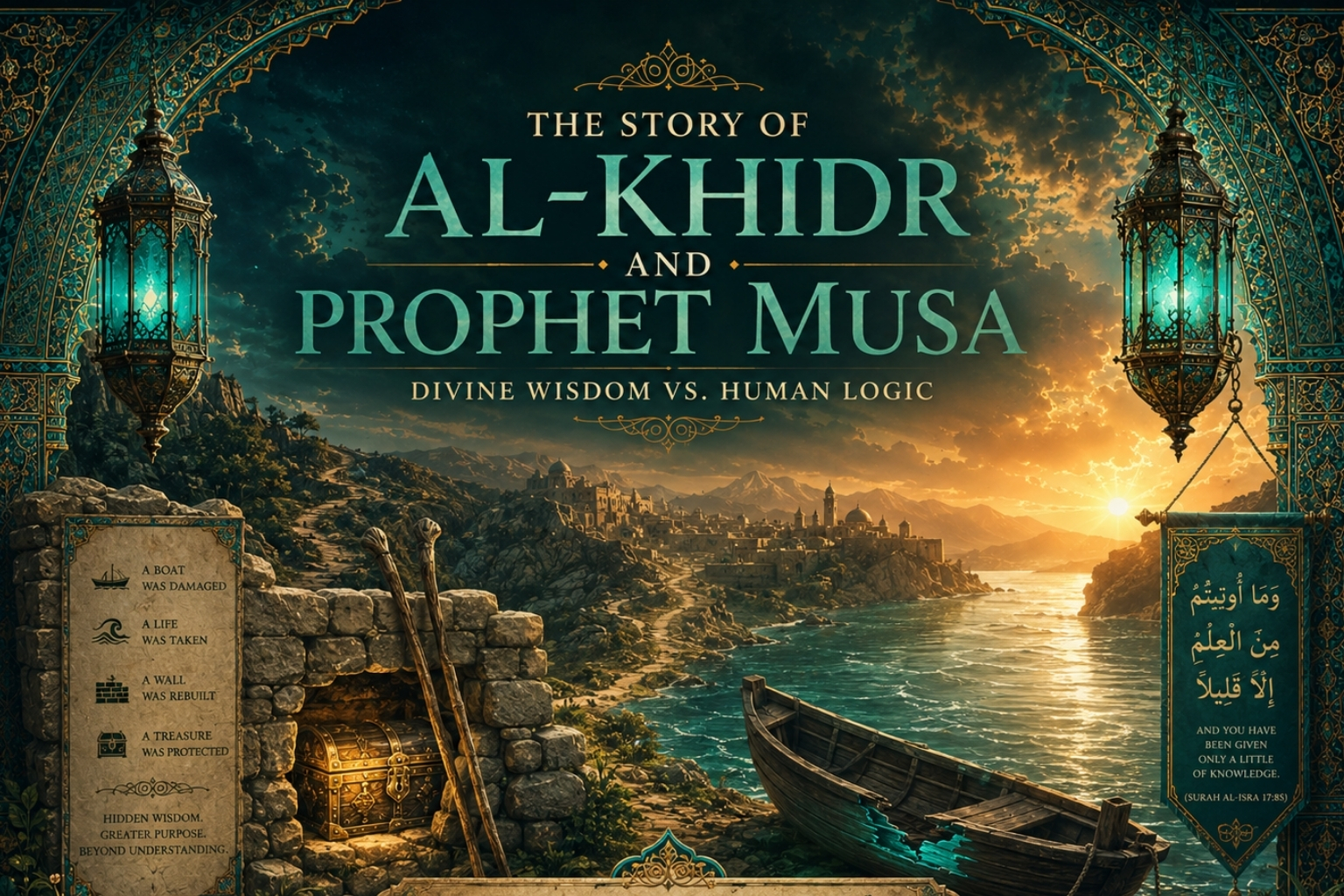

Among the most enigmatic, intellectually challenging, and spiritually deep narratives recorded in the Holy Quran is the encounter between Prophet Musa (Moses) and Al-Khidr (The Green One). Found in the central section of Surah Al-Kahf (Chapter 18), this narrative transcends typical historical accounts. It takes the reader on a metaphysical journey that explores the boundary between human logic and Divine Destiny (Qadar).
Revealed to the Prophet Muhammad to humble human intellect and provide comfort during times of inexplicable hardship, the story of Al-Khidr in Islam serves as an eternal textbook on patience, the limitations of human perception, and the hidden mercy embedded within seemingly tragic events decreed by Allah.
The Catalyst: A Lesson in Humility
The narrative begins when Prophet Musa stood before the Children of Israel and delivered an exceptionally eloquent sermon. Deeply moved by his speech, someone asked him: “O Messenger of Allah, is there anyone on earth more knowledgeable than you?”
Sensing his unique position as a law-bearing Prophet who spoke directly to God, Prophet Musa replied: “No.”
Allah immediately corrected Prophet Musa, revealing that he had not attributed absolute knowledge to the Divine. Allah informed him that a servant living at the junction of the two seas possessed a unique type of esoteric, experiential knowledge (‘Ilm al-Ladunni) that Prophet Musa did not have. Determined to find this wise teacher, Prophet Musa embarked on a rigorous journey alongside his young assistant, Yusha bin Nun (Joshua).
The Sign at the Junction of the Two Seas
Allah gave Prophet Musa a distinct sign to locate this mysterious servant: he was to carry a dead, salted fish in a basket. The exact spot where the fish miraculously came back to life and escaped into the ocean would be the meeting place.
After traveling for days, they rested near a rock at the confluence of the waters. While Prophet Musa slept, the dead fish suddenly slipped out of the basket, came alive, and burrowed its way into the sea, forming a tunnel-like path.
Upon waking and continuing their journey, Prophet Musa expressed exhaustion and asked for their meal. It was then that Yusha remembered the miracle at the rock. They retraced their steps and found Al-Khidr, whom the Quran describes as a servant enveloped in special divine mercy and knowledge.
The Terms of Companionship
Prophet Musa approached him with deep respect, asking permission to follow him to learn this higher guidance. Al-Khidr, possessing deep insight into Prophet Musa’s nature as a prophet of law and visible justice, warned him that he would not be able to remain patient.
“قَالَ إِنَّكَ لَن تَسْتَطِيعَ مَعِيَ صَبْرًا وَكَيْفَ تَصْبِرُ عَلَىٰ مَا لَمْ تُحِطْ بِهِ خُبْرًا”
“He said, ‘Indeed, with me you will never be able to have patience. And how can you have patience for that which you do not encompass in knowledge?'”
— (Surah Al-Kahf, 18:67-68)
Prophet Musa promised to be patient and obedient. Al-Khidr accepted under one strict condition: Prophet Musa must not question anything he did until Al-Khidr chose to explain it himself.
The Three Inexplicable Acts
1. Damaging the Boat
They boarded a ship owned by poor fishermen who generously offered them a free ride out of respect for Al-Khidr. As soon as they were out at sea, Al-Khidr pulled out an axe and intentionally broke one of the ship’s planks, endangering everyone on board. Driven by his innate sense of justice, Prophet Musa immediately broke his promise and objected.
“قَالَ أَخَرَقْتَهَا لِتُغْرِقَ أَهْلَهَا لَقَدْ جِئْتَ شَيْئًا إِمْرًا”
“Musa said, ‘Have you pierced it to drown its people? You have certainly done a grave thing.'”
— (Surah Al-Kahf, 18:71)
Al-Khidr calmly reminded him of his promise, and Prophet Musa apologized, asking for forgiveness for his forgetfulness.
2. The Execution of the Boy
Shortly after returning to land, they passed by a group of children playing. Al-Khidr approached one of the young boys and took his life. Horrified by what appeared to be an unprovoked, cold-blooded murder of an innocent child, Prophet Musa aggressively intervened.
“قَالَ أَقَتَلْتَ نَفْسًا زَكِيَّةً بِغَيْرِ نَفْسٍ لَّقَدْ جِئْتَ شَيْئًا نُّكْرًا”
“He said, ‘Have you killed a pure soul for other than [retaliation for] a soul? You have certainly done an evil thing.'”
— (Surah Al-Kahf, 18:74)
Al-Khidr repeated his warning with greater emphasis. Prophet Musa, deeply embarrassed, agreed that if he questioned Al-Khidr a third time, their companionship would be permanently dissolved.
3. Rebuilding the Wall in an Unhospitable Town
They reached a town where the inhabitants were incredibly hostile, flatly refusing to offer the travelers basic food or hospitality. Walking through the streets, Al-Khidr noticed a massive wall that was structurally compromised and on the verge of collapsing. Instead of leaving it, Al-Khidr spent his energy rebuilding and stabilizing the wall without asking for payment.
Prophet Musa, frustrated by the town’s hostility and their own hunger, remarked: “If you wished, you could have taken a wage for it.” Al-Khidr looked at him and said: “This is the parting between me and you.”
The Unveiling of the Unseen Reality (Al-Ghaib)
Before sending Prophet Musa away, Al-Khidr systematically dismantled the outward illusions of his actions, revealing the deep mathematical mercy of Allah’s blueprint:
- The Damaged Boat: A tyrannical king was operating down the coast, violently seizing every perfect ship by force. By creating a visible defect in the boat, Al-Khidr saved the livelihood of the poor fishermen, as the king’s soldiers skipped over their damaged vessel.
- The Death of the Boy: Allah knew this child was genetically predisposed to extreme rebellion and evil. Had he grown up, he would have violently forced his deeply pious parents into apostasy and ruin. Allah chose to take him back in a state of innocence to replace him with a righteous, compassionate child, securing the parents’ salvation.
- The Rebuilt Wall: The wall belonged to two orphaned boys in the city. Buried directly beneath it was a massive gold treasure left by their late, highly righteous father. Had the wall collapsed, the greedy townspeople would have discovered and stolen the treasure. Al-Khidr rebuilt it so it would stand until the boys reached maturity and could safely retrieve their inheritance as a direct mercy from Allah.
Core Spiritual Lessons from the Story of Al-Khidr
- The Split Between Knowledge of Law and Knowledge of Destiny: Prophet Musa judged by the outward law (Shariah), which was entirely correct for his position. Al-Khidr acted upon direct inspiration regarding destiny (Qadar). Both realities are valid, but destiny answers to a cosmic timeline that human beings cannot track in real-time.
- Seemingly Evil Events Carry Hidden Mercy: When the fishermen lost their plank, they likely cried and wondered why bad things happen to good people. They had no idea that their loss was the exact mechanism saving them from total bankruptcy. Your current crisis might be a divine shield blocking a far greater disaster.
- The Blessing of Righteous Ancestors: Allah sent a prophet and an angelic saint to repair a wall in a hostile town purely because the orphans’ deceased father was a righteous man. The piety you cultivate today acts as an active insurance policy protecting your children long after you pass away.
- Humility Prior to Knowledge: No single human being possesses a monopoly on absolute knowledge. We must remain perpetually humble, recognizing that what we see of our lives is merely a single page of a massive, divine book.
Conclusion
The profound chronicle of Al-Khidr and Prophet Musa completely re-engineers how a believer views the world. It proves that Allah never decrees pure, absolute evil for a believer; every loss, every delay, and every broken plank in our lives is structurally calibrated to guide us toward a superior outcome. By embodying the humility of Prophet Musa and trusting the absolute execution of Allah’s plan, we quiet our anxieties, anchored in the liberating truth that behind every closed door is a wave of divine mercy waiting to be unveiled.