
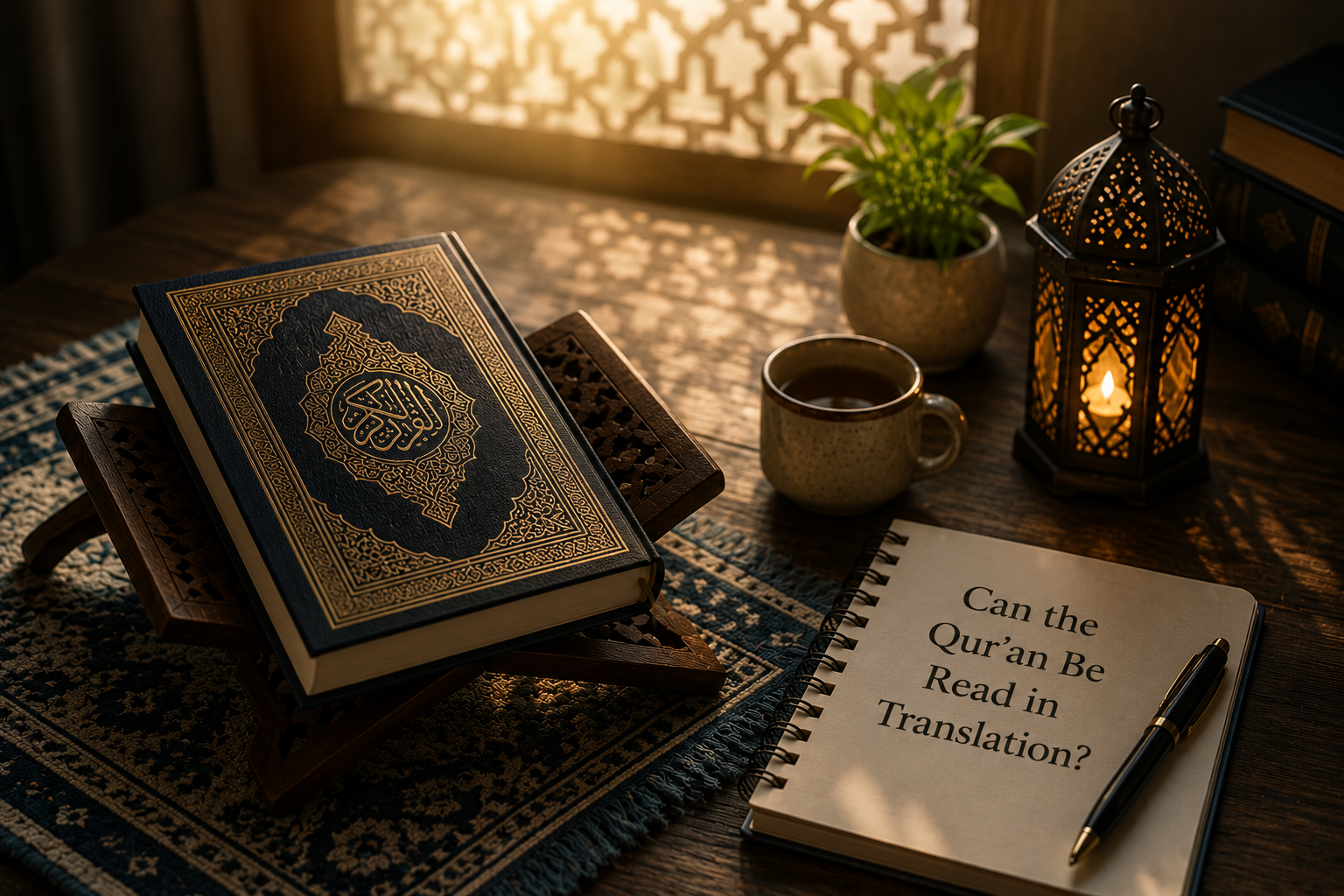

Can the Qur’an Be Read in Translation? Understanding the Difference Between the Qur’an and Its Meaning
For millions of people around the world, the Arabic language is unfamiliar. Yet many still wish to understand the Qur’an, explore Islam, or read the message that Muslims believe was revealed to Prophet Muhammad ﷺ over fourteen centuries ago.
This naturally leads to an important question:
Can the Qur’an be read in translation?
The answer is yes — translations can absolutely help people understand the message of the Qur’an. In fact, for non-Arabic speakers, translations often become the first step toward discovering Islam itself.
However, in Islamic understanding, there is an important distinction 1 between the Qur’an itself and the translation of its meanings.
The original Arabic text is considered the direct word of Allah revealed to Prophet Muhammad ﷺ. A translation, no matter how accurate, is ultimately a human explanation attempting to convey the meanings of that revelation 2 into another language.
Because of this, Muslims deeply value translations while also recognizing their limitations.
Why the Qur’an Was Revealed in Arabic
The Qur’an was revealed in Arabic because Prophet Muhammad ﷺ and the first audience of Islam were Arabic speakers.
Allah says:
“إِنَّا أَنزَلْنَاهُ قُرْآنًا عَرَبِيًّا لَّعَلَّكُمْ تَعْقِلُونَ”
“Indeed, We have sent it down as an Arabic Qur’an so that you may understand.”
— Surah Yusuf (12:2)
Arabic possesses unique linguistic 3 qualities that play a major role in the Qur’an’s style:
- Precision
- Depth
- Rhythm
- Eloquence 4
- Powerful word structure
Many Qur’anic expressions carry layers of meaning difficult to transfer completely into another language.
This is one reason translations often differ slightly from one another even when produced by respected scholars.
A Translation Is an Interpretation of Meaning
One important concept in Islam is that no translation can fully replace the Arabic Qur’an itself.
Why?
Because languages do not always match perfectly.
A single Arabic word in the Qur’an may carry:
- Multiple meanings
- Emotional depth
- Linguistic beauty
- Contextual implications 5
Sometimes translators must choose one possible meaning while other shades of meaning become less visible.
This does not mean translations are useless — far from it. Translations are extremely valuable for understanding the overall message of Islam. But they remain human efforts to explain divine revelation.
This is why many published translations include phrases like:
- “The Meaning of the Qur’an”
- “Interpretation 6 of the Qur’an”
- “Translated Meanings”
Rather than claiming to fully reproduce the Qur’an itself.
Can Someone Learn Islam Through Translation?
Absolutely.
Many people around the world first discovered Islam through reading translated versions of the Qur’an in:
- English
- French
- Spanish
- Turkish
- Urdu
- Indonesian
- Dozens of other languages
A sincere reader can understand many central teachings of Islam through translation, including:
- Belief in one God
- Mercy
- Justice
- Worship
- The stories of prophets
- Morality
- The afterlife
For countless converts to Islam, reading a translated Qur’an became a life-changing experience.
Why Muslims Still Preserve the Arabic Text
Although translations exist in hundreds of languages, Muslims continue preserving the Qur’an in its original Arabic form worldwide.
Whether a person lives in:
- Egypt
- Nigeria
- Indonesia
- Bosnia
- America
- China
The Arabic Qur’an remains exactly the same.
This preservation 7 creates extraordinary unity.
A Muslim in Japan can pray using the exact same Qur’anic words recited by a Muslim in Morocco or Saudi Arabia.
The Qur’an says:
“إِنَّا نَحْنُ نَزَّلْنَا الذِّكْرَ وَإِنَّا لَهُ لَحَافِظُونَ”
“Indeed, We have sent down the Reminder, and surely We will preserve it.”
— Surah Al-Hijr (15:9)
For Muslims, preserving the Arabic revelation protects the original message from distortion 8 over time.
Why Qur’anic Arabic Feels Different
Even native Arabic speakers often describe the Qur’an as linguistically unique.
Its style differs from:
- Ordinary conversation
- Poetry
- Classical prose 9
The Qur’an itself challenges humanity regarding its language and literary power.
Allah says:
“فَأْتُوا بِسُورَةٍ مِّن مِّثْلِهِ”
“Produce a chapter like it.”
— Surah Al-Baqarah (2:23)
Because of this unique style, certain emotional and linguistic qualities can become difficult to reproduce completely in translation.
Readers may understand the meaning intellectually while still missing some of the rhythm, depth, and rhetorical 10 beauty present in the Arabic original.
Can Muslims Pray Using Translation?
In formal Islamic prayer (Salah), the Qur’an is recited in Arabic.
This preserves:
- Unity in worship
- Accuracy of revelation
- Original wording revealed by Allah
However, outside formal prayer 11, people may read translations freely in order to understand the meanings of the Qur’an more deeply.
In fact, understanding the message is highly encouraged.
Many Muslims around the world study both:
- Arabic recitation
- Translation and explanation
So that worship becomes both correct and meaningful.
The Importance of Understanding the Qur’an
Islam does not encourage blind recitation without understanding.
The Qur’an repeatedly calls people to:
- Reflect
- Think
- Contemplate 12
- Understand
Allah says:
“أَفَلَا يَتَدَبَّرُونَ الْقُرْآنَ”
“Will they not reflect upon the Qur’an?”
— Surah An-Nisa (4:82)
For non-Arabic speakers, translation becomes an important bridge toward reflection and understanding.
While translations may not capture every linguistic detail, they still open the door to the Qur’an’s guidance, wisdom, and spiritual message.
Which Qur’an Translation Is Best?
Different translations vary in:
- Simplicity
- Accuracy
- Literary style
- Depth of commentary 13
Some translations use modern English, while others preserve older formal wording.
Among widely respected English translations are:
- The Clear Quran by Dr. Mustafa Khattab
- Saheeh International
- The Qur’an translated by Abdul Haleem
Many readers benefit from comparing multiple translations to gain broader understanding of difficult verses.
Conclusion
Yes, the Qur’an can absolutely be read in translation, and translations help millions of people understand Islam every day.
However, in Islamic understanding, the Arabic Qur’an remains the original revealed word of Allah, while translations are human explanations of its meanings.
Although no translation can fully capture every layer of the Qur’an’s linguistic beauty and depth, translated meanings still provide access to its guidance, wisdom, and message.
For many people around the world, reading the Qur’an in their own language becomes the first step toward understanding one of the most influential religious texts in human history.