
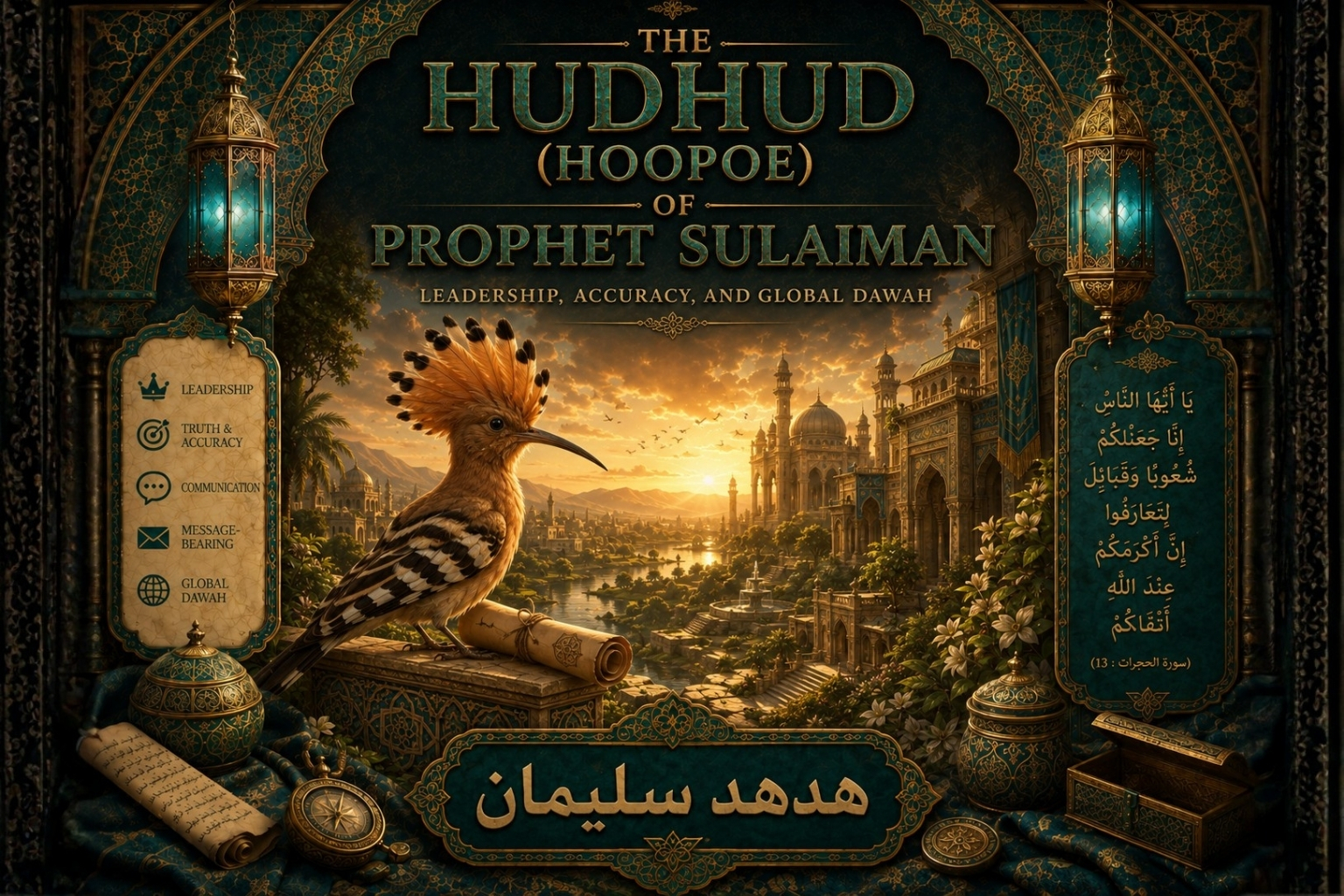

Among the most politically fascinating, structurally advanced, and intellectually rich narratives recorded in the Holy Quran is the chronicle of Hudhud Sulaiman (The Hoopoe bird of Prophet Sulaiman). Detailed beautifully in Surah An-Naml (The Ants, Chapter 27), this unique account highlights the sweeping, cross-species global empire granted exclusively to Prophet Sulaiman (Solomon).
Revealed by Allah to showcase the apex of organizational governance, accountability, and the importance of precise information, the story of the Hoopoe in Islam serves as an eternal educational blueprint on the psychology of professional responsibility, reporting, and how a single, tiny creature can become the catalyst for transforming an entire pagan empire into an enlightened monotheistic civilization.
The Imperial Inspection and the Missing Soldier
Prophet Sulaiman was not merely a king; he was a divinely empowered emperor whose massive military and administrative legions were structured systematically across three distinct realms: humans, Jinn, and animals/birds. He possessed the unique miracle of understanding the complex languages of all animals (Mantiq at-Tayr).
The narrative begins with Prophet Sulaiman conducting a highly rigorous, disciplined inspection of his avian battalions. Demonstrating the sharp, detail-oriented eye of a true Islamic leader, he immediately noticed the unexcused absence of a single, small bird: the Hudhud (Hoopoe).
“وَتَفَقَّدَ الطَّيْرَ فَقَالَ مَا لِيَ لَا أَرَى الْهُدْهُدَ أَمْ كَانَ مِنَ الْغَائِبِينَ لَأُعَذِّبَنَّهُ عَذَابًا شَدِيدًا أَوْ لَأَذْبَحَنَّهُ أَوْ لَيَأْتِيَنِّي بِسُلْطَانٍ مُّبِينٍ”
“And he inspected the birds and said, ‘Why do I not see the hoopoe, or is he among the absent? I will surely punish him with a severe punishment or slaughter him unless he brings me a clear authorization.'” — (Surah An-Naml, 27:20-21)
The Report from Saba: Geopolitics and Spiritual Devastation
The Hoopoe was not absent out of laziness or desertion of duty; he was engaged in an unauthorized, long-distance reconnaissance mission. Returning shortly after the inspection, the tiny bird stepped forward with incredible confidence, addressing the mighty Emperor with a profound piece of geopolitical intelligence that Prophet Sulaiman—despite all his Jinn and human spies—did not yet know.
The Hudhud had flown deep into the Arabian Peninsula, discovering the wealthy, highly advanced kingdom of Saba (Sheba, modern-day Yemen), which was ruled by a powerful, brilliant queen (traditionally identified as Queen Bilqis).
“فَمَكَثَ غَيْرَ بَعِيدٍ فَقَالَ أَحَطتُ بِمَا لَمْ تُحِطْ بِهِ وَجِئْتُكَ مِن سَبَإٍ بِنَبَإٍ يَقِينٍ إِنِّي وَجَدتُّ امْرَأَةً تَمْلِكُهُمْ وَأُوتِيَتْ مِن كُلِّ شَيْءٍ وَلَهَا عَرْشٌ عَظِيمٌ”
“But the hoopoe stayed not long and said, ‘I have encompassed [in knowledge] that which you have not encompassed, and I have come to you from Sheba with certain news. Indeed, I found [there] a woman ruling them, and she has been given of all things, and she has a great throne.'” — (Surah An-Naml, 27:22-23)
Demonstrating a profound, deeply rooted sense of monotheistic consciousness (Tawheed), the bird did not just report on their economic wealth or military architecture. The Hudhud expressed deep spiritual distress and analytical grief over the fact that this magnificent civilization was completely enslaved by paganism, bowing down to the sun instead of Allah.
“وَجَدتُّهَا وَقَوْمَهَا يَسْجُدُونَ لِلشَّمْسِ مِن دُونِ اللَّهِ وَزَيَّنَ لَهُمُ الشَّيْطَانُ أَعْمَالَهُمْ فَصَدَّهُمْ عَنِ السَّبِيلِ فَهُمْ لَا يَهْتَدُونَ”
“I found her and her people prostrating to the sun instead of Allah, and Satan has made their deeds pleasing to them and averted them from [His] way, so they are not guided.” — (Surah An-Naml, 27:24)
The Verification and the Imperial Letter
An ordinary king might have acted impulsively based on such a sensational report, either launching an immediate military invasion or completely dismissing the bird’s testimony as an exaggeration. But Prophet Sulaiman modeled the ultimate Quranic standard of data verification (Tabayyun). He informed the Hoopoe that his life depended on the accuracy of his report.
“قَالَ سَنَنظُرُ أَصَدَقْتَ أَمْ كُنتَ مِنَ الْكَاذِبِينَ”
“[Sulaiman] said, ‘We will see whether you were truthful or were of the liars.'” — (Surah An-Naml, 27:27)
Prophet Sulaiman drafted a concise, authoritative diplomatic letter and appointed the Hudhud as his official imperial ambassador, instructing him to fly back to Saba, drop the letter directly into the Queen’s private chambers, and observe her political reaction from a hidden vantage point.
The Catalyst for Global Transformation
The Hoopoe successfully completed his mission. He dropped the letter into the palace of Queen Bilqis. Upon reading the opening words, she immediately summoned her grand political council, recognizing the immense weight of the correspondence.
The letter began with the ultimate formula of Islamic monotheism:
“إِنَّهُ مِن سُلَيْمَانَ وَإِنَّهُ بِسْمِ اللَّهِ الرَّحْمَٰنِ الرَّحِيمِ أَلَّا تَعْلُوا عَلَيَّ وَأْتُونِي مُسْلِمِينَ”
“Indeed, it is from Sulaiman, and indeed, it reads: ‘In the name of Allah, the Entirely Merciful, the Especially Merciful. Be not haughty with me but come to me in submission [as Muslims].'” — (Surah An-Naml, 27:30-31)
This diplomatic catalyst initiated a profound chain of events: Queen Bilqis tried to send lavish gold gifts to bribe Prophet Sulaiman, which he fiercely rejected, stating that the gifts of Allah were far superior. Eventually, realizing the spiritual and material supremacy of Prophet Sulaiman’s kingdom, the Queen traveled to Jerusalem herself. Upon witnessing the miraculous architecture of his palace, her heart opened completely, and she explicitly declared her submission to Allah.
The Prophet Muhammad frequently highlighted that every creature in the heavens and the earth—even the fish in the deep sea and the ants in their dwellings—actively seeks the path of goodness and glorifies Allah, emphasizing that humans must never underestimate the spiritual consciousness of the animal kingdom.
Core Spiritual Lessons from the Hudhud of Sulaiman
- The Mandate of Verification (Tabayyun): The narrative provides a fundamental lesson in institutional justice. A leader must never react emotionally to shocking news or rumors. Prophet Sulaiman established a systematic framework to investigate and verify information before taking definitive political action.
- The Monotheistic Instinct (Fitrah) of Creation: The Hudhud was just a small bird, yet it possessed an innate theological clarity that allowed it to recognize that worship belongs exclusively to Allah. It felt deep psychological discomfort witnessing a society bow to the creation (the sun) rather than the Creator.
- Accountability Requires Clear Authorization (Sultan Mubin): When the Hoopoe faced punishment for unauthorized absence, it did not panic. It knew that in a just Islamic governance system, an employee or citizen is completely exonerated from punishment if they can produce an objective, valid reason that serves the higher good of the state.
- No Contribution is Too Small for Dawah: The entire empire of Saba—thousands of men, women, and generations of citizens—embraced Islam and avoided a devastating war entirely because one tiny bird chose to look closely, analyze, and report a spiritual crisis. You must never underestimate your individual capacity to guide others to Allah.
Conclusion
The brilliant, highly sophisticated history of Hudhud Sulaiman serves as a timeless masterpiece on organizational discipline, communication, and spiritual awareness. It shatters the human delusion of superiority, proving that Allah can utilize the smallest, most unexpected elements of His creation to humble emperors, guide nations, and preserve the truth. By embodying the precision of Prophet Sulaiman’s leadership and the intense monotheistic proactivity of the loyal Hoopoe, modern believers learn to operate with a deep sense of professional accountability and global responsibility, transforming their daily observations into powerful channels of divine guidance, clarity, and absolute success.