

We live in an age of constant mental fragmentation. Modern life forces us to manage a non-stop influx of data—from breaking news updates and corporate emails to group chats and algorithmically driven entertainment feeds. This relentless sensory bombardment keeps the human brain locked in a state of chronic hyper-vigilance. Even when we try to rest, our minds continue to process, analyze, and worry, directly fueling severe overthinking in Islam. We find ourselves physically present in our living rooms but mentally shipwrecked by a mountain of digital clutter, entirely cut off from deep, sustainable peace of mind.
To counter this mental exhaustion, modern wellness trends heavily promote mindfulness apps, weekend silent retreats, or isolated cabin getaways. While stepping away from your house can offer temporary relief, secular retreats often leave the human spirit starved of its ultimate food. They clear out your immediate surroundings, but they cannot fill the existential void within the heart.
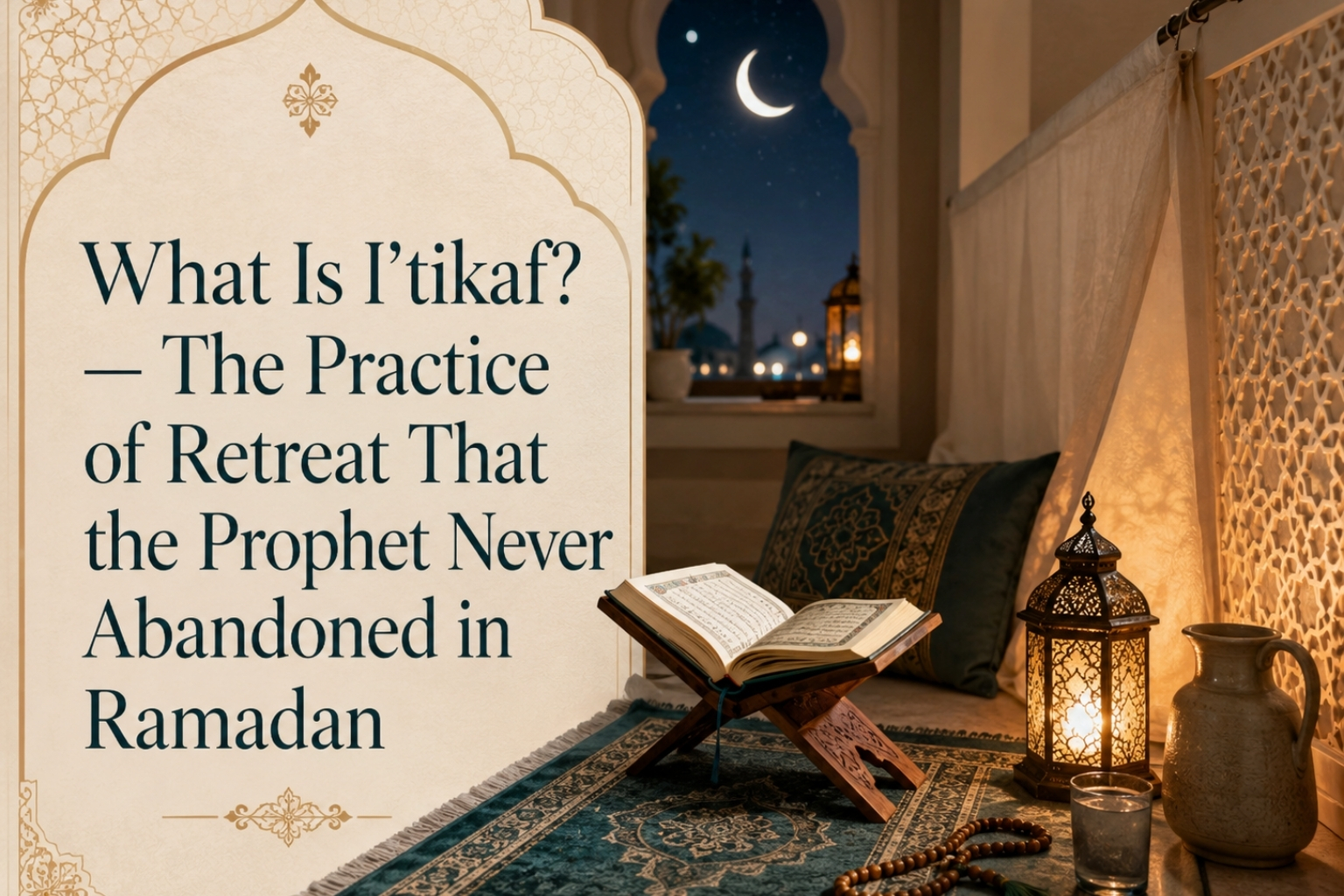
However, when we apply Tadabbur (deep Quranic reflection) to the prophetic lifestyle, we discover that Islam contains a built-in, ultimate annual masterclass in total digital and spiritual detoxification: I’tikaf (spiritual seclusion). I’tikaf is not an optional luxury or a modern self-care trend; it is a profound prophetic institution. In the framework of Islamic psychology, it serves as a highly targeted clinical intervention—a deliberate retreat from the noise of the worldly marketplace designed by Al-Khaliq (The Creator) to completely reset your internal focus, dismantle your deep-seated anxieties, and anchor your soul in trusting Allah’s plan.
The Core Mandate: The Complete Separation of the Soul
Linguistically, the Arabic word I‘tikāf stems from the root ‘akafa, which means to cling, to adhere, or to dedicate oneself completely to a singular object with absolute devotion. In Islamic law, it refers to the practice of confining oneself to the physical boundaries of a mosque for a specific period, accompanied by a explicit intention (Niyyah) to worship Allah alone.
This practice is deeply rooted in the text of the Quran, where Allah frames the mosque as a dedicated sanctuary of isolation, protected from the standard distractions of domestic and commercial life:
“وَلَا تُبَاشِرُوهُنَّ وَأَنتُمْ عَاكِفُونَ فِي الْمَسَاجِدِ ۗ تِلْكَ حُدُودُ اللَّهِ فَلَا تَقْرَبُوهَا”
“And do not have relations with them as long as you are staying for seclusion in the mosques. These are the bounds [set by] Allah, so do not approach them.”
— Surah Al-Baqarah, 2:187
To help a believer understand the functional structure of this intense spiritual retreat, the core rules and daily boundaries of a classic I’tikaf are mapped out below:
|
The Rule of Seclusion |
The Practical Boundaries |
The Deep Psychological Purpose |
|
1. The Physical Location |
Must be performed exclusively within a mosque where the five daily congregational prayers are established. |
Rips you entirely out of your domestic comfort zone, removing the visual triggers of your daily stresses and chores. |
|
2. The Separation Boundary |
The practitioner (Mu’takif) cannot step outside the mosque gates except for absolute human necessities (like using the restroom or collecting food). |
Shuts down the illusion of availability. It proves to your anxious intellect that the world can continue to spin without your constant intervention. |
|
3. The Digital Intercept |
Complete cessation of business transactions, casual phone use, social media browsing, and non-essential worldly conversation. |
Starves the Default Mode Network (DMN) of the brain of the continuous stimulation that fuels anxiety and overthinking. |
|
4. The Core Occupation |
Dedicating the entire block of time to reading the Quran (Tadabbur), performing voluntary prayers, making Du’a, and executing slow Dhikr. |
Replaces cognitive junk food with high-vibrancy divine speech, providing a direct avenue for healing anxiety with the Quran. |
The Prophetic Obsession: The Practice That Was Never Dropped
To understand the immense spiritual weight of this practice, we have to look closely at the historical behavior of the Prophet Muhammad. As the leader of an entire nation, the supreme commander of the military, the ultimate judge of the community, and a family man, his schedule was incredibly complex. Yet, despite carrying the heaviest administrative and personal burdens imaginable, he never allowed the world to crowd out his annual retreat.
His wife Aisha narrated the absolute constancy of this commitment:
“The Prophet used to engage in I’tikaf during the last ten nights of Ramadan until he passed away.” — Sahih al-Bukhari, 2026
Consider the profound lesson embedded in this prophetic consistency. If the most busy, highly responsible human being on Earth found it absolutely necessary to drop his political, judicial, and social duties for ten straight days every single year to lock himself inside the mosque, how can we believe that our corporate careers, family schedules, or digital projects are too critical for us to pause?
I’tikaf teaches your overthinking intellect a vital lesson in how to trust Allah: You are not the manager of the universe. By stepping back and entering the mosque, you return custody of your life to Al-Wakil (The Best Disposer of Affairs), allowing your soul to recover its true baseline of internal safety.
The Mechanical Shift: Claiming the Sanctuary of the Last Ten Nights
The primary spiritual target of entering I’tikaf during the final third of Ramadan is to catch Laylat al-Qadr (the Night of Decree)—a single night that is explicitly declared by the Quran to be superior to a thousand months of human labor.
When you spend those final ten nights living on the carpet of the mosque, you completely eliminate the logistical stress of trying to balance your spiritual focus with your daily commute or household management. You are already in the prime location. Whether you are awake praying, reading a page of scriptural text, or even sleeping to recover your energy, your entire existence is classified as continuous, high-vibrancy worship. This constant immersion dissolves the exhausting performance anxiety that often plagues believers during the holy month, allowing the heart to rest in an unshakeable state of absolute clarity.
The Modern Mini-I’tikaf: A Four-Step Protocol for Weekly Healing
If your current employment or family dependencies make a full ten-day physical disappearance into the mosque completely impossible, do not let religious perfectionism cause you to abandon the concept entirely. Islamic law permits a “voluntary mini-I’tikaf” that can be performed for any duration—even for just a single hour. Use this structured sequence to run a highly targeted spiritual retreat this week:
Step 1:
The Strategic Sanctuary Lockout
Identify a local mosque and select a 2-to-3-hour window on your weekend schedule (such as the quiet block between Asr and Maghrib prayers). Before crossing the threshold of the building, place your smartphone on absolute silent mode and bury it deep inside your car or bag.
Step 2:
The Launch of the Intentional Niyyah
As you step into the prayer hall with your right foot, articulate a explicit, quiet internal intention in your heart: “O Allah, I am intending the reward of I’tikaf in this mosque for the duration of my stay, solely to seek Your pleasure and to heal my heart.” With this simple statement, your time in the room is legally elevated to a sacred retreat.
Step 3:
The Execution of Focused Tadabbur
Sit down facing the direction of prayer (Qiblah). Open a physical copy of the Quran—refuse the smartphone application to prevent notification temptations. Read a single chapter slowly, pausing at every verse to reflect deeply on how its lessons apply to your current life stresses. Let the acoustic beauty of the text quiet your internal dialogue.
Step 4:
The Unburdening Transition (The Safe Exit)
Conclude your mini-retreat by raising your hands for an unedited session of Du’a. Pour out your raw anxieties, naming your professional or domestic fears to Al-Razzaq. Stand up only when the call to prayer begins, stepping back into your worldly routine with a mind that is beautifully light, centered, and structurally protected.
Actionable Steps to Cultivate Internal Sovereignty
- Establish a Daily “Mosque Cushion” Buffer: Do not allow your relationship with the local mosque to be a hurried, stressful transit where you sprint in for the mandatory prayer and instantly run back to your car. Commit to arriving just ten minutes early or staying ten minutes late after at least one daily prayer. Use this brief cushion to sit perfectly still on the carpet with zero digital devices active, allowing your nervous system to register the peaceful frequency of the space.
- Practice Radical Environmental Separation at Home: Replicate the psychological boundaries of I’tikaf within your domestic architecture by establishing a strict “Device-Free Prayer Zone” in your home. Dedicate a specific corner or room exclusively for prayer, Dhikr, and scriptural reading. Forbid the entry of laptops, televisions, or smartphones into this perimeter, creating a clean mental sanctuary for permanent peace of mind.
- Utilize the Sincere Language of Istighfar to Clear Guilt: Use the deep quiet of your solitary retreats to run an honest audit of your subconscious mind. If you find your thoughts spiraling around past moral failures or deep-seated guilt, translate that internal tension into a rhythmic, focused session of Istighfar (seeking forgiveness). Remind your overthinking intellect: “Allah’s mercy is infinitely wider than my mistakes, and I choose to rest under His complete forgiveness.”
Conclusion
The exquisite, profoundly restorative, and highly disciplined practice of I’tikaf in Islam serves as an essential spiritual compass for a human generation completely drowning in digital distraction, continuous performance pressure, and chronic mental exhaustion. Islam reminds you that your human worth is never determined by how fast you reply to messages, how many tasks you manage at once, or how aggressively you hustle in the worldly marketplace. You are a noble creation designed for direct connection with the Divine—capable of absolute self-mastery, deep psychological stillness, and unshakeable resilience. When you choose to step out of the crowd, claim your direct access to the sanctuary of the mosque, and anchor your ultimate confidence in trusting Allah’s plan, the suffocating weight of modern overthinking completely evaporates—leaving your soul beautifully wrapped in an unshakeable state of profound safety, clean energy, and everlasting spiritual success.