

Many people assume the words Islam and Iman mean exactly the same thing.
They are closely connected, but in Islamic teachings, each word carries a distinct meaning that describes a different dimension 1 of faith.
Understanding this difference helps explain how Islam views not only outward actions, but also the inner condition of the heart.
In simple terms:
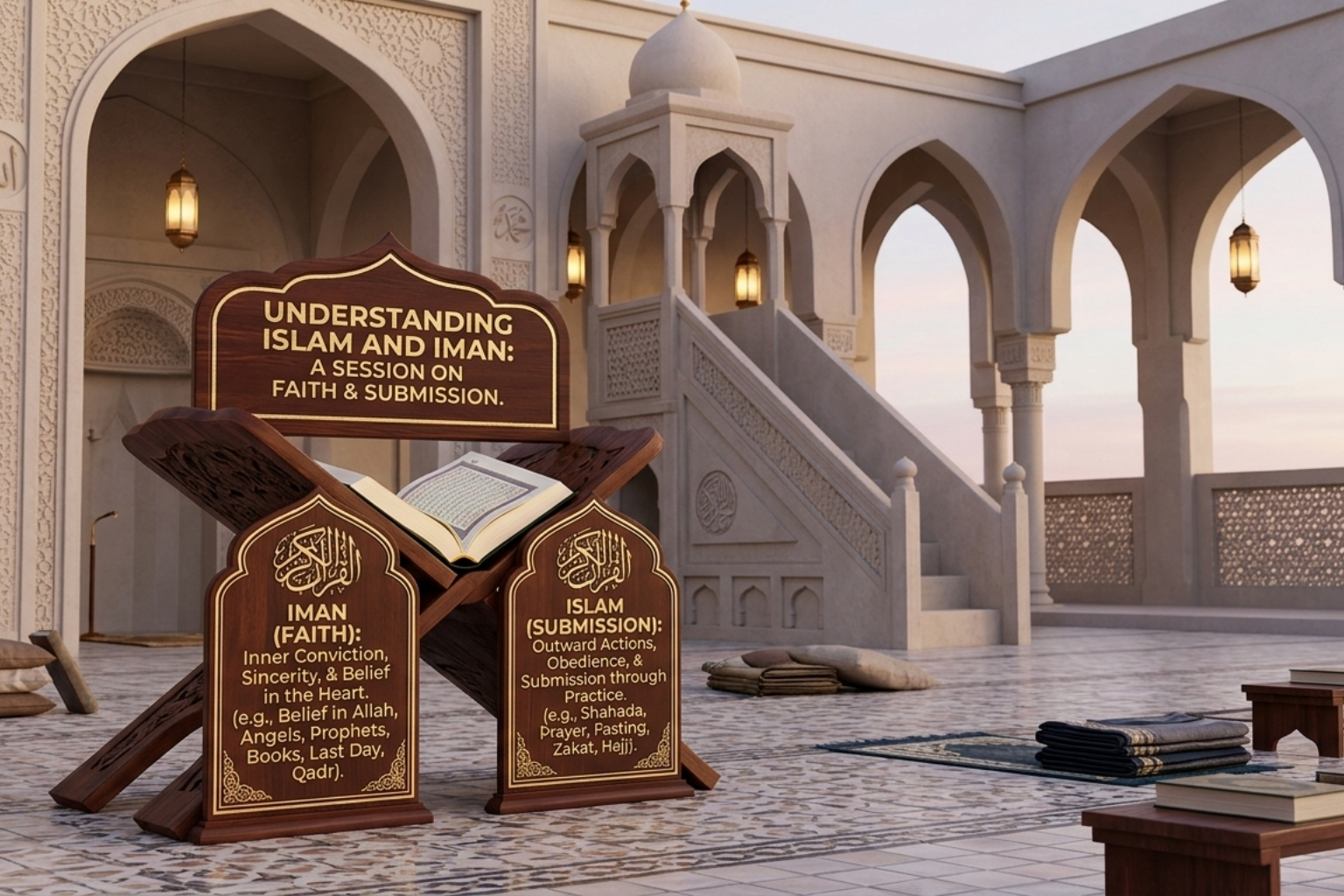
- Islam refers primarily to outward submission and actions.
- Iman refers to inner faith, belief, and conviction within the heart.
A person’s relationship with Allah is therefore not based only on visible religious practices, nor only on personal belief hidden internally. Islam combines both outer obedience and inner faith together.
What Does the Word “Islam” Mean?
The word Islam comes from the Arabic root connected to:
- Peace
- Submission 2
- Surrender to Allah
Islam means submitting oneself willingly to the Creator through worship, obedience, and following divine guidance.
This submission appears outwardly through actions such as:
- Prayer
- Fasting
- Charity
- Pilgrimage
- Daily acts of worship
These practices are known as the Five Pillars of Islam.
The Prophet Muhammad ﷺ described Islam by saying:
“الإِسْلاَمُ أَنْ تَشْهَدَ أَنْ لاَ إِلَهَ إِلاَّ اللَّهُ وَأَنَّ مُحَمَّدًا رَسُولُ اللَّهِ، وَتُقِيمَ الصَّلاَةَ، وَتُؤْتِيَ الزَّكَاةَ، وَتَصُومَ رَمَضَانَ، وَتَحُجَّ الْبَيْتَ”
“Islam is to testify that there is no god but Allah and that Muhammad is the Messenger of Allah, establish prayer, give Zakah, fast Ramadan, and perform pilgrimage to the House if able.”
— Sahih Muslim (8)
These actions form the visible structure of a Muslim’s life.
What Does the Word “Iman” Mean?
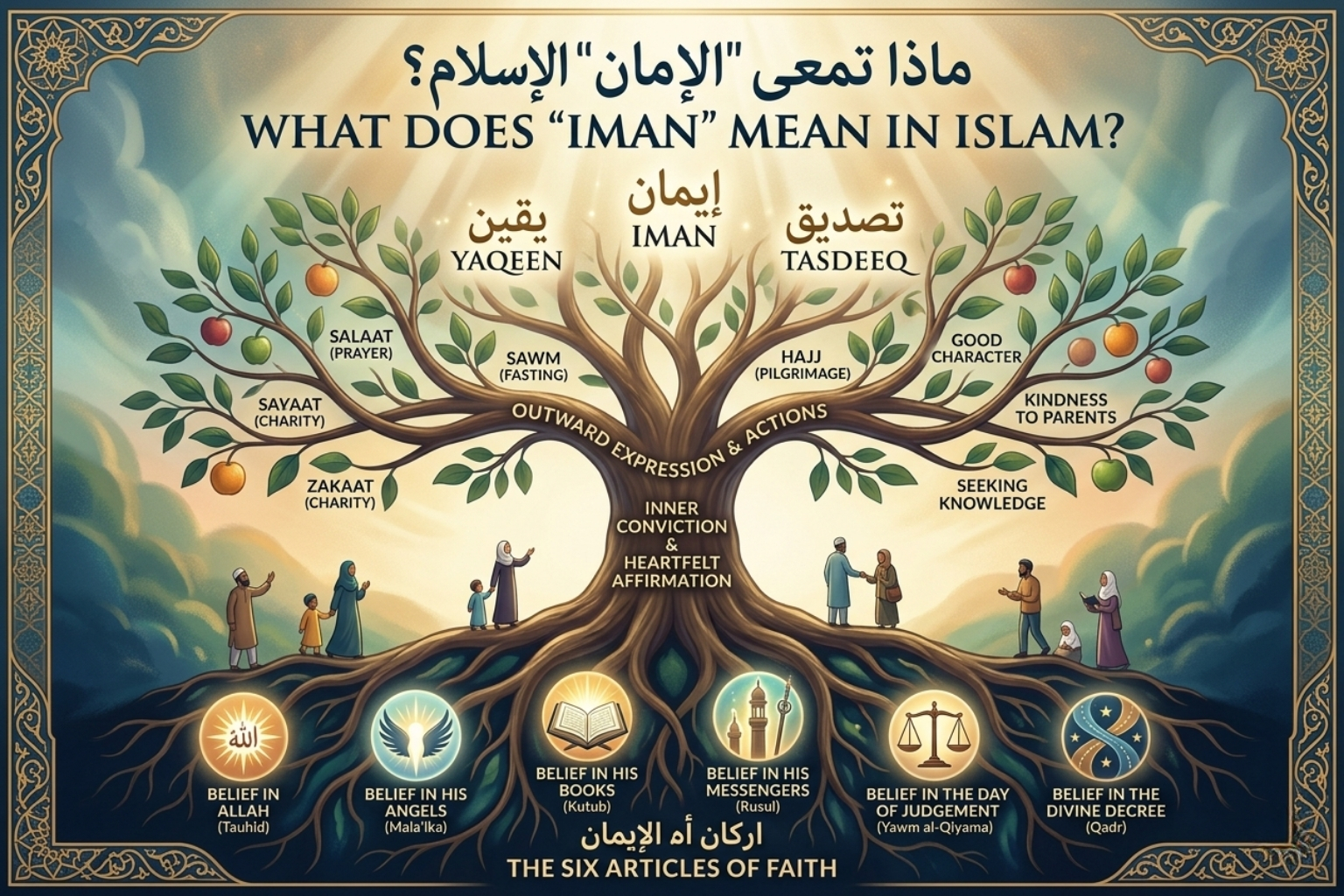
The Arabic word Iman is usually translated as faith or belief.
But in Islam, Iman is not merely intellectual 3 agreement. It includes:
- Belief in the heart
- Speech by the tongue
- Actions that reflect faith
Iman represents the inner spiritual foundation 4 behind outward worship.
In the same famous hadith, the Prophet Muhammad ﷺ explained Iman as:
“أَنْ تُؤْمِنَ بِاللَّهِ، وَمَلَائِكَتِهِ، وَكُتُبِهِ، وَرُسُلِهِ، وَالْيَوْمِ الآخِرِ، وَتُؤْمِنَ بِالْقَدَرِ خَيْرِهِ وَشَرِّهِ”
“It is to believe in Allah, His angels, His books, His messengers, the Last Day, and divine decree — both its good and its difficult aspects.”
— Sahih Muslim (8)
These are known as the Six Pillars of Iman.
While Islam often appears externally through actions, Iman lives internally within the heart.
Why Both Islam and Iman Matter
Islam does not separate actions from belief.
A person may perform outward religious actions while the heart remains spiritually empty. At the same time, claiming faith without sincere worship and obedience creates imbalance as well.
The Qur’an addresses this distinction directly.
Allah says:
“قَالَتِ الْأَعْرَابُ آمَنَّا ۖ قُل لَّمْ تُؤْمِنُوا وَلَٰكِن قُولُوا أَسْلَمْنَا وَلَمَّا يَدْخُلِ الْإِيمَانُ فِي قُلُوبِكُمْ”
“The Bedouins say, ‘We believe.’ Say: You have not yet believed; rather say, ‘We have submitted,’ for faith has not yet entered your hearts.”
— Surah Al-Hujurat (49:14)
This verse shows that outward submission and inward faith are connected but not always identical.
True spiritual excellence develops when both become strong together.
Islam Builds Structure — Iman Gives It Life
A helpful way to understand the relationship between Islam and Iman is to compare them to the body and the soul.
Islam provides visible structure through worship and obedience:
- Prayer
- Fasting
- Charity
- Moral behavior
Iman gives those actions sincerity, meaning, and spiritual depth.
Without Iman, worship can become mechanical 5. Without Islam, faith may remain only an idea without discipline or action.
Islam therefore teaches balance between:
- External practice
- Internal faith
Both are necessary for spiritual growth.
Can Iman Increase and Decrease?
One important teaching in Islam is that Iman is not static 6.
Faith can strengthen or weaken depending on:
- Worship
- Sins
- Environment 7
- Knowledge
- Remembrance of Allah
- Personal choices
The Qur’an describes believers whose faith increases when hearing Allah’s words:
“وَإِذَا تُلِيَتْ عَلَيْهِمْ آيَاتُهُ زَادَتْهُمْ إِيمَانًا”
“And when His verses are recited to them, it increases them in faith.”
— Surah Al-Anfal (8:2)
This understanding explains why spiritual effort remains important throughout life.
Faith is not simply inherited 8 automatically or guaranteed permanently without care and growth.
What Is Ihsan?
In the famous hadith of Jibril (Gabriel), the Prophet Muhammad ﷺ explained not only Islam and Iman, but also a third level called Ihsan.
The Prophet ﷺ said:
“أَنْ تَعْبُدَ اللَّهَ كَأَنَّكَ تَرَاهُ، فَإِن لَّمْ تَكُن تَرَاهُ فَإِنَّهُ يَرَاكَ”
“It is to worship Allah as though you see Him, and even if you do not see Him, know that He sees you.”
— Sahih Muslim (8)
Ihsan represents spiritual excellence — worship performed with deep sincerity 9, awareness, and closeness to Allah.
Together:
- Islam shapes actions
- Iman shapes belief
- Ihsan perfects sincerity
These three dimensions create the full spiritual framework of Islam.
Why This Difference Matters Today
Many modern discussions about religion focus only on outward identity or personal belief separately.
Islam approaches human beings more comprehensively 10.
It recognizes that people need:
- Belief
- Discipline
- Morality 11
- Worship
- Spiritual awareness
The heart and the actions influence one another continuously.
Strong faith inspires righteous 12 action, while sincere worship strengthens faith in return.
Conclusion
Islam and Iman are deeply connected, yet they describe different aspects of a believer’s relationship with Allah.
Islam refers primarily to outward submission through worship and action, while Iman refers to inward belief and faith rooted in the heart.
Together, they form a balanced spiritual life where belief is supported by action and action is filled with sincerity and meaning.
In Islam, true faith is not limited to words alone, nor to rituals performed without conviction. It is the harmony 13 between the heart, the mind, and the actions — all directed toward Allah.