
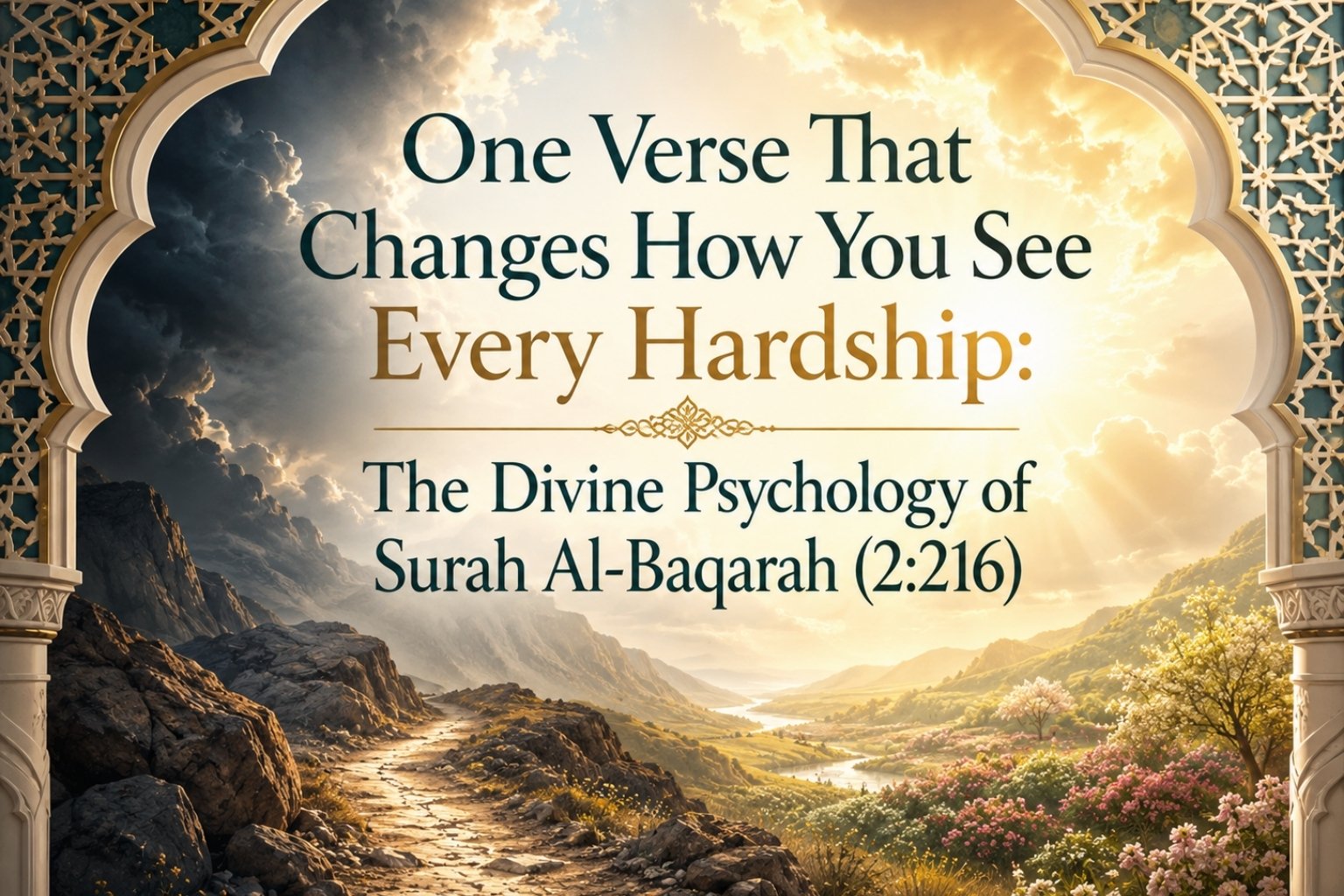

Every human being eventually encounters a moment where life completely shatters their expectations. A door closes, a career pathway collapses, a relationship ends, or a sudden loss leaves them standing in absolute emotional ruins. In those dark moments of personal crisis, the human mind naturally spirals into a state of panic, asking an exhausting question: “Why is this happening to me?”
Within Islamic psychology and the text of the Holy Quran, Allah provides a single, revolutionary verse that fundamentally rewrites how a believer perceives pain, disappointment, and unwanted delays. It is an internal anchor that alters your entire perspective on adversity.
The Divine Formula: Surah Al-Baqarah, Verse 216
Embedded within a passage discussing structural responsibilities and difficult societal obligations, Allah drops a timeless psychological law that transcends its immediate historical context:
“وَعَسَىٰ أَن تَكْرَهُوا شَيْئًا وَهُوَ خَيْرٌ لَّكُمْ ۖ وَعَسَىٰ أَن تُحِبُّوا شَيْئًا وَهُوَ شَرٌّ لَّكُمْ ۖ وَاللَّهُ يَعْلَمُ وَأَنتُمْ لَا تَعْلَمُونَ”
“Perhaps you dislike something and it is good for you; and perhaps you love something and it is bad for you. And Allah knows, while you know not.” — (Surah Al-Baqarah, 18:216)
This profound statement splits human reality into two distinct realms: your immediate emotional reaction, and the ultimate, hidden reality of consequences monitored exclusively by the Creator.
THE DUALITY OF HUMAN PERCEPTION | |
Human Reaction: “I hate this event.” ➡️ | Divine Reality: Good |
Human Reaction: “I want this event.”➡️ | Divine Reality: Bad |
Ultimate Boundary: Allah knows, while you know not. | |
The Limitations of Human Sight vs. Divine Foresight
The structural beauty of this verse lies in how it challenges human intellectual arrogance. As human beings, our vision is inherently horizontal; we can only see the immediate present, the pain of the moment, or the material loss. However, the vision of Allah is vertical and eternal—He sees the macro-level trajectory of your entire life, your spiritual maturity, and your ultimate destiny in the afterlife (Akhirah).
Consider a classic example: a person desperately tries to catch a flight but faces unexpected traffic jams, a flat tire, and ultimate delays. They miss the flight in absolute anger and frustration, disliking the situation immensely. Hours later, news broke that the aircraft suffered a fatal mechanical failure. Instantly, the very event they perceived as a “hardship” is revealed to be their ultimate rescue.
This is the exact spiritual mechanics of Surah Al-Baqarah (2:216). The delay was not a punishment; it was a protective shield.
Prophetic Masterclasses in “Hidden Good”
The history of the messengers is a continuous demonstration of this specific verse in action. When we trace the steps of the chosen servants of Allah, we find that their greatest triumphs were birthed directly from the wombs of situations they naturally disliked.
1. Prophet Yusuf (Joseph)
Think of Prophet Yusuf. As a young boy, he was betrayed by his brothers and cast into the cold, dark depths of a well. To human eyes, this was an absolute tragedy. He was then sold into slavery, framed for a crime he did not commit, and locked away in an Egyptian prison for years.
Yet, if Prophet Yusuf had never been thrown into the well, he would have never been picked up by the caravan. If he had never been enslaved in Egypt, he would have never entered the house of the minister. If he had never been imprisoned, he would have never interpreted the dreams of the king’s servants, a skill that ultimately elevated him to become the treasurer of Egypt, saving millions of lives—including his own family—from a devastating famine. Every layer of hardship was a mandatory stepping stone to his ultimate elevation.
2. Prophet Musa (Moses)
Similarly, look at the mother of Prophet Musa. Allah commanded her to place her newborn infant into a fragile wooden chest and cast him directly into the rushing waters of the Nile River—an act that every mother’s heart would naturally detest and fear.
“فَإِذَا خِفْتِ عَلَيْهِ فَأَلْقِيهِ فِي الْيَمِّ وَلَا تَخَافِي وَلَا تَحْزَنِي ۖ إِنَّا رَادُّوهُ إِلَيْكِ وَجَاعِلُوهُ مِنَ الْمُرْسَلِينَ”
“But when you fear for him, cast him into the river and do not fear and do not grieve. Indeed, We will return him to you and will make him [one] of the messengers.” —
(Surah Al-Qasas, 28:7)
What seemed like an absolute abandonment was actually a divine escort that delivered Prophet Musa straight into the royal palace of Pharaoh, ensuring he was raised with maximum security and luxury at the expense of his worst enemy.
Practical Steps to Apply This Verse to Your Daily Life
- Shift from Emotion to Observation: The next time a plan falls through, give yourself permission to feel the initial sting, but quickly repeat the divine formula: “Perhaps you dislike something and it is good for you.” Stop mourning the closed door and start looking for the new path Allah is opening for you.
- Anchor Your Heart in Tawakkul (Trust): True reliance upon Allah means accepting that the Author of your story is infinitely more merciful to you than you are to yourself. If He removes something or someone from your life, it is because He knows they cannot walk with you into the next, elevated chapter of your spiritual journey.
- Embrace the Peace of Surrender: The closing phrase of the verse, “And Allah knows, while you know not,” is an invitation to lay down the exhausting burden of trying to control the future. It allows you to breathe through the storm, knowing that your affairs are being managed by absolute wisdom.
Conclusion
Surah Al-Baqarah (2:216) is not a call to passive complacency; it is a supreme psychological shield that protects the believer from falling into clinical despair or bitter resentment. It teaches us that in the divine economy, no tear is wasted, no delay is accidental, and no heartbreak is without a higher purpose. When you completely internalize this single verse, you stop viewing hardships as obstacles destroying your life, and you begin viewing them as raw, deeply disguised mercies designed by Allah to safely navigate your soul toward its ultimate peace, protection, and eternal success.