
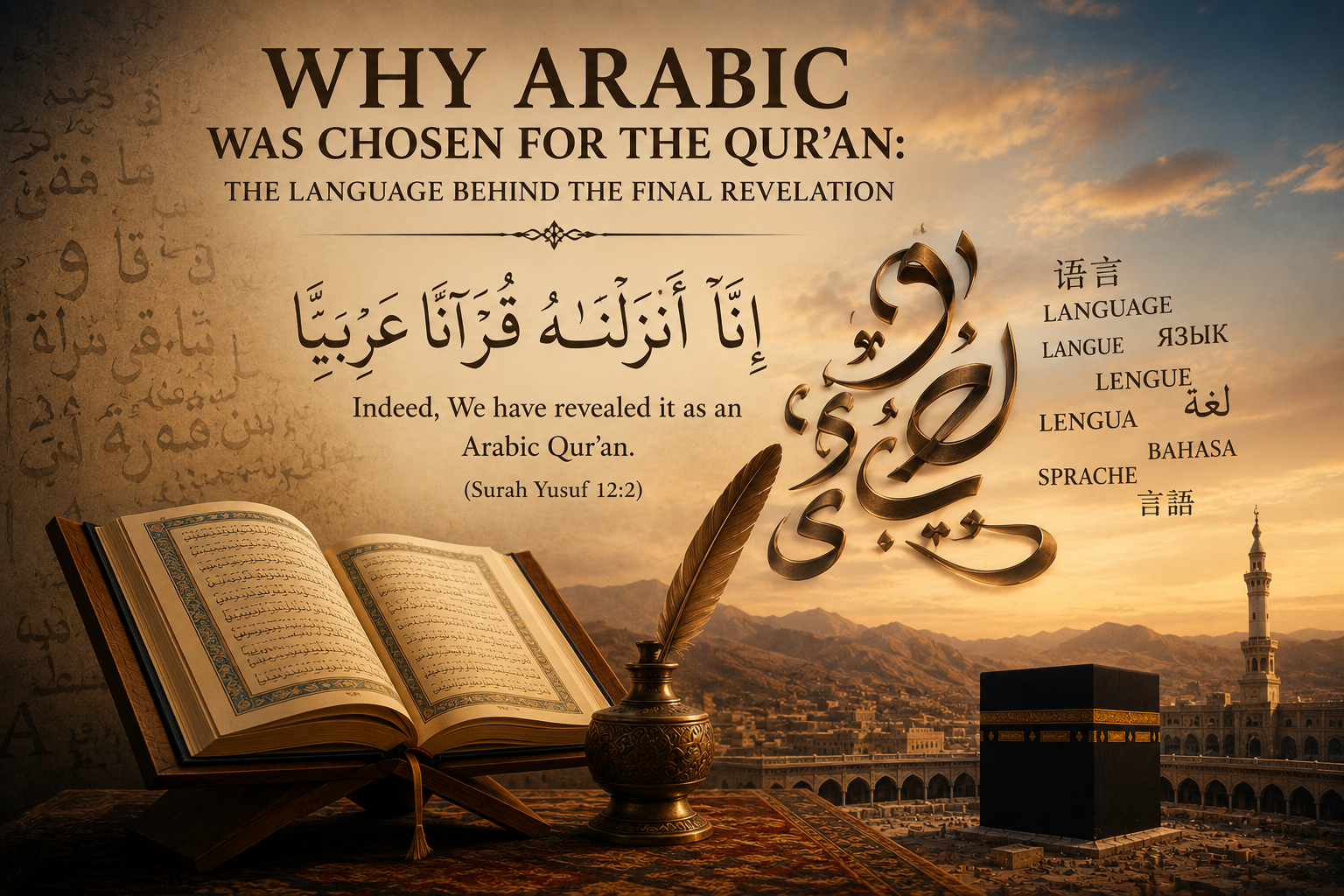

One of the most common questions asked by both Muslims and non-Muslims is: why was the Qur’an revealed specifically in Arabic?
If Islam is a religion meant for all humanity, why was its final revelation 1 not sent in a universal language understood by everyone immediately?
The answer lies not only in history, but also in the extraordinary nature of the Arabic language itself. Muslims believe Arabic was chosen intentionally by Allah because of its unique ability to preserve meaning, convey depth, and carry the powerful linguistic 2 structure of the Qur’an.
The language of the Qur’an is not viewed merely as a cultural detail — it is considered part of the miracle itself.
Every Prophet Was Sent in the Language of His People
The Qur’an explains an important principle regarding divine revelation: every messenger was sent speaking the language of his own people so that the message could first be understood clearly.
Allah says:
“وَمَا أَرْسَلْنَا مِن رَّسُولٍ إِلَّا بِلِسَانِ قَوْمِهِ لِيُبَيِّنَ لَهُمْ”
“We never sent a messenger except in the language of his people so that he might make the message clear to them.”
— Surah Ibrahim (14:4)
The Prophet Muhammad ﷺ was sent among Arabic-speaking people in the Arabian Peninsula. Naturally, the Qur’an was revealed in the language they understood best.
However, Muslims believe there was also a deeper wisdom behind choosing Arabic specifically.
Arabic Is One of the Richest Languages in the World
Arabic possesses extraordinary linguistic depth. A single Arabic root word can produce many related meanings, allowing the language to communicate ideas with remarkable precision and subtlety 3.
This richness allows the Qur’an to express:
- Spiritual meanings
- Emotional depth
- Legal rulings
- Moral guidance
- Powerful imagery
often using very few words.
For example, many Qur’anic verses contain layers of meaning that become difficult to fully capture in translation. This is why Muslims usually describe English versions of the Qur’an not as the Qur’an itself, but as interpretations 4 of its meaning.
Scholars of Arabic linguistics frequently discuss the language’s highly structured root system and expressive flexibility 5.
The Qur’an Describes Itself as an Arabic Revelation
The Qur’an repeatedly emphasizes that it was revealed in clear Arabic language.
Allah says:
“إِنَّا أَنزَلْنَاهُ قُرْآنًا عَرَبِيًّا لَّعَلَّكُمْ تَعْقِلُونَ”
“Indeed, We have sent it down as an Arabic Qur’an so that you may understand.”
— Surah Yusuf (12:2)
And Allah also says:
“بِلِسَانٍ عَرَبِيٍّ مُّبِينٍ”
“In a clear Arabic tongue.”
— Surah Ash-Shu‘ara (26:195)
The phrase “clear Arabic” reflects both clarity of communication and linguistic excellence.
For Muslims, this clarity is one reason the Qur’an’s message spread so powerfully despite emerging in a largely tribal society over fourteen centuries ago.
The Beauty of Qur’anic Arabic
One reason the Qur’an continues to deeply move listeners is the unique beauty of its language.
The Qur’an combines:
- Rhythm
- Balance
- Precision
- Emotional impact
- Powerful sound patterns
in a way that even many Arabic experts considered impossible to imitate.
The Arabs during the time of the Prophet Muhammad ﷺ were masters of poetry and eloquence 6. Public poetry competitions were common, and language was considered one of the greatest forms of cultural achievement.
Yet despite their mastery of Arabic, even the Qur’an’s opponents struggled to produce speech comparable 7 to it.
For Muslims, this linguistic uniqueness forms part of the Qur’an’s miraculous nature.
Arabic Helped Preserve the Qur’an
Another important reason Arabic was chosen relates to preservation.
The Arabic language possesses a highly stable grammatical structure 8 compared to many other languages. In addition, Muslims preserved the Qur’an not only through writing, but also through memorization and oral recitation.
This preservation system protected:
- Pronunciation
- Sentence structure
- Word order
- Meaning
Because millions of Muslims memorized the Qur’an generation after generation in its original Arabic form, the text remained remarkably consistent throughout history.
Today, Muslims around the world still recite the Qur’an in the same language used during the lifetime of the Prophet Muhammad ﷺ.
The Qur’an Is Universal Despite Being Arabic
Some people mistakenly assume that because the Qur’an is Arabic, its message is limited to Arabs.
Islam teaches the opposite.
Allah says:
“وَمَا أَرْسَلْنَاكَ إِلَّا كَافَّةً لِّلنَّاسِ”
“And We have not sent you except to all mankind.”
— Surah Saba (34:28)
Although the Qur’an was revealed in Arabic, its message is intended for humanity as a whole.
This is similar to how many important historical texts were originally written in a specific language while still influencing people globally.
Today, the Qur’an is translated into hundreds of languages, allowing people worldwide to understand its message while preserving the original Arabic text.
Why Translation Can Never Fully Replace the Original
Translations help readers understand the meaning of the Qur’an, but many elements of the original Arabic remain impossible to reproduce completely.
This includes:
- Sound patterns
- Rhythm
- Wordplay 9
- Multiple layers of meaning
- Emotional tone
A single Arabic word in the Qur’an may contain meanings that require an entire sentence to explain in English.
Because of this, many scholars encourage Muslims to gradually learn at least some Qur’anic Arabic in order to experience the depth of the revelation more directly.
Oxford Reference – Arabic Language History
More Than a Language
For Muslims, Arabic is not considered sacred merely because it is Arabic. Rather, its honor comes from being the language chosen for the final revelation of Allah.
The beauty, precision, and preservation of Qur’anic Arabic continue to inspire scholars, linguists, and believers across generations.
Even today, many people who study the Qur’an deeply become fascinated not only by its message, but also by the extraordinary language through which that message was delivered.
Conclusion
The Qur’an was revealed in Arabic not by coincidence, but through divine wisdom 10. Arabic’s depth, precision, beauty, and stability made it uniquely suited to carry the final revelation of Islam.
For Muslims, the Arabic language is deeply connected to the miracle of the Qur’an itself — a language capable of expressing profound meanings with unmatched clarity and emotional power.
More than fourteen centuries later, the Qur’an continues to be recited in the same Arabic words revealed to the Prophet Muhammad ﷺ, preserving a message that remains alive in the hearts of millions around the world.