

There is a prayer that was made in the darkest place a human being has ever been.
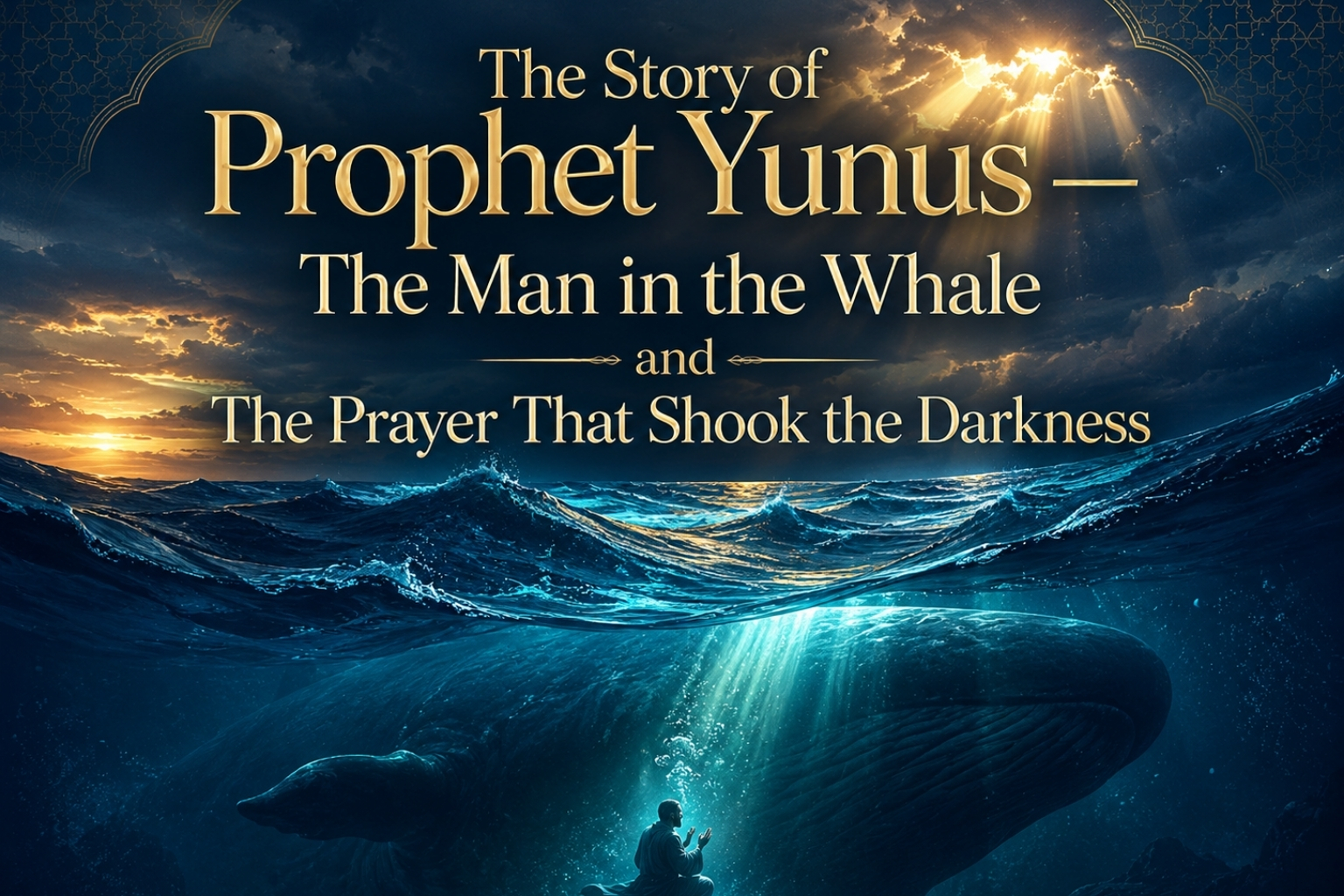
Not dark in the way of a cloudy night. Dark in the way of the belly of a whale, beneath the surface of the sea, in the depths where no light reaches — three layers of darkness stacked upon each other, each one more complete than the last. The darkness of the whale’s stomach. The darkness of the ocean depths. The darkness of the night above the water.
In that place — swallowed, alone, with no human possibility of escape — Prophet Yunus, peace be upon him, made a prayer that Allah preserved in His eternal Book and promised to answer for every believer who calls upon Him with it until the end of time.
It was not a long prayer. It was not an elaborate prayer. It was twenty-one words in Arabic — a declaration of Allah’s absolute perfection, a confession of personal fault, and an implied plea for mercy — and it split the darkness like a sword.
Yunus’s story is the story of a prophet who left his mission before Allah gave him permission to leave, who found himself in the consequence of that departure, who called out from the most impossible place imaginable — and who was not only rescued but returned to his mission, given a second chance, and watched the city he had abandoned become the largest successful prophetic call in human history.
It is the story of what happens when a servant of Allah stumbles in a way that is uniquely their own — not the stumble of wickedness, but the stumble of impatience — and what Allah does with the sincere return of a heart that has never stopped belonging to Him.
Chapter One — Nineveh: The City That Needed a Prophet
Yunus, peace be upon him, was sent to the people of Nineveh — a great city in what is today northern Iraq, near the modern city of Mosul. Nineveh was not a small settlement. It was one of the most significant urban centers of the ancient Near East — a city of power, of population, and of deep spiritual corruption.
Allah sent Yunus to call them back from their wrongdoing, to warn them of what awaited them if they continued, and to invite them to the worship of Allah alone.
Yunus called. He warned. He delivered the message with the patience that the mission required — for a time.
And then something happened that the Quran captures with a brevity that makes it all the more striking:
Quran Verse:
وَذَا النُّونِ إِذ ذَّهَبَ مُغَاضِبًا فَظَنَّ أَن لَّن نَّقْدِرَ عَلَيْهِ
“And remember the man of the whale — when he went away in anger, and thought that We would not decree against him.”
Surah Al-Anbiya (21:87)
“He went away in anger.” — Yunus left his mission without Allah’s permission. He departed from Nineveh — whether from frustration at the slow response of his people, from exhaustion, from a human moment of feeling that he had done enough and that the people were hopeless — the Quran does not specify the exact internal state beyond this: he was angry. And he left.
“And thought that We would not decree against him” — This phrase is the most theologically significant part of the verse. Yunus did not leave in conscious defiance of Allah. He left in a state of mind in which he perhaps did not fully reckon with the fact that a prophet cannot simply choose to leave a mission Allah has assigned to him. He underestimated — not Allah’s power, but Allah’s will to hold him accountable even in this.
This is one of the Quran’s most honest portraits of a prophet — not as a superhuman figure immune to human error, but as a person who, in a moment of genuine struggle, made a decision that was not his to make.
Chapter Two — The Ship, The Lot, and The Sea
Yunus boarded a ship heading away from Nineveh. The ship became overladen and in danger of sinking in a storm. The sailors, following the practice of their time, cast lots to determine who among the passengers would be thrown into the sea to lighten the load.
The lot fell to Yunus. Three times, by some accounts — and each time it fell to him:
Quran Verse:
فَسَاهَمَ فَكَانَ مِنَ الْمُدْحَضِينَ
“And he drew lots and was among the losers.”
Surah As-Saffat (37:141)
Yunus was thrown into the sea. And then came what no human being has ever experienced before or since:
Quran Verse:
فَالْتَقَمَهُ الْحُوتُ وَهُوَ مُلِيمٌ
“And the whale swallowed him while he was blameworthy.”
Surah As-Saffat (37:142)
The whale swallowed him. And the Quran adds — with a precision that is both honest and compassionate — “while he was blameworthy.” Not a condemned man. Not a wicked man. A blameworthy one — someone who had made an error, who was in the consequence of his own departure without permission, who was being held accountable in the most vivid way possible for the decision to leave before Allah had released him.
Chapter Three — Three Darknesses: The Place Where the Prayer Was Made
Yunus was alive inside the whale. The Quran describes his location with a layered description that captures both the physical reality and the spiritual weight of his situation:
Quran Verse:
فَنَادَىٰ فِي الظُّلُمَاتِ أَن لَّا إِلَٰهَ إِلَّا أَنتَ سُبْحَانَكَ إِنِّي كُنتُ مِنَ الظَّالِمِينَ
“And he called out within the darknesses: ‘There is no deity except You; exalted are You. Indeed, I have been of the wrongdoers.'”
Surah Al-Anbiya (21:87)
الظُّلُمَاتِ — the darknesses. Plural. Scholars describe three layers: the darkness inside the whale’s stomach, the darkness of the ocean depths, and the darkness of the night above the water. Three complete, stacked, unbroken darknesses.
In that place, Yunus made his prayer.
Read it again slowly:
لَا إِلَٰهَ إِلَّا أَنتَ — There is no deity except You. This is tawhid — the declaration of Allah’s absolute oneness. Even in the belly of a whale, even in three darknesses, even with no human possibility of escape — the first thing Yunus said was: You alone are God.
سُبْحَانَكَ — Exalted are You. A declaration of Allah’s absolute perfection, His transcendence above any fault or deficiency. Even in the moment of his own greatest fault — Yunus declared the perfection of Allah.
إِنِّي كُنتُ مِنَ الظَّالِمِينَ — Indeed, I have been of the wrongdoers. Complete, unambiguous ownership of the error. No justification. No explanation of why he left Nineveh. No argument about whether the people deserved his patience. Simply: I was wrong. I wronged myself.
Twenty-one words. Tawhid, then glorification, then confession. And it was enough — more than enough — to split three darknesses and bring him back to light.
Chapter Four — The Response of Allah: Immediate, Complete, Merciful
Allah’s response to Yunus’s prayer is one of the most immediate divine responses recorded in the Quran:
Quran Verse:
فَاسْتَجَبْنَا لَهُ وَنَجَّيْنَاهُ مِنَ الْغَمِّ ۚ وَكَذَٰلِكَ نُنجِي الْمُؤْمِنِينَ
“So we responded to him and saved him from the distress. And thus do We save the believers.”
Surah Al-Anbiya (21:88)
“We responded to him.” — Immediately. Completely. The prayer was made — and Allah answered.
“And thus do We save the believers.” — This is the verse that transforms Yunus’s individual experience into a universal promise. Allah is not saying: We saved Yunus because he was a prophet. He is saying: this is how We save the believers — all of them. This is the pattern. This is the promise.
When a believer calls upon Allah from their own “belly of the whale” — from their own place of darkness, their own consequence, their own mistake — with the same three elements Yunus used: declaration of Allah’s oneness, declaration of Allah’s perfection, and honest confession of fault — Allah responds. Not because the believer is a prophet. Because Allah has promised to respond to the believers.
The Prophet Muhammad ﷺ confirmed this explicitly:
Hadith:
دَعْوَةُ ذِي النُّونِ إِذْ دَعَا وَهُوَ فِي بَطْنِ الْحُوتِ: لَا إِلَهَ إِلَّا أَنْتَ سُبْحَانَكَ إِنِّي كُنْتُ مِنَ الظَّالِمِينَ، فَإِنَّهُ لَمْ يَدْعُ بِهَا رَجُلٌ مُسْلِمٌ فِي شَيْءٍ قَطُّ إِلَّا اسْتَجَابَ اللَّهُ لَهُ
“The supplication of Dhul-Nun — when he called while in the belly of the whale: ‘There is no deity except You; exalted are You. Indeed, I have been of the wrongdoers’ — no Muslim man ever supplicates with it regarding any matter except that Allah responds to him.”
Recorded in Sunan At-Tirmidhi, Hadith No. 3505, authenticated by Al-Albani
No Muslim — ever — in any matter — who calls upon Allah with this prayer — except that Allah responds.
The Prophet Muhammad ﷺ did not say sometimes. He did not say usually. He said: no Muslim who calls with this prayer in any matter — except that Allah responds.
This is Yunus’s gift to every believer who comes after him. A prayer tested in the darkest possible place — and proven effective for everything.
Chapter Five — The Shore: What Allah Does After the Rescue
The whale brought Yunus to shore — cast him out onto open land. And the Quran describes the state in which he emerged:
Quran Verse:
فَنَبَذْنَاهُ بِالْعَرَاءِ وَهُوَ سَقِيمٌ
“Then We threw him onto the open shore while he was ill.”
Surah As-Saffat (37:145)
He was ill. Weak. The experience of being inside the whale — the physical reality of it — had left him in a state of vulnerability that no strength of will could immediately overcome. He was on an open shore, exposed, sick, and unable to care for himself.
And Allah cared for him:
Quran Verse:
وَأَنبَتْنَا عَلَيْهِ شَجَرَةً مِّن يَقْطِينٍ
“And We caused to grow over him a gourd plant.”
Surah As-Saffat (37:146)
A gourd plant. Allah grew a plant over Yunus — providing him shade from the sun, shelter from the elements, and in the understanding of many scholars, nourishment as well. A single plant, grown specifically for a single recovering prophet on an open shore.
This detail — the gourd plant — is one of the most intimate acts of divine care in the entire Quran. The One who commands wind and sea and whale also grows a plant over a sick servant who needs shade. The scale of Allah’s mercy does not prevent its precision. He is as attentive to the need for a shade plant as He is to the parting of seas.
Allah was caring for Yunus not just rescuing him — tending to his recovery with the detailed, personal mercy of a Lord who does not consider any need of His servant too small to attend to.
Chapter Six — The Return to the Mission: A Second Chance
After Yunus recovered, Allah sent him again — back to his mission:
Quran Verse:
فَلَوْلَا أَنَّهُ كَانَ مِنَ الْمُسَبِّحِينَ ﴿١٤٣﴾ لَلَبِثَ فِي بَطْنِهِ إِلَىٰ يَوْمِ يُبْعَثُونَ
“And had he not been of those who exalt Allah, he would have remained inside it until the Day they are resurrected.”
Surah As-Saffat (37:143–144)
This verse is extraordinary in its honesty. Allah tells us directly: if Yunus had not been among those who exalt Allah — if his life had not been one of consistent glorification and worship — he would have remained in the whale until the Day of Resurrection.
The prayer in the darkness was effective not because it was spoken in the darkness. It was effective because it was the expression of a life already oriented toward Allah. The words لَا إِلَٰهَ إِلَّا أَنتَ سُبْحَانَكَ were not emergency words that Yunus learned in the whale — they were the words his heart had always spoken, now finding their most desperate expression.
This is one of the Quran’s most important teachings about the relationship between regular worship and crisis prayer: the du’a you make in your darkest moment draws on the reservoir of worship you have built in your ordinary moments. The person who glorifies Allah consistently has something to call upon when the darkness closes in. The person who has built no reservoir of worship has no depth to draw from when they need it most.
Then Allah sent Yunus to a city of a hundred thousand people or more — understood by scholars to be Nineveh, the city he had left:
Quran Verse:
وَأَرْسَلْنَاهُ إِلَىٰ مِائَةِ أَلْفٍ أَوْ يَزِيدُونَ ﴿١٤٧﴾ فَآمَنُوا فَمَتَّعْنَاهُمْ إِلَىٰ حِينٍ
“And We sent him to a hundred thousand or more. And they believed, so we gave them enjoyment for a time.”
Surah As-Saffat (37:147–148)
“And they believed.” — The city that Yunus had left in frustration, the people whose response had seemed hopeless, the nation whose rejection had contributed to Yunus’s departure — believed. The entire city. A hundred thousand people or more.
It became the only city in prophetic history to believe collectively, before the punishment arrived, and to be spared because of that belief:
Quran Verse:
فَلَوْلَا كَانَتْ قَرْيَةٌ آمَنَتْ فَنَفَعَهَا إِيمَانُهَا إِلَّا قَوْمَ يُونُسَ لَمَّا آمَنُوا كَشَفْنَا عَنْهُمْ عَذَابَ الْخِزْيِ فِي الْحَيَاةِ الدُّنْيَا وَمَتَّعْنَاهُمْ إِلَىٰ حِينٍ
“Then has there not been a city that believed and its faith benefited it, except the people of Yunus? When they believed, We removed from them the punishment of disgrace in worldly life and gave them enjoyment for a time.”
Surah Yunus (10:98)
The people of Yunus — the only city in history to believe before the punishment fell and to have that belief accepted and the punishment lifted. The largest successful da’wah in prophetic history. A hundred thousand souls or more, turning to Allah together.
And it happened after Yunus returned. After the whale. After the prayer in the darkness. After the gourd plant on the shore.
The city that looked hopeless when Yunus left became the greatest success of his mission. What he could not see from inside his frustration — Allah could see from inside His infinite knowledge of what was coming.
Chapter Seven — The Warning Against Impatience: A Direct Address to the Prophet Muhammad ﷺ
The story of Yunus occupies a unique position in the Quran — it is not only narrated as history. It is used by Allah as a direct, personal counsel to the Prophet Muhammad ﷺ in moments of his own distress:
Quran Verse:
فَاصْبِرْ لِحُكْمِ رَبِّكَ وَلَا تَكُن كَصَاحِبِ الْحُوتِ إِذْ نَادَىٰ وَهُوَ مَكْظُومٌ
“Then be patient for the decision of your Lord and be not like the companion of the whale, when he called out while he was distressed.”
Surah Al-Qalam (68:48)
Allah told Muhammad ﷺ directly: be patient — do not be like the companion of the whale. This verse was revealed during one of the most difficult periods of the Prophet Muhammad’s ﷺ mission — when rejection was heavy, when the people of Makkah seemed completely closed, when the results of years of calling were, by worldly measure, minimal.
Allah used Yunus as a reference point — not to criticize Yunus, but to remind Muhammad ﷺ of what happens when a prophet acts on impatience before Allah has released him from his station.
And then Allah affirmed that He had not abandoned Muhammad ﷺ:
Quran Verse:
لَوْلَا أَن تَدَارَكَهُ نِعْمَةٌ مِّن رَّبِّهِ لَنُبِذَ بِالْعَرَاءِ وَهُوَ مَذْمُومٌ ﴿٤٩﴾ فَاجْتَبَاهُ رَبُّهُ فَجَعَلَهُ مِنَ الصَّالِحِينَ
“If not that a favor from his Lord overtook him, he would have been thrown onto the open shore while he was blamed. But his Lord chose him and made him of the righteous.”
Surah Al-Qalam (68:49–50)
Allah chose Yunus. Even after the whale. Even after the error of departure. Even after the three darknesses. Allah chose him — and made him righteous. The error did not define him. The return defined him.
Hadith:
لَا يَنْبَغِي لِأَحَدٍ أَنْ يَقُولَ: أَنَا خَيْرٌ مِنْ يُونُسَ بْنِ مَتَّى
“It is not appropriate for anyone to say: I am better than Yunus ibn Matta.”
Recorded in Sahih Al-Bukhari, Hadith No. 3416
The Prophet Muhammad ﷺ — the best of all creation, the seal of all prophets — said it is not appropriate for anyone to claim superiority over Yunus. This hadith is a permanent protection of Yunus’s honor and station. Whatever his error, whatever the whale, whatever the impatience — Yunus remains among the chosen of Allah, honored by the final prophet’s own words, until the end of time.
Timeless Lessons from the Story of Yunus
- Even prophets can act on impatience — the return is what matters Yunus left without permission. He was blameworthy. He was swallowed by a whale as a consequence. And Allah chose him, saved him, and made him righteous. The error of impatience does not disqualify a sincere servant. The return — immediate, complete, honest — is what defines them.
- The prayer of the darkness is the most powerful prayer ever made. Twenty-one words. Three darknesses. Immediate divine response. “No Muslim calls upon Allah with this prayer in any matter except that Allah responds.” Memorize it. Use it. It was proven in the most impossible place imaginable — which means it works in whatever place you are in.
- The consistency of your regular worship determines what you can call on in crisis. Yunus was saved partly because he was already among those who glorify Allah regularly. The prayer in the darkness drew on the reservoir of a worshipping life. Build that reservoir now — in ordinary times, in easy moments, in the daily glorification that seems small but is in fact the very thing that will sustain you when the darkness comes.
- Allah’s mercy includes practical care — the gourd plant is as divine as the whale Allah grew a plant to shade a sick prophet on an open shore. He did not only rescue dramatically — He tended quietly. His mercy attends to every level of your need, from the miraculous to the mundane. The shade plant was as much a gift from Allah as the rescue from the whale.
- The city that looks hopeless may be the one closest to turning Yunus left Nineveh in frustration — and Nineveh became the largest successful da’wah in prophetic history. What looks like impossible resistance from inside the difficulty may, from Allah’s perspective, be a city on the verge of turning. Do not read the ending from the middle of the story.
- Impatience with the mission can separate you from the breakthrough you were about to witness Yunus left before the breakthrough. He missed — in that departure — the moment of Nineveh’s faith. He returned and continued, and the mission succeeded. How many breakthroughs have been missed by people who left — from a relationship, from a call, from a commitment — one step before the turn?
- Allah chooses you even after your worst moment — if you return sincerely “His Lord chose him and made him of the righteous” — after the whale, after the error, after the darkness. The choosing came after the fall and the return, not before it. Allah’s choice of a servant is not revoked by their error. It is confirmed by their return.
Closing Reflection
A prophet left his mission in anger. A ship’s lot fell on him. A whale swallowed him. Three darknesses closed around him — complete, absolute, with no human possibility of escape.
And in that place — the place where no human being has ever been and survived — he made a prayer. Not a long prayer. Not an elaborate supplication. Twenty-one words that distilled everything that matters into the smallest possible space:
You alone are God. You are perfect. I was wrong.
And the darkness broke. The whale obeyed. The shore received him. A plant grew over him. He recovered. He returned. A hundred thousand people believed.
And Allah — in His Book, in the words of His final prophet, across fourteen centuries of Islamic tradition — honored Yunus with a protection that no human criticism can penetrate: it is not appropriate for anyone to say they are better than Yunus ibn Matta.
The man who was swallowed by a whale is protected by the words of the Prophet ﷺ. The prayer he made in the darkness is promised to every Muslim who calls with it in any matter. The city he left in frustration became the greatest success of his mission.
Allah does not waste the journeys of His servants — not even the detours through the belly of a whale.
Quran Verse:
فَاسْتَجَبْنَا لَهُ وَنَجَّيْنَاهُ مِنَ الْغَمِّ ۚ وَكَذَٰلِكَ نُنجِي الْمُؤْمِنِينَ
“So we responded to him and saved him from the distress. And thus do We save the believers.”
Surah Al-Anbiya (21:88)
And thus do We save the believers.
You. In your darkness. In your consequence. In your three-layered impossibility.
Say the words. Mean them. Allah is listening in the depths.