

We live in a culture that treats aging as a disease and mortality as a design flaw. We spend vast amounts of time, energy, and money trying to preserve our youth, polish our social standing, and accumulate assets—all to construct a psychological fortress that blocks out a single, inescapable reality: our time here is finite.
This deep societal denial of death doesn’t actually give us peace. Instead, it creates a constant, low-grade ambient panic. We obsess over the passage of time, stress over our legacy, and experience intense burnout trying to achieve everything right now. This underlying fear of the clock running out is one of the single greatest drivers of modern existential crisis and overthinking in Islam.
When we approach the Holy Quran with the spirit of Tadabbur (deep Quranic reflection), we discover that Islam treats mortality with absolute, refreshing honesty. The final revelation does not shield us from the reality of our end; instead, it uses it as the ultimate diagnostic tool to dismantle anxiety, restore our peace of mind, and teach us how to truly live.
The Universal Equalizer: Surah Ali ‘Imran, Verse 185
The absolute certainty of death is punctuated throughout the Quran, but its most iconic, behavior-altering framing occurs in the heart of Surah Ali ‘Imran:
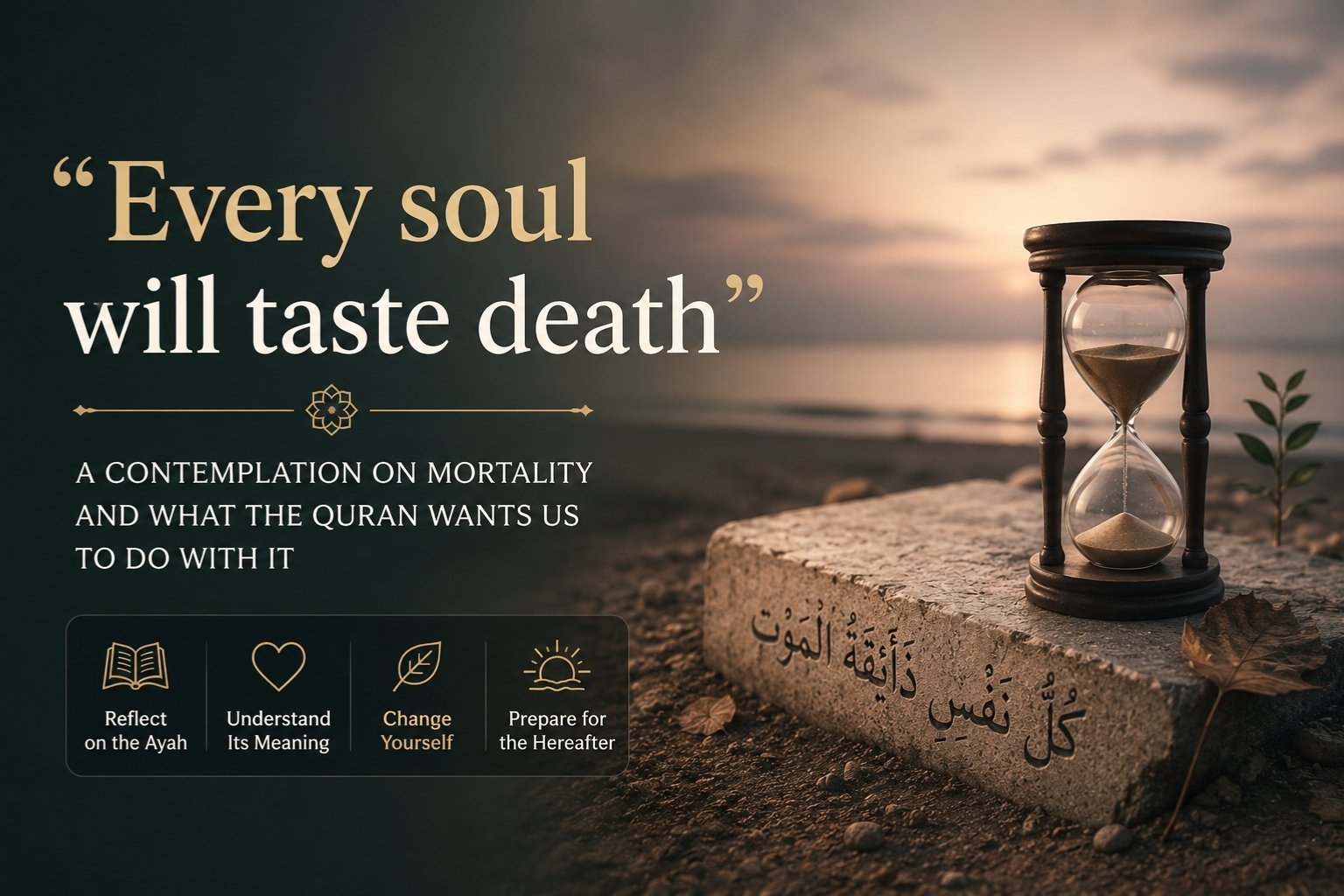
“كُلُّ نَفْسٍ ذَائِقَةُ الْمَوْتِ ۗ وَإِنَّمَا تُوَفَّوْنَ أُجُورَكُمْ يَوْمَ الْقِيَامَةِ ۖ فَمَن زُحْزِحَ عَنِ النَّارِ وَأُدْخِلَ الْجَنَّةَ فَقَدْ فَازَ ۗ وَمَا الْحَيَاةُ الدُّنْيَا إِلَّا مَتَاعُ الْغُرُورِ”
“Every soul will taste death, and you will only be given your [full] compensation on the Day of Resurrection. So he who is drawn away from the Fire and admitted to Paradise has attained [his desire]. And what is the worldly life except the enjoyment of delusion.” — Surah Ali ‘Imran, 3:185
THE QURANIC SHIFT IN FOCUS |
The Delusion (Dunya): Accumulating temporary vanity, chasing permanent comfort in a temporary world, feeding anxiety. The Reality (Aakhirah): Recognizing mortality, investing in permanent deeds, finding deep internal tranquility. |
Notice the exquisite linguistic choices made by Allah here. The verse states that every single soul will taste (Dhā’iqah) death. Tasting implies an experience that occurs in a transient moment—it is a gateway, a brief transition, not a final destination or an absolute end into nothingness.
The verse then concludes by calling the glittering distractions of this life Matā‘ al-Ghurūr—the “enjoyment of delusion.” It is a psychological wakeup call. Allah isn’t telling us this to make us morbid or depressed. He is giving us the ultimate tool of clarity: when you realize that everything around you has a built-in expiration date, you stop letting temporary things cause you permanent anxiety.
Mortality as the Ultimate Remedy for Modern Anxiety
A massive amount of chronic worry stems from a distorted sense of proportion. We treat a minor career setback, a bad social interaction, or a missed financial milestone like it is a catastrophic, life-ending event. We carry the crushing weight of trying to build a perfect, permanent paradise out of an environment that was explicitly designed to be temporary and flawed.
In Islamic psychology, the conscious remembrance of death—known as Thikr al-Mawt—acts as an incredible, rapid cognitive reset. It shatters the illusion of permanence that our egos try to construct.
When you look at your anxieties through the lens of your own mortality, your problems instantly shrink down to their true size. You realize that the corporate validation you are losing sleep over, the trivial arguments you are stressing about, and the material milestones you are burning yourself out to hit will mean absolutely nothing when you are resting beneath the soil. This realization instantly unburdens the soul. How to trust Allah begins when you stop expecting Dunya to be your ultimate destination and start viewing it simply as a brief transit lounge.
The Prophetic Formula: The Wisest Among You
The companions of the Prophet Muhammad did not view the reminder of death as a dark cloud that ruined their joy. Rather, it was their primary source of focus, urgency, and internal strength. It was the fuel that allowed them to change the world without letting the world corrupt their hearts.
A companion once asked the Messenger of Allah: “Who is the wisest and most intelligent among the believers?” The Prophet replied with a profound psychological insight:
“أَكْثَرُهُمْ ذِكْرًا لِلْمَوْتِ، وَأَحْسَنُهُمْ لَهُ اسْتِعْدَادًا، أُولَئِكَ الأَكْيَاسُ”
“Those who remember death the most, and who are the best prepared for it. It is they who are the truly wise.” — Sunan Ibn Majah
To the modern mind, constantly thinking about death sounds like the definition of clinical anxiety. But the Prophet defines it as the pinnacle of intelligence. Why? Because the person who remembers their mortality lives with absolute intentionality. They do not waste hours scrolling mindlessly, they do not hold onto toxic grudges, and they do not succumb to despair when life gets hard. They realize their days are numbered, so they actively channel their energy into things that will matter eternally—their character, their relationship with their Creator, and their service to humanity.
Practical Mindset Calibration for Everyday Life
- Apply the “One-Hundred Year Filter”: The next time you find yourself stuck in a heavy, paralyzing loop of overthinking an interpersonal conflict, a financial worry, or a blow to your reputation, pause. Ask yourself: “Will this specific issue matter to me one hundred years from now when I am in Barzakh?” If the answer is no, give yourself permission to drop the anxiety and hand the situation entirely over to trusting Allah’s plan.
- Transition from Accumulation to Contribution: Shift your baseline daily objective away from “How much more can I gather today?” to “What permanent value can I leave behind today?” Intentionally plant small, quiet seeds of ongoing charity (Sadaqah Jariyah)—smile at a stranger, help someone in need, share beneficial knowledge, or make a sincere prayer for an absent friend. Ensure that your daily schedule includes investments that survive your heartbeat.
- Practice the Evening Death Audit: As you lie down to sleep each night, consciously internalize that sleep is the minor death (al-Mawt al-Asghar). Reflect on the fact that your soul leaves your body during sleep and may not return. Reconcile with Allah by making a sincere, raw Tawbah (repentance), forgive anyone who has wronged you to free your own chest from toxic baggage, and let your final conscious thought be the declaration of faith (Shahadah).
Conclusion
The spectacular, unyielding truth of Surah Ali ‘Imran (3:185) is not a dark warning meant to paralyze your ambitions or fill your days with dread. It is an intensely liberating gift of perspective from Allah. It breaks the hypnotic, exhausting spell of a world that demands you sacrifice your mental health for temporary illusions. You do not have to carry the brutal, impossible weight of trying to make this passing world perfect. You are a traveler passing through a brief destination. When you accept your mortality, simplify your priorities, and anchor your daily actions in trusting Allah’s plan, the heavy chains of existential panic completely dissolve—leaving your mind beautifully wrapped in an unshakeable state of deep emotional freedom, profound clarity, and everlasting spiritual success.