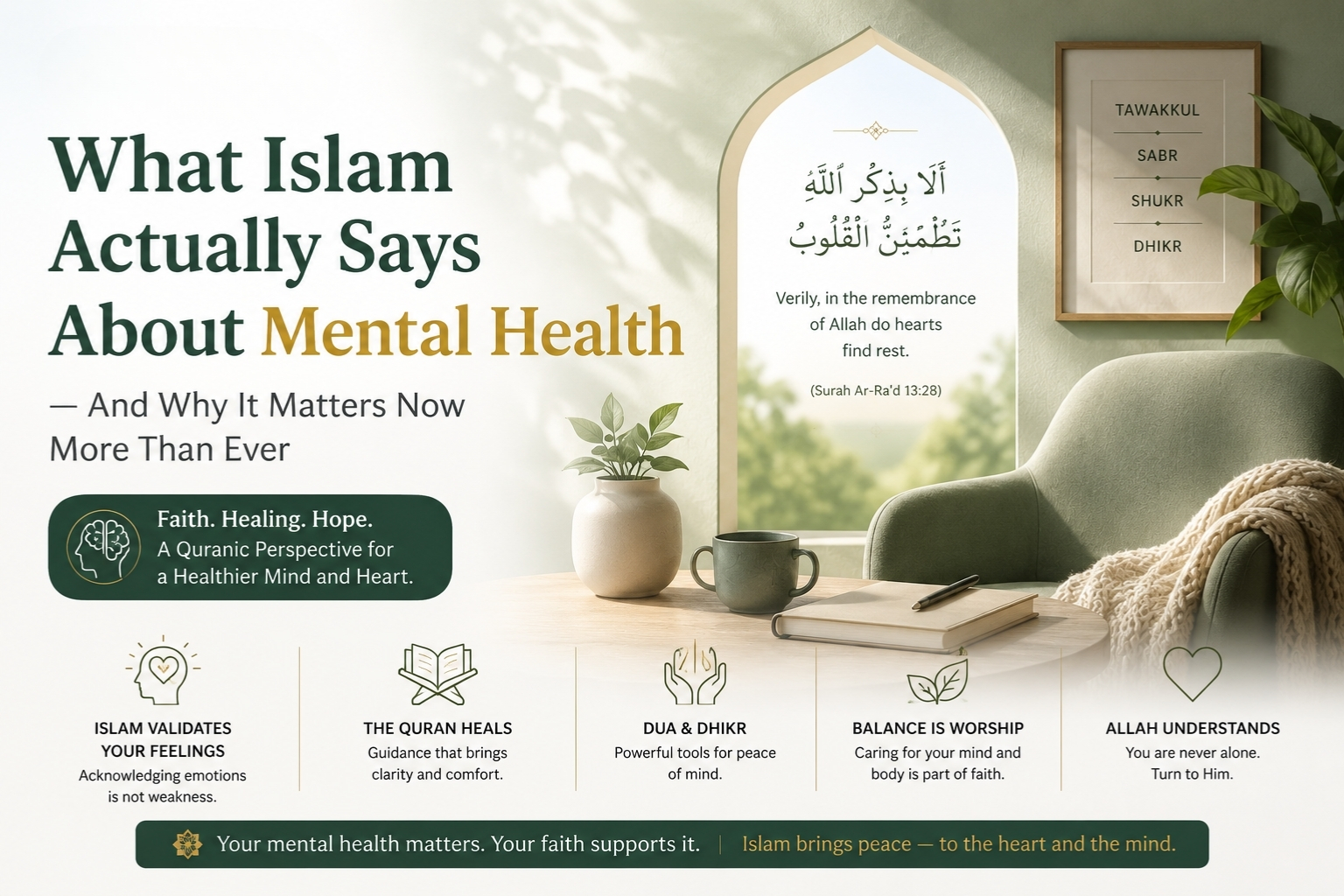
What Islam Actually Says About Mental Health — And Why It Matters Now More Than Ever

Share : 

Table of Contents

We live in an age of hyper-connectivity and deep isolation. Despite living in the most technologically optimized era in human history, global rates of clinical depression, panic disorders, and chronic burnout have reached unprecedented heights. For many believers, navigating this modern landscape has triggered a secondary crisis: a quiet, exhausting struggle with overthinking in Islam.

When a practicing Muslim experiences a persistent dark cloud of sadness or a sudden panic attack, an internal conflict often begins. They are frequently met with outdated cultural narratives telling them that psychological suffering is simply a “punishment for sins,” a “curse,” or a definitive sign of “weak faith (Iman).”

This toxic mischaracterization turns clinical conditions into spiritual failures, trapping vulnerable minds in an agonizing loop of religious guilt and hyper-vigilance.

However, when we rescue our understanding from cultural biases and approach the final revelation through Tadabbur (deep Quranic reflection), we discover a paradigm that is profoundly validating, deeply medical, and centuries ahead of its time.

By looking directly at the text, the prophetic traditions, and the historical legacy of Islamic sciences, we find a beautifully balanced approach to Islamic psychology—one that integrates clinical science with spiritual mindfulness, offering an unmatched framework for healing anxiety with the Quran and reclaiming your ultimate peace of mind.

The Quranic Validation of Psychological Pain

The first step in dismantling the stigma surrounding mental health is recognizing that the Quran explicitly validates human emotional suffering. It never shames a believer for feeling sadness, grief, or fear.

Consider Surah Yusuf, where the Quran documents the intense psychological trauma experienced by Prophet Yaqub (Jacob) after losing his beloved son:

“وَتَوَلَّىٰ عَنْهُمْ وَقَالَ يَا أَسَفَىٰ عَلَىٰ يُوسُفَ وَابْيَضَّتْ عَيْنَاهُ مِنَ الْحُزْنِ فَهُوَ كَظِيمٌ”

“And he turned away from them and said, ‘Oh, my sorrow over Joseph,’ and his eyes became white from grief, for he was [a man] suppressing [a bitter sorrow].” — Surah Yusuf, 12:84


THE QURANIC VALIDATION OF HUMAN EMOTION

THE CRITIQUE: 

Cultural myths claim true prophets/believers never experience deep, debilitating sadness or grief.

THE REALITY:  

Prophet Yaqub grieved so intensely that it caused a physical manifestation—psychosomatic blindness.    

THE DIVINE VERDICT:

Allah immortalized his sorrow in the Quran without a single word of spiritual condemnation or shame


Yaqub was a grand Prophet of God, possessing an elite level of faith. Yet, his grief was so profound that it manifested physically, causing him to lose his eyesight. Allah did not reprimand him for having weak faith. Instead, He validated his tears, immortalized his pain in the final scripture, and ultimately restored his sight and his son.

The Quran openly shows us that psychological pain is not a spiritual defect; it is a fundamental part of the vulnerable human design (Inṣān).

Dual Causation: The Prophetic Medical Mandate

The foundational error of modern religious stigma is treating the human being as a single-dimensional spiritual entity. Islam, however, looks at human anatomy through a sophisticated lens of dual causation: we are composed of both a physical body (Jasad) and a divine soul (Rūḥ).

Consequently, a breakdown in human well-being can stem from biological, environmental, or spiritual roots—and often a combination of all three.

The Prophet Muhammad established a radical, absolute medical mandate that completely separates clinical treatment from spiritual shaming:

“تَدَاوَوْا فَإِنَّ اللَّهَ عَزَّ وَجَلَّ لَمْ يَضَعْ دَاءً إِلاَّ وَضَعَ لَهُ دَوَاءً”

“Make use of medical treatment, for Allah has not created a disease without appointing a remedy for it.” — Sunan Abi Dawud, 3855

When you experience clinical anxiety, clinical depression, or chemical imbalances in the brain, seeking professional therapy, counseling, or psychiatric medication is not a betrayal of your spiritual devotion. It is an act of direct obedience to the Prophetic command.

True trusting Allah’s plan (Tawakkul) does not mean refusing worldly assistance; it means utilizing the scientific means Allah created while trusting Him for the ultimate cure.

The Legacy of Islamic Psychotherapy (‘Ilm al-Nafs)

To understand why mental health matters now more than ever, we must look at how early Muslim scholars put this theology into practice during the Islamic Golden Age. While medieval Europe was still chaining mentally ill individuals in dungeons under the assumption that they were possessed by demons, classical Muslim physicians were building the world’s first psychiatric wards


PIONEERS OF CLASSICAL ISLAMIC PSYCHOLOGY    

ABU ZAYD AL-BALKHI
(9th Century) 

Authored “Sustenance of the Soul” (9th Century). First to distinguish between endogenous psychosis
and reactive, environmental anxiety/depression. Pioneered Cognitive Behavioral Therapy (CBT). 

ISLAMIC BISTANIS
(Hospitals) 

Provided free, universal psychiatric care. Utilized somatic medication, music therapy, light exposure, baths, and cognitive talk therapy. 

.

PIONEERS OF CLASSICAL ISLAMIC PSYCHOLOGY                

ABU ZAYD AL-BALKHI  | Authored “Sustenance of the Soul” (9th Century). 

(9th Century)First to distinguish between endogenous psychosis 

and reactive, environmental anxiety/depression.  

Pioneered Cognitive Behavioral Therapy (CBT).   


|  ISLAMIC BISTANIS    | Provided free, universal psychiatric care.(Hospitals) Utilized somatic medication, music therapy, light 

exposure, baths, and cognitive talk therapy.    


In his brilliant 9th-century manuscript, Masalih al-Abdan wal-Anfus (Sustenance of the Soul), Abu Zayd al-Balkhi wrote extensively about mental health. He argued that just as a person keeps physical medicine nearby for sudden bodily ailments, a human being must also keep psychological cognitive scripts ready to counter sudden attacks of anxiety, anger, and deep depression.

He pioneered early forms of Cognitive Behavioral Therapy (CBT), instructing patients to use rational self-talk to defeat irrational thoughts. This rich history proves that mental health care is deeply embedded in the DNA of Islamic intellectual tradition.

Practical Pillars for Integrating Faith and Mental Health Care

  • Adopt the Dual-Track Healing Strategy: If you are struggling with your mental health, build a comprehensive, two-front strategy. Track One is clinical: schedule appointments with a culturally competent therapist, psychologist, or physician to unpack trauma, learn coping mechanisms, and balance physiology. Track Two is spiritual: implement daily Tadabbur, perform mindful prayers (Khushu), and practice the protective shield of Istighfar to soothe your spirit. Do not sacrifice one track for the other; let them work in perfect, supportive harmony.
  • Aggressively Filter Your Cognitive Input: Your mind is a sacred space under your direct stewardship (Khalifah). In an era of continuous, toxic algorithmic loops and constant bad news, your nervous system is easily overloaded. Practice radical digital hygiene. Limit your consumption of stressful content and replace it with the grounding, rhythmic sounds of the Quran and nature. Give your brain the quiet space it desperately needs to heal.
  • Interrupt Spiritual Self-Sabotage: The moment shaitan tries to weaponize your psychological low points by telling you, “You are too broken, too anxious, or too sinful to pray,” recognize the deception. Reframe your relationship with your Creator. How to trust Allah means knowing that He does not demand a flawless, perfectly calm mind before you approach Him. He welcomes you exactly as you are—bleeding, anxious, or weary. Your prayer is not a victory lap for the flawless; it is an emergency hospital for the broken.

Conclusion

The spectacular, deeply compassionate framework of authentic Islam stands as an unyielding sanctuary for the modern mind breaking under the weight of existential stress. Islam does not demand that you wear a mask of constant emotional perfection, nor does it dismiss your deep psychological struggles as mere spiritual failures. It looks at your humanity with immense mercy, acknowledging your pain, validating your tears, and commanding you to seek both medical and spiritual healing. You do not have to carry the heavy, crushing weights of your anxieties entirely on your own fragile shoulders. You belong to a Lord who created your mind, understands your intricate nervous system, and invites you to rest securely within His protective boundaries. When you combine modern clinical wisdom with the timeless, restorative power of trusting Allah’s plan, the suffocating shadows of mental exhaustion completely evaporate—leaving your mind beautifully wrapped in an unshakeable state of profound safety, enduring tranquility, and everlasting spiritual success.

Leave a Reply

Your email address will not be published. Required fields are marked *