
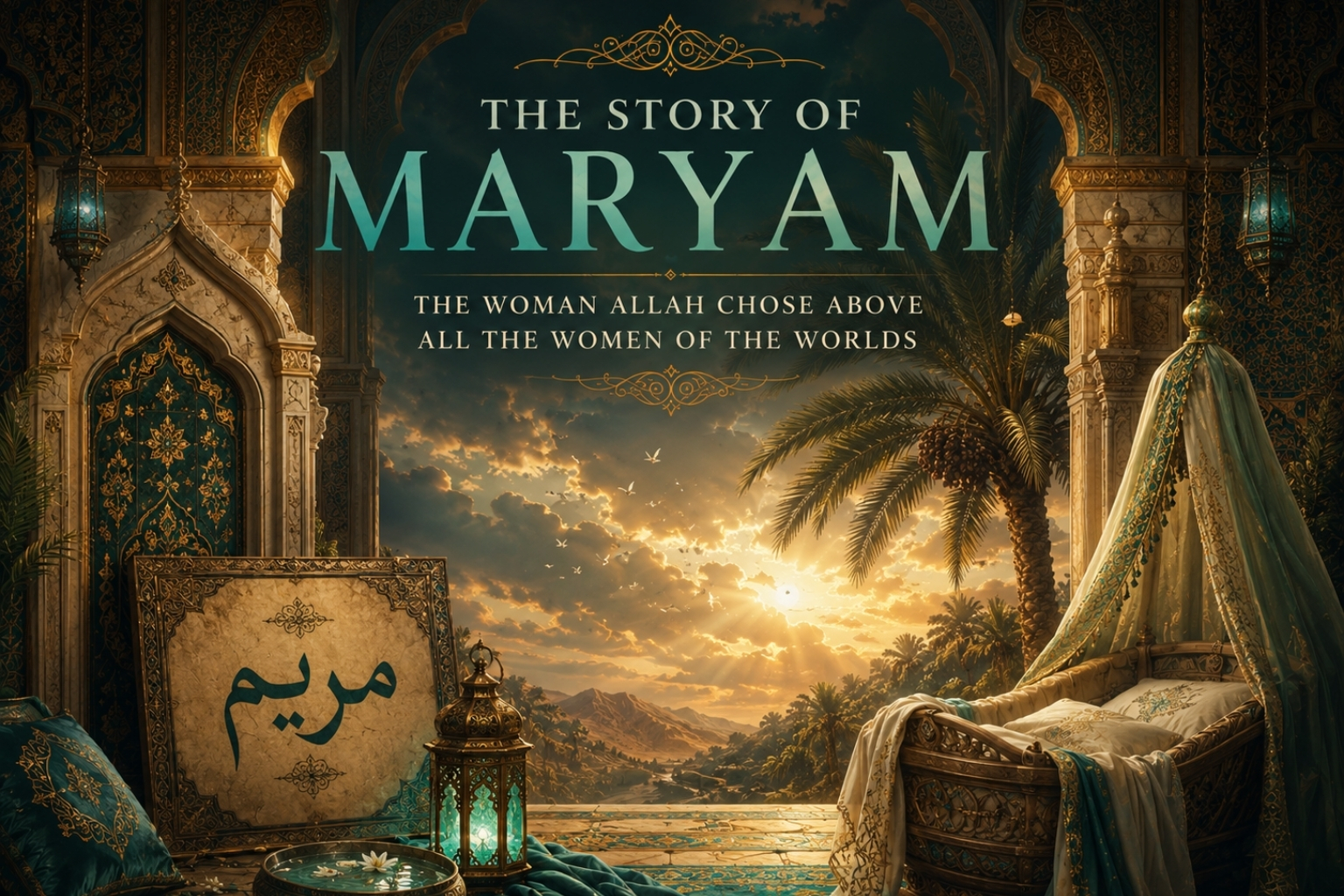

In the entire Quran — one hundred and fourteen chapters, six thousand two hundred and thirty-six verses — only one woman is mentioned by name.
Not because women are absent from the Quran. They are present in its stories, its laws, its parables, its highest praise and its most serious warnings. But among all the women who walk through its pages — the wives of prophets, the mothers of nations, the queens and the servants, the believers and the disbelievers — only one is honored with a name.
Maryam, peace be upon her.
And she was not simply named. She was given an entire chapter bearing her name — Surah Maryam, the nineteenth chapter of the Quran. She was declared by Allah Himself to be chosen above the women of all the worlds. She was defended by Allah against the most serious accusation a woman can face. She was given the most extraordinary experience ever given to a human mother — a pregnancy without a father, a birth without a husband, a child who spoke from his cradle to defend her honor.
Her story is not a footnote in the story of Prophet Isa, peace be upon him. It is its own complete narrative — a portrait of what complete devotion to Allah looks like when it is lived in the body of a woman who had every reason to despair and chose, in every single moment, to trust.
She is not a saint to be worshipped. She is not a goddess. She is not a minor supporting character in someone else’s story.
She is Maryam — chosen, purified, honored above all women — and her story belongs to every believer who has ever been alone with a truth the world was not ready to hear.
Chapter One — Before Maryam Was Born: A Mother’s Prayer
The story of Maryam begins before she existed — in the heart of her mother, the wife of Imran, a woman of profound faith who had longed for a child and made a promise to Allah before she knew whether her prayer would be answered or what form the answer would take:
Quran Verse:
إِذْ قَالَتِ امْرَأَتُ عِمْرَانَ رَبِّ إِنِّي نَذَرْتُ لَكَ مَا فِي بَطْنِي مُحَرَّرًا فَتَقَبَّلْ مِنِّي ۖ إِنَّكَ أَنتَ السَّمِيعُ الْعَلِيمُ
“When the wife of Imran said: ‘My Lord, indeed I have pledged to You what is in my womb, consecrated, so accept this from me. Indeed, You are the Hearing, the Knowing.'”
Surah Al-Imran (3:35)
She dedicated her unborn child to Allah’s service — to the temple, to worship, to a life of religious consecration — before the child was born, before she knew if it was a boy or a girl, before she could predict what challenges such a dedication would bring.
This is the first lesson embedded in Maryam’s story before Maryam even appears: she was dedicated to Allah by a mother who gave what she had not yet received. Who made a promise before she knew the outcome. Who trusted Allah’s acceptance before she could verify it.
When the child was born — a girl — the mother’s response reveals her humanity and her faith simultaneously:
Quran Verse:
فَلَمَّا وَضَعَتْهَا قَالَتْ رَبِّ إِنِّي وَضَعْتُهَا أُنثَىٰ وَاللَّهُ أَعْلَمُ بِمَا وَضَعَتْ وَلَيْسَ الْذَّكَرُ كَالْأُنثَىٰ ۖ وَإِنِّي سَمَّيْتُهَا مَرْيَمَ وَإِنِّي أُعِيذُهَا بِكَ وَذُرِّيَّتَهَا مِنَ الشَّيْطَانِ الرَّجِيمِ
“But when she delivered her, she said: ‘My Lord, I have delivered a female’ — and Allah was most knowing of what she delivered — ‘and the male is not like the female. And I have named her Maryam, and I seek refuge for her in You and her descendants from Shaytan, the expelled.'”
Surah Al-Imran (3:36)
“The male is not like the female.” — She was speaking of the temple service of her time, in which men served and women did not. She had promised a temple servant and received a girl — and she brought her disappointment, her confusion, and her complete reality to Allah with radical transparency.
But notice what Allah inserted into this verse — in a parenthetical that carries the weight of an entire theological correction: “And Allah was most knowing of what she delivered.” He knew. He always knew. The girl the mother feared had not fulfilled the promise was precisely the one Allah had always intended. The mother’s concern was real. Allah’s plan was greater.
She named her Maryam. And she asked Allah for one thing for her daughter that every believing parent should ask: refuge from Shaytan. Not wealth. Not beauty. Not status. Protection from the enemy who seeks to corrupt every human soul.
Allah accepted both the daughter and the prayer:
Quran Verse:
فَتَقَبَّلَهَا رَبُّهَا بِقَبُولٍ حَسَنٍ وَأَنبَتَهَا نَبَاتًا حَسَنًا وَكَفَّلَهَا زَكَرِيَّا
“So her Lord accepted her with good acceptance and caused her to grow in a good manner and placed her in the care of Zakariyya.”
Surah Al-Imran (3:37)
“Good acceptance” — Allah did not merely tolerate the dedication of a girl when a boy had been expected. He accepted her — with good acceptance, with an acceptance that was specifically, explicitly, unambiguously good. And He caused her to grow — in a good manner — meaning that her upbringing, her development, her formation as a person was itself a divine act of care.
He placed her under the guardianship of Prophet Zakariyya, peace be upon him — the elderly prophet who would himself later receive the miracle of a son in his old age, partly inspired by what he witnessed in Maryam’s chamber.
Chapter Two — The Girl in the Temple: Provision From Above
Maryam grew up in the temple — a young woman of extraordinary devotion, spending her days in worship, in prayer, in the service of Allah. And Allah responded to her devotion with a sign that would inspire her guardian to make the most impossible prayer of his prophetic life:
Quran Verse:
كُلَّمَا دَخَلَ عَلَيْهَا زَكَرِيَّا الْمِحْرَابَ وَجَدَ عِندَهَا رِزْقًا ۖ قَالَ يَا مَرْيَمُ أَنَّىٰ لَكِ هَٰذَا ۖ قَالَتْ هُوَ مِنْ عِندِ اللَّهِ ۖ إِنَّ اللَّهَ يَرْزُقُ مَن يَشَاءُ بِغَيْرِ حِسَابٍ
“Every time Zakariyya entered upon her in the prayer chamber, he found with her provision. He said: ‘O Maryam, from where is this coming to you?’ She said: ‘It is from Allah. Indeed, Allah provides for whom He wills without account.'”
Surah Al-Imran (3:37)
Out-of-season fruit. Food that appeared without earthly explanation, in a sealed chamber, for a young woman whose only occupation was worship. Zakariyya — a prophet himself, a man who understood divine signs — asked her directly: where is this from?
Her answer is one of the most theologically precise statements in the entire Quran: “It is from Allah. Indeed, Allah provides for whom He wills without account.”
She did not explain the mechanism. She did not speculate about how. She simply named the source — Allah — and then stated the principle that made the how irrelevant: Allah provides without account. Without limitation. Without being bound by the normal channels through which provision flows.
This statement — from a young woman in a prayer chamber, explaining out-of-season fruit to an elderly prophet — became the theological foundation that inspired Zakariyya to immediately turn and make his own impossible prayer. If Allah provides for Maryam without account — then what is impossible for Allah?
Nothing.
Maryam did not know, in that moment, that her simple answer to a simple question would inspire a prayer that would produce Prophet Yahya, peace be upon him. She was simply stating the truth she knew from her own experience of Allah’s provision. And that truth — spoken in a prayer chamber by a devoted young woman — rippled outward into prophetic history.
Chapter Three — Chosen Above All Women: The Highest Honor Given to Any Woman
At some point in her development — the Quran does not specify her age — Allah sent a declaration to Maryam through the angels that stands as the highest honor given to any woman in the entire Quranic record:
Quran Verse:
وَإِذْ قَالَتِ الْمَلَائِكَةُ يَا مَرْيَمُ إِنَّ اللَّهَ اصْطَفَاكِ وَطَهَّرَكِ وَاصْطَفَاكِ عَلَىٰ نِسَاءِ الْعَالَمِينَ
“And when the angels said: ‘O Maryam, indeed Allah has chosen you and purified you and chosen you above the women of the worlds.'”
Surah Al-Imran (3:42)
Three declarations in one verse — each one building on the previous:
“Chosen you” — Istafaki — Allah selected Maryam from among all people, designated her for a specific, extraordinary purpose. This was not earned through her own efforts alone — it was divine selection, Allah’s choice.
“Purified you” — Tahharaki — a purification that scholars understand as both spiritual and physical — the purity of faith, of character, of the womb that would carry the miraculous child. Allah prepared her at every level for what was coming.
“Chosen you above the women of the worlds” — Istafaki ala nisa’il ‘alamin — not above the women of her time. Not above the women of Bani Israel. Above the women of the worlds — al-‘alamin — the entirety of creation across all of time and space.
This is Allah’s testimony. Not human opinion. Not cultural assessment. Allah’s own declaration, carried by angels, preserved in His eternal Book: Maryam was chosen above every woman who has ever lived or will ever live.
The response Allah commanded of her immediately follows:
Quran Verse:
يَا مَرْيَمُ اقْنُتِي لِرَبِّكِ وَاسْجُدِي وَارْكَعِي مَعَ الرَّاكِعِينَ
“O Maryam, be devoutly obedient to your Lord and prostrate and bow with those who bow in prayer.”
Surah Al-Imran (3:43)
The response to being told you are the greatest woman in all the worlds: prostrate. Bow. Be devoutly obedient. Allah did not tell Maryam to celebrate her status, to announce her selection, to take pride in her position. He told her to worship. The highest honor is met with the deepest submission.
This is Allah’s perpetual message to those He chooses: the greater the honor, the more complete the worship required. Maryam had been selected above all women — and the appropriate response was to fall to the ground before Allah.
Chapter Four — The Angel at the Door: The Most Terrifying Announcement
Maryam had withdrawn from her family — to a place of seclusion, the eastern side, away from people — when a figure appeared before her in the form of a complete human being:
Quran Verse:
فَاتَّخَذَتْ مِن دُونِهِمْ حِجَابًا فَأَرْسَلْنَا إِلَيْهَا رُوحَنَا فَتَمَثَّلَ لَهَا بَشَرًا سَوِيًّا
“And she took, in seclusion from them, a screen. Then We sent to her Our spirit and he represented himself to her as a well-proportioned man.”
Surah Maryam (19:17)
A man. A perfectly formed man, appearing suddenly in her private space. And Maryam’s response — immediate, instinctive, revealing everything about who she was in an unguarded moment — was not to scream, not to flee, not to calculate how to escape. It was Allah:
Quran Verse:
قَالَتْ إِنِّي أَعُوذُ بِالرَّحْمَٰنِ مِنكَ إِن كُنتَ تَقِيًّا
“She said: ‘Indeed, I seek refuge in the Most Merciful from you, so leave me, if you should be fearing of Allah.'”
Surah Maryam (19:18)
“I seek refuge in the Most Merciful from you.” — Her first word in the face of fear was Allah’s name. Not a human plea for help. Not a calculation of escape routes. الرَّحْمَٰنِ — the Most Merciful — the name of Allah that emphasizes His all-encompassing mercy, His care for every created thing.
And then — with extraordinary composure — she appealed to his own conscience: “if you should be afraid of Allah“ — as if to say: if there is any taqwa in you, you will leave. She was asserting a moral boundary even in her fear. Even alone. Even with no protection visible.
This single verse is a complete lesson in the character of Maryam: her first resource in danger was Allah, her second was moral clarity, and her third was the courage to speak both even when she was afraid.
Jibreel then revealed himself — and delivered the announcement that would change her life completely:
Quran Verse:
قَالَ إِنَّمَا أَنَا رَسُولُ رَبِّكِ لِأَهَبَ لَكِ غُلَامًا زَكِيًّا
“He said: ‘I am only the messenger of your Lord to give you news of a pure boy.'”
Surah Maryam (19:19)
A pure boy. Without context. Without explanation of how. Just: you will have a son.
And Maryam asked the question that stands as one of the most human moments in the Quran — the honest, direct, unashamed question of a woman who knew herself completely:
Quran Verse:
قَالَتْ أَنَّىٰ يَكُونُ لِي غُلَامٌ وَلَمْ يَمْسَسْنِي بَشَرٌ وَلَمْ أَكُ بَغِيًّا
“She said: ‘How can I have a boy while no man has touched me and I have not been unchaste?'”
Surah Maryam (19:20)
She asked how — not because she doubted Allah’s power, but because she was a rational human being confronting a biological impossibility. And she named both conditions clearly: no man has touched me — she was not married, not in a relationship. And I have not been unchaste — she was not that kind of woman. She was stating the complete truth of her situation, without embarrassment, without deflection.
The answer came — the only answer that has ever been sufficient for the impossible:
Quran Verse:
قَالَ كَذَٰلِكِ قَالَ رَبُّكِ هُوَ عَلَيَّ هَيِّنٌ ۖ وَلِنَجْعَلَهُ آيَةً لِّلنَّاسِ وَرَحْمَةً مِّنَّا ۚ وَكَانَ أَمْرًا مَّقْضِيًّا
“He said: ‘It will be so. Your Lord says: It is easy for Me, and We will make him a sign to the people and a mercy from Us. And it is a matter already decreed.'”
Surah Maryam (19:21)
“It is easy for Me.” — The answer to every impossible thing. The Creator of the universe, who brought existence itself from absolute nothingness — does not find a pregnancy without a father difficult. He says “Be” — and it is.
And He gave Maryam the context she deserved: a sign to the people and a mercy from Us. This was not happening to her. It was happening through her. She was being trusted with the delivery of one of Allah’s greatest signs to humanity.
Jibreel breathed into her — by Allah’s command — and she became pregnant with Isa, peace be upon him.
Chapter Five — Pregnant and Alone: The Weight She Carried Without Support
Maryam carried her pregnancy knowing what it would look like to everyone who saw it. An unmarried woman, a woman consecrated to temple service, a woman known in her community for extraordinary piety — visibly pregnant.
There was no human being in the world who could understand what had happened to her. No one she could explain it to. No precedent she could point to. She was carrying the most extraordinary secret in human history — and she was carrying it alone.
She withdrew. The Quran does not tell us exactly where she went or how long she walked — only that the pains of childbirth eventually found her far from her people, beneath a palm tree:
Quran Verse:
فَأَجَاءَهَا الْمَخَاضُ إِلَىٰ جِذْعِ النَّخْلَةِ قَالَتْ يَا لَيْتَنِي مِتُّ قَبْلَ هَٰذَا وَكُنتُ نَسْيًا مَّنسِيًّا
“And the pains of childbirth drove her to the trunk of a palm tree. She said: ‘Oh, I wish I had died before this and was in oblivion, forgotten.'”
Surah Maryam (19:23)
“I wish I had died before this.” — The woman chosen above all the women of the worlds, giving birth alone under a palm tree, wished she had never existed.
This verse is one of the most important in the entire Quran for understanding what faith actually looks like in a human life. Maryam was chosen by Allah. She was purified. She was honored with the most extraordinary trust given to any woman in history. And she was in so much pain — physical, emotional, social — that she wished she was forgotten.
Allah did not remove this verse from the Quran. He preserved it. Because He wants every believer who suffers to know: the chosen ones also reach their limit. The honored ones also feel like they cannot bear it. The women Allah raises above all the women of the worlds also cry under palm trees and wish they had never been born.
Faith is not the absence of that cry. It is what happens after it.
And what happened after it was Allah’s response — immediate, practical, specific, tender:
Quran Verse:
فَنَادَاهَا مِن تَحْتِهَا أَلَّا تَحْزَنِي قَدْ جَعَلَ رَبُّكِ تَحْتَكِ سَرِيًّا ﴿٢٤﴾ وَهُزِّي إِلَيْكِ بِجِذْعِ النَّخْلَةِ تُسَاقِطْ عَلَيْكِ رُطَبًا جَنِيًّا ﴿٢٥﴾ فَكُلِي وَاشْرَبِي وَقَرِّي عَيْنًا
“So a voice called to her from below her: ‘Do not grieve; your Lord has provided beneath you a stream. And shake toward you the trunk of the palm tree; it will drop upon you ripe, fresh dates. So eat and drink and be comforted.'”
Surah Maryam (19:24–26)
“Do not grieve.” — The first words Allah directed toward Maryam in her moment of despair were not theology. They were not a reminder of her honored status. They were not a lecture about the importance of patience.
They were: do not grieve. Here is water. Here are dates. Eat. Drink. Be comforted.
Allah responded to her physical and emotional exhaustion with physical and emotional care. A stream beneath her feet. Dates from the palm tree she was leaning against. The instruction to eat and drink — because a body that has just given birth needs nourishment, and Allah attends to what bodies need.
“Be comforted” — qarri ‘aynan — literally, let your eyes be cool, meaning: let your anxiety settle. Rest. The crisis is not what it appears. I am here.
Then Allah prepared her for the social trial to come:
Quran Verse:
فَإِمَّا تَرَيِنَّ مِنَ الْبَشَرِ أَحَدًا فَقُولِي إِنِّي نَذَرْتُ لِلرَّحْمَٰنِ صَوْمًا فَلَنْ أُكَلِّمَ الْيَوْمَ إِنسِيًّا
“And if you see from among humanity anyone, say: ‘Indeed, I have vowed to the Most Merciful abstention, so I will not speak today to any human.'”
Surah Maryam (19:26)
She would not need to explain. The child would speak for himself. Allah had already arranged the defense — she only needed to carry the child back and let Allah handle what she could not handle on her own.
Chapter Six — Returning to the People: The Courage of Walking Back
Maryam returned to her people carrying her newborn son. Every step of that walk was an act of extraordinary courage — because she knew what she was walking toward.
She knew what they would say. She knew what they would think. She knew that no explanation she could offer would be believed by people who had only ever encountered the ordinary laws of biology. She was walking back to accusation, to judgment, to the dismantling of the reputation she had spent her entire life building through devotion and purity.
And she walked back anyway.
Because Allah had told her to. Because the baby in her arms was a sign to the people and a mercy from Allah. Because her job was to deliver what she had been given — and let Allah do the rest.
The reaction was exactly as she had expected:
Quran Verse:
فَأَتَتْ بِهِ قَوْمَهَا تَحْمِلُهُ ۖ قَالُوا يَا مَرْيَمُ لَقَدْ جِئْتِ شَيْئًا فَرِيًّا ﴿٢٧﴾ يَا أُخْتَ هَارُونَ مَا كَانَ أَبُوكِ امْرَأَ سَوْءٍ وَمَا كَانَتْ أُمُّكِ بَغِيًّا
“So she brought him to her people, carrying him. They said: ‘O Maryam, you have certainly done a thing unprecedented. O sister of Harun, your father was not a man of evil, nor was your mother unchaste.'”
Surah Maryam (19:27–28)
“A thing unprecedented.” — They were not wrong about the unprecedented nature of what had happened. They were wrong about the reason. And their reference to her father and mother — your father was not evil, your mother was not unchaste — reveals the depth of their pain. They were not just accusing Maryam. They were grieving the Maryam they thought they knew, the Maryam whose purity had been one of the reliable certainties of their community.
And Maryam — who had been told by Allah not to speak to anyone that day — said nothing. She pointed to the infant.
Chapter Seven — The Infant Speaks: When Allah Defends Those He Loves
The people were incredulous:
Quran Verse:
قَالُوا كَيْفَ نُكَلِّمُ مَن كَانَ فِي الْمَهْدِ صَبِيًّا
“They said: ‘How can we speak to one who is in the cradle, a child?'”
Surah Maryam (19:29)
And then Isa, peace be upon him — a newborn infant, days old, lying in a cradle — spoke:
Quran Verse:
قَالَ إِنِّي عَبْدُ اللَّهِ آتَانِيَ الْكِتَابَ وَجَعَلَنِي نَبِيًّا ﴿٣٠﴾ وَجَعَلَنِي مُبَارَكًا أَيْنَ مَا كُنتُ وَأَوْصَانِي بِالصَّلَاةِ وَالزَّكَاةِ مَا دُمْتُ حَيًّا ﴿٣١﴾ وَبَرًّا بِوَالِدَتِي وَلَمْ يَجْعَلْنِي جَبَّارًا شَقِيًّا
“He said: ‘Indeed, I am the servant of Allah. He has given me the scripture and made me a prophet. And He has made me blessed wherever I am and has enjoined upon me prayer and charity as long as I remain alive. And dutiful to my mother — and He has not made me a wretched tyrant.'”
Surah Maryam (19:30–32)
Among the first things Isa said in this world — in the very speech that vindicated his mother’s honor — was: “dutiful to my mother.” Allah placed the honor of Maryam inside the testimony of her son. He defended her not just by making the infant speak — but by making the infant’s first declaration include his devotion to her.
Maryam had walked back to her people alone, carrying a child she could not explain, to face an accusation she could not answer. And Allah answered it for her — with a miracle so complete, so undeniable, so precisely targeted at the specific accusation she faced, that the only possible response was either to believe or to close your eyes and choose not to see.
Chapter Eight — The Example of Maryam: How Allah Describes Her
After narrating Maryam’s story, Allah draws an explicit lesson from her life — placing her as one of two women given as examples to the believers:
Quran Verse:
وَمَرْيَمَ ابْنَتَ عِمْرَانَ الَّتِي أَحْصَنَتْ فَرْجَهَا فَنَفَخْنَا فِيهِ مِن رُّوحِنَا وَصَدَّقَتْ بِكَلِمَاتِ رَبِّهَا وَكُتُبِهِ وَكَانَتْ مِنَ الْقَانِتِينَ
“And Maryam, daughter of Imran, who guarded her chastity, so We breathed into her of Our spirit, and she believed in the words of her Lord and His scriptures and was of the devoutly obedient.”
Surah At-Tahrim (66:12)
Four qualities that define Maryam in Allah’s own summary of her life:
“Guarded her chastity” — Ahsanat farjaha — not just the physical reality of her purity, but the active, consistent, deliberate preservation of it across her entire life. She did not simply happen to be chaste. She chose it, maintained it, guarded it — and then trusted Allah with the miraculous pregnancy that appeared to contradict it.
“We breathed into her of Our spirit” — The divine act that made her unique in all of human history — the miraculous conception through Allah’s spirit, by His command, for His purpose.
“She believed in the words of her Lord and His scriptures” — Saddaqat bi kalimati rabbiha wa kutubihi — she was a believer. Not just ritually devout. A woman of genuine, internalized faith — who believed what Allah said even when what He said was incomprehensible, who trusted His words even when His plan made no human sense.
“And was of the devoutly obedient” — Qaanitin — the word used for the deeply, consistently, thoroughly obedient. Maryam is placed in this category alongside the most honored of Allah’s servants.
Chapter Nine — Her Station in the Hereafter
The Prophet Muhammad ﷺ described Maryam’s station — and confirmed the divine testimony of the Quran — in a hadith that places her among the greatest human beings who have ever lived:
Hadith:
حَسْبُكَ مِنْ نِسَاءِ الْعَالَمِينَ مَرْيَمُ ابْنَةُ عِمْرَانَ، وَخَدِيجَةُ بِنْتُ خُوَيْلِدٍ، وَفَاطِمَةُ بِنْتُ مُحَمَّدٍ، وَآسِيَةُ امْرَأَةُ فِرْعَوْنَ
“Sufficient for you among the women of the worlds are: Maryam daughter of Imran, Khadijah daughter of Khuwaylid, Fatimah daughter of Muhammad, and Asiyah wife of Pharaoh.”
Recorded in Sunan At-Tirmidhi, Hadith No. 3878, authenticated by Al-Albani
Four women — named by the Prophet Muhammad ﷺ as sufficient examples from among all the women of the worlds. Maryam is first among them — the woman chosen by Allah above all the women of the worlds, confirmed by the final prophet as one of the four greatest women in human history.
And in another hadith, Muhammad ﷺ confirmed her station in the Hereafter:
Hadith:
أَفْضَلُ نِسَاءِ أَهْلِ الْجَنَّةِ خَدِيجَةُ بِنْتُ خُوَيْلِدٍ، وَفَاطِمَةُ بِنْتُ مُحَمَّدٍ، وَمَرْيَمُ ابْنَةُ عِمْرَانَ، وَآسِيَةُ بِنْتُ مُزَاحِمٍ امْرَأَةُ فِرْعَوْنَ
“The best of the women of the people of Paradise are: Khadijah daughter of Khuwaylid, Fatimah daughter of Muhammad, Maryam daughter of Imran, and Asiyah daughter of Muzahim, wife of Pharaoh.”
Recorded in Musnad Ahmad, Hadith No. 2663, authenticated by Al-Albani
Among the best of the women of Paradise. The woman who gave birth alone under a palm tree and wished she had died — is among the best of the women of Paradise.
Chapter Ten — What Maryam Teaches Every Believer
Maryam’s story is not just the story of a woman. It is a complete spiritual curriculum — Allah’s teaching through the life of the most honored woman in history about what faith, trust, and surrender actually look like when they are tested to their limits.
She was devoted before she was tested. She was pious before the crisis came. She was consistent in her worship across the ordinary years — and that consistency was the foundation that held when the extraordinary arrived.
She faced the impossible — a pregnancy without a father — and did not run from it. She carried it, literally and metaphorically, and trusted Allah to defend what she could not defend herself.
She reached her limit — alone, in pain, under a palm tree — and expressed it honestly, without pretending to be stronger than she was. And Allah responded to her honesty with water, dates, and the instruction to eat.
She walked back to face the judgment of her community — not because she had a plan, not because she had an explanation, not because she felt strong — but because Allah had told her to, and she trusted that He would handle what she could not handle.
And He did.
Timeless Lessons from the Story of Maryam
- Your mother’s prayer for you is one of the most powerful forces in your formation Maryam’s mother dedicated her before birth and asked Allah to protect her from Shaytan. That prayer shaped a life that would shape history. Never underestimate the power of a mother’s du’a — to make it, or to receive it.
- Your first resource in fear should be Allah’s name When Maryam was frightened, her first word was الرَّحْمَٰنِ — the Most Merciful. Before any human help. Before any plan. Allah’s name. Train yourself in the ordinary moments to reach for Allah first — so that in the extraordinary moments, it is instinct.
- Being chosen above all others does not exempt you from suffering — it calls you deeper into it Maryam was chosen above all the women of the worlds — and she gave birth alone under a palm tree and wished she had died. Divine selection does not mean a life free from pain. It means being trusted with something greater than ordinary pain can produce.
- Express your limit to Allah — He responds to honesty, not performance “I wish I had died before this.” — Maryam said it. Allah preserved it. He did not rebuke her. He sent water and dates and said: do not grieve. Bring your real state to Allah — not the state you think you should be in, not the faith performance you think He expects. He knows what you are carrying. He responds to what is real.
- Walk back into the difficulty Allah has assigned you — and let Him handle what you cannot Maryam could not explain her pregnancy. She could not defend herself. Allah told her to walk back and be silent — and He arranged the defense through a speaking infant. Your job is to do what Allah tells you to do. His job is to handle what is beyond your capacity. Trust the division of responsibility.
- Chastity and purity are active choices, not passive states Allah described Maryam as one who guarded her chastity — an active verb, a continuous action. Purity in any dimension — physical, spiritual, moral — is not something that simply happens. It is something chosen, maintained, and protected, day after day, in the ordinary moments that no one witnesses except Allah.
- The greatest women in history were defined by taqwa and surrender — not by worldly recognition Maryam was not a queen. She was not a scholar with public influence. She was a young woman in a prayer chamber, eating food that arrived without explanation, carrying a pregnancy she could not explain, giving birth alone under a tree. And Allah placed her above all the women of the worlds. The measure of a woman before Allah has never been her public status. It has always been her private surrender.
Closing Reflection
She was dedicated to Allah before she was born — by a mother who did not know she was a girl. She grew up in a prayer chamber, receiving food from Allah directly, inspiring an elderly prophet to pray for the impossible.
She was told she was chosen above all the women of the worlds — and responded by prostrating.
She was visited by an angel who announced the impossible — and asked how with honest, unashamed humanity.
She carried the most extraordinary secret in human history — alone, without support, without anyone who could understand.
She gave birth under a palm tree, in pain, alone, and said: I wish I had died. And Allah sent her water and dates and said: do not grieve.
She walked back to her people — knowing what awaited her — and said nothing. Because Allah had already arranged the defense.
And the infant in her arms said: I am the servant of Allah. And I am dutiful to my mother.
Allah defended her through her son. Allah honored her in His Book — with her own chapter, with her own name, with the testimony that she was chosen above all the women of the worlds. Allah placed her among the best women of Paradise.
The girl whose mother was disappointed to receive her — became the woman Allah chose above everyone.
The woman who wished she had died under a palm tree — is among the best of the women of Paradise.
Quran Verse:
إِنَّ اللَّهَ اصْطَفَاكِ وَطَهَّرَكِ وَاصْطَفَاكِ عَلَىٰ نِسَاءِ الْعَالَمِينَ
“Indeed, Allah has chosen you and purified you and chosen you above the women of the worlds.”
Surah Al-Imran (3:42)
She did not choose herself. She did not campaign for her own honor. She did not build a public platform or seek recognition.
She simply — in a prayer chamber, under a palm tree, carrying what no one could understand — surrendered completely to Allah.
And Allah took care of the rest.
That has always been the way. It will always be the way.