

There is a moment in every parent’s life when they must release their child into a world they cannot control.
Most parents release their children gradually — to school, to friendships, to adulthood — in a process that happens slowly enough to adjust to. But there has been only one mother in human history who was commanded by Allah to release her child by placing him in a basket and casting him into a river — in a country where his kind were being killed — and to call that act an expression of trust rather than abandonment.
The mother of Musa, peace be upon him — whose name Islamic tradition preserves as Yukabid — did not have the luxury of a gradual release. She had days, perhaps weeks, to nurse her infant son after his birth. And then she was commanded to let go in the most terrifying way imaginable: to place him on the water and walk away.
She is not named in the Quran. She does not have a chapter named after her. She appears in only a handful of verses.
And yet — Allah describes what He placed in her heart with a word He uses for divine communication to prophets. He preserved her story across three separate chapters of the Quran. He validated her terror, named her grief, and fulfilled His promise to her with a precision so complete that the mother who cast her son into the river received him back — nursing him — inside the palace of the very man who had ordered his death.
Her story is the story of what Tawakkul — complete reliance on Allah — looks like when it costs everything. When it is not a comfortable theological concept but a living, breathing, terrifying act that a mother performs with shaking hands and a breaking heart.
And it is the story of what Allah does when a heart trusts Him completely.
Chapter One — Egypt Under Terror: The World She Was Born Into
To understand the mother of Musa, we must understand the world that made her act necessary.
Pharaoh — Fir’awn — had issued a decree that stands as one of the most horrifying acts of state-sanctioned murder in recorded history: every male child born among the Children of Israel was to be killed at birth. The midwives were ordered to execute the boys as they delivered them.
The stated reason was political fear — Pharaoh’s advisors had warned him that a child from among the Israelites would grow up to challenge his power. The decree was his attempt to prevent the prophecy from being fulfilled by eliminating the entire pool of potential prophets before they could speak.
Into this world — a world of systematic infanticide, of mothers weeping over the bodies of their newborn sons, of an entire people living under the shadow of a death sentence attached to a child’s gender — the mother of Musa gave birth to her son.
And he was extraordinary. The narrations describe a light in his face, a radiance that made it impossible to want to hide him, impossible to want him to be harmed. His own mother — holding him for the first time — was consumed by both love and terror in the same moment.
Chapter Two — The Revelation to a Mother: Allah Spoke to Her Heart
What happened next is one of the most remarkable divine interventions in the entire Quranic narrative — Allah communicated directly to the heart of a mother who was not a prophet:
Quran Verse:
وَأَوْحَيْنَا إِلَىٰ أُمِّ مُوسَىٰ أَنْ أَرْضِعِيهِ ۖ فَإِذَا خِفْتِ عَلَيْهِ فَأَلْقِيهِ فِي الْيَمِّ وَلَا تَخَافِي وَلَا تَحْزَنِي ۖ إِنَّا رَادُّوهُ إِلَيْكِ وَجَاعِلُوهُ مِنَ الْمُرْسَلِينَ
“And We inspired to the mother of Musa: ‘Nurse him; but when you fear for him, cast him into the river and do not fear and do not grieve. Indeed, We will return him to you and will make him one of the messengers.'”
Surah Al-Qasas (28:7)
Allah used the word Awhayna — We inspired — the same root used for divine revelation to prophets. He communicated to her heart with a clarity and certainty that was unmistakably divine — not through an angel appearing visibly, but through an inspiration that she knew, with absolute certainty, came from Allah.
The instruction was both specific and paradoxical — two commands and two prohibitions and two promises packed into a single verse:
“Nurse him” — Begin with the ordinary. Give him what a mother gives. Let the first act be nourishment and closeness. Do not let the fear steal the time you have with him now.
“But when you fear for him, cast him into the river” — When the danger becomes immediate — when the soldiers are coming, when concealment is no longer possible — the way to protect him is to release him. The counterintuitive command: save him by letting go of him.
“Do not fear” — la takhafi — the prohibition on fear about his safety. Not the instruction to suppress the feeling, but the assurance that the foundation of that fear — the idea that releasing him means losing him — is false. The One who created him will protect him.
“Do not grieve” — la tahzani — the prohibition on grief about the separation. Not because the separation won’t hurt — it will — but because it is not a permanent separation.
“Indeed, We will return him to you” — The first promise. Not perhaps or hopefully. We will return him. The certainty of a divine commitment, stated in the present tense of absolute intention.
“And will make him one of the messengers” — The second promise. The child she was about to cast into a river in terror was already, in Allah’s knowledge, a prophet. The basket on the water was the beginning of a prophetic journey — not the end of a mother’s hope.
Two commands. Two prohibitions. Two promises. In one verse. Given to a mother who was about to do the hardest thing any mother has ever been asked to do.
Chapter Three — The Basket: What Her Hands Did While Her Heart Was Breaking
She obeyed.
She nursed him as long as she safely could — hiding his existence from the soldiers, keeping him quiet, managing the impossible logistics of concealing an infant in a surveillance state. And when the moment came that concealment was no longer possible, she did what Allah had told her to do.
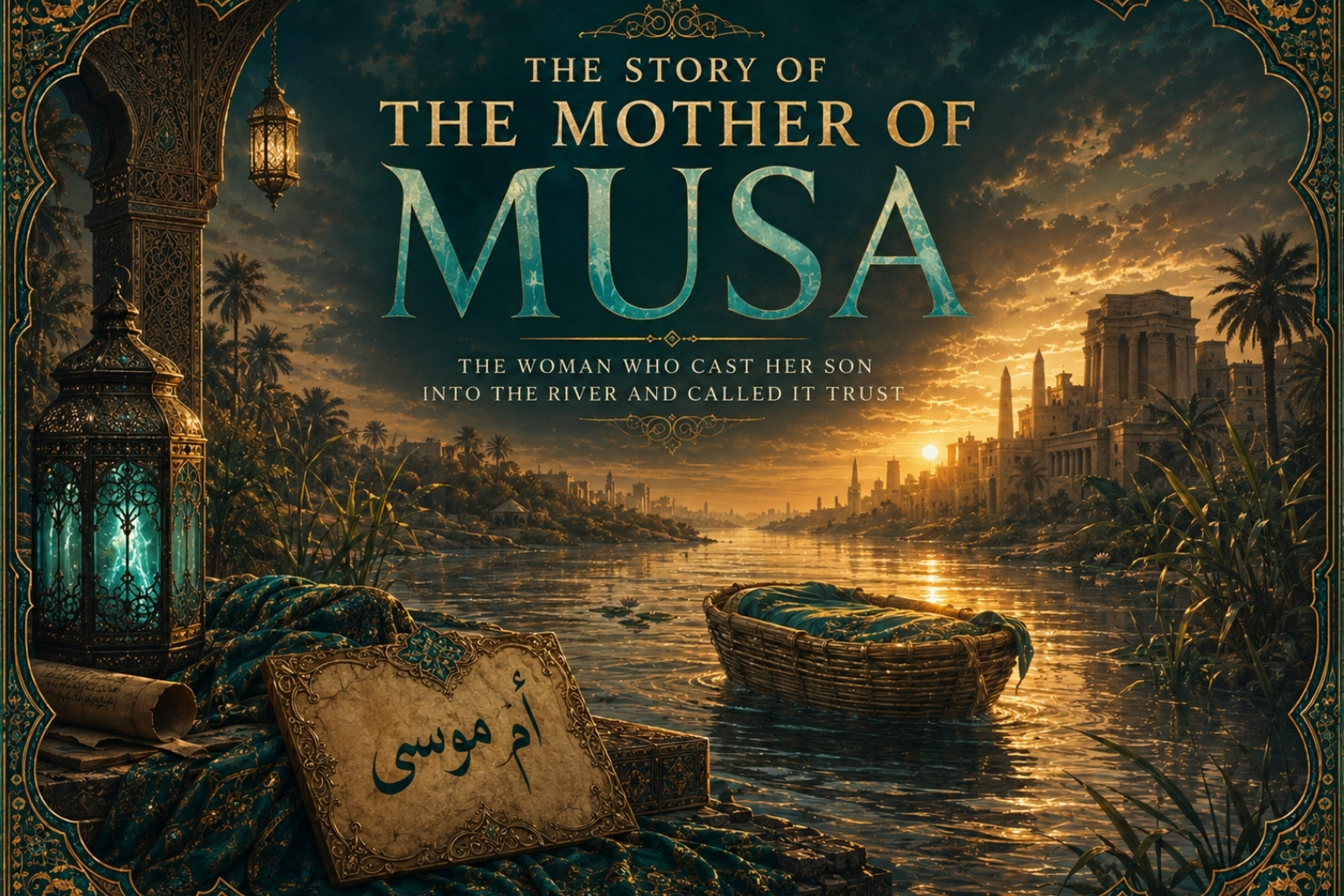
She made a basket — or a box, the narrations vary on the exact form — waterproofed it, placed her infant son inside it, and cast it into the Nile.
The Quran does not describe what she felt in that moment. It does not describe the trembling of her hands or the sound she may have made. It does not describe the walk back from the river or the silence of the house without him.
It describes what happened to her afterward — because what happened to her afterward is the part Allah wanted preserved:
Quran Verse:
وَأَصْبَحَ فُؤَادُ أُمِّ مُوسَىٰ فَارِغًا ۖ إِن كَادَتْ لَتُبْدِي بِهِ لَوْلَا أَن رَّبَطْنَا عَلَىٰ قَلْبِهَا لِتَكُونَ مِنَ الْمُحْمِنِينَ
“And the heart of the mother of Musa became empty. She would have almost revealed her son had We not bound her heart that she might be of the believers.”
Surah Al-Qasas (28:10)
“Her heart became empty.” — Fariaghan — vacant, void, hollowed out. This is Allah’s description of what it felt like to be her. Not a metaphor about spiritual emptiness. A description of the specific, physical sensation of a mother whose child has just been taken from her arms — even by her own hands, even in obedience to Allah — and who now faces the silence of his absence.
“She would have almost revealed him” — She almost told people. She almost broke. The grief was so overwhelming that the impulse to speak — to tell someone what she had done, to call for help, to do something rather than simply endure the emptiness — almost overtook her.
“Had We not bound her heart” — Allah intervened. He bound her heart — held it together, stabilized it, provided the supernatural steadiness that her human capacity could not produce on its own. This binding was not the suppression of her feelings. It was Allah accompanying her through them — holding her in place when everything in her was about to give way.
“That she might be of the believers” — The entire binding — the divine steadying of a breaking heart — was so that she could maintain the trust, the faith, the iman that the moment required. Allah did not remove the pain. He supported her within it.
Chapter Four — The Sister Who Watched: Her Obedience Extended Through Her Daughter
The mother of Musa did not simply release him and surrender all agency. She did what every wise, faithful, and practical believer does — she combined trust in Allah with the human means available to her. She sent her daughter to follow the basket:
Quran Verse:
وَقَالَتْ لِأُخْتِهِ قُصِّيهِ ۖ فَبَصُرَتْ بِهِ عَن جُنُبٍ وَهُمْ لَا يَشْعُرُونَ
“And she said to his sister: ‘Follow him.’ So she watched him from a distance while they did not know.”
Surah Al-Qasas (28:11)
She sent a child — Musa’s sister — to follow the basket and report what happened. To watch from a distance without being seen. To be the eyes that the mother could not be.
This detail matters. The mother of Musa did not use tawakkul as an excuse for passivity. She trusted Allah — and she did everything within her human capacity alongside that trust. She nursed him as long as she could. She made the basket carefully. She placed him in it deliberately. She sent her daughter to watch. She remained available.
Tawakkul and human effort are not opposites. The mother of Musa lived this truth in the most pressurized possible circumstances — and demonstrated that complete reliance on Allah includes using every legitimate means available to you while surrendering the outcome to Him.
Musa’s sister watched from a distance — and saw the basket taken to Pharaoh’s palace, and saw the infant refuse every wet nurse offered to him.
Chapter Five — The Forbidden and The Permitted: Why He Would Not Nurse
Allah had arranged things so that Musa would refuse every wet nurse offered to him in Pharaoh’s palace — because Allah had forbidden him to nurse from anyone other than his mother:
Quran Verse:
وَحَرَّمْنَا عَلَيْهِ الْمَرَاضِعَ مِن قَبْلُ فَقَالَتْ هَلْ أَدُلُّكُمْ عَلَىٰ أَهْلِ بَيْتٍ يَكْفُلُونَهُ لَكُمْ وَهُمْ لَهُ نَاصِحُونَ
“And We had forbidden for him wet nurses before, so she said: ‘Shall I direct you to a household who will nurse him for you and they will be sincere to him?'”
Surah Al-Qasas (28:12)
Allah made the infant refuse. Every woman offered to nurse him — he would not take from her. The people of Pharaoh’s palace were desperate for someone who could feed this child who had captured Asiyah’s heart.
And Musa’s sister stepped forward — carefully, intelligently, from her position of observation — and offered: I know a household. They will nurse him and they will be sincere to him.
The offer was accepted. And the mother of Musa was brought to the palace of Pharaoh to nurse her own son — the son she had cast into the river in terror — in the arms of the very man who had ordered his death, under the protection of the very institution that was persecuting her people.
Chapter Six — The Reunion: When Allah Fulfilled His First Promise
Quran Verse:
فَرَدَدْنَاهُ إِلَىٰ أُمِّهِ كَيْ تَقَرَّ عَيْنُهَا وَلَا تَحْزَنَ وَلِتَعْلَمَ أَنَّ وَعْدَ اللَّهِ حَقٌّ وَلَٰكِنَّ أَكْثَرَهُمْ لَا يَعْلَمُونَ
“So We restored him to his mother that she might be comforted and not grieve and that she would know that the promise of Allah is true — but most of them do not know.”
Surah Al-Qasas (28:13)
“We restored him to his mother.” — The first promise fulfilled. We will return him to you. Fulfilled — in a way no human mind could have designed. Not returned quietly at night, not slipped back through a window. Returned inside the palace of Pharaoh, paid by Pharaoh’s own household, protected by Pharaoh’s own wife.
Allah named three reasons for the restoration — three purposes behind the fulfillment of His promise:
“That she might be comforted” — kay taqarra ‘aynuha — that her eyes might be cooled, that the grief of her empty heart might be filled. Allah restored her son to her specifically so that her comfort would come. Her emotional healing was one of the stated purposes of Allah’s plan.
“And not grieve” — The prohibition on grief from the original inspiration was now being fulfilled — not by suppression but by the removal of the cause. She was told not to grieve, and Allah made the grief unnecessary by giving her back what she had lost.
“And that she would know that the promise of Allah is true” — This is the deepest purpose. The entire experience — the casting of the basket, the empty heart, the sister’s watching, the refusal to nurse, the return — was arranged so that she would know, with personal, lived, embodied certainty, that Allah’s promises are true.
Not believe theoretically. Not accept theologically. Know — in the way that a person knows something that has happened to their own body and soul.
Allah gave her this knowledge through the most intense, personal, irreplaceable experience of her life.
Chapter Seven — Her Story in Three Chapters: How Allah Honored Her
Allah told the story of the mother of Musa three times — in three different chapters of the Quran, each telling adding different dimensions and details:
In Surah Al-Qasas — the most detailed account, preserved above.
In Surah Ta-Ha:
Quran Verse:
إِذْ أَوْحَيْنَا إِلَىٰ أُمِّكَ مَا يُوحَىٰ ﴿٣٨﴾ أَنِ اجْعَلِيهِ فِي التَّابُوتِ فَاقْذِفِيهِ فِي الْيَمِّ فَلْيُلْقِهِ الْيَمُّ بِالسَّاحِلِ يَأْخُذْهُ عَدُوٌّ لِّي وَعَدُوٌّ لَّهُ
“When We inspired to your mother what We inspired: ‘Place him in the chest and cast it into the river, and the river will throw it onto the bank; there will take him an enemy to Me and an enemy to him.'”
Surah Ta-Ha (20:38–39)
Here Allah speaks directly to Musa — telling him about his own mother’s story, about what Allah had inspired her to do. He calls Pharaoh “an enemy to Me and an enemy to him” — and yet it was precisely into this enemy’s hands that Allah sent Musa through his mother’s obedience. Allah placed the future of His own prophet in the home of His own enemy — through the trust of a mother.
In Surah Al-A’raf — a brief reference to the mother’s role in the broader context of Musa’s story.
Three chapters. Three tellings. Allah returned to this mother’s story repeatedly — because the principle it embodies is one He wanted woven into the Quran at multiple points: when you trust Allah with the impossible, He does what only He can do.
Hadith:
مَثَلُ الْمُؤْمِنِ كَمَثَلِ الزَّرْعِ، لَا تَزَالُ الرِّيحُ تُمِيلُهُ وَلَا يَزَالُ الْمُؤْمِنُ يُصِيبُهُ الْبَلَاءُ
“The example of the believer is like a crop — the wind keeps bending it, and the believer keeps being struck by trials.”
Recorded in Sahih Al-Bukhari, Hadith No. 5644
The mother of Musa was bent by the wind of the most extreme trial imaginable. And she did not break — because Allah bound her heart. She was the crop that bent but held, because her roots were in the promise of Allah.
Chapter Eight — What Her Story Teaches About Impossible Obedience
The mother of Musa is the Quran’s most complete portrait of what scholars call tawakkul fil balaa — trust in Allah in the midst of trial — as distinct from tawakkul in ease.
It is relatively easy to trust Allah when circumstances are favorable, when the path ahead is visible, when the promise seems likely to be fulfilled. The mother of Musa trusted Allah when:
— The command she received made no sense by any human logic of protection — The action she was asked to take felt like the opposite of what a mother should do — The outcome she was promised was invisible from where she stood — Her heart was empty and she almost broke
And she obeyed. Not without feeling. Not without her heart almost giving out. But she obeyed.
And Allah used her obedience to fulfill not just the promise He made to her — We will return him to you — but the promise He made about her son: We will make him one of the messengers.
Her act of trust on the bank of the Nile was the first step in the prophetic journey of Musa — the most mentioned prophet in the Quran, the one who parted the sea, the one Allah spoke to directly.
The basket she made with her hands carried the future.
Timeless Lessons from the Story of the Mother of Musa
- Allah’s inspiration to a believing heart is as real as His revelation to prophets Allah used the word awhayna — We inspired — for what He communicated to the mother of Musa. This was not a vague feeling or a hopeful thought. It was a divine communication to a believing heart. When you have a certainty about what Allah is asking of you — even in a situation where the human logic says otherwise — that certainty deserves to be honored.
- The counterintuitive command is sometimes the most protective Cast your child into the river to save him. Release what you love most as the act of greatest protection. Sometimes Allah’s command for safety looks like the opposite of safety to human eyes. The measure of trust is whether you can obey when the command defies your instinct.
- Allah names your grief and addresses it directly “Do not fear. Do not grieve.” — He named both emotions. He did not tell her not to feel them. He addressed the foundation beneath them — by promising their removal. Allah is not distant from your specific, named emotional state. He addresses it directly, by name, in His own words.
- Empty hearts are not abandoned hearts — they are held by Allah “Her heart became empty… had We not bound her heart.” Her emptiness was real and Allah acknowledged it. And then He described what He did with it — He bound it. He held it together. The empty heart that trusts Allah is not left to collapse. It is held from within by the One who knows its capacity and provides exactly what is needed to sustain it.
- Tawakkul includes human effort — trust and action are not opposites She sent her daughter to watch. She remained available to be called. She used every means available to her while surrendering the outcome to Allah. Complete reliance on Allah is not the abandonment of human effort. It is human effort offered in full while releasing control of the result.
- Allah’s promises are fulfilled in ways beyond human planning She was returned to nurse her son — inside Pharaoh’s palace, paid by Pharaoh’s household. No human being could have designed this outcome. Allah’s promises are fulfilled not by the most obvious path but by the most complete one — the one that also produces the maximum possible testimony to His power and His care.
- Your obedience today may be the first step in a prophetic journey you cannot see The basket she cast into the Nile was the beginning of Musa’s journey to prophethood, to the burning bush, to the parting of the sea, to being the most mentioned prophet in the Quran. She could not see any of this from the riverbank. She saw only the water and the basket and the grief. But her obedience on that day set in motion everything that followed. Your act of trust today — however small and frightened and uncertain — may be the first step in something whose full dimension you will only see much later.
Closing Reflection
She held him. She nursed him. She loved him with the particular, consuming love of a mother who knows her child is in danger.
And then she placed him in a basket. And she cast him into the river. With her own hands.
Not because she wanted to. Not because it made sense. Not because any human instinct of protection would have told her this was the right thing to do.
Because Allah told her to. And because Allah made two promises — We will return him to you and We will make him one of the messengers — and she believed both of them more than she believed the fear.
Her heart became empty. Allah bound it.
She almost broke. Allah held her.
And then the river brought her son back — not to the bank where she had released him — but to the palace of the man who had ordered his death. Where the most powerful woman in Egypt had fallen in love with him. Where no wet nurse could feed him. Where a sister waited with an offer. Where a mother was summoned to nurse her own son — in safety, in provision, in the precise fulfillment of a promise that had seemed impossible from the riverbank.
“That she would know that the promise of Allah is true.”
She knew. With her body. With her empty heart that was filled. With her arms that held him again inside the palace that should have been his death.
She knew.
Quran Verse:
فَرَدَدْنَاهُ إِلَىٰ أُمِّهِ كَيْ تَقَرَّ عَيْنُهَا وَلَا تَحْزَنَ وَلِتَعْلَمَ أَنَّ وَعْدَ اللَّهِ حَقٌّ
“So We restored him to his mother that she might be comforted and not grieve and that she would know that the promise of Allah is true.”
Surah Al-Qasas (28:13)
Whatever you have cast into the river — whatever you have released in terror and trust — the promise is still true.
Allah will return it. In ways you cannot design. At a time you cannot predict. Through a door you cannot see from the riverbank.
Hold to the promise. He has never broken one.