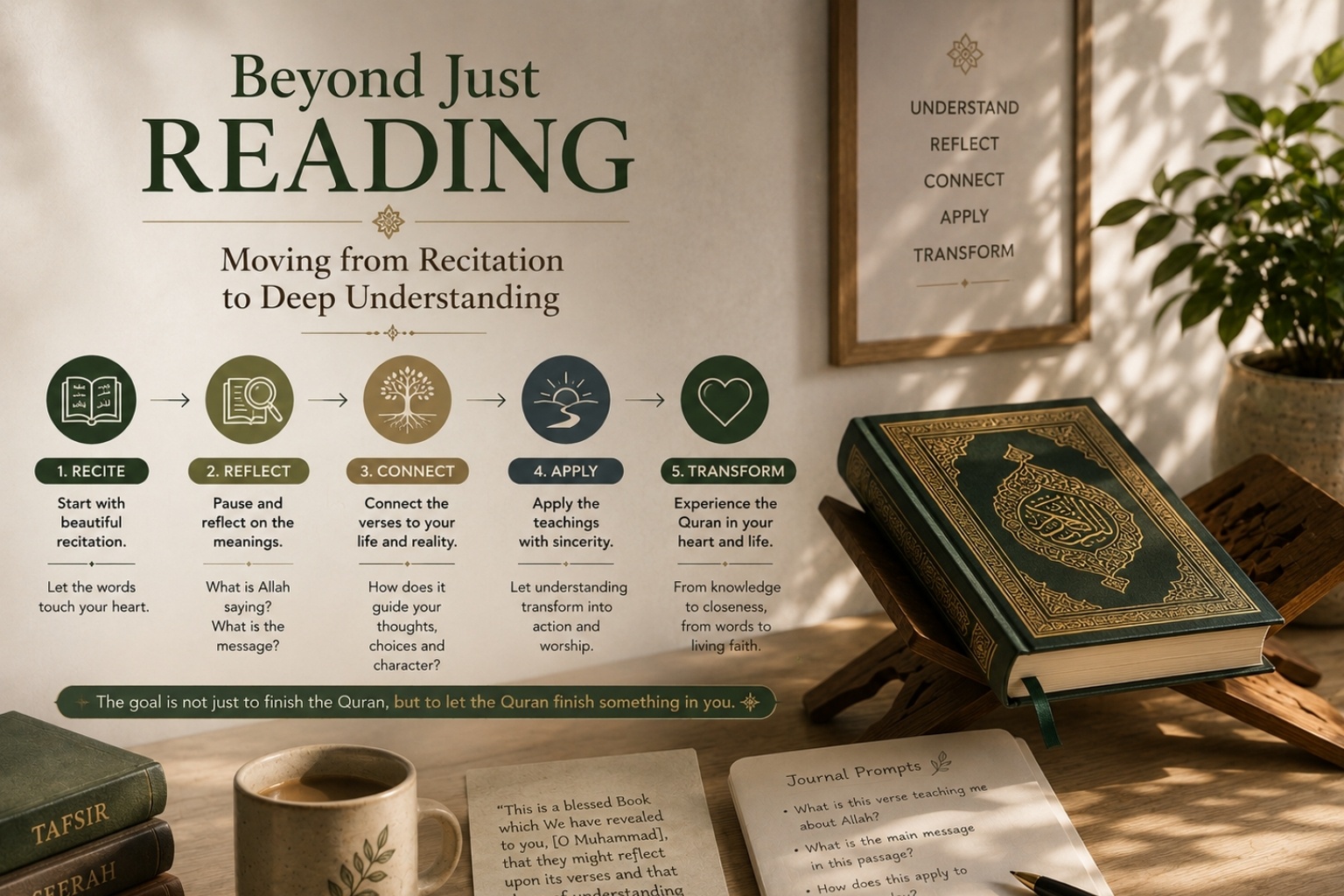

For many people around the world, engaging with the Holy Quran often begins and ends with the act of recitation. Beautiful melodies, perfect pronunciation, and completing chapters are heavily emphasized. While there is immense spiritual reward and peace in reciting the divine words, a critical question remains: Are we actually absorbing the message?
To unlock the true power of the divine text, we must look beyond just reading and learn how to move from simple recitation to a deep understanding of the Quran. This shift is essential for anyone seeking genuine spiritual growth and practical life guidance from the text.
Why Recitation Alone is Not Enough
Reciting the text without knowing its meaning is like having a map to a hidden treasure but only admiring the ink and paper it is printed on. The linguistic beauty of the text is undeniable, but its core purpose is guidance (Hudah).
The concept of Quranic reflection (Tadabbur) is heavily emphasized within the scripture itself. The text frequently asks its readers: “Do they not then reflect upon the Quran?” This indicates that the ultimate goal of reading is to engage our intellect, question our habits, and allow the divine wisdom to transform our daily lives. Moving beyond the surface allows the text to become a living, breathing guide rather than a ritualistic chant.
Practical Steps to Move into Deep Quranic Reflection
Transitioning into a deeper level of study does not require you to be a scholar overnight. By implementing a few mindful habits, you can elevate your study sessions significantly:
1. Integrate Reliable Quranic Commentaries (Tafsir)
An English translation gives you the literal meaning of the words, but a Quranic commentary (Tafsir) gives you the story behind them. Knowing why and when a verse was revealed provides the necessary historical context that prevents misunderstandings. For beginners, accessible commentaries like Tafsir Ibn Kathir or modern, clear English study guides are excellent places to start.
2. Slow Down and Isolate Key Verses
It is easy to get caught up in the goal of finishing a specific number of pages. Instead, try isolating just one or two verses during your study time. Read them in English, look up their commentary, and sit with them in silence. Ask yourself:
- What is the core moral lesson here?
- How does this verse connect to the challenges I am facing today?
3. Maintain a Reflection Journal
Writing down your thoughts bridges the gap between passive reading and active learning. Dedicate a notebook specifically for your Quranic journey. Write down the verses that resonate with you, your personal emotional responses, and the practical action steps you can take based on what you have learned.
Shifting Your Ultimate Goal
When you sit down to read, change your personal metric of success. Do not ask yourself, “How much did I read today?” Instead, ask, “What did I understand today, and how will it change my character tomorrow?”
The ultimate purpose of moving beyond just reading is application. A single verse that teaches patience, honesty, or mindfulness—when truly understood and implemented—holds far more weight in transforming your life than chapters read in a language you do not fully comprehend.
Conclusion: Start Your Journey Today
The path from rhythmic recitation to deep understanding of the Quran is one of the most rewarding spiritual journeys you can undertake. It changes the scripture from an ancient, revered text into a deeply personal, contemporary manual for your life.
Before you open your translation today, make a conscious decision to slow down, ask questions, and seek the profound depth waiting just beneath the surface of the words.
When you first open the Quran, you are not just opening a book of ancient history or a list of strict rules. You are entering a dialogue. It is a living guidance, a divine message, and a profound mirror reflecting the human soul. For a non-native English speaker, particularly one approaching it as a curiosity or a new faith, the translation can seem like a barrier. But the biggest barrier is often not language—it’s mindset.
To truly unlock the Quran’s wisdom and allow it to speak to you, you must cultivate the correct mental and spiritual attitude. This transformation in your approach changes the entire experience, shifting it from a dry academic exercise to a deeply personal, transformative journey.
The Mental Shift: It’s Personal
The Quran is not a static historical artifact. Its verses were revealed over 23 years, addressing specific situations and hearts. To understand it, you must read it as if it were revealed for you, today.
When you encounter a verse, don’t immediately distance it by thinking, “Oh, that was about the people of the 7th century.” Instead, ask a single, powerful question: “What is the Divine telling me through these words right now?” This simple frame shifts the entire meaning. Historical context is important, but personal application is paramount. The Quran is designed to offer solace, guidance, and challenge to the human condition across all of time. Connect with that timeless quality.
Trading Speed for Depth: Quality Over Quantity
In a fast-paced world, we have been conditioned to finish books, get through checklists, and consume content rapidly. When you approach the Quran, you must intentionally slow down.
The metric of success in understanding the Quran is not how many chapters you can finish in a single sitting. It is about how many verses sink into your heart and stay with you. It is far more beneficial to read just three verses with deep contemplation, cross-referencing their meanings and feeling their impact, than to rush through an entire section without absorbing anything. The text is dense with meaning; it requires time and space for its ideas to unfold within your mind. Read a little, pause a lot, and let the message resonate.
The Stance of Humility and Openness
Our preconceptions are often the strongest filters on reality. If you approach any text with the single intention of finding faults, you will find them, but you will miss the truth.
Approaching the Quran requires intellectual and spiritual humility. Acknowledge that you might not know everything about the historical context, the depth of the language, or the nature of existence. This does not mean being uncritical or blind; it means being open. Be prepared to have your perspectives challenged, your assumptions questioned, and your character elevated. If a verse puzzles you, instead of dismissing it, hold onto it as an invitation for further study. True understanding starts with a humble question.
Expecting a Dialogue, Not a Monologue
Think of your reading as a conversation. The Quran frequently prompts self-reflection, asks rhetorical questions, and addresses human emotions head-on.
When the text describes the quality of the believers, ask yourself, “Do I have this quality?” When it speaks of God’s immense mercy, pause and actively ask for that mercy for your own shortcomings. If it mentions the beauty of the natural world, look around you and feel the connection. This internal dialogue turns your reading into a reciprocal spiritual act. You are not simply observing a text; you are actively participating in its wisdom.
Conclusion and Your First Step
The Quran is a map, but a map can only guide you if you are willing to walk the path.
Before you sit down for your next reading, take a simple 60-second reset. Clear your mind of the noise of your day. Breathe deeply. Set a conscious intention in your heart: “I am opening this book to find guidance, peace, and truth.” This small moment of preparation aligns your inner self with the spiritual depth of the message you are about to encounter. You might be surprised at how much clearer, how much closer, the divine words suddenly feel.