
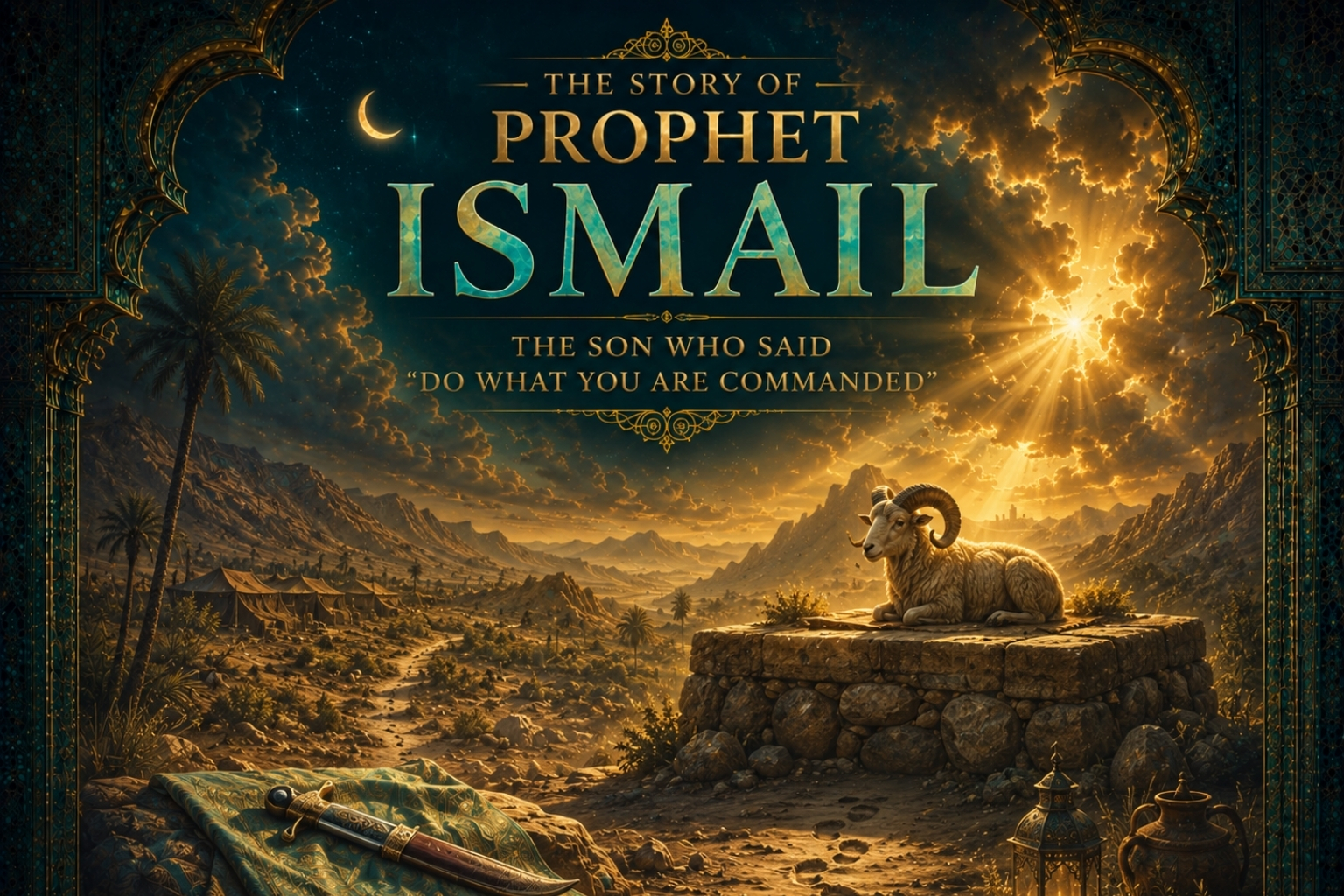

There are people who enter history through what they did. There are people who enter history through what they survived. And then there is Prophet Ismail, peace be upon him — a man who entered history through what he was willing to give up.
He did not part the sea. He did not survive a fire. He did not build an ark. What Ismail did was quieter, more personal, and in many ways more demanding than any of these: when his father came to him with a knife and a dream, Ismail looked at both — and said yes.
That single word of surrender became the foundation of one of the five pillars of Islam. It is re-enacted by over a billion Muslims every year. It is woven into the very geography of Makkah, into the rituals of Hajj, into the call that Ibrahim made and that Ismail helped answer with his own hands and his own blood.
But before the knife, there was the desert. Before the sacrifice, there was the well. Before the Ka’bah, there was a mother’s footsteps and an infant’s cry — and the mercy of Allah that answered both.
Chapter One — Left in the Desert: The First Test Before He Could Walk
Ismail’s story begins before he was old enough to understand it. He was an infant — not yet speaking, not yet walking — when Prophet Ibrahim, peace be upon him, carried him and his mother Hajar to a valley in the Arabian Peninsula that had no water, no vegetation, and no people.
By Allah’s command, Ibrahim left them there. He placed them down, left provisions, and began to walk away. Hajar — a woman of extraordinary faith — called after him:
“O Ibrahim, where are you going? Are you leaving us in this valley where there is no person and nothing?”
She repeated it. He did not turn back. She asked the question that changed everything:
“Did Allah command you to do this?”
He said: “Yes.”
And she said — in words that became one of the defining statements of tawakkul in Islamic tradition:
“Then Allah will not neglect us.”
Quran Verse:
رَّبَّنَا إِنِّي أَسْكَنتُ مِن ذُرِّيَّتِي بِوَادٍ غَيْرِ ذِي زَرْعٍ عِندَ بَيْتِكَ الْمُحَرَّمِ رَبَّنَا لِيُقِيمُوا الصَّلَاةَ فَاجْعَلْ أَفْئِدَةً مِّنَ النَّاسِ تَهْوِي إِلَيْهِمْ وَارْزُقْهُم مِّنَ الثَّمَرَاتِ لَعَلَّهُمْ يَشْكُرُونَ
“Our Lord, I have settled some of my descendants in an uncultivated valley near Your sacred House, our Lord, that they may establish prayer. So make hearts among the people incline toward them and provide for them from the fruits that they might be grateful.”
Surah Ibrahim (14:37)
Ibrahim walked away from his infant son in an empty desert — and made du’a. He did not arrange logistics. He did not leave a survival plan. He left a prayer. And that prayer — make hearts incline toward them — was answered so completely that fourteen centuries later, eight million people a year travel to that same valley from every corner of the earth.
The empty desert became the most visited place in human history. Because a father trusted Allah enough to walk away — and Allah honored that trust with something that has never stopped growing.
Chapter Two — Zamzam: When Allah Answered a Mother’s Footsteps
With Ibrahim gone and provisions exhausted, Hajar faced the crisis that every parent fears most — her infant son was dying of thirst. She ran between the hills of Safa and Marwa, seven times, desperately searching for water or any sign of life.
This running — born of a mother’s desperation, her refusal to surrender, her active search even when the situation seemed hopeless — was so honored by Allah that He made it a permanent ritual of Islam. Every Muslim who performs Hajj or Umrah walks those same steps, between those same hills, commemorating the faith of a woman who ran when she could have sat down and wept.
Then — beneath the feet of infant Ismail, as he struck the ground — water burst from the earth:
Hadith:
فَجَعَلَتْ تَنْظُرُ إِلَى الْمَاءِ وَتَحُوطُهُ بِيَدِهَا هَكَذَا، وَتَغْرِفُ مِنَ الْمَاءِ فِي سِقَائِهَا وَهُوَ يَنْبُعُ بَعْدَ مَا تَغْرِفُ، قَالَ النَّبِيُّ ﷺ: يَرْحَمُ اللَّهُ أُمَّ إِسْمَاعِيلَ، لَوْ تَرَكَتْ زَمْزَمَ أَوْ قَالَ لَوْ لَمْ تَغْرِفْ مِنَ الْمَاءِ لَكَانَتْ زَمْزَمُ عَيْنًا مَعِيناً
“She began looking at the water and scooping it up with her hands, and it continued to flow after she scooped. The Prophet ﷺ said: ‘May Allah have mercy on the mother of Ismail. Had she left Zamzam alone — or had she not scooped from the water — it would have been a flowing spring.'”
Recorded in Sahih Al-Bukhari, Hadith No. 3364
The Prophet Muhammad ﷺ — centuries later — invoked mercy upon Hajar by name. The water she scooped with her hands has been flowing for over four thousand years. Millions of Muslims carry it home from Makkah today. It has never run dry.
This is what Allah does with the actions of those who trust Him completely — He makes them eternal.
Chapter Three — The Boy Who Grew: Building Faith Before Building the Ka’bah
Ismail grew up in Makkah — among the tribe of Jurhum who had settled near the water of Zamzam. He learned Arabic from them, became known for his character and trustworthiness, and grew into a young man of exceptional quality.
Allah describes Ismail with a title that summarizes his entire character:
Quran Verse:
وَاذْكُرْ فِي الْكِتَابِ إِسْمَاعِيلَ ۚ إِنَّهُ كَانَ صَادِقَ الْوَعْدِ وَكَانَ رَسُولًا نَّبِيًّا
“And mention in the Book, Ismail. Indeed, he was true to his promise, and he was a messenger and a prophet.”
Surah Maryam (19:54)
Sadiq al-Wa’d — true to his promise. In a world where promises are broken casually, where commitments dissolve under pressure, where people say one thing and do another — Ismail was a man whose word was his bond. Absolutely. Without exception. Without condition.
This quality — sadiq al-wa’d — was not merely a personality trait. It was the foundation that made everything else in his story possible. A man who is true to his promises to people will be true to his promise to Allah. And when Allah tested that promise, Ismail did not flinch.
Chapter Four — The Dream and The Knife: The Greatest Yes in History
Prophet Ibrahim had waited decades for a son. He had made du’a for a righteous child, and Allah had given him Ismail. Then — after years of separation, after Ismail had grown into a young man — Ibrahim received a dream that would test everything:
Quran Verse:
فَلَمَّا بَلَغَ مَعَهُ السَّعْيَ قَالَ يَا بُنَيَّ إِنِّي أَرَىٰ فِي الْمَنَامِ أَنِّي أَذْبَحُكَ فَانظُرْ مَاذَا تَرَىٰ ۚ قَالَ يَا أَبَتِ افْعَلْ مَا تُؤْمَرُ ۖ سَتَجِدُنِي إِن شَاءَ اللَّهُ مِنَ الصَّابِرِينَ
“And when he reached with him the age of exertion, he said: ‘O my son, indeed I have seen in a dream that I sacrifice you, so see what you think.’ He said: ‘O my father, do what you are commanded. You will find me, if Allah wills, of the steadfast.'”
Surah As-Saffat (37:102)
Pause here. Read Ismail’s response again.
His father has just told him: I dreamed I am sacrificing you. And Ismail — a young man with his whole life ahead of him, with strength in his body and years of living yet to come — does not run. Does not argue. Does not ask for time to think. He says: do what you are commanded.
Five words that contain an entire theology of surrender.
And then — with a humility that makes the statement even more extraordinary — he adds: “You will find me, if Allah wills, of the steadfast.” He did not say “I will be patient.” He said “if Allah wills.” He understood that even his own patience was a gift from Allah — not a quality he could guarantee from himself.
This is the most complete surrender recorded in the Quran from a human being who was not even the one receiving the command. Ibrahim was commanded. Ismail chose.
Chapter Five — The Moment on the Mountain
They went together. Father and son, walking toward the place of sacrifice. The narrations describe Shaytan attempting to intercept them three times — appearing to Ibrahim, then to Hajar, then to Ismail — trying to plant doubt, fear, or resistance in each of them. Each time, they drove him away by throwing stones. This act became the ritual of Rami al-Jamarat — the stoning of the pillars — performed by every Muslim during Hajj until the end of time.
Ismail lay down. Ibrahim raised the knife. And at the moment of complete, total, willing surrender from both of them:
Quran Verse:
فَلَمَّا أَسْلَمَا وَتَلَّهُ لِلْجَبِينِ ﴿١٠٣﴾ وَنَادَيْنَاهُ أَن يَا إِبْرَاهِيمُ ﴿١٠٤﴾ قَدْ صَدَّقْتَ الرُّؤْيَا ۚ إِنَّا كَذَٰلِكَ نَجْزِي الْمُحْسِنِينَ ﴿١٠٥﴾ إِنَّ هَٰذَا لَهُوَ الْبَلَاءُ الْمُبِينُ ﴿١٠٦﴾ وَفَدَيْنَاهُ بِذِبْحٍ عَظِيمٍ
“And when they had both submitted and he put him down upon his forehead, We called to him: ‘O Ibrahim, you have fulfilled the vision.’ Indeed, We thus reward the doers of good. Indeed, this was the clear trial. And We ransomed him with a great sacrifice.”
Surah As-Saffat (37:103–107)
“When they had both submitted.” Both. Allah named them together — because both of them passed the test. Ibrahim submitted by raising the knife. Ismail submitted by lying down for it. The reward was shared. The honor was shared. The legacy was shared.
A ram was sent from Allah as the ransom. The knife was not needed. It never was. Allah never wanted Ismail’s death — He wanted their surrender. And when the surrender was complete, the test was complete.
Chapter Six — Building the Ka’bah: Hands That Raised What Still Stands
After the trial of the sacrifice, Ibrahim and Ismail were given a command that would define the spiritual geography of the entire Muslim world:
Quran Verse:
وَإِذْ بَوَّأْنَا لِإِبْرَاهِيمَ مَكَانَ الْبَيْتِ أَن لَّا تُشْرِكْ بِي شَيْئًا وَطَهِّرْ بَيْتِيَ لِلطَّائِفِينَ وَالْقَائِمِينَ وَالرُّكَّعِ السُّجُودِ
“And when We showed Ibrahim the site of the House, saying: ‘Do not associate anything with Me and purify My House for those who perform tawaf, and those who stand in prayer, and those who bow and prostrate.'”
Surah Al-Hajj (22:26)
Father and son, side by side, lifting stones and placing them in the walls of the first house built for the worship of Allah on earth. And as they built, they made a prayer — one of the most beautiful supplications in the entire Quran:
Quran Verse:
وَإِذْ يَرْفَعُ إِبْرَاهِيمُ الْقَوَاعِدَ مِنَ الْبَيْتِ وَإِسْمَاعِيلُ رَبَّنَا تَقَبَّلْ مِنَّا ۖ إِنَّكَ أَنتَ السَّمِيعُ الْعَلِيمُ ﴿١٢٧﴾ رَبَّنَا وَاجْعَلْنَا مُسْلِمَيْنِ لَكَ وَمِن ذُرِّيَّتِنَا أُمَّةً مُّسْلِمَةً لَّكَ وَأَرِنَا مَنَاسِكَنَا وَتُبْ عَلَيْنَا ۖ إِنَّكَ أَنتَ التَّوَّابُ الرَّحِيمُ
“And when Ibrahim was raising the foundations of the House and with him Ismail, saying: ‘Our Lord, accept this from us. Indeed, You are the Hearing, the Knowing. Our Lord, and make us Muslims submitting to You and from our descendants a Muslim nation submitting to You. And show us our rites and accept our repentance. Indeed, You are the Accepting of Repentance, the Merciful.'”
Surah Al-Baqarah (2:127–128)
Two prophets, lifting stones with their hands, asking Allah to accept their labor. “Our Lord, accept this from us.” — the prayer of every sincere believer who has ever done anything for Allah’s sake, uncertain whether it was worthy enough, hoping only that the sincerity behind it would be enough.
Allah accepted. The Ka’bah they built with their hands still stands. It is the direction toward which over a billion Muslims turn in prayer, five times a day, across every time zone on earth.
Chapter Seven — The Legacy of Ismail: Father of the Arabs, Ancestor of the Final Prophet
Ismail settled in Makkah, married among the tribe of Jurhum, and became the father of twelve sons — from whom the Arab tribes descended. He spent his life calling his people to the worship of Allah, teaching them the rites that Ibrahim had established, and preserving the sanctity of the Ka’bah.
Allah records his prophethood and his mission with the same honorable titles given to the greatest of prophets:
Quran Verse:
وَإِسْمَاعِيلَ وَإِدْرِيسَ وَذَا الْكِفْلِ ۖ كُلٌّ مِّنَ الصَّابِرِينَ ﴿٨٥﴾ وَأَدْخَلْنَاهُمْ فِي رَحْمَتِنَا ۖ إِنَّهُم مِّنَ الصَّالِحِينَ
“And Ismail and Idris and Dhul-Kifl — all were of the patient ones. And We admitted them into Our mercy. Indeed, they were of the righteous.”
Surah Al-Anbiya (21:85–86)
Patient. Righteous. Admitted into Allah’s mercy. These are the words Allah chose to define Ismail for eternity.
And from his descendants — through a chain of generations spanning over two thousand years — came the man whose birth Ibrahim had prayed for while laying the very foundations of the Ka’bah:
Hadith:
إِنَّ اللَّهَ اصْطَفَى كِنَانَةَ مِنْ وَلَدِ إِسْمَاعِيلَ، وَاصْطَفَى قُرَيْشًا مِنْ كِنَانَةَ، وَاصْطَفَى مِنْ قُرَيْشٍ بَنِي هَاشِمٍ، وَاصْطَفَانِي مِنْ بَنِي هَاشِمٍ
“Indeed, Allah chose Kinanah from the children of Ismail, and chose Quraysh from Kinanah, and chose Banu Hashim from Quraysh, and chose me from Banu Hashim.”
Recorded in Sahih Muslim, Hadith No. 2276
The Prophet Muhammad ﷺ — the final messenger to all of humanity, the seal of all prophets — traced his lineage directly to Ismail. The infant left in the desert became the ancestor of the greatest human being who ever lived. The boy who said “do what you are commanded” became the grandfather of the one who would carry that same commandment to the entire world.
Timeless Lessons from the Story of Ismail
- The greatest tests begin before you are old enough to choose Ismail was left in a desert as an infant. He did not choose that test — he was placed in it. But Allah does not abandon those placed in tests they did not choose. The water came. The people came. The future came. Trust the One who placed you in your circumstances.
- “Do what you are commanded” is the highest sentence a human being can say Five words. No conditions. No bargaining. No request for more time. When Allah’s command is clear, the only response that honors the relationship is complete and immediate surrender. Ismail modeled this for every human being who would come after him.
- Humility about your own strength is itself a form of strength Ismail did not say “I will be patient.” He said “you will find me patient, if Allah wills.” He understood that patience, courage, and steadfastness are gifts from Allah — not qualities a person can guarantee from themselves. This humility is what made his surrender real.
- Shaytan attacks at the moment of greatest commitment He appeared three times as Ibrahim and Ismail walked to the place of sacrifice — at the moment of their highest dedication to Allah. The closer you get to fulfilling something important for Allah’s sake, the more intensely the whispers will come. Drive them away. Keep walking.
- True to your promise — to people and to Allah — is the foundation of character. Allah described Ismail as Sadiq al-Wa’d — true to his promise. This was his defining quality. Before miracles, before prophethood, before the great sacrifice — he was known as someone whose word was his bond. Build that quality now, in small things, before the big tests arrive.
- What is built for Allah’s sake never truly falls. Ismail and Ibrahim built the Ka’bah with their hands, stone by stone, praying that Allah would accept it. That building has stood for over four thousand years. It has been rebuilt and restored — but it has never been abandoned. What you build sincerely for Allah, He preserves.
- You do not know what your surrender today will produce across centuries. Ismail lay down on a mountain and said yes to a knife. That yes became Eid Al-Adha — observed by over a billion Muslims every year. He could not have imagined it. He did not need to. He only needed to say yes. Say yes. Allah will do the rest.
Closing Reflection
Every year, on the day of Eid Al-Adha, over a billion Muslims around the world slaughter an animal in remembrance of what happened on that mountain. Every year, the pilgrims of Hajj run between Safa and Marwa in memory of Hajar’s footsteps. Every year, they throw stones at three pillars in memory of the moments Shaytan tried to stop what Allah had commanded.
And at the center of all of it — the Ka’bah, standing in the valley that was once empty desert — built by the hands of a father and a son who chose Allah over everything, including each other.
Ismail was not the most famous prophet. He was not given the most dramatic miracles. He did not confront the most powerful kings. What he was given was a single, defining moment — and he met it with five words that echo through fourteen centuries of Islamic practice:
Quran Verse:
يَا أَبَتِ افْعَلْ مَا تُؤْمَرُ ۖ سَتَجِدُنِي إِن شَاءَ اللَّهُ مِنَ الصَّابِرِينَ
“O my father, do what you are commanded. You will find me, if Allah wills, of the steadfast.”
Surah As-Saffat (37:102)
When your moment comes — and it will come — may Allah give you the same words in your heart.
Tags: Prophet Ismail · Ismail in Islam · Ishmael Quran · Sacrifice of Ismail Islam · Zamzam Water Story · Building of Kaaba Islam · Eid Al-Adha Story · Prophets of the Quran · Islamic Articles English · Quran Route · Prophets Series 08