
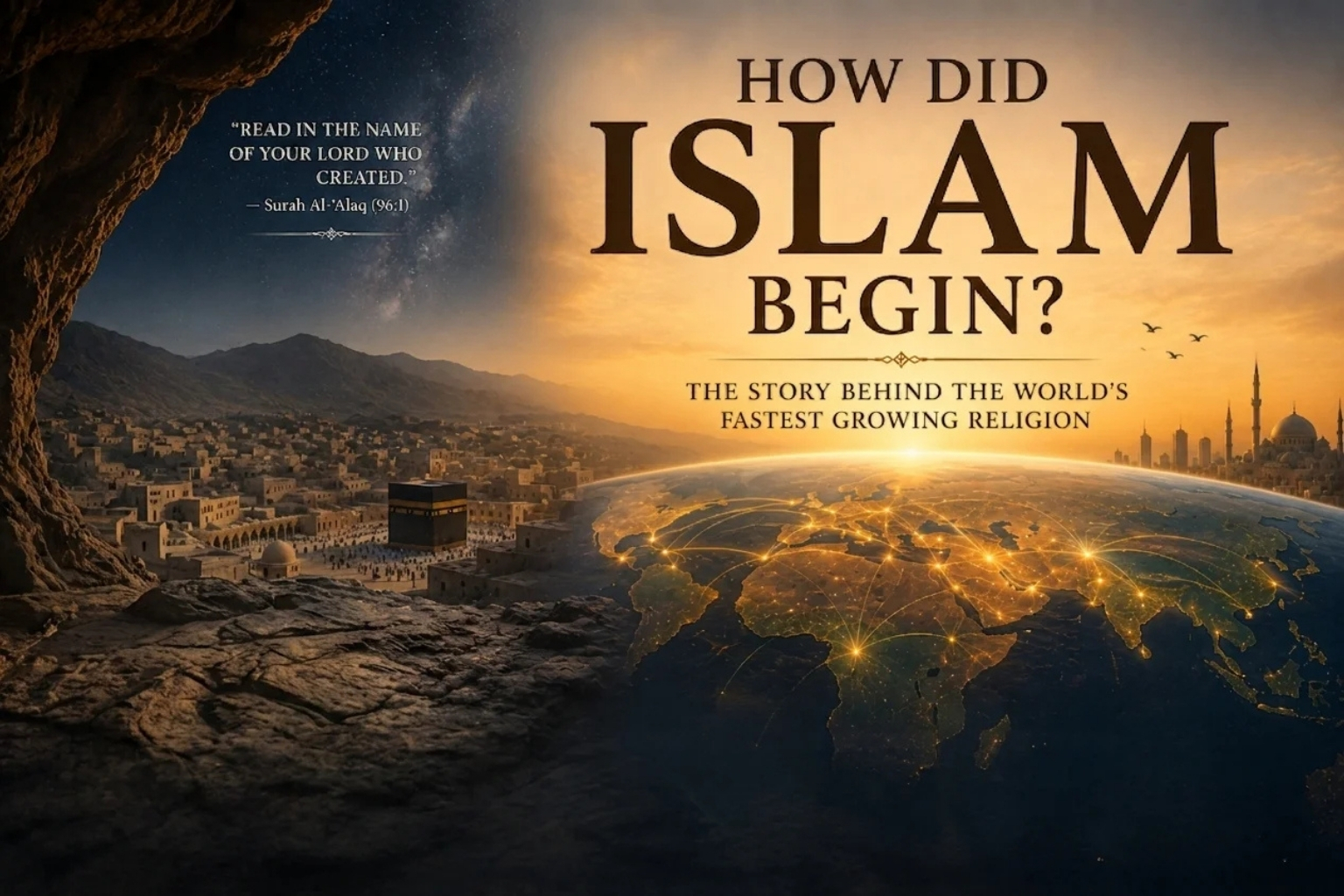

More than 1,400 years ago, in the middle of the Arabian desert, a man stood alone inside a mountain cave reflecting deeply about life, humanity, and the condition of the world around him.
At that time, Arabia was filled with tribal conflict, injustice, idol worship, and social inequality. Powerful tribes dominated weaker people, violence was common, and many societies lacked moral structure. Although traces of earlier monotheistic traditions still existed, much of Arabia had become spiritually fragmented 1.
That man was Muhammad ﷺ.
He would soon receive a revelation 2 that would permanently change human history.
What began as a small message preached quietly in the city of Makkah eventually spread across continents andIt became the most widespread religion on Earth. But to understand Islam properly, it is important to understand how it first began.
Arabia Before Islam
Before Islam,most tribes in Makkah practiced polytheism and worshipped idols placed around the Kaaba.
The Kaaba itself, had originally been built by Prophet إبراهيم عليه السلام (Abraham) and his son إسماعيل عليه السلام (Ishmael) as a place dedicated to the worship of one God. Over generations, however, idol worship gradually entered the region.
Society also faced serious moral problems. Tribal loyalty often mattered more than justice. The poor and weak were frequently mistreated, and women in many situations lacked protection or basic rights.
Despite this environment, Muhammad ﷺ became widely respected for his honesty and character long before prophethood. People in Makkah even gave him the title:
“الصادق الأمين”
“The Truthful and the Trustworthy.”
He was known for fairness, honesty, and compassion in a society filled with conflict.
The First Revelation
As Muhammad ﷺ grew older, he increasingly withdrew from the distractions of society and spent time alone reflecting in the Cave of Hira near Makkah.
At the age of forty, something extraordinary happened.
The Angel Jibreel (Gabriel) appeared to him with the first revelation from Allah.
The first revealed words of the Qur’an were:
“اقْرَأْ بِاسْمِ رَبِّكَ الَّذِي خَلَقَ خَلَقَ الْإِنسَانَ مِنْ عَلَقٍ اقْرَأْ وَرَبُّكَ الْأَكْرَمُ”
“Read in the name of your Lord who created — created man from a clinging substance. Read, and your Lord is the Most Generous.”
— Surah Al-‘Alaq (96:1–3)
This moment marks the true beginning of Islam as the final revelation from Allah to humanity.
Muhammad ﷺ was deeply shaken by the experience and returned home frightened. His wife خديجة رضي الله عنها (Khadijah) comforted and supported him, becoming the first person to believe in his message.
The Message of Islam
The central message brought by Prophet Muhammad ﷺ was simple, yet revolutionary:
There is only one God worthy of worship.
Islam called people away from idol worship and toward direct worship of Allah alone. It also emphasized morality, justice, compassion, honesty, and accountability.
The Qur’an repeatedly reminded people that:
- Life has purpose
- Human beings are accountable for their actions
- Wealth and power do not define true success
- Every person will eventually return to Allah
This message challenged the social and economic structure of Makkah, where powerful tribes benefited from the existing system.
Early Opposition and Persecution
At first, only a small number of people accepted Islam. Many of the earliest Muslims were poor, socially vulnerable, or searching for deeper spiritual truth.
As Islam spread, opposition in Makkah became increasingly hostile 3.
The leaders of Quraysh feared that Islam threatened:
- Their authority
- Their religious traditions
- Their economic influence connected to idol worship
Muslims faced mockery, social boycotts, torture, and persecution 4.
Some companions of the Prophet ﷺ were severely abused for accepting Islam. Among them was Bilal ibn Rabah رضي الله عنه , who was tortured publicly under the desert sun because of his belief in one God.
Despite these hardships, the message continued spreading.
The Qur’an gave believers strength during this difficult period:
“فَإِنَّ مَعَ الْعُسْرِ يُسْرًا إِنَّ مَعَ الْعُسْرِ يُسْرًا”
“Indeed, with hardship comes ease. Indeed, with hardship comes ease.”
— Surah Ash-Sharh (94:5–6)
The Migration That Changed History
As persecution intensified, Prophet Muhammad ﷺ and his followers eventually migrated from Makkah to the city of Madinah in an event known as the Hijrah.
This migration 5 became one of the most important turning points in Islamic history. In fact, the Islamic calendar itself begins from this event.
In Madinah, Islam developed into a complete community and civilization. Muslims established:
- Places of worship
- Systems of charity
- Social laws
- Agreements between communities
- Principles of justice and cooperation
The Prophet Muhammad ﷺ was no longer only preaching a spiritual message — he was building a society based upon it.
The Qur’an Was Revealed Gradually
Unlike many religious texts believed to appear all at once, the Qur’an was revealed gradually over approximately 23 years.
This gradual revelation carried deep wisdom:
- It strengthened believers during hardship
- It addressed real situations as they occurred
- It allowed people to slowly transform spiritually and socially
The Qur’an itself says:
“وَقُرْآنًا فَرَقْنَاهُ لِتَقْرَأَهُ عَلَى النَّاسِ عَلَىٰ مُكْثٍ”
“And it is a Qur’an which We have divided so that you might recite it to the people gradually.”
— Surah Al-Isra (17:106)
This gradual transformation helped shape an entire generation of believers.
Why Islam Spread So Rapidly
Many people wonder how Islam spread so quickly across regions and cultures.
The answer is complex, but several important reasons stand out.
Islam offered:
- Clear monotheism 6
- Moral structure
- Spiritual purpose
- Social justice
- Equality between races and tribes
- Strong community values
The message resonated 7 deeply with many people who were searching for meaning and fairness.
The Prophet Muhammad ﷺ also emphasized mercy and character.
He said:
“إِنَّمَا بُعِثْتُ لِأُتَمِّمَ صَالِحَ الْأَخْلَاقِ”
“I was sent only to perfect good character.”
— Musnad Ahmad (8952)
For many early Muslims, Islam transformed not only beliefs, but their entire way of living.
Islam Today
Today, Islam is practiced by nearly two billion people around the world.
Muslims come from every background imaginable:
- Arab
- African
- Asian
- European
- American
Islam is not tied to one ethnicity 8 or nationality. Its followers speak hundreds of languages and belong to diverse cultures, yet they remain connected through belief in:
- One God
- The Qur’an
- The Prophet Muhammad ﷺ
Five times every day, millions of Muslims across the globe pray toward the Kaaba in Makkah — the same sacred place connected to the origins of Islam centuries ago.
Conclusion
Islam began with a single revelation received by Prophet Muhammad ﷺ in a quiet mountain cave near Makkah. What started as a small message preached to a struggling society eventually transformed the lives of millions across continents and generations.
For Muslims, Islam is not viewed as a human invention or a cultural movement. It is believed to be the final continuation of the same message brought by earlier prophets: worship Allah alone, live morally, and prepare for the life to come.
More than fourteen centuries later, the story of how Islam began continues to inspire people searching for truth, purpose, and connection with their Creator 9.