

There is a phrase that every Muslim says more than any other phrase in their life.
More than alhamdulillah. More than subhanallah. More than la ilaha illa Allah — more, even, than the shahadah itself as a standalone utterance. A phrase said before eating, before drinking, before beginning any work, before entering a home, before reading, before sleeping, before driving, before anything of consequence is begun. A phrase so woven into the texture of Muslim daily life that it is said dozens of times every day without counting — and hundreds of thousands of times across a lifetime.
The phrase is: Bismillah Al-Rahman Al-Raheem.
In the name of Allah, the Most Merciful, the Most Compassionate.
Four Arabic words. Nineteen letters. And within those nineteen letters — according to fourteen centuries of Islamic scholarship — the most concentrated summary of the entire Quran that exists. The scholars have said that the Quran is a summary of all divine revelation, that Al-Fatiha is a summary of the Quran, and that the Bismillah is a summary of Al-Fatiha. Which means that the nineteen letters of Bismillah Al-Rahman Al-Raheem contain, in compressed form, the essence of everything Allah revealed to humanity.
Most people who say it say it as a beginning — a habitual, conditioned phrase that marks the start of an action. A prayer-formula. A pious prefix. Something said because it should be said, because it was taught to be said, because the action feels incomplete without it.
What very few people have done is stop and ask: what am I actually saying? What does bism mean — specifically? What is the ism of Allah? What does it mean to begin in the name of the Most Merciful? And why is it that the Prophet Muhammad ﷺ said that any significant action not begun with the Bismillah is incomplete — abtar, cut off — as if something essential is missing from its very foundation?
This is the complete tafsir of Bismillah Al-Rahman Al-Raheem. Not a formula. A statement about the nature of existence, about who Allah is, and about what it means to begin anything — any action, any day, any life — in His name.
The Text: Arabic and English
بِسْمِ اللَّهِ الرَّحْمَٰنِ الرَّحِيمِ
“In the name of Allah, the Most Gracious, the Most Merciful.”
The Bismillah in the Quran: Unique Standing
Before the tafsir of the words, the standing of the Bismillah within the Quran itself must be established — because it is unique in all of Quranic revelation.
The Bismillah appears 114 times in the Quran: at the beginning of every surah except Surah At-Tawbah (9), and once within the text of Surah Al-Naml (27:30) in the letter of Sulayman ﷺ to the Queen of Sheba. One hundred and thirteen surahs begin with it. One surah has it within it. No other phrase in the Quran has this standing — beginning chapter after chapter, announcing every section of Allah‘s revelation with the same four words.
The scholars note that Allah chose to begin 113 chapters of His Book with a reference to His mercy — Al-Rahman Al-Raheem — before anything else. Before commands, before narratives, before warnings, before promises. The first theological statement of every surah except one is mercy. The frame within which the entire Quran is meant to be received is mercy.
The Prophet Muhammad ﷺ said:
كُلُّ أَمْرٍ ذِي بَالٍ لَا يُبْدَأُ فِيهِ بِبِسْمِ اللَّهِ الرَّحْمَنِ الرَّحِيمِ فَهُوَ أَبْتَرُ
“Every matter of significance that is not begun with Bismillah Al-Rahman Al-Raheem is abtar — cut off.”
Recorded in Musnad Ahmad, authenticated by Al-Albani
Abtar — cut off, severed, incomplete at its root. Like an animal without a tail — missing something from its very structure. The Prophet ﷺ is saying that the Bismillah is not a pious addition to an action that would be complete without it. It is structurally necessary. The action without it lacks something essential to its foundation.
Understanding why requires understanding what the Bismillah actually says.
The First Word: Bism — In the Name Of
بِسْمِ
“In the name of…”
The Bismillah begins with a preposition attached to a noun: bi (in/with) + ism (name). Bism — in the name of.
The scholars identify an important grammatical point immediately: the Bismillah is an incomplete sentence. Bismillah — in the name of Allah — is a prepositional phrase without a main verb. What verb is implied?
The scholars explain that the implied verb is whatever action the person is about to perform. When you say Bismillah before eating — the full implied sentence is: I begin my eating in the name of Allah. When you say it before reading — I begin my reading in the name of Allah. When you say it before beginning a journey — I begin my journey in the name of Allah.
The grammatical incompleteness is deliberate: the phrase is designed to be completed by every action it precedes. It is a universal beginning that attaches itself to whatever follows. Its incompleteness is its flexibility — it is the beginning that fits everything.
The scholars also note: the implied verb is always I begin — not I ask or I pray or I seek. The Bismillah is a declaration of how the action is being done, not a petition for something before the action. It is a statement: I am beginning this in Allah‘s name. The action is being dedicated, positioned, and oriented from its first moment within the frame of Allah‘s name.
What Does Ism Mean?
Ism — name. But the scholars ask: what does a name actually do? Why does beginning something “in the name” of Allah matter?
In Arabic and Islamic thought, a name is not merely a label — it is a pointer to the reality of the thing named. The ism of Allah points to Allah — to His existence, His attributes, His sovereignty, His presence. When you begin in the name of Allah, you are not merely attaching a word to your action. You are orienting your action toward the reality that the name points to.
Ibn Al-Qayyim writes that Bism carries two dimensions simultaneously:
Seeking blessing through the name — tabarruk — drawing the blessing and grace attached to Allah‘s name into the action being begun. By invoking Allah‘s name at the start, the person is drawing the baraka of that name into what follows.
Seeking help through the name — isti’anah — asking for Allah‘s assistance in the action. Beginning in Allah‘s name is the declaration that the action is being done with Allah as the source of strength and help, not the person’s own capacity alone.
Both are present every time bism is said. The person who says Bismillah before eating is both drawing Allah‘s blessing into the meal and acknowledging that the meal itself — the food, the body that digests it, the health that results — comes from Allah and is sustained by Allah‘s ongoing provision.
The Missing Alif: Why Bism and Not Bi-ism
The scholars of Arabic linguistics note that in standard Arabic, the preposition bi attached to ism should produce bi-ism. But in the Bismillah, the alif of ism is dropped: bism rather than bi-ism.
In Arabic, the dropping of the alif in ism when preceded by a preposition is a standard grammatical contraction. But the scholars note a deeper significance in the specific context of the Bismillah: the dropping of the alif makes the phrase more fluid, more natural, easier to say — as though Allah designed even the phonetics of this phrase for ease of use, for the frequency with which it would be said across a lifetime, for the way it rolls off the tongue without interruption.
The phrase was designed to be said constantly. Its very sound reflects that design.
The Name: Allah
اللَّهِ
“Allah”
The scholars have devoted entire books to the name Allah — and no brief tafsir can fully contain what they found. But the essential points must be stated.
Allah is not a description. It is not an attribute. It is not a word that was borrowed from another language or adapted from a generic term. It is the proper name — al-ism al-a’zam, the greatest name — the name that refers to Allah specifically, uniquely, without application to anyone or anything else. Every other name of Allah describes an attribute — Al-Rahman describes His mercy, Al-Qadir describes His power, Al-‘Alim describes His knowledge. The name Allah refers to the One who possesses all attributes, the One who is worshipped, the One who is uniquely deserving of everything that the word ilah implies.
The scholars note three features of the name Allah that set it apart from every other name:
It cannot be applied to any created being. Al-Rahman can be applied to a compassionate human being in a limited sense. Al-Karim can describe a generous person. But Allah — never. No created being has ever been called Allah or can be called Allah. The name is exclusively, uniquely, permanently His.
It cannot be modified by number. You cannot say “two Allahs” or “three Allahs.” The name is inherently singular — not just grammatically singular but ontologically singular. The singularity of Allah is embedded in the structure of His name.
It cannot be made feminine. The name has no feminine form. In Arabic, many names can be feminized. Allah cannot. The One referred to by this name is beyond the categories of gender that apply to created beings.
The scholars also reflect on the etymology — disputed but significant. The most widely accepted view: Allah is derived from al-ilah — the deity, the one who is worshipped. With the alif and lam of specificity: al-ilah — the specific, unique, ultimate One who is worshipped — compressed over time into Allah. The name, in this view, contains within it the declaration of monotheism: not just any ilah — the ilah. The only One deserving of the worship the name implies.
The Prophet Muhammad ﷺ described the name Allah as Al-Ism Al-A’zam — the Greatest Name — the name whose invocation carries the greatest blessing, the name by which the greatest prayers are answered. Beginning the Bismillah with this name is beginning with the greatest possible name — the name that encompasses every attribute, every perfection, every dimension of the divine reality.
The First Attribute: Al-Rahman
الرَّحْمَٰنِ
“The Most Gracious…”
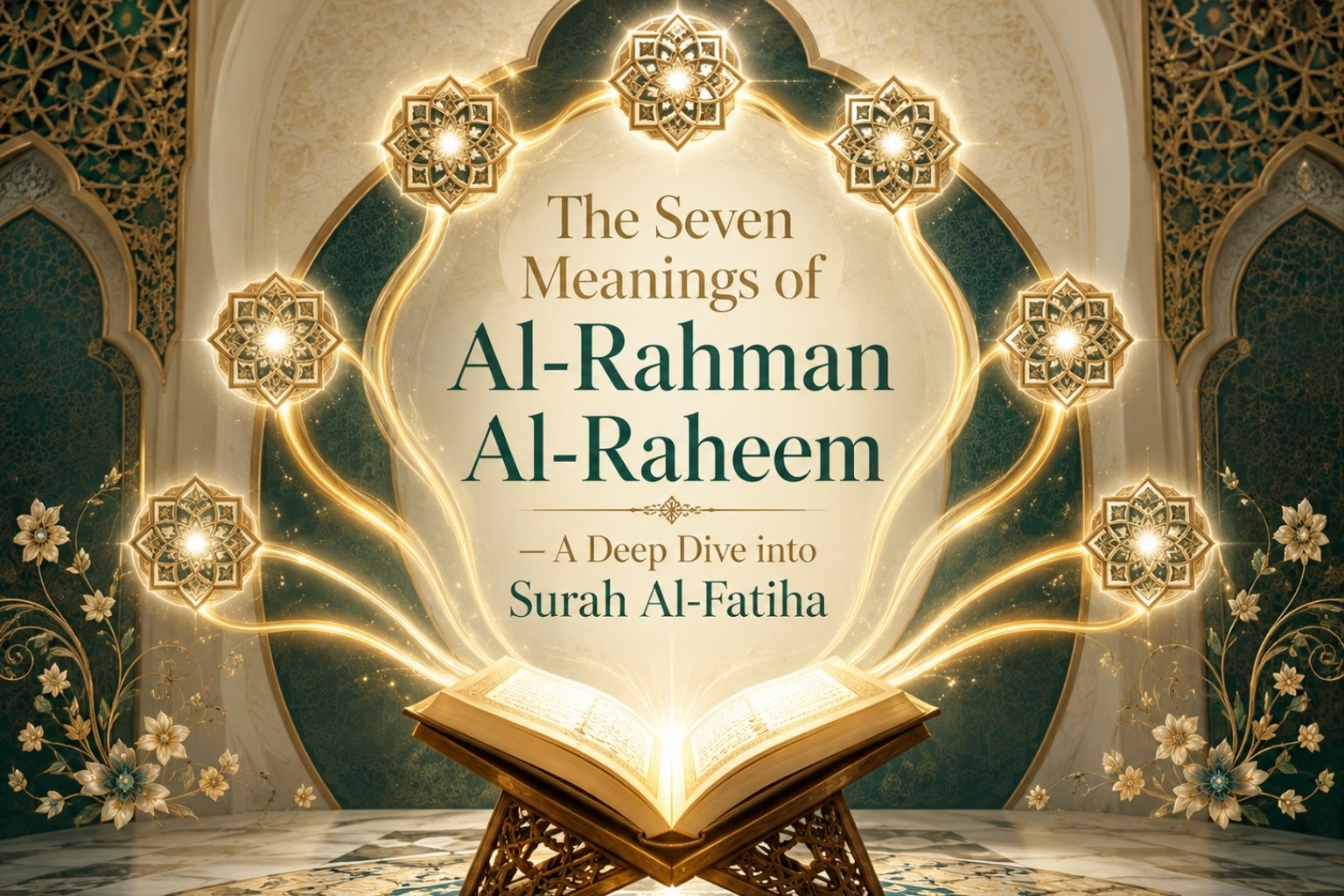
Al-Rahman — this name has been analyzed in depth in the article on the seven meanings of Al-Rahman Al-Raheem in Surah Al-Fatiha in this series. But its specific function within the Bismillah deserves its own reflection.
Why, of all the attributes Allah could have placed after His name, did He choose mercy? Not power — Al-Qadir. Not knowledge — Al-‘Alim. Not sovereignty — Al-Malik. Mercy.
The scholars offer an answer that opens up the entire purpose of the Bismillah: because every action that is begun in Allah‘s name is being begun within the frame of mercy. The Bismillah does not say “in the name of Allah the All-Powerful” — which would frame every action as a reminder of divine omnipotence. It says “in the name of Allah the Merciful” — which frames every action as occurring within the context of divine mercy.
The person who eats Bismillah Al-Rahman Al-Raheem is eating within Allah‘s mercy — the food itself is an expression of that mercy, the body that receives it was designed by that mercy, the nourishment that results is sustained by that mercy. The person who reads Bismillah Al-Rahman Al-Raheem is reading within Allah‘s mercy — the ability to read is mercy, the access to knowledge is mercy, the comprehension that follows is mercy.
Every action done by Bismillah is an action done within the awareness of Allah‘s encompassing mercy. And that awareness transforms the action — from a purely human activity to an activity embedded in the context of divine care.
Al-Rahman specifically — the vast, universal, encompassing mercy that reaches every created being — is the frame. The food that Allah‘s universal mercy provides is being eaten with the acknowledgment that the mercy provided it.
The Second Attribute: Al-Raheem
الرَّحِيمِ
“The Most Merciful…”
Al-Raheem — especially, specifically, continuously merciful toward the believers. The mercy that responds to the turning of the heart, the mercy of the next world, the mercy that is specific rather than general.
If Al-Rahman is the frame of the Bismillah — the universal mercy within which every action occurs — Al-Raheem is the relationship within the frame. The person saying Bismillah is not just acknowledging Allah‘s general mercy to all of creation. They are affirming that they are in a specific relationship with the One who is Al-Raheem — whose mercy responds to them, follows them, is especially directed toward them as a servant who is turning toward Allah in this very act of invocation.
The sequence within the Bismillah — Allah, then Al-Rahman, then Al-Raheem — is a movement from the cosmic to the intimate:
Allah — the name that encompasses all. The One who is worshipped. The One who is the source of all existence.
Al-Rahman — the mercy that encompasses all creation. The vast ocean of divine generosity in which everything floats.
Al-Raheem — the specific, flowing, personal mercy directed toward the believer who says this name. You are not just in the ocean of Al-Rahman. You are in the current of Al-Raheem that moves directly toward you.
The three words together make the Bismillah a complete theological statement: I begin this action in the name of the One who is everything, within the universal mercy that surrounds everything, in the specific mercy that is directed toward me. That is what is being said every time Bismillah Al-Rahman Al-Raheem is uttered.
What Beginning in Allah’s Name Actually Does
The scholars identify several specific transformations that occur when an action is genuinely begun with the Bismillah — transformations that explain why the Prophet ﷺ called an action without it abtar (cut off).
It Dedicates the Action to Allah
Every action has an orientation — a purpose, a direction, an implicit answer to the question “why.” The Bismillah provides the most fundamental possible answer: this action is being done in Allah‘s name. Not for self-promotion, not for worldly gain as the primary orientation, not for approval from other people. In Allah‘s name.
The scholars note that this does not mean every Bismillah-prefaced action is purely spiritual in the sense of being otherworldly. The person who says Bismillah before eating and then eats is still eating. The person who says Bismillah before beginning work is still working for their livelihood. But the orientation is set: this eating is within Allah‘s name, this work is within Allah‘s name. The mundane becomes, at the level of its orientation, an act of acknowledgment of Allah.
This is what Ibn Al-Qayyim means when he describes the Bismillah as the key to ‘ibadah — to worship in its broadest Quranic sense. Every act of a believer’s life can be ‘ibadah if it is done with the awareness of Allah and within the frame of seeking His pleasure. The Bismillah is the mechanism by which that transformation is effected — it is the act of saying, before the action: this is Allah‘s name this is being done within.
It Invites Allah’s Blessing into the Action
Barakah — divine blessing — is not a mystical addition to an action. The scholars describe it as the quality of increase and benefit that Allah‘s presence in an action produces. The same amount of food is more nourishing Bismillah. The same amount of work produces a more lasting benefit Bismillah. The same amount of time is more productive Bismillah.
The Prophet Muhammad ﷺ illustrated this in a specific narration about eating:
إِذَا أَكَلَ أَحَدُكُمْ فَلْيَذْكُرِ اسْمَ اللَّهِ تَعَالَى، فَإِنْ نَسِيَ أَنْ يَذْكُرَ اسْمَ اللَّهِ تَعَالَى فِي أَوَّلِهِ فَلْيَقُلْ: بِسْمِ اللَّهِ أَوَّلَهُ وَآخِرَهُ
“When one of you eats, let him mention Allah’s name. If he forgets to mention Allah’s name at the beginning, let him say: Bismillah at its beginning and its end.”
Recorded in Sunan Abu Dawud, Hadith No. 3767
The Bismillah said at the beginning of the meal invites Allah‘s blessing into the meal. The scholars record that the Prophet ﷺ observed that the devil shares in the meal of one who does not say Bismillah — meaning the meal is spiritually different depending on whether the Bismillah frames it.
It Protects the Action from Harm
The scholars note that beginning in Allah‘s name establishes a divine presence at the start of the action that protects what follows. The narrations about the Bismillah before entering one’s home, before beginning a journey, before intimate relations between spouses — all describe the protective effect of the invocation. In each case, the Prophet ﷺ described the Bismillah as what prevents harm from attaching itself to the action.
This protection is not mechanical — it is relational. By invoking Allah‘s name at the beginning of the action, the person is acknowledging Allah‘s sovereignty over what follows. And Allah, whose sovereignty is real and complete, responds to that acknowledgment with care.
It Connects the Human to the Divine
Perhaps the most profound function of the Bismillah: it is the act of connection. By saying Bismillah, the person is not just beginning an action — they are beginning it in relationship with Allah. The action is no longer a purely human activity. It is a human activity that has been placed, by the utterance of Allah‘s name, within the context of Allah‘s presence.
This is the answer to why the action without the Bismillah is abtar — cut off. It is cut off from its connection to Allah. It is performed in the human realm alone, without the invocation that connects it to the divine. The action that begins Bismillah is embedded in a relationship. The action that does not is severed from that embedding.
The Bismillah and Surah Al-Fatiha
The Bismillah occupies a unique position in Islamic jurisprudence that has been debated by scholars for centuries: is it a verse of Surah Al-Fatiha — and by extension of every surah — or a standalone phrase placed before each surah without being part of it?
The majority of scholars hold that the Bismillah is a full verse of Surah Al-Fatiha — and that it is therefore the first verse of the Quran, the first thing Allah revealed (in terms of the written compilation), and the first verse of every prayer in which Al-Fatiha is read.
What this means practically: when the servant stands in prayer and says Bismillah Al-Rahman Al-Raheem — they are already in the conversation that Allah described in the Hadith Qudsi of Al-Fatiha. They are already speaking. The Bismillah is not a clearing of the throat before the prayer begins. It is the first verse. It is the prayer itself, from its first syllable.
The scholars note the extraordinary significance of this: Allah designed the first word a believer says when standing before Him in prayer to be an invocation of His name, framed within two attributes of mercy. Before the praise, before the declaration of worship, before the petition for guidance — mercy. Bismillah Al-Rahman Al-Raheem. This is what you say to Allah when you first stand before Him. In the name of Allah, the Most Merciful, the Most Compassionate. The first word of the conversation is: I come to You in the context of Your mercy.
Why Scholars Called It a Summary of the Quran
The classical scholars made an astonishing claim about the Bismillah that is worth sitting with at length: that it contains, in compressed form, the entire message of the Quran.
Their argument:
The Quran’s entire message can be summarized as the declaration that Allah is the Lord of all creation (Al-Rabb), that He is the One deserving of all worship (Al-Ilah), and that His fundamental relationship with His creation is one of mercy (Al-Rahman Al-Raheem). Every command in the Quran is a specification of what worship of Allah looks like. Every narrative is an illustration of how Allah relates to His creation in mercy or in consequence. Every theological statement is a description of Allah‘s attributes.
The Bismillah contains all three foundational elements: the name Allah (pointing to the One who is uniquely deserving of worship, the unique ilah), and the two names of mercy (Al-Rahman Al-Raheem) that describe His fundamental relationship with creation.
From those foundations, the entire Quran is elaborated. Every command is an elaboration of what “in Allah‘s name” requires. Every promise is an elaboration of what Al-Rahman Al-Raheem gives. Every warning is a description of what happens when the connection to Allah‘s name is severed.
The person who truly says Bismillah Al-Rahman Al-Raheem and means it — who says it with the awareness of what they are saying — is affirming every major theological truth the Quran was sent to establish. The Quran then elaborates what the Bismillah has already stated at its root.
The Bismillah and Every Moment
There is a vision of the believer’s life that the Bismillah, rightly understood, produces.
It is a life in which no significant moment is disconnected from Allah. Not because the person is performing piety at every moment — but because the habit of saying Bismillah means the habit of orienting every beginning toward Allah. Every meal. Every journey. Every conversation. Every page of reading. Every day’s work. Every night’s sleep. Every significant beginning is begun with the acknowledgment: this is being done in Allah‘s name, within Allah‘s mercy, within the specific mercy that Allah holds for me.
The cumulative effect of this practice — over days, over years, over a lifetime — is not just the accumulation of good deeds. It is the gradual transformation of the person’s relationship to everything they do. The meal becomes a gift acknowledged. The work becomes a trust fulfilled. The day becomes a series of moments given meaning by being begun in Allah‘s name.
Ibn Al-Qayyim writes: the person who truly says Bismillah at the beginning of each act is a person who lives in a different relationship with their life than the person who does not. Not because the acts are different — they are often identical. But because the orientation is different. The person who begins Bismillah inhabits a life that is woven through with Allah, even in its most ordinary moments.
This is what the Prophet ﷺ was pointing to when he said the action without it is arbitrary — incomplete. Not morally incomplete, not practically incomplete, but spiritually incomplete. Missing its connection to Allah at the beginning.
A Final Reflection: Before Everything
The Bismillah is the first thing said before reading the Quran. The first thing said before eating. The first thing said before beginning any significant work. The first verse of the first surah of the Book Allah sent to humanity.
Before everything — mercy. Before every command, every story, every law, every theological declaration of the entire Quran — Al-Rahman Al-Raheem. The frame is set before anything else is placed within it: you are entering Allah‘s mercy. Whatever comes next is within that.
And the person who says Bismillah before their action is making the same declaration: I am beginning this within Allah‘s mercy. Not within my own strength, not within my own understanding, not within my own capacity. Within the mercy of Al-Rahman — the vast, encompassing, all-of-creation mercy — and within the specific, personal, flowing mercy of Al-Raheem directed toward me.
Every door opens with it.
Every meal is blessed with it. Every journey is protected with it. Every work is connected to Allah with it. Every day is begun within Allah‘s name with it.
Nineteen letters. A summary of the Quran. A summary of the nature of Allah. A summary of the relationship between Allah and the servant.
Say it with awareness. Before everything.
بِسْمِ اللَّهِ الرَّحْمَٰنِ الرَّحِيمِ
“In the name of Allah, the Most Gracious, the Most Merciful.”
In His name. Within His mercy. Begin.